


Solar charger for lead-acid batteries
#solar charger
#lead-acid battery
#FET-comparator
#temperature compensated
#voltage cutoff
#battery protection
#solar panel
#charging circuit
#voltage regulator
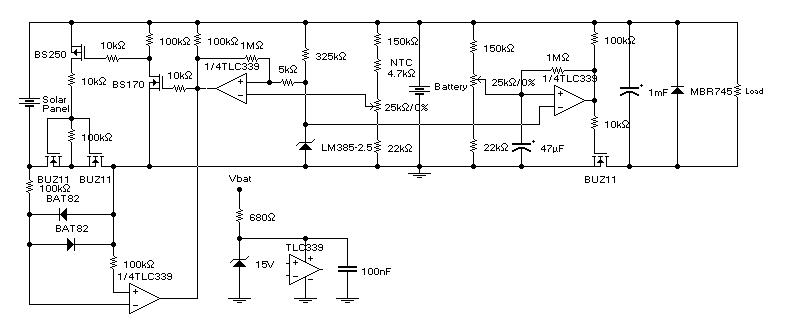
Description: This circuit is intended for charging lead-acid batteries with a solar panel. The customary diode that prevents the battery from discharging through the solar panel has been replaced by a FET-comparator combination. The charger will stop charging once a pre-set voltage (temperature compensated) has been reached, and recommence charging when the voltage has dropped off sufficiently. The load is disconnected when the battery voltage drops below 11V and reconnected when it gets back to 12.5V. More: The circuit has the following features:
* Charges until Vbat = 13.8V (adjustable), then float charges;
* Shuts down load when Vbat < 11V (adjustable), resets at 12.5V;
* Temperature compensation;
* Will work with cheap and readily available components.
This circuit is designed to efficiently charge lead-acid batteries using solar energy while incorporating a FET-comparator arrangement to enhance performance compared to traditional diode-based systems. The charging process is initiated by the solar panel output, which is directed to the battery through the FET. The FET serves not only as a switch but also as a means to minimize energy loss, which is often associated with diodes due to their forward voltage drop.
The charging voltage is set to a maximum of 13.8V, which is a common float charging voltage for lead-acid batteries. This voltage can be adjusted to suit specific battery types or requirements. The circuit includes a temperature compensation feature, which adjusts the charging voltage based on the ambient temperature, ensuring that the battery is charged optimally without risk of overcharging in high-temperature conditions.
When the battery voltage falls below 11V, the FET disconnects the load to prevent further discharge, protecting the battery from damage due to over-discharge. This threshold is adjustable, allowing for customization based on the battery specifications. The load is automatically reconnected when the battery voltage rises back to 12.5V, ensuring that the battery remains operational without manual intervention.
The use of readily available and cost-effective components makes this circuit accessible for various applications, particularly in off-grid solar systems where efficient battery management is crucial. Overall, this circuit provides a reliable solution for solar charging of lead-acid batteries, integrating essential features for effective battery maintenance and longevity.This circuit is intended for charging lead-acid batteries with a solar panel. The customary diode that prevents the battery from discharging through the solar panel has been replaced by a FET-comparator combination. The charger will stop charging once a pre-set voltage (temperature compensated) has been reached, and recommence charging when the voltage has dropped off sufficiently.
The load is disconnected when the baterry voltage drops below 11V and reconnected when it gets back to 12.5V. The circuit has the following features: * Charges until Vbat = 13,8V (adjustable), then float charges; * Shuts down load when Vbat < 11V (adjustable), resets at 12,5V; * Temperature compensation; * Will work with cheap and readily
* Charges until Vbat = 13.8V (adjustable), then float charges;
* Shuts down load when Vbat < 11V (adjustable), resets at 12.5V;
* Temperature compensation;
* Will work with cheap and readily available components.
This circuit is designed to efficiently charge lead-acid batteries using solar energy while incorporating a FET-comparator arrangement to enhance performance compared to traditional diode-based systems. The charging process is initiated by the solar panel output, which is directed to the battery through the FET. The FET serves not only as a switch but also as a means to minimize energy loss, which is often associated with diodes due to their forward voltage drop.
The charging voltage is set to a maximum of 13.8V, which is a common float charging voltage for lead-acid batteries. This voltage can be adjusted to suit specific battery types or requirements. The circuit includes a temperature compensation feature, which adjusts the charging voltage based on the ambient temperature, ensuring that the battery is charged optimally without risk of overcharging in high-temperature conditions.
When the battery voltage falls below 11V, the FET disconnects the load to prevent further discharge, protecting the battery from damage due to over-discharge. This threshold is adjustable, allowing for customization based on the battery specifications. The load is automatically reconnected when the battery voltage rises back to 12.5V, ensuring that the battery remains operational without manual intervention.
The use of readily available and cost-effective components makes this circuit accessible for various applications, particularly in off-grid solar systems where efficient battery management is crucial. Overall, this circuit provides a reliable solution for solar charging of lead-acid batteries, integrating essential features for effective battery maintenance and longevity.This circuit is intended for charging lead-acid batteries with a solar panel. The customary diode that prevents the battery from discharging through the solar panel has been replaced by a FET-comparator combination. The charger will stop charging once a pre-set voltage (temperature compensated) has been reached, and recommence charging when the voltage has dropped off sufficiently.
The load is disconnected when the baterry voltage drops below 11V and reconnected when it gets back to 12.5V. The circuit has the following features: * Charges until Vbat = 13,8V (adjustable), then float charges; * Shuts down load when Vbat < 11V (adjustable), resets at 12,5V; * Temperature compensation; * Will work with cheap and readily
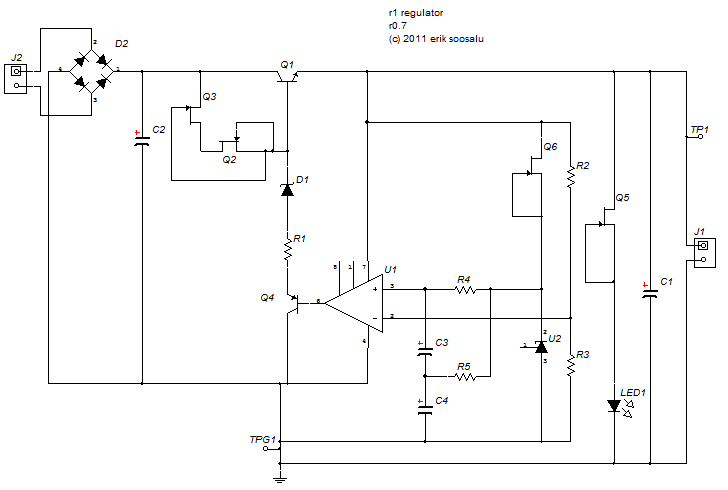
A TREAD sized regulator
The size of the tread was 5 cm by 3 cm. The current design measures 5 cm by 3.3 cm. The regulator's foundation is based on Walt Jung's 1997 article, "Regulator Excels in Noise and Line Rejection," with modifications derived...
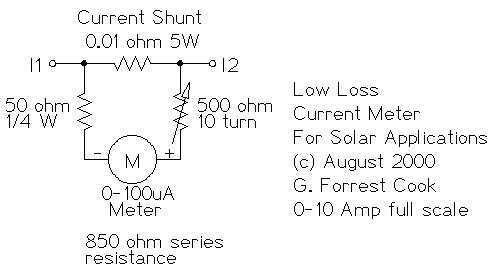
Solar Panel Current Meter
This circuit is used to measure the current from a solar panel. It has very low power loss for currents in the 0-10A range. It also works as a general purpose DC current meter. The circuit can be used on...
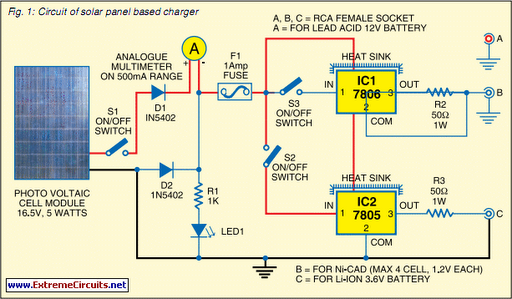
Solar Panel Based Charger And Small LED Lamp
Savings on electricity bills can be achieved by utilizing alternative power sources. The photovoltaic module, or solar panel, described here has a power output of 5 watts and delivers 16.5V under full sunlight conditions, with a current output of 300-350...
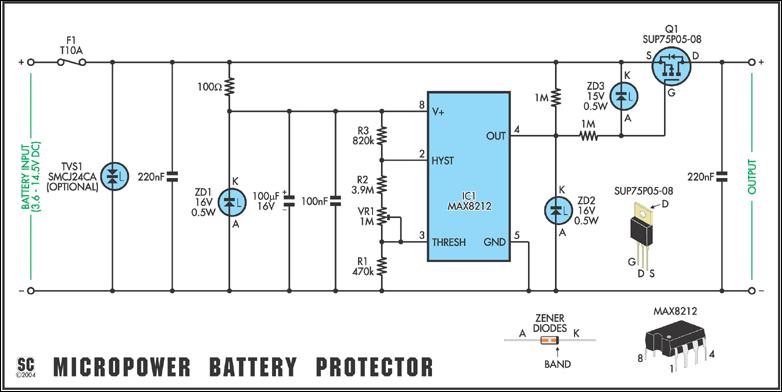
versatile micropower battery protector
Protect expensive batteries from discharge damage with this mini-sized electronic cutout switch. It consumes minimal power and can be adapted to accommodate a wide range of battery voltages. In May 2002, Silicon Chip introduced the "Battery Guardian," a project specifically...
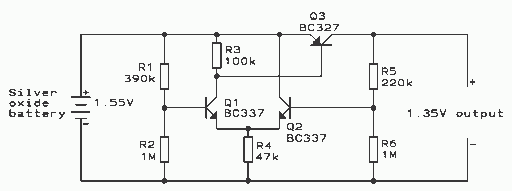
Voltage Regulator
This regulator is suitable for devices that need up to 1mA. For higher output current, the resistors would have to be scaled down in reverse proportion to the peak current expected. With the resistor values shown, the regulator draws a...
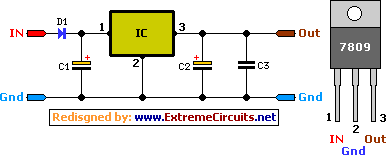
9 Volt 2 Ampere DC Power SupplyCircuit
A simple 9 Volt, 2 amp power supply utilizing a single integrated circuit (IC) regulator. This circuit is straightforward, as the regulator handles the majority of the work. The component used is the 7809 voltage regulator.
The circuit consists primarily of...
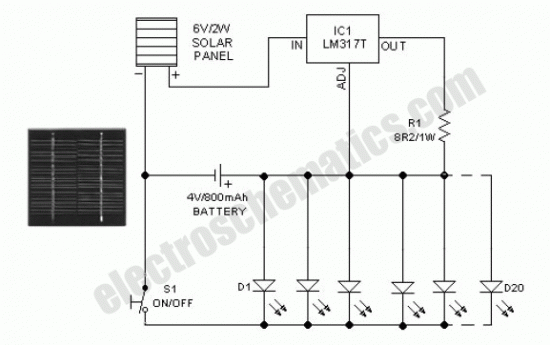
DIY Solar Birdhouse Light
This solar birdhouse light features an economical circuit for a mini solar lighting system. The core component of the circuit is a mini 6V/2W solar panel, which is utilized to charge a 4V/800mAh rechargeable battery. The charging process is managed...
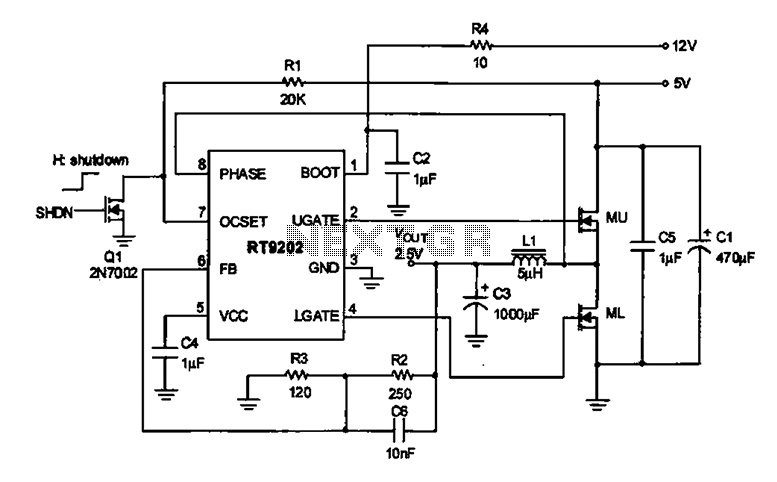
2.5V voltage regulator circuit
A 2.5V voltage regulator circuit is illustrated, which is part of a computer's motherboard. The circuit employs an oscillation circuit with the RT9202 control core chip, converting a 5V input supply into a regulated +2.5V output voltage, with the chip's...
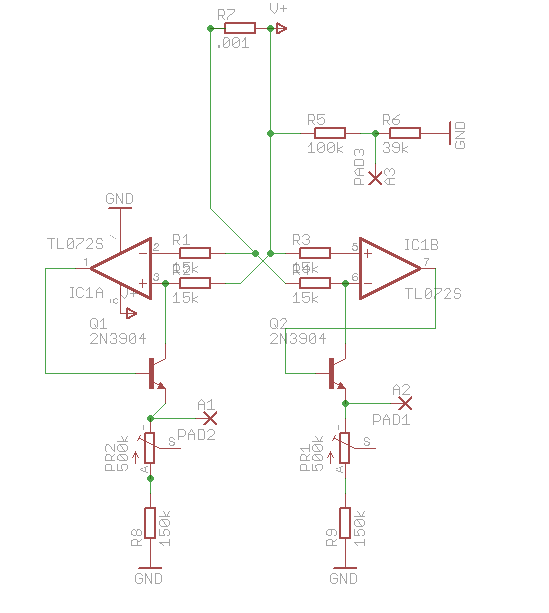
battery tender for the school server
The ideas presented here explore various methods for controlling and monitoring the charging of lead-acid storage batteries. To ensure that the benefits of digital technology impact education in developing regions, reliable access during school hours is essential. The O-1.75 device...