


YUV(YCbCr) to RGB converter
#YUV
#YCbCr
#RGB
#video converter
#component video
#digital video
#signal processing
#video equipment
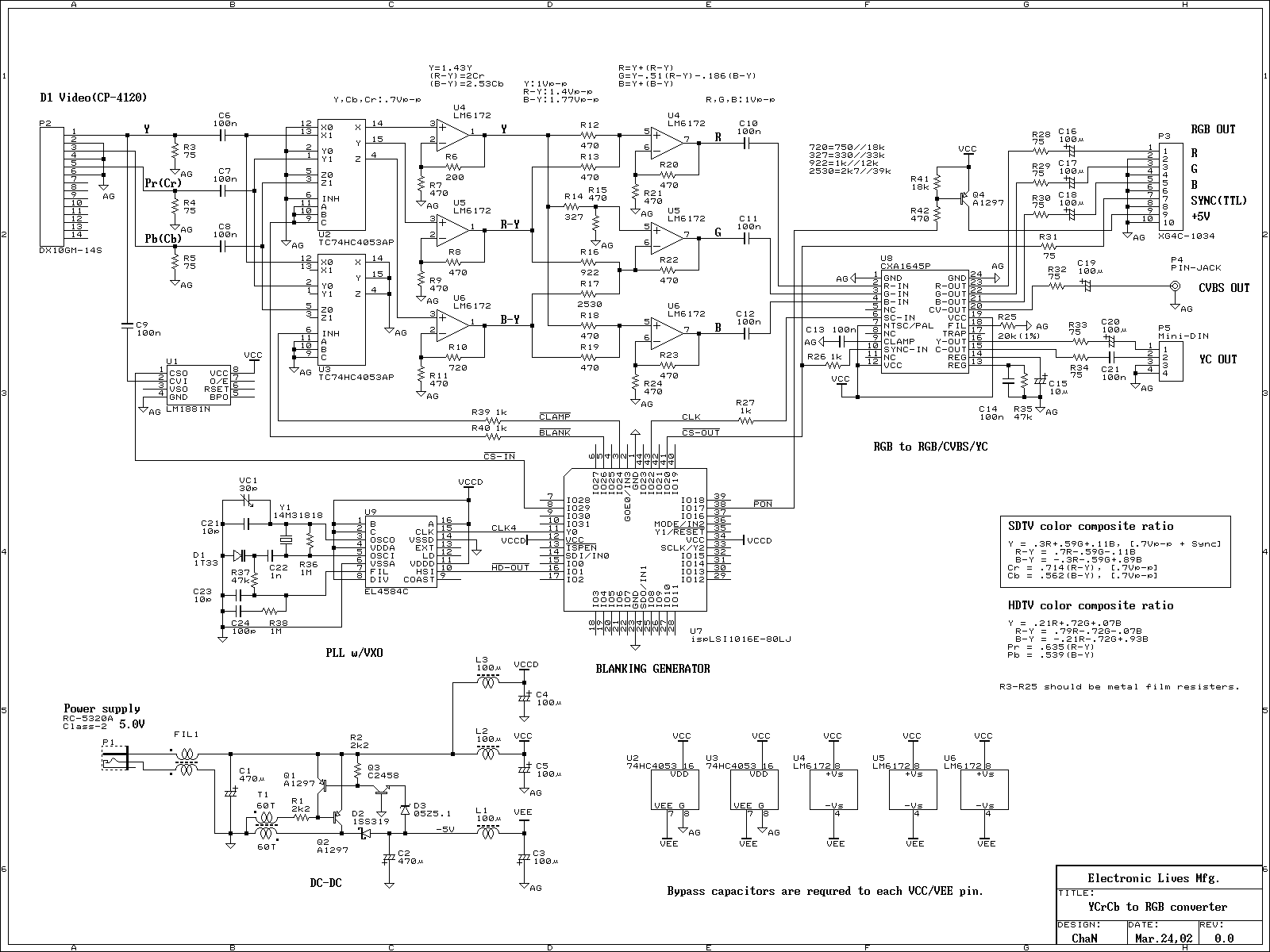
Description: Recently, most digital video equipments, such as video recorder, DVD player and TV game, have component video output. The component video signal is like RGB video signal, but it cannot connect to RGB monitor directly. Thus I designed and built YUV(YCrCb) to RGB converter to use old TV monitor or video equipment which does not have component video input.
The YUV to RGB converter is an essential circuit for interfacing modern video equipment with legacy displays that lack direct component video input. This converter takes the YUV (or YCrCb) format, which separates luminance (Y) from chrominance (U and V) information, and transforms it into the RGB format used by older monitors and televisions.
The typical architecture of a YUV to RGB converter includes several key components. First, an analog front end is employed to receive the YUV signals. This front end may consist of operational amplifiers configured to buffer and scale the incoming signals to appropriate levels for further processing.
The core of the conversion process is achieved through a series of matrix multipliers. The YUV signals are mathematically transformed into RGB using the following equations:
- R = Y + 1.402 * (V - 128)
- G = Y - 0.344136 * (U - 128) - 0.714136 * (V - 128)
- B = Y + 1.772 * (U - 128)
These equations indicate that the Y component contributes directly to the RGB outputs, while the U and V components are used to adjust the color information. The constant values in the equations are derived from the standard conversion coefficients for the YUV color space.
After the conversion, the RGB signals may require further conditioning to match the voltage levels and impedance characteristics of the target display. This may involve additional amplification stages or filtering to minimize noise and ensure signal integrity.
Finally, the output stage of the converter is designed to drive the RGB inputs of the display device. This can include buffering circuits to prevent loading effects that may degrade the video quality. In some designs, additional features such as sync signal generation may be incorporated to ensure proper timing and synchronization with the display.
Overall, the YUV to RGB converter is a critical component in bridging the gap between modern digital video sources and older analog display technologies, enabling the continued use of legacy equipment in contemporary video applications.Recently, most digital video equipments, such as video recorder, DVD player and TV game, have component video output. The component video signal is like RGB video signal, but it cannot connect to RGB monitor directly. Thus I designed and built YUV(YCrCb) to RGB converter to use old TV monitor or video equipment which does not have component video input.
The YUV to RGB converter is an essential circuit for interfacing modern video equipment with legacy displays that lack direct component video input. This converter takes the YUV (or YCrCb) format, which separates luminance (Y) from chrominance (U and V) information, and transforms it into the RGB format used by older monitors and televisions.
The typical architecture of a YUV to RGB converter includes several key components. First, an analog front end is employed to receive the YUV signals. This front end may consist of operational amplifiers configured to buffer and scale the incoming signals to appropriate levels for further processing.
The core of the conversion process is achieved through a series of matrix multipliers. The YUV signals are mathematically transformed into RGB using the following equations:
- R = Y + 1.402 * (V - 128)
- G = Y - 0.344136 * (U - 128) - 0.714136 * (V - 128)
- B = Y + 1.772 * (U - 128)
These equations indicate that the Y component contributes directly to the RGB outputs, while the U and V components are used to adjust the color information. The constant values in the equations are derived from the standard conversion coefficients for the YUV color space.
After the conversion, the RGB signals may require further conditioning to match the voltage levels and impedance characteristics of the target display. This may involve additional amplification stages or filtering to minimize noise and ensure signal integrity.
Finally, the output stage of the converter is designed to drive the RGB inputs of the display device. This can include buffering circuits to prevent loading effects that may degrade the video quality. In some designs, additional features such as sync signal generation may be incorporated to ensure proper timing and synchronization with the display.
Overall, the YUV to RGB converter is a critical component in bridging the gap between modern digital video sources and older analog display technologies, enabling the continued use of legacy equipment in contemporary video applications.Recently, most digital video equipments, such as video recorder, DVD player and TV game, have component video output. The component video signal is like RGB video signal, but it cannot connect to RGB monitor directly. Thus I designed and built YUV(YCrCb) to RGB converter to use old TV monitor or video equipment which does not have component video input.

Rgb-composite-converter
The incoming RGB inputs are terminated with resistors R1, R2, and R3, along with potentiometers RV1, RV2, and RV3. These components provide input impedances of approximately 75 ohms. The presets should be adjusted to allow a maximum input of 1...
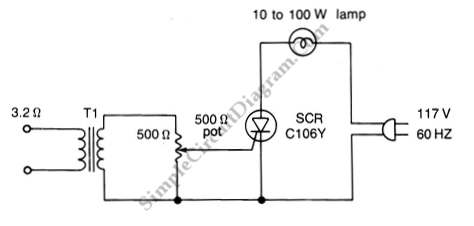
basic circuit makes rgb color organ
The concept of a color organ involves the transformation of sound, including musical tones, into light. According to wave theory, both music and light possess similar wave characteristics.
A color organ is an electronic device that visually represents sound through the...
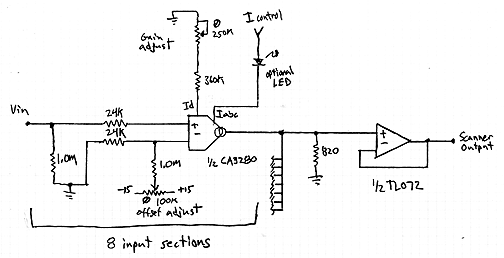
Interpolating Scanner Circuit
This design is for an interpolating scanner, a circuit featuring multiple signal inputs, a control voltage input, and a signal output. The output selectively transitions between inputs, smoothly fading from one to the next as the control voltage increases. A...
ypbpr to rgb video converter circuit
The LT6552 is a video difference amplifier optimized for low voltage single supply operation. The LT6552 features a 75MHz 3dB bandwidth, a 600V/µs slew rate, and ±70mA output current, making it ideal for driving cables directly. This circuit maps the...
RGB To Monochrome converter
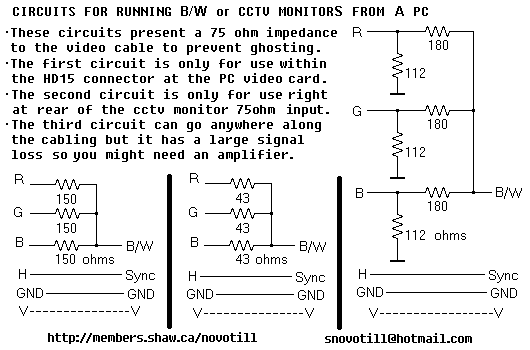
Often you can get away with running a monochrome monitor on GREEN, but this looks real crappy when viewing color images. These simple resistor networks allow you to display R+G+B on a B/W or CCTV monitor without ghosting. Be sure...
Rgb-blue-box
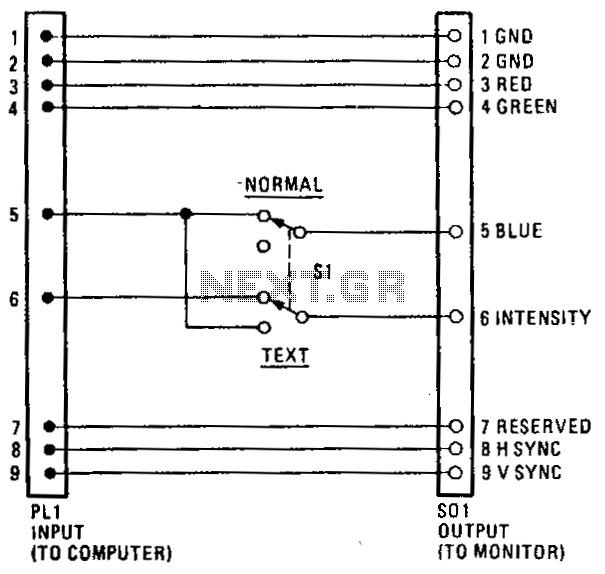
The RGB blue box allows users to change their PC's RGB monitor screen to a blue background at the flip of a switch. It enables the display of bright white text on a blue background instead of the typical low-intensity...
Video Master Circuit
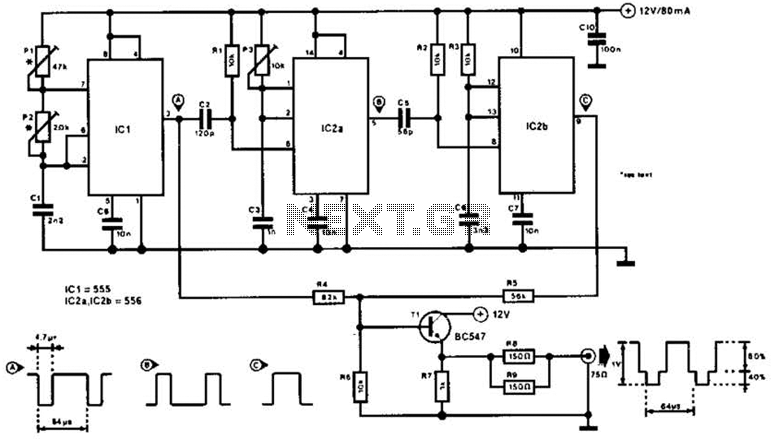
The video master comprises a series of converters that allocate all video sources to unused UHF channels. These channels are then combined with standard TV channels, whether terrestrial or cable, into a single cable. This single cable can subsequently provide...
RGB To Monochrome converter
Often you can get away with running a monochrome monitor on GREEN, but this looks real crappy when viewing color images. These simple resistor networks allow you to display R+G+B on a B/W or CCTV monitor without ghosting. Be sure...
Rgb/Ntsc Converter
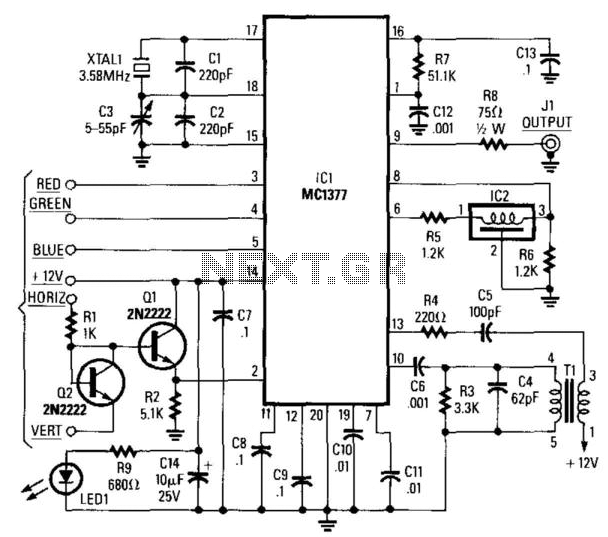
This circuit utilizes a Motorola MC1377 to generate NTSC video from an RGB source. The components are not critical, with the exception of resistor R7, which should have a tolerance of 1%, and capacitor CB, which should have a tolerance...