


Computer-speech-synthesizer
#speech synthesizer
#text-to-speech
#SP0256-AL2
#Cf6256AL2
#RS-232
#ASCII
#microcomputer
#terminal-emulator
#BASIC
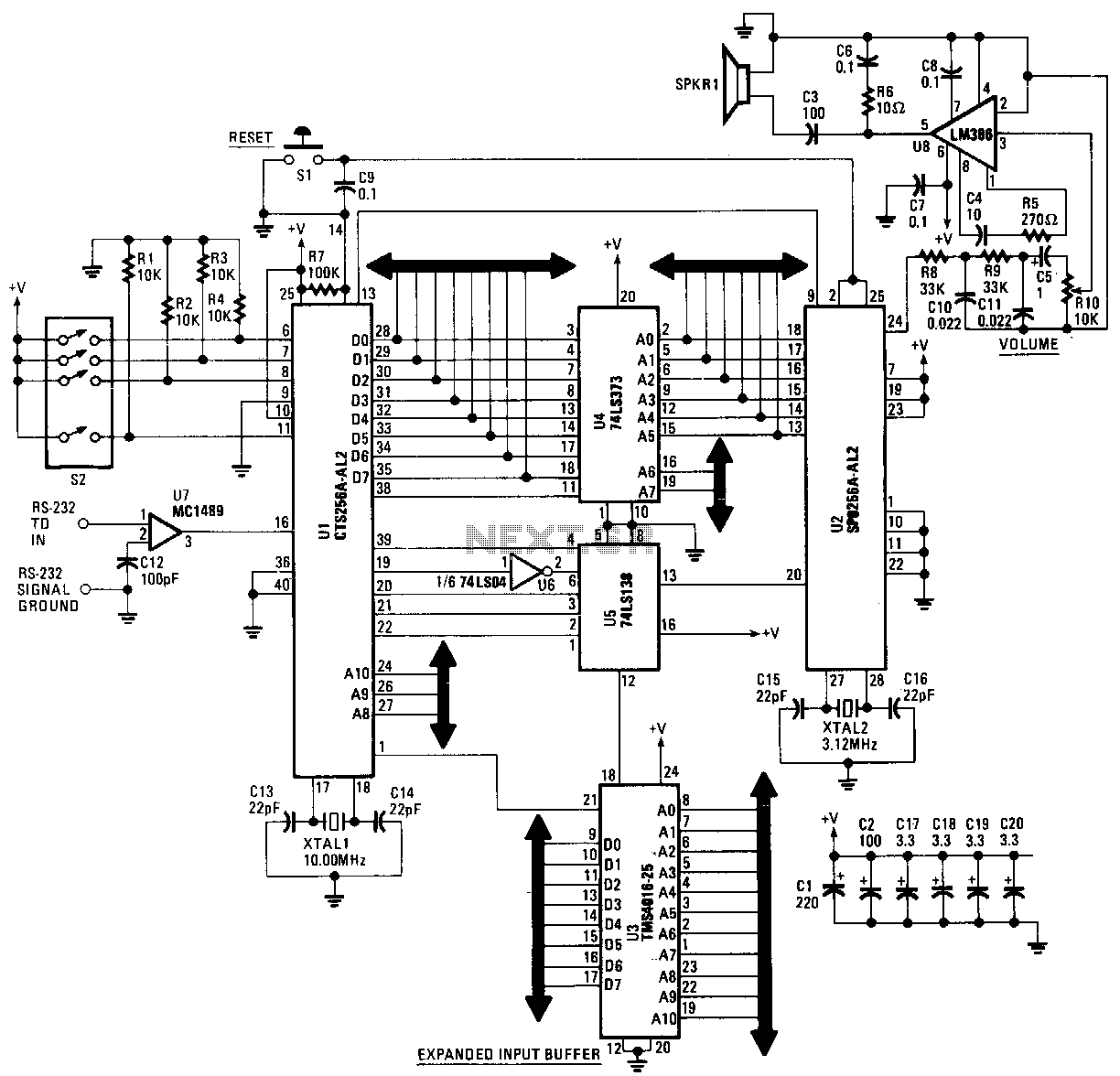
Description: This text-to-speech converter is constructed using the SP0256-AL2 speech processor and the CF6256AL2 text-to-speech converter chips manufactured by General Instruments. The circuit is designed to receive standard ASCII code from virtually any microcomputer or dumb terminal equipped with an RS-232 port, such as a serial printer or modem port. When a microcomputer is utilized, the synthesizer can be activated from a terminal emulator of any communications program or from any programming language, such as BASIC. The serial input from the RS-232 port enters the circuit through U7, the MC1489 RS-232 receiver chip, which converts the RS-232 level signals to TTL-level signals. The CTS256-AL2 chip, U1, then converts the ASCII characters into allophone codes and sends those codes to U3, the TMS4016 external RAM chip. These codes are subsequently transferred to the SP0256-AL2, U2, via the 74LS373 octal latch, U4. Finally, the SP0256-AL2 outputs an audio signal to the LM386 audio amplifier, U5, through high-pass filtering, and then to the speaker. The 74LS138, U5, and the 74LS04, U6, provide control logic.
The text-to-speech converter circuit is a sophisticated assembly designed to facilitate the conversion of textual data into audible speech. The core components include the SP0256-AL2 speech processor, which is responsible for generating the speech output, and the CF6256AL2 text-to-speech converter, which interprets the incoming ASCII data. The circuit architecture begins with the RS-232 interface, where the MC1489 chip (U7) plays a crucial role in receiving and translating the incoming serial data into a format compatible with the internal logic levels of the circuit.
Once the ASCII data is received, the CTS256-AL2 chip (U1) processes these characters into allophone codes, which represent phonetic components essential for speech synthesis. The use of the TMS4016 external RAM chip (U3) allows for temporary storage of these codes, facilitating smooth data flow to the SP0256-AL2 processor (U2). The 74LS373 octal latch (U4) serves as an intermediary, ensuring that the data is latched correctly before being sent to the speech processor.
The audio output generated by the SP0256-AL2 is then passed through a high-pass filter to eliminate any low-frequency noise, ensuring clarity in the sound produced. The LM386 audio amplifier (U5) amplifies the audio signal, making it suitable for driving a speaker. Control logic is provided by the 74LS138 (U5) and the 74LS04 (U6) chips, which manage the operation of the circuit, allowing for effective coordination between the various components.
Overall, this text-to-speech converter circuit exemplifies a well-integrated design that utilizes established electronic components to achieve the conversion of text into speech, making it a valuable tool for applications requiring audio output from textual data.This text-to-speech converter is built around the SP0256-AL2 speech processor and the Cf6256AL2 text-to-speech converter chips~manufactured by General Instruments. The circuit is set up to receive standard ASCII code from virtually any microcomputer or dumb tenninal that is equipped with an RS-232 port -such as a serial-printer or modem port.
If a microcomputer is used, the synthesizer can be activated from a terminal-emulator of any communications program, or from any programming language such as BASIC. The serial input from the RS-232 port enters the circuit through U7. the MC1489 RS-232 receiver chip, and is converted from an RS-232 level to a TTL-level signal. The CTS256-AL2 chip, Ul, then converts the ASCII characters into allophone codes and sends those codes to U3, the TMS4016 externalRAM chip. The codes are then transferred to the SP0256-AL2, U2, through the 74LS373 octal latch, U4. Finally, the SP0256-AL2 sends out an audio signal to the LM386 audio amplifier, US, through some highpass filtering, and on to the speaker.
The 74LS138d, US, and the 74LS04, U6, provide control logic.
The text-to-speech converter circuit is a sophisticated assembly designed to facilitate the conversion of textual data into audible speech. The core components include the SP0256-AL2 speech processor, which is responsible for generating the speech output, and the CF6256AL2 text-to-speech converter, which interprets the incoming ASCII data. The circuit architecture begins with the RS-232 interface, where the MC1489 chip (U7) plays a crucial role in receiving and translating the incoming serial data into a format compatible with the internal logic levels of the circuit.
Once the ASCII data is received, the CTS256-AL2 chip (U1) processes these characters into allophone codes, which represent phonetic components essential for speech synthesis. The use of the TMS4016 external RAM chip (U3) allows for temporary storage of these codes, facilitating smooth data flow to the SP0256-AL2 processor (U2). The 74LS373 octal latch (U4) serves as an intermediary, ensuring that the data is latched correctly before being sent to the speech processor.
The audio output generated by the SP0256-AL2 is then passed through a high-pass filter to eliminate any low-frequency noise, ensuring clarity in the sound produced. The LM386 audio amplifier (U5) amplifies the audio signal, making it suitable for driving a speaker. Control logic is provided by the 74LS138 (U5) and the 74LS04 (U6) chips, which manage the operation of the circuit, allowing for effective coordination between the various components.
Overall, this text-to-speech converter circuit exemplifies a well-integrated design that utilizes established electronic components to achieve the conversion of text into speech, making it a valuable tool for applications requiring audio output from textual data.This text-to-speech converter is built around the SP0256-AL2 speech processor and the Cf6256AL2 text-to-speech converter chips~manufactured by General Instruments. The circuit is set up to receive standard ASCII code from virtually any microcomputer or dumb tenninal that is equipped with an RS-232 port -such as a serial-printer or modem port.
If a microcomputer is used, the synthesizer can be activated from a terminal-emulator of any communications program, or from any programming language such as BASIC. The serial input from the RS-232 port enters the circuit through U7. the MC1489 RS-232 receiver chip, and is converted from an RS-232 level to a TTL-level signal. The CTS256-AL2 chip, Ul, then converts the ASCII characters into allophone codes and sends those codes to U3, the TMS4016 externalRAM chip. The codes are then transferred to the SP0256-AL2, U2, through the 74LS373 octal latch, U4. Finally, the SP0256-AL2 sends out an audio signal to the LM386 audio amplifier, US, through some highpass filtering, and on to the speaker.
The 74LS138d, US, and the 74LS04, U6, provide control logic.
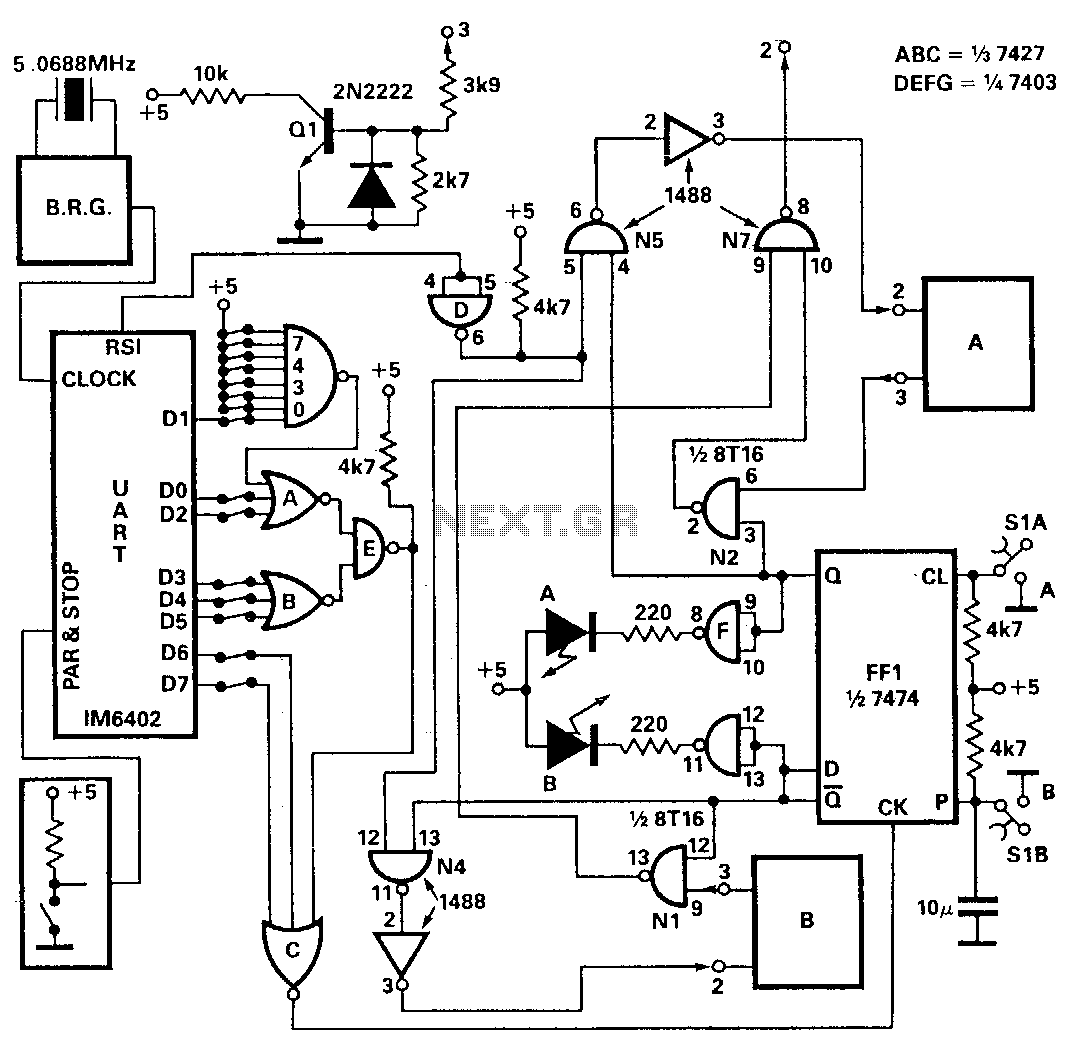
Automatic-rs-232-dataselector
This data selector utilizes a single RS-232 port to connect two RS-232 devices (such as printers or plotters) to a mini or microcomputer. The operation is straightforward. When powered on, it resets FFI (QFFT ~ Low), which activates gates N1,...
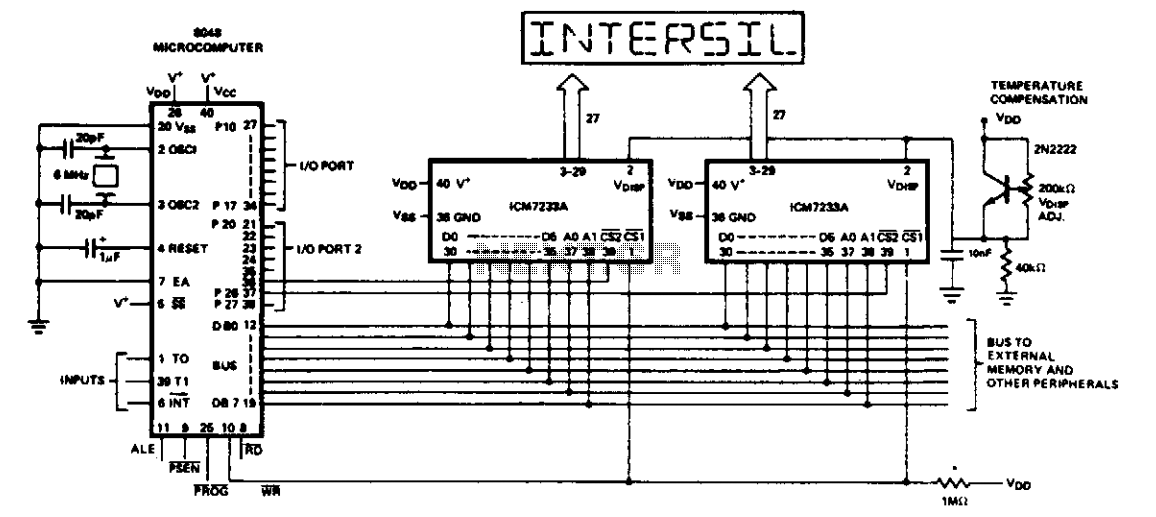
Microcomputer circuit
This is an 8048/IM80C48 microcomputer equipped with an 8-character, 16-segment ASCII triplex liquid crystal display. The two-bit character address is combined with the data and sent to the display driver under the control of the WR line. Port lines are...
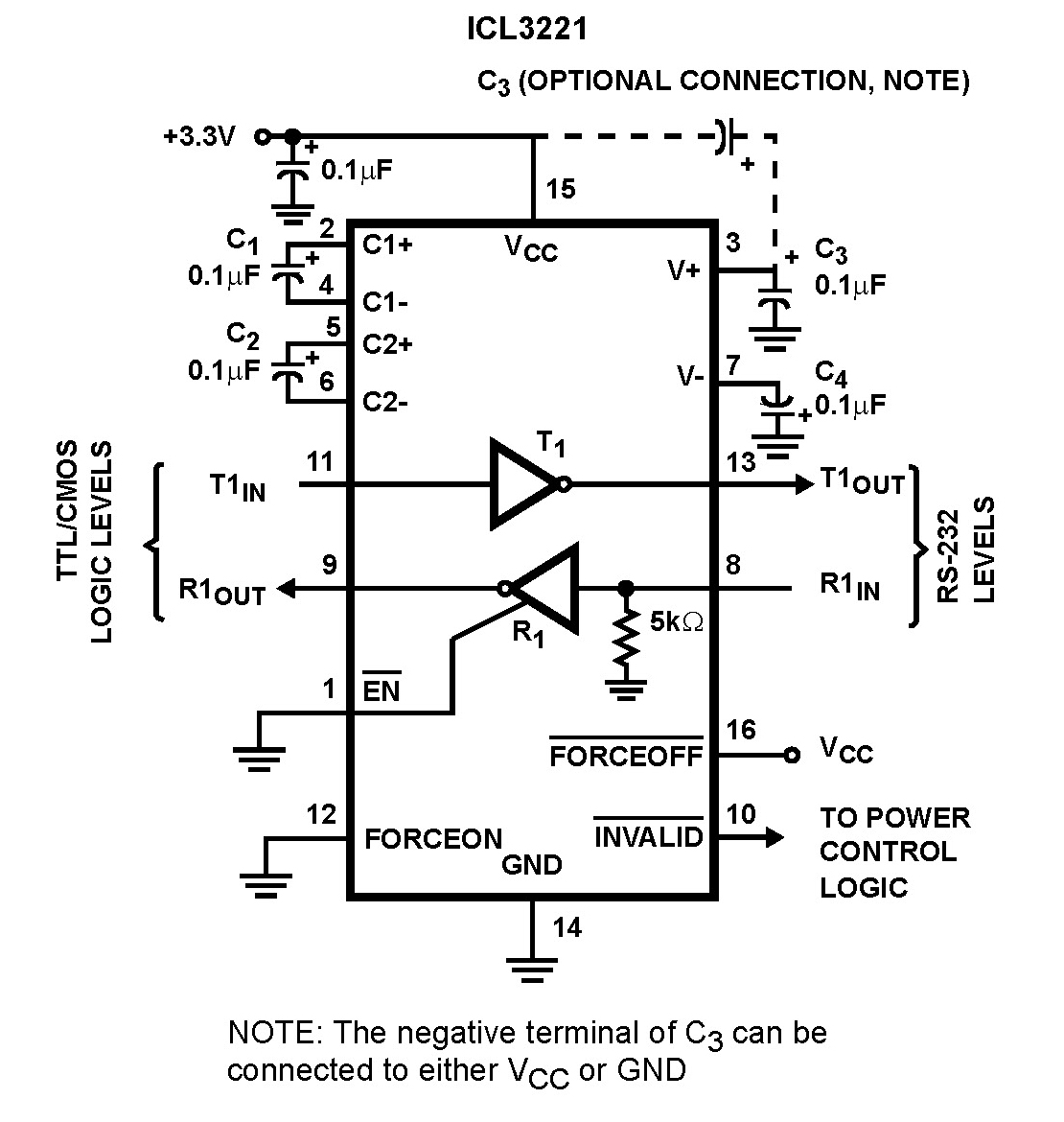
ICL3232 250kbps RS-232 Transmitters/Receivers
The Intersil ICL32XX devices are powered by 3.0V to 5.5V and function as RS-232 transmitters and receivers, complying with EIA/TIA-232 and V.28/V.24 specifications, even at a supply voltage of 3.0V. These devices are designed for applications such as PDAs, palmtops,...
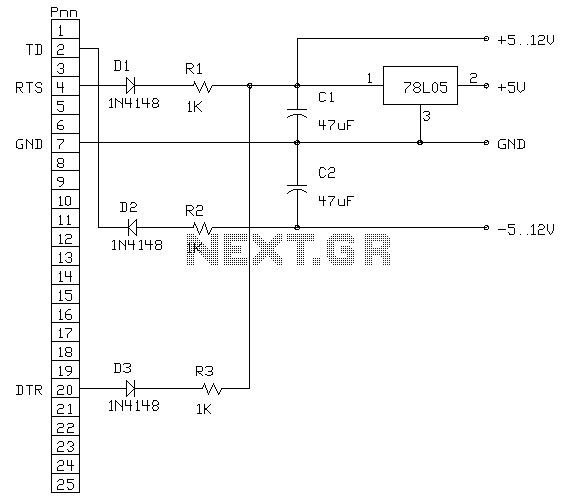
Power from PC's RS-232 circuit
The following circuit is an example of how to get power from an RS-232 serial port. It provides regulated +5V power for logic circuits and also unregulated positive and negative power supplies for the RS-232 transmitting circuit. The circuit delivers...
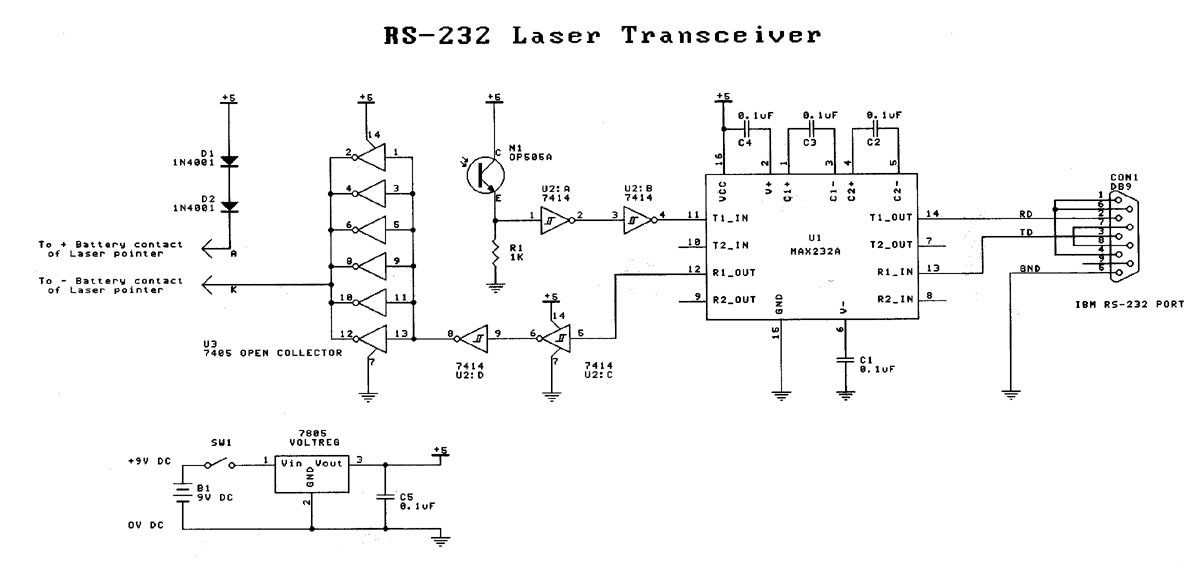
RS-232 Laser Transciever circuit
Laser based projects used to be expensive, until the development of solid state lasers. This project is designed for the entry level laser experimenter. The circuit allows any two computers with serial (RS-232) communication capability to communicate over 200 meters...
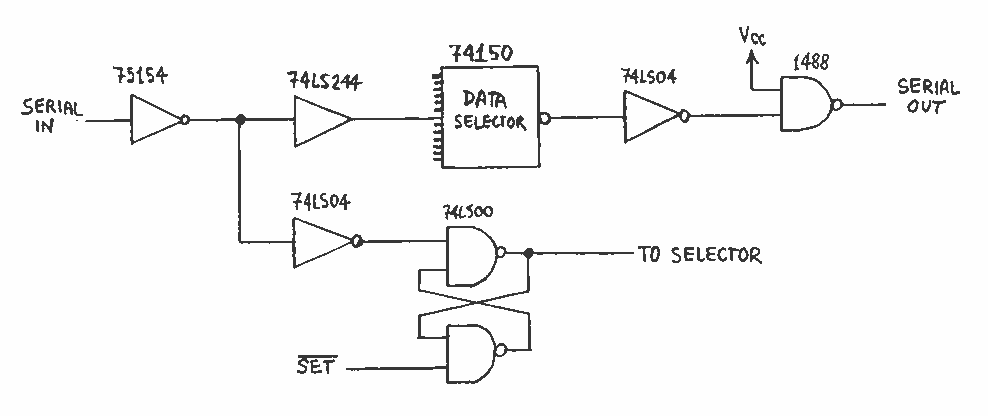
RS-232 Data Switch
This report deals with the design for a small asynchronous serial data switch. The switch architecture allows 14 serial ports supporting a subset of the RS-232 protocol. The requirements for the switch are discussed. The hardware interfaces are described in...
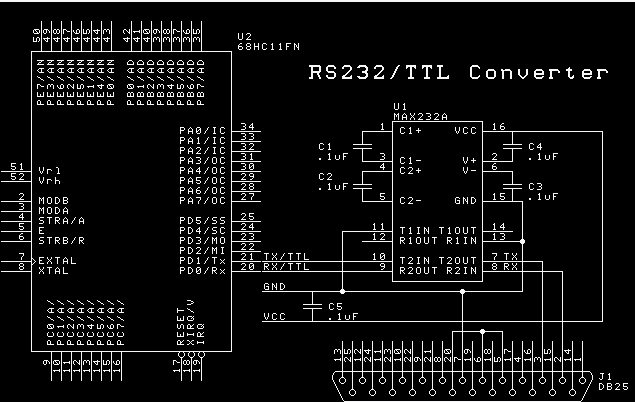
RS-232 to TTL cable with MAX232
Here is a diagram of the internals of the MAX232A. It shows a double charge pump voltage doubler and a +10v to -10v voltage inverter. The voltages output are used to generate the RS-232 compliant signals. The MAX232A has provisions...
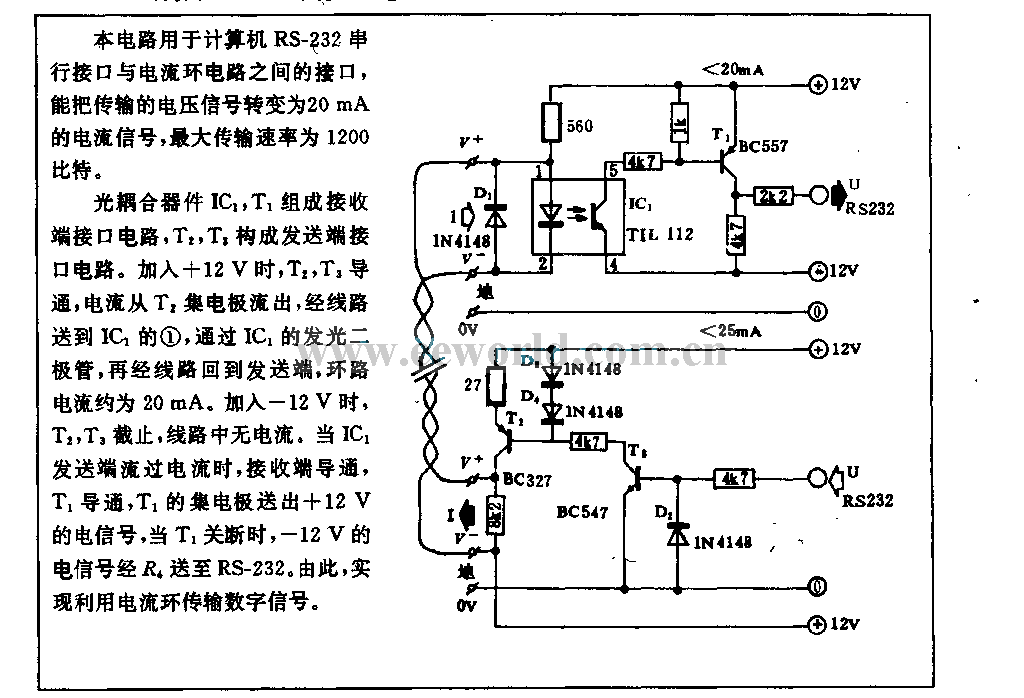
Computer RS-23Z serial interface current loop circuit
This circuit is utilized in RS-232 serial interface and current loop circuit applications. It converts voltage signals into a 20mA current signal, with a maximum transmission rate of 1200 bits per second. The CCD IC1 and transistor T1 form the...
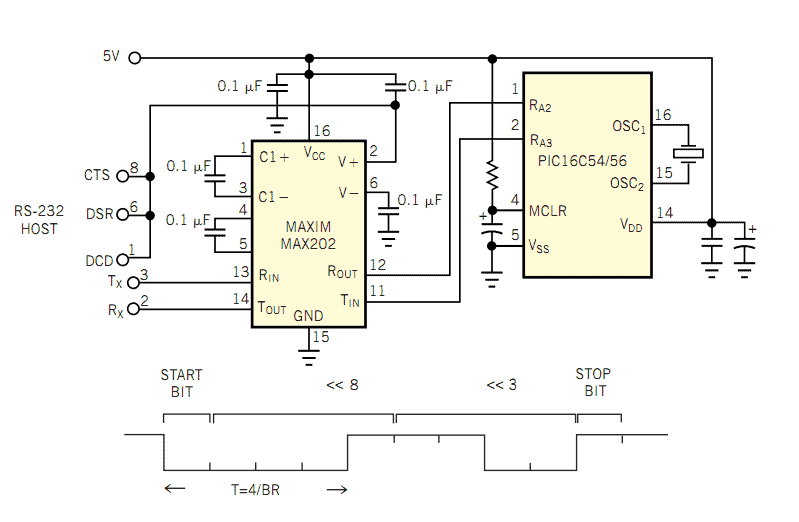
autodetects baud rate circuit MAX202 and PIC16C54
The popularity and easy access of RS-232 ports lend them to many communication projects. You can use a port as is or as a tiny parallel port when the exchange uses only control lines. Before the asynchronous serial-data transfer between...