


interfacing relay with spartan 6 fpga
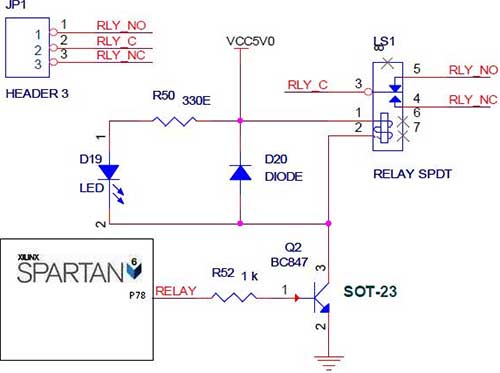
Description: The Spartan-6 board features onboard 5V relay interfacing, as illustrated in the accompanying figure. The ULN2803 serves as a driver for the FPGA I/O lines, with the driver's outputs connected to the relay modules. A PTB connector is provided for an external power supply if necessary.
The Spartan-6 board is designed with a robust relay interfacing capability, enabling control of various high-power devices through low-power FPGA I/O lines. The ULN2803, a high-voltage, high-current Darlington transistor array, is employed to facilitate this control. It allows the FPGA to switch the relays on and off without directly handling the higher voltages or currents associated with the relay operation. The outputs of the ULN2803 are connected to the relay modules, effectively isolating the FPGA from the electrical load and providing a safe operating environment.
The onboard 5V relay modules can be used to control devices such as motors, lights, or other electrical appliances, making the Spartan-6 board versatile for various applications in automation and control systems. The PTB connector allows for the integration of an external power supply, ensuring that the relays can operate independently of the FPGA's power supply. This feature is particularly useful in applications where the relay load requires more power than what the FPGA can provide.
In summary, the Spartan-6 board's relay interfacing capability, driven by the ULN2803, and the provision for an external power supply through the PTB connector, make it an effective solution for interfacing with high-power devices in a controlled manner. This design enhances the board's functionality and expands its application potential in electronic projects.The Spartan-6 board has on board 5v Relay interfacing, indicated as in Figure. ULN2803 is used as a driver for FPGA I/O lines, drivers output connected to relay modules. PTB connector provided for external power supply if needed.
The Spartan-6 board is designed with a robust relay interfacing capability, enabling control of various high-power devices through low-power FPGA I/O lines. The ULN2803, a high-voltage, high-current Darlington transistor array, is employed to facilitate this control. It allows the FPGA to switch the relays on and off without directly handling the higher voltages or currents associated with the relay operation. The outputs of the ULN2803 are connected to the relay modules, effectively isolating the FPGA from the electrical load and providing a safe operating environment.
The onboard 5V relay modules can be used to control devices such as motors, lights, or other electrical appliances, making the Spartan-6 board versatile for various applications in automation and control systems. The PTB connector allows for the integration of an external power supply, ensuring that the relays can operate independently of the FPGA's power supply. This feature is particularly useful in applications where the relay load requires more power than what the FPGA can provide.
In summary, the Spartan-6 board's relay interfacing capability, driven by the ULN2803, and the provision for an external power supply through the PTB connector, make it an effective solution for interfacing with high-power devices in a controlled manner. This design enhances the board's functionality and expands its application potential in electronic projects.The Spartan-6 board has on board 5v Relay interfacing, indicated as in Figure. ULN2803 is used as a driver for FPGA I/O lines, drivers output connected to relay modules. PTB connector provided for external power supply if needed.
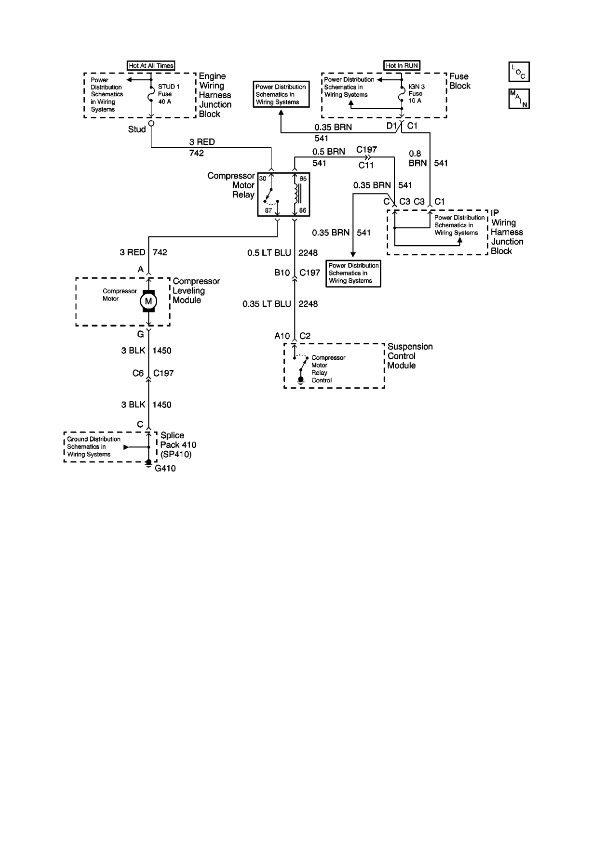
2000 suburban: relay air compressor LT v i manually put power
The physical location of the compressor relay is needed, as well as instructions on how to test the pressure sensor on the plastic tank of the compressor assembly. The exact location of the relay has not been confirmed, but one...
relay Do I need a protection diode here
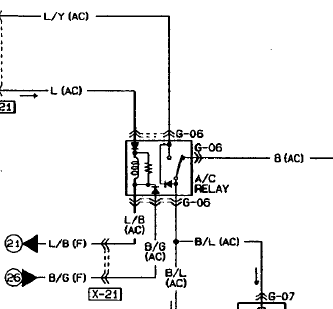
An automotive relay is being analyzed, which exhibits a more complex wiring configuration than typical relays. The diagram indicates that the B/G line maintains a high signal if certain conditions are met, specifically when the engine temperature is excessively high,...
Know About The Relay Logic
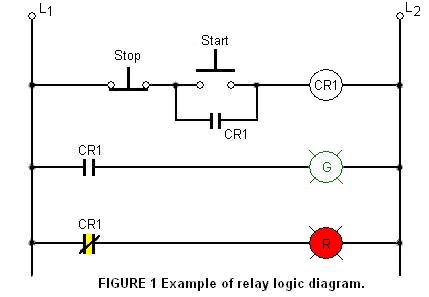
The relay logic circuit creates an electrical schematic diagram for controlling input and output devices. Components include resistors, capacitors, and others.
The relay logic circuit operates by utilizing electromechanical relays to control various input and output devices in a systematic manner....
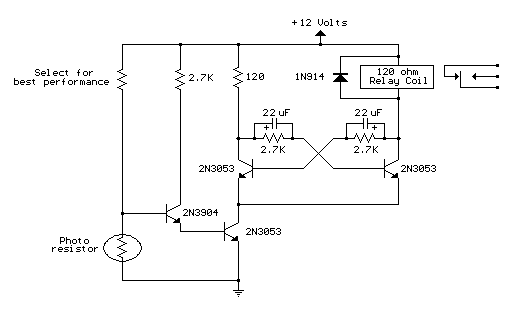
light activated relay
This circuit is similar to the previous one but incorporates a photoresistor to trigger the flip-flop instead of a push button. A bias resistor is placed in series with the photoresistor to ensure that adequate voltage is present at the...
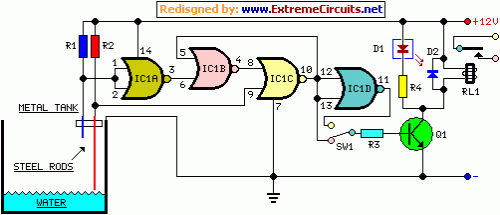
water pump relay controller circuit schematic
This circuit utilizes a relay to control a water pump, enabling automatic level control for a water reservoir or well. The shorter steel rod acts as the "water high" sensor, while the longer rod serves as the "water low" sensor....
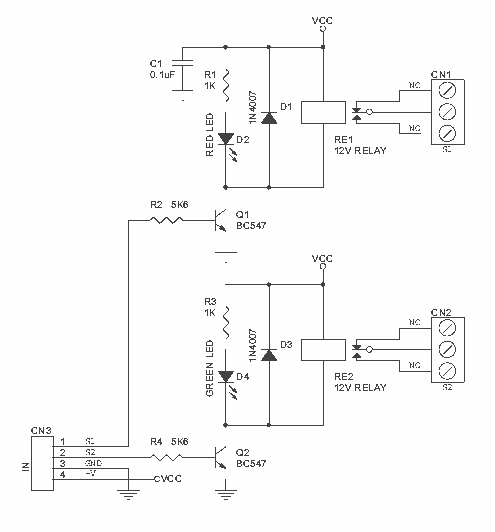
12V Relay Driver
Dual Channel Relay Board is a simple and convenient way to interface 2 relays for switching application in your project. Input - 12 VDC @ 84 mA. Output - two SPDT relay. Relay specification - 5 A @ 230 VAC....
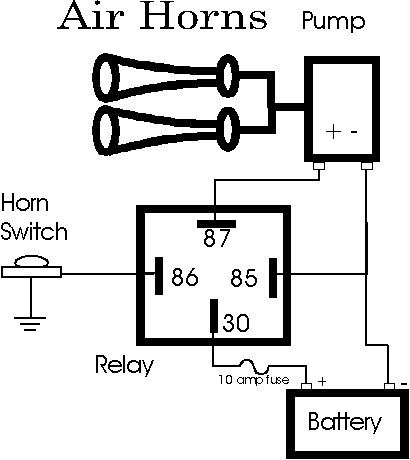
relay circuits
Remove the 6 mm screw that secures the lower rear fairing cover. This cover is the black plastic piece to which the spark plug protectors are attached. Only the machine screw should be removed; do not detach the lower rear...
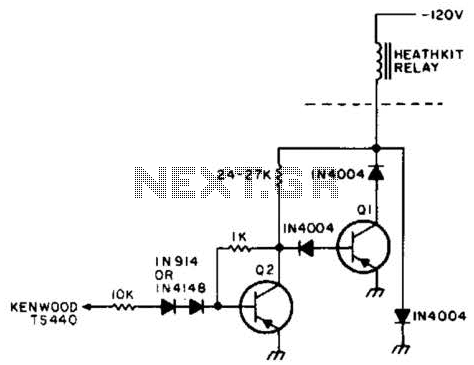
Relay Interface For Amateur Radio Transceivers Circuit
The relay power in the linear circuit is derived from a -120 V bias supply, while the transmit keying output from the Kenwood device is +12 V with a maximum current of 10 mA. A critical component of this circuit...
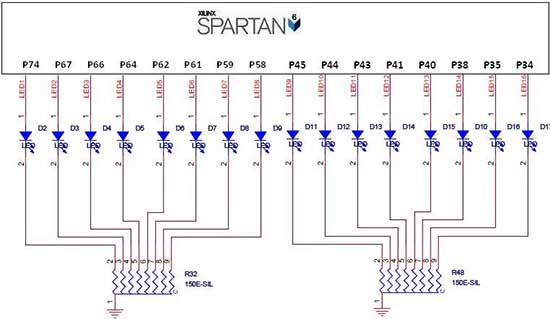
interfacing leds with spartan 6 fpga
The Spartan-6 board features 16 LEDs connected to FPGA I/O pins, as detailed in the table below. The cathode of each LED is connected to ground through a 330-ohm resistor. To illuminate a specific LED, the corresponding FPGA control signal...