


John Bedini Monopole Mechanical Oscillator
#Bedini
#monopole
#mechanical oscillator
#energy harvesting
#battery charging
#free energy
#motor system
#charge transfer
#Rick Friedrich
#environmental energy
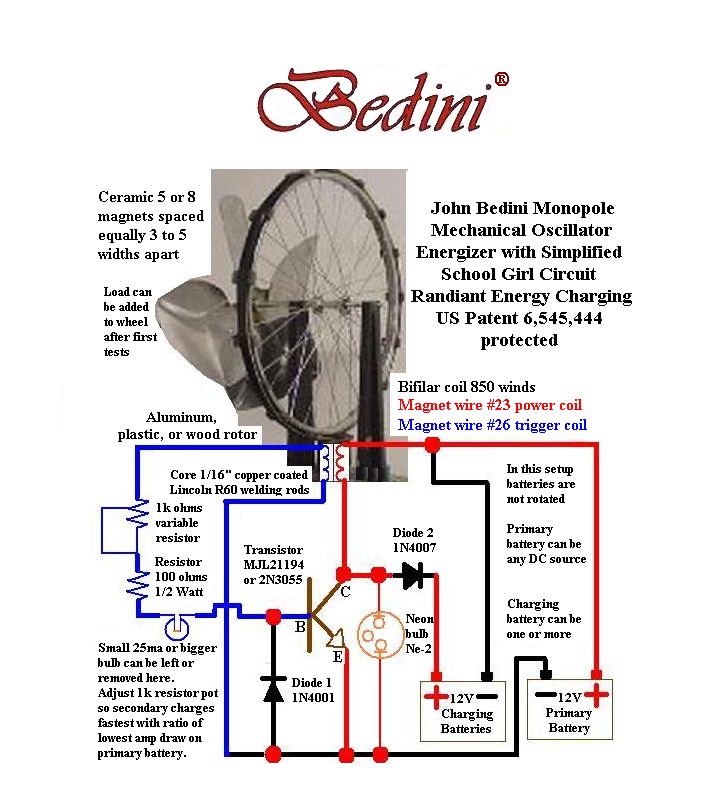
Description: Rick Friedrich, a student of Bedini, demonstrates his setup and results, asserting that by transferring charge from one battery to another using a motor system, this configuration can achieve a net energy gain by harvesting energy from the environment.
The described setup involves a motor system designed to facilitate the transfer of electrical charge between two batteries. This system is based on the principles of energy conversion and electromagnetic induction. The motor operates by converting electrical energy into mechanical energy to drive a rotor, which is linked to the charge transfer process.
In this configuration, one battery serves as the source of energy while the second battery acts as the destination for the transferred charge. The motor's operation is initiated by the energy from the source battery, which powers the motor to create motion. As the rotor spins, it generates a magnetic field that interacts with coils arranged strategically around it, inducing a voltage in the coils through electromagnetic induction.
The key aspect of this setup is the claim of achieving a net energy gain. This is postulated to occur due to the system's ability to harness additional energy from the surrounding environment, possibly through mechanisms such as ambient electromagnetic fields or other forms of energy harvesting. It is essential to note that the concept of net energy gain must be approached with caution, as it challenges the established laws of thermodynamics, particularly the conservation of energy.
The efficiency of the setup can be analyzed by measuring the energy input from the source battery against the energy output received by the destination battery. Various factors, including the motor's efficiency, the quality of the connections, and the environmental conditions, can significantly influence the results.
Overall, this motor system represents an experimental approach to exploring alternative energy solutions, with implications for renewable energy technologies and energy efficiency improvements. Further research and rigorous testing would be required to validate the claims of energy gain and to understand the underlying mechanisms at play in such a system.Bedini student, Rick Friedrich, presents his set-up and results, claiming that in the process of moving charge from one battery to another through the motor system, that this system can achieve a net energy gain, harvesting energy from the environment..
The described setup involves a motor system designed to facilitate the transfer of electrical charge between two batteries. This system is based on the principles of energy conversion and electromagnetic induction. The motor operates by converting electrical energy into mechanical energy to drive a rotor, which is linked to the charge transfer process.
In this configuration, one battery serves as the source of energy while the second battery acts as the destination for the transferred charge. The motor's operation is initiated by the energy from the source battery, which powers the motor to create motion. As the rotor spins, it generates a magnetic field that interacts with coils arranged strategically around it, inducing a voltage in the coils through electromagnetic induction.
The key aspect of this setup is the claim of achieving a net energy gain. This is postulated to occur due to the system's ability to harness additional energy from the surrounding environment, possibly through mechanisms such as ambient electromagnetic fields or other forms of energy harvesting. It is essential to note that the concept of net energy gain must be approached with caution, as it challenges the established laws of thermodynamics, particularly the conservation of energy.
The efficiency of the setup can be analyzed by measuring the energy input from the source battery against the energy output received by the destination battery. Various factors, including the motor's efficiency, the quality of the connections, and the environmental conditions, can significantly influence the results.
Overall, this motor system represents an experimental approach to exploring alternative energy solutions, with implications for renewable energy technologies and energy efficiency improvements. Further research and rigorous testing would be required to validate the claims of energy gain and to understand the underlying mechanisms at play in such a system.Bedini student, Rick Friedrich, presents his set-up and results, claiming that in the process of moving charge from one battery to another through the motor system, that this system can achieve a net energy gain, harvesting energy from the environment..
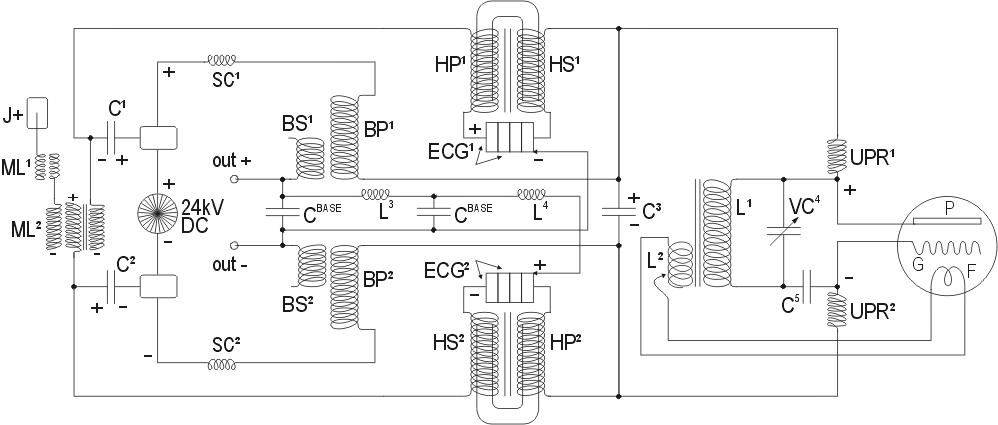
Testatika Free energy
The Testatika design, based on the Pidgeon/Wimshurst machine, represents one type of electrostatic generator that can be used to construct this system. Since the early 1900s, such power generators have significantly evolved in terms of sophistication and power output. Recently...
Testatika Free energy
The Testatika design, based on the Pidgeon/Wimshurst machine, represents one type of electrostatic generator that can be used to construct this system. Since the early 1900s, such power generators have significantly evolved in terms of sophistication and power output. Recently...
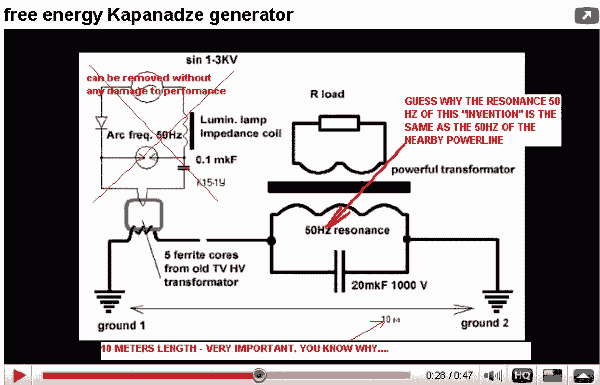
Kapanadze Free Energy Generator
An inventor from the Republic of Georgia, Tariel Kapaladze, claims to have developed a 5-kilowatt free energy generator. In a demonstration video, the device seemingly produces large amounts of energy without any visible source. While it appears to extract energy...
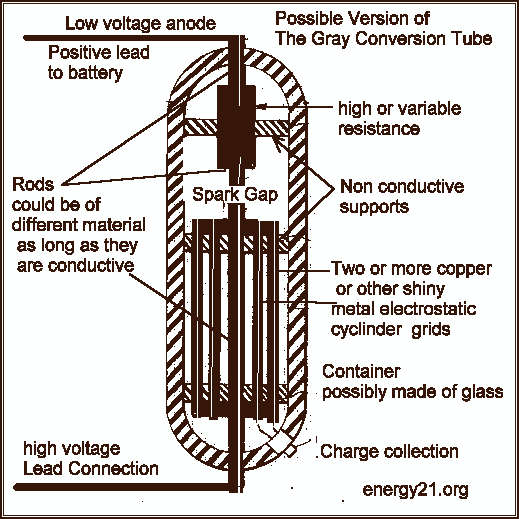
Free Energy Circuit
This type of design can produce a very high amperage current for a fraction of a second that can be used to do some useful work if properly harnessed. A point to remember is that Paul Baumann built his first...
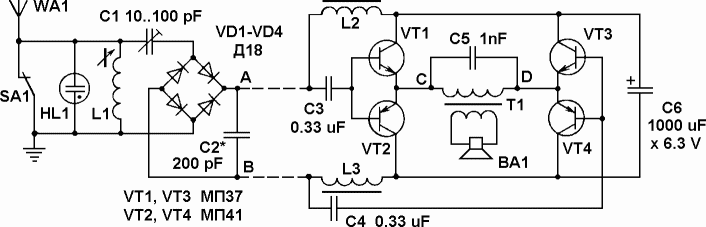
Loudspeaking radio receiver with a bridge amplifier powered by free energy
During experiments with various receivers and amplifiers powered by "free energy," it was discovered that connecting the audio amplifier to the receiver using only two wires for audio signals and supply voltage is more convenient. This setup allows the radio...
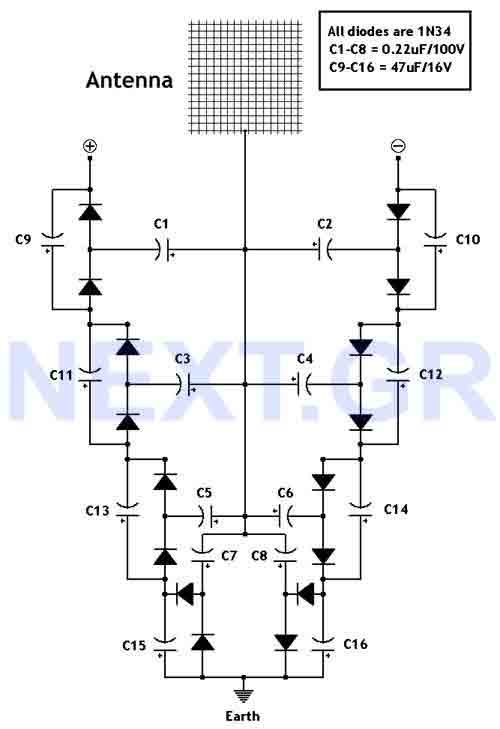
Free energy collector circuit
This circuit converts surrounding radio frequency waves to electric power. It can provide 40 Volts at 10 Watts indefinitely. The output power can be improved by adjusting the antenna. Placing the antenna near large metal objects increases power. The antenna...
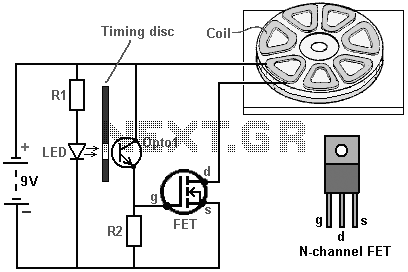
Free energy magnet motor
This invention relates to a method of producing useful energy with magnets as the driving force and represents an important improvement over known constructions and it is one which is simpler to construct, can be made to be self starting,...
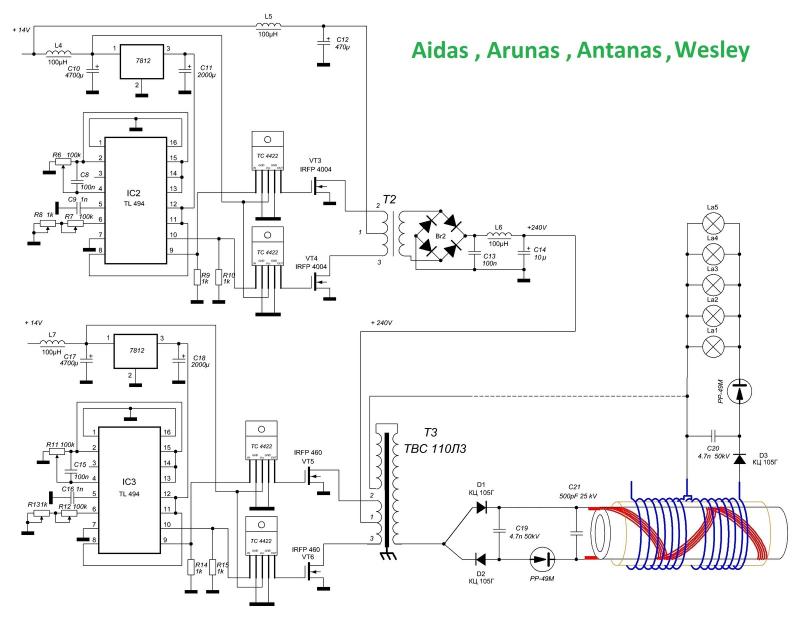
Selfrunning Free Energy 5 KW Kapanadze 1
A circuit diagram has been found on a Russian website, freeenergylt.narod2.ru/Aidas. The diagram includes a pulse generator, which requires PCGU1000 equipment for the coils to function. There are discussions about the internal resonation design, involving a capacitor in parallel with...
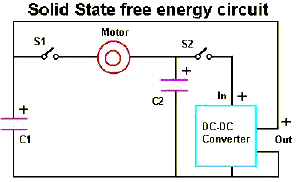
Solid State Free energy Basic
A circuit that utilizes capacitors to power a load, subsequently discharging a half-full capacitor into a DC-DC converter to recharge the initial capacitor, allowing the process to repeat while retaining some surplus energy.
This circuit operates on the principle of energy...