


400mA Micropower Synchronous Step-Up DC/DC Converter with Output Disconnect
#DC/DC converter
#step-up
#synchronous
#output disconnect
#high efficiency
#Li-Ion
#alkaline
#charge pump
#compact
#micropower
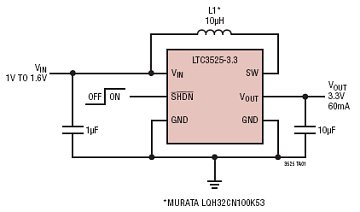
Description: The LTC3525-3/LTC3525-3.3/LTC3525-5 are high-efficiency synchronous step-up DC/DC converters with output disconnect capability that can operate with an input voltage as low as 1V. These converters provide a compact and efficient alternative to charge pumps for single-cell or dual-cell alkaline or Li-Ion applications, requiring only three small external components. The LTC3525 is available in fixed output voltages of 3V, 3.3V, or 5V. The device features a 0.5Ω N-channel MOSFET switch and a 0.8Ω P-channel synchronous rectifier. The peak switch current ranges from 150mA to 400mA, depending on the load, which enhances efficiency. The quiescent current is an ultra-low 7µA, maximizing battery life in portable applications.
The LTC3525 series of DC/DC converters is designed to efficiently boost low input voltages, making them well-suited for applications where power sources are limited, such as in portable devices powered by single or dual-cell batteries. The synchronous step-up architecture allows for a reduction in the number of external components required, simplifying the design process and minimizing the board space needed for implementation.
The device's output disconnect feature enables the output voltage to be isolated from the input when the converter is not in operation, which is critical for battery-powered applications where minimizing leakage current is essential. The selection of fixed output voltages (3V, 3.3V, or 5V) allows designers to choose the most suitable option for their specific application requirements, ensuring compatibility with a wide range of electronic components.
The integration of a 0.5Ω N-channel MOSFET switch along with a 0.8Ω P-channel synchronous rectifier contributes to the overall efficiency of the converter by minimizing conduction losses during operation. The peak switch current capability of 150mA to 400mA enables the converter to handle varying load conditions effectively, ensuring stable output voltage even under dynamic load changes.
The extremely low quiescent current of 7µA is particularly advantageous for battery-operated devices, as it significantly extends battery life when the device is in standby mode. This feature is crucial for applications that require long periods of operation without frequent battery replacement or recharging.
Overall, the LTC3525 series provides a reliable and efficient solution for boosting low input voltages in a compact package, making it an ideal choice for a variety of portable electronic applications.The LTC ®3525-3/LTC3525-3. 3/LTC3525-5 are high efficiency synchronous step-up DC/DC converters with output disconnect that can start up with an input as low as 1V. They offer a compact, high efficiency alternative to charge pumps in single cell or dual cell alkaline or Li-Ion applications.
Only three small external components are required. The LTC 3525 is offered in fixed output voltages of 3V, 3. 3V or 5V. The device includes a 0. 5 © N-channel MOSFET switch and a 0. 8 © P-channel synchronous rectifier. Peak switch current ranges from 150mA to 400mA, depending on load, providing enhanced efficiency. Quiescent current is an ultralow 7 A, maximizing battery life in portable applications.
The LTC3525 series of DC/DC converters is designed to efficiently boost low input voltages, making them well-suited for applications where power sources are limited, such as in portable devices powered by single or dual-cell batteries. The synchronous step-up architecture allows for a reduction in the number of external components required, simplifying the design process and minimizing the board space needed for implementation.
The device's output disconnect feature enables the output voltage to be isolated from the input when the converter is not in operation, which is critical for battery-powered applications where minimizing leakage current is essential. The selection of fixed output voltages (3V, 3.3V, or 5V) allows designers to choose the most suitable option for their specific application requirements, ensuring compatibility with a wide range of electronic components.
The integration of a 0.5Ω N-channel MOSFET switch along with a 0.8Ω P-channel synchronous rectifier contributes to the overall efficiency of the converter by minimizing conduction losses during operation. The peak switch current capability of 150mA to 400mA enables the converter to handle varying load conditions effectively, ensuring stable output voltage even under dynamic load changes.
The extremely low quiescent current of 7µA is particularly advantageous for battery-operated devices, as it significantly extends battery life when the device is in standby mode. This feature is crucial for applications that require long periods of operation without frequent battery replacement or recharging.
Overall, the LTC3525 series provides a reliable and efficient solution for boosting low input voltages in a compact package, making it an ideal choice for a variety of portable electronic applications.The LTC ®3525-3/LTC3525-3. 3/LTC3525-5 are high efficiency synchronous step-up DC/DC converters with output disconnect that can start up with an input as low as 1V. They offer a compact, high efficiency alternative to charge pumps in single cell or dual cell alkaline or Li-Ion applications.
Only three small external components are required. The LTC 3525 is offered in fixed output voltages of 3V, 3. 3V or 5V. The device includes a 0. 5 © N-channel MOSFET switch and a 0. 8 © P-channel synchronous rectifier. Peak switch current ranges from 150mA to 400mA, depending on load, providing enhanced efficiency. Quiescent current is an ultralow 7 A, maximizing battery life in portable applications.
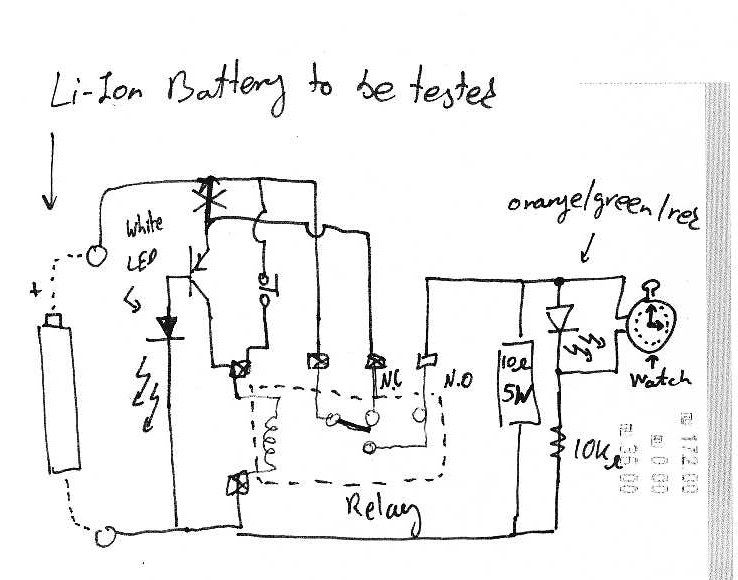
Li-Ion Battery capacity tester
It is assumed that individuals interested in constructing this circuit can interpret the schematics provided below. Basic principles: Note that lithium-ion batteries should not be discharged below 3V.
The circuit design focuses on the safe operation of lithium-ion batteries, particularly emphasizing...
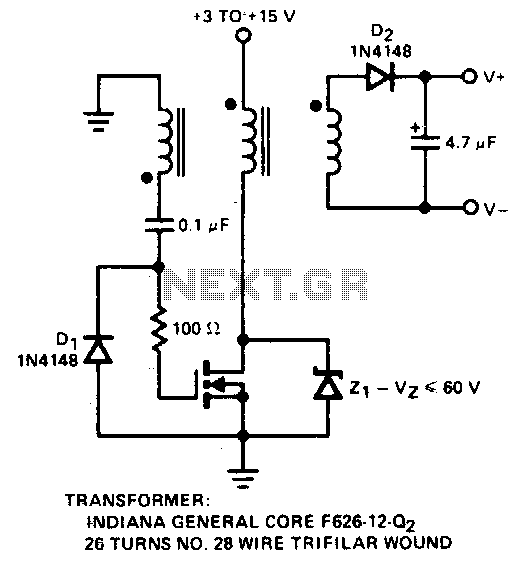
Positive input-negative output charge pump
A simple method for generating a low-power voltage supply of opposite polarity from the main supply. A self-oscillating driver produces pulses at a repetition frequency of 100 kHz. When the VMOS device is off, capacitor C is charged to the...
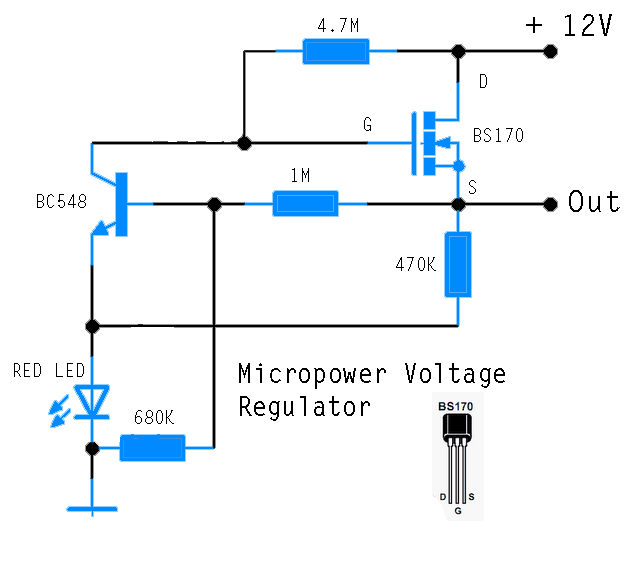
Micropower Voltage Regulator Schematic Diagram
This circuit is designed to power an AVR microcontroller from a 12V lead-acid battery. The watchdog component consumes only 14 µA. While integrated circuits (ICs) from manufacturers like Linear Technology or Maxim can be utilized for this purpose, they are...
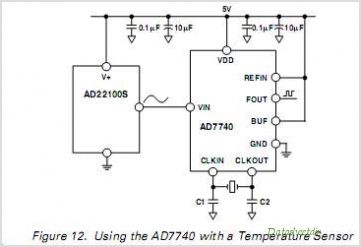
3 V/5 V Low Power Synchronous Voltage-to-Frequency Converter
The ADF4107 Frequency Synthesizer can be used to implement local oscillators in the upconversion and downconversion sections of wireless receivers and transmitters. It consists of a low noise digital phase frequency detector (PFD), a precision charge pump, a programmable reference...

Kapanadze 2
The DC/DC converter operates from 110/220V to 12V, not in the reverse direction. The 12V output serves as a substitute for the battery. This output is derived from L4 (which has been marked as L3). The transformer T1 has four...
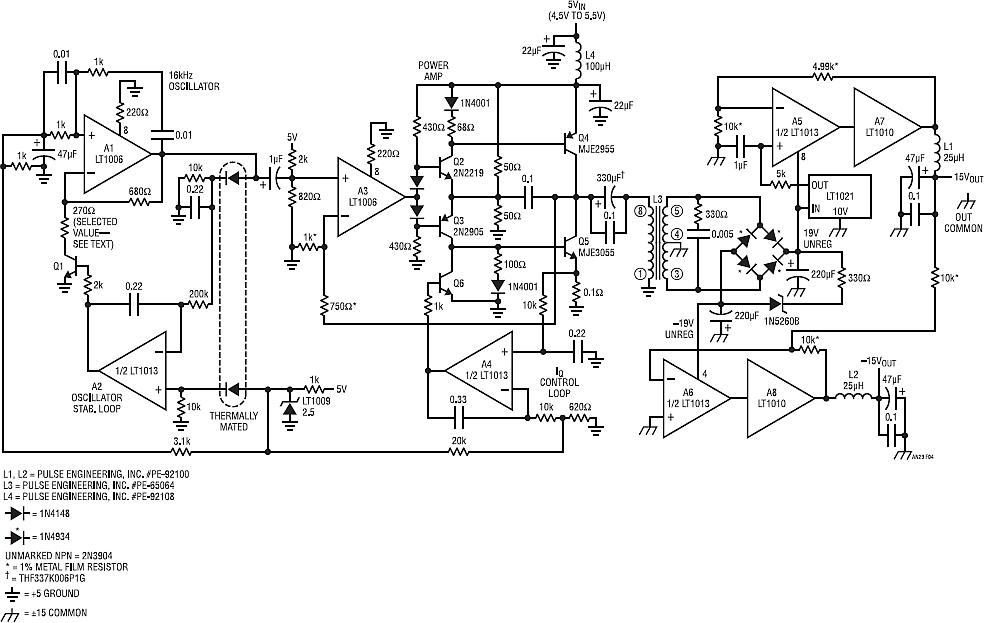
Some thoughts on DC/DC converters
Many systems require that the primary source of DC power be converted to other voltages. Battery-driven circuitry is an obvious candidate.
In many electronic applications, it is essential to convert a primary source of direct current (DC) power into various voltage...
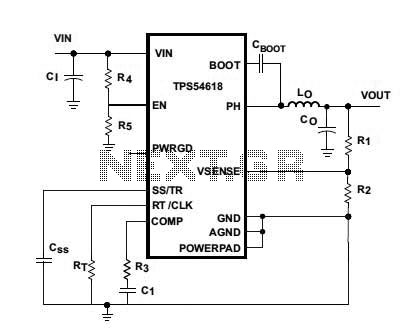
TPS54618 6-A Step-Down SWIFT DC/DC Converter
Texas Instruments introduced the TPS54618, a 6-A step-down SWIFT DC/DC converter. The new TPS54618 is a monolithic synchronous switcher featuring two integrated 12-milliohm MOSFETs.
The TPS54618 is designed to provide high efficiency and compact solutions for powering a variety of applications,...
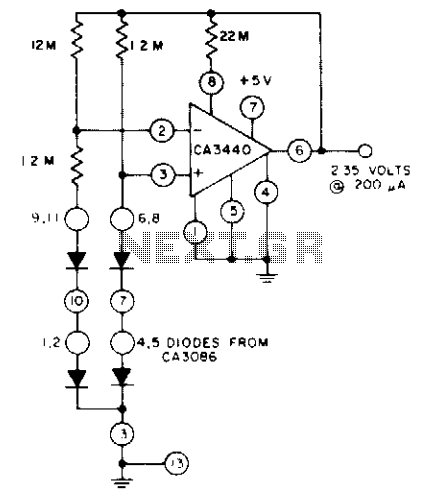
Micropower supply
The circuit utilizes a CA3440 BiMOS operational amplifier and a CA3086 transistor array. The no-load current drawn from the 5-volt supply is 1.5 µA. The load current can reach up to 200 µA while still maintaining output voltage regulation within...
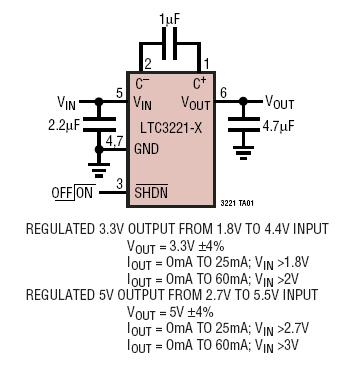
Micropower Regulated Charge Pump in 2 x 2 DFN
The LTC3221 family consists of micropower charge pump DC/DC converters that deliver a regulated output of up to 60mA. The input voltage range is from 1.8V to 5.5V. With an extremely low operating current of 8µA typical at no load...