


Ac-to-DC converter
#AC-to-DC
#converter
#PMOS
#FET
#buffer amplifier
#absolute value circuit
#power conversion
#rectifier
#voltage regulation
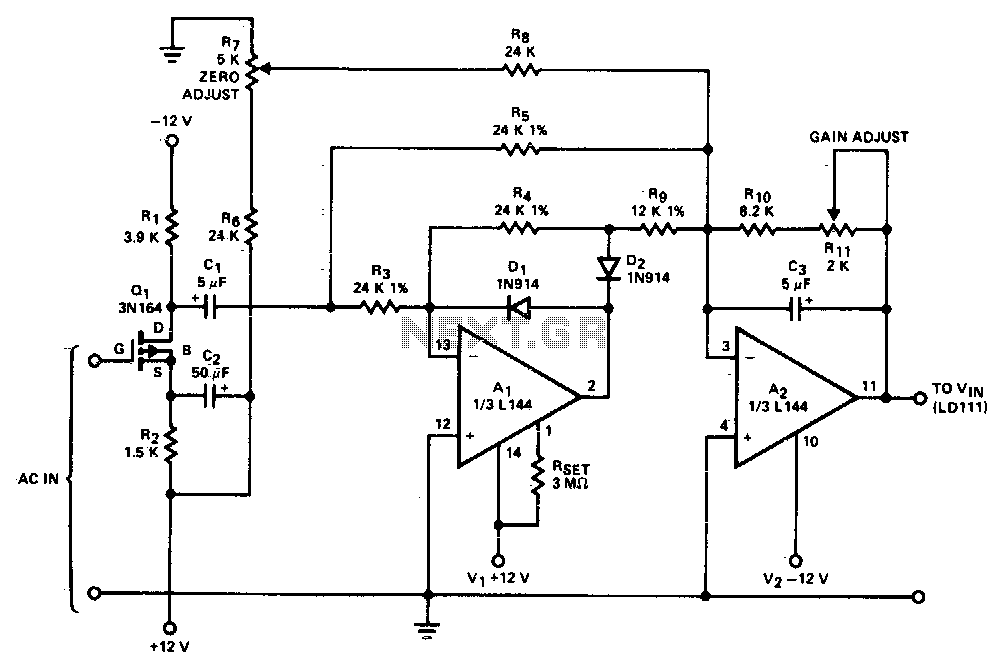
Description: This circuit features a PMOS enhancement-mode FET input buffer amplifier connected to a traditional absolute value circuit, which effectively mitigates the impact of the forward voltage drop across diodes D1 and D2.
The described circuit employs a PMOS enhancement-mode field-effect transistor (FET) as an input buffer amplifier. This type of FET is characterized by its ability to operate with a positive gate-source voltage, which enhances its conductivity. The input buffer configuration serves to isolate the input signal from the subsequent circuitry, ensuring that the input impedance remains high while the output impedance remains low. This arrangement is particularly beneficial in applications where signal integrity and impedance matching are crucial.
The absolute value circuit is designed to convert both positive and negative input signals into a positive output. This is achieved through the use of diodes D1 and D2, which are arranged in a way that allows for the conduction of the signal regardless of its polarity. By incorporating these diodes, the circuit effectively eliminates the forward voltage drop that typically occurs when diodes are conducting. This is significant because the forward voltage drop can introduce inaccuracies in the output signal, particularly in precision applications.
In summary, the combination of the PMOS enhancement-mode FET input buffer and the absolute value circuit allows for a robust design that maintains signal integrity while providing accurate output levels, regardless of the input signal's polarity. This circuit configuration is well-suited for use in various electronic applications where accurate signal processing is essential.This circuit includes a PMOS enhancement-mode FET input buffer amplifier, coupled to a classical absolute value circuit which essentially eliminates the effect of the forward voltage drop across diodes D1 and D2.
The described circuit employs a PMOS enhancement-mode field-effect transistor (FET) as an input buffer amplifier. This type of FET is characterized by its ability to operate with a positive gate-source voltage, which enhances its conductivity. The input buffer configuration serves to isolate the input signal from the subsequent circuitry, ensuring that the input impedance remains high while the output impedance remains low. This arrangement is particularly beneficial in applications where signal integrity and impedance matching are crucial.
The absolute value circuit is designed to convert both positive and negative input signals into a positive output. This is achieved through the use of diodes D1 and D2, which are arranged in a way that allows for the conduction of the signal regardless of its polarity. By incorporating these diodes, the circuit effectively eliminates the forward voltage drop that typically occurs when diodes are conducting. This is significant because the forward voltage drop can introduce inaccuracies in the output signal, particularly in precision applications.
In summary, the combination of the PMOS enhancement-mode FET input buffer and the absolute value circuit allows for a robust design that maintains signal integrity while providing accurate output levels, regardless of the input signal's polarity. This circuit configuration is well-suited for use in various electronic applications where accurate signal processing is essential.This circuit includes a PMOS enhancement-mode FET input buffer amplifier, coupled to a classical absolute value circuit which essentially eliminates the effect of the forward voltage drop across diodes D1 and D2.
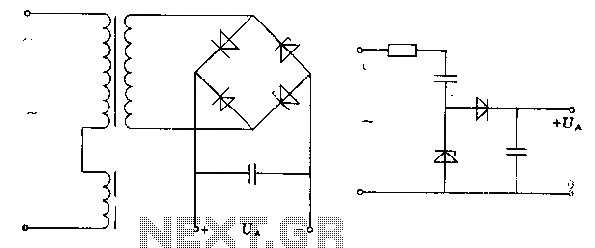
Zero rectifier regulator schematic
The pre-regulator circuit is connected to a capacitor and a resistor element. The regulator operates in its conducting direction through the input. A capacitor is connected to AC power, and in the blocking direction, it limits the current, allowing the...
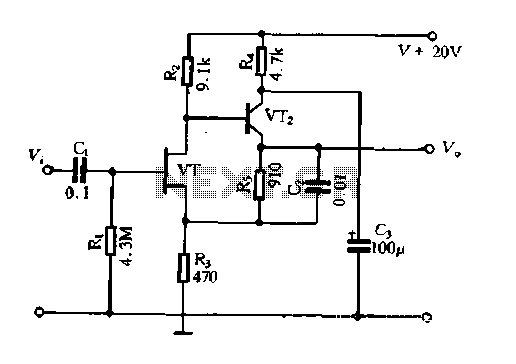
FET high input impedance wideband amplifiers
The Field Effect Transistor (FET) exhibits a high input impedance, allowing the construction of high input impedance amplifiers. However, as a FET amplifying device, the distributed capacitance and the Miller effect significantly increase input capacitance at high frequencies. Furthermore, as...
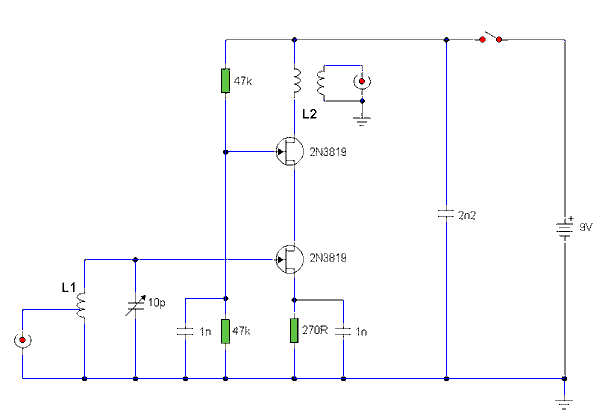
Band 2 Preamplifier
The lower FET operates in common source mode, while the upper FET operates in common gate mode, achieving full high-frequency gain. The bottom FET is tunable, allowing for peak adjustment for a particular station. Coil details follow:
The described circuit employs...
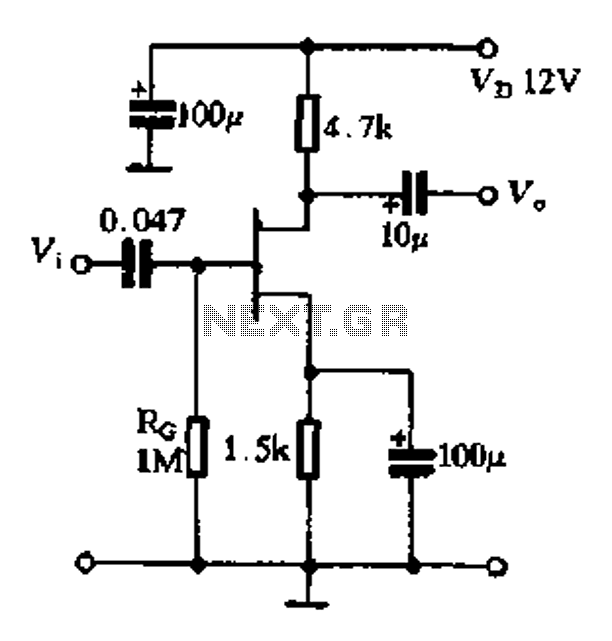
The basic FET amplifier circuit a
The FET exhibits a high input impedance, a low noise figure, anti-crosstalk capabilities, and good mutual interference performance, making it increasingly utilized in electronic circuits. FET amplifiers can be configured in various ways, including as common source (equivalent to a...
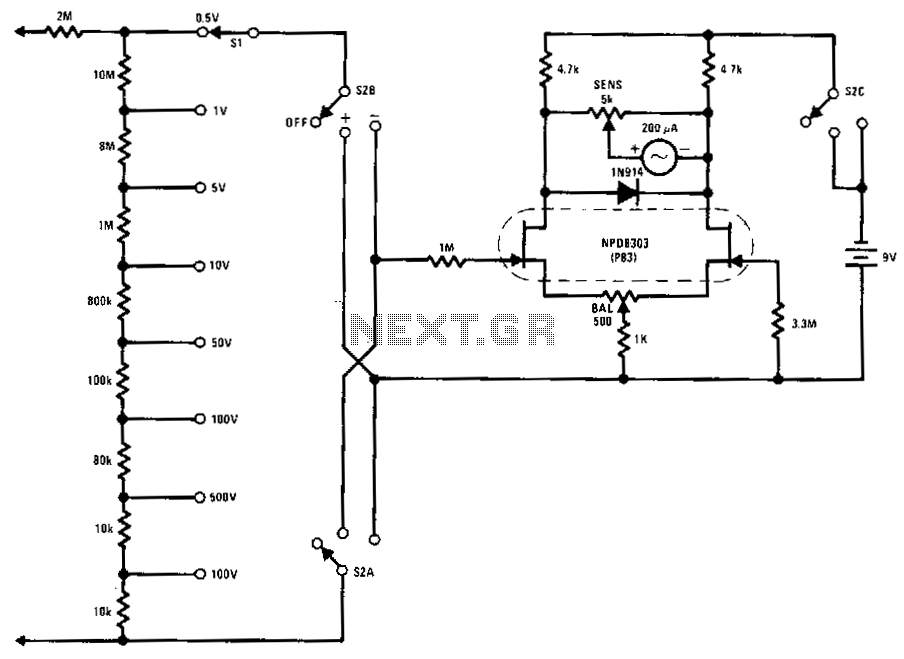
Fet-voltmeter
This FETVM replaces the function of the VTVM and eliminates the need for a standard line cord. Additionally, FET drift rates are significantly better than those of vacuum tube circuits, enabling a full-scale range of 0.5 V, which is not...
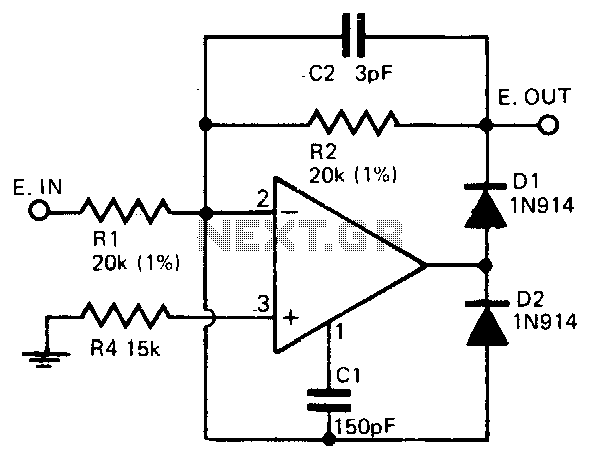
Fast half-wave rectifier
A precision half-wave rectifier utilizing an operational amplifier will achieve a rectification accuracy of 1% from DC to 100 kHz.
A precision half-wave rectifier circuit is designed to convert an AC signal into a unidirectional output while maintaining high accuracy in...
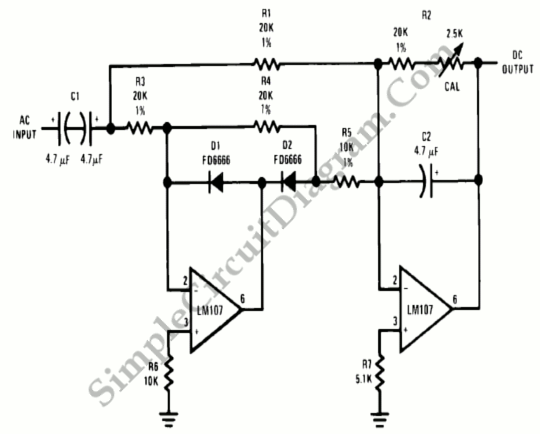
The Full-Wave Rectifier and Averaging Filter
The core of a typical RMS calibrated AC voltmeter consists of a rectifier and averaging filter. To create a precision full-wave rectifier, the averaging function can be removed by eliminating capacitor C2, while deleting capacitor C1 will enable the circuit...
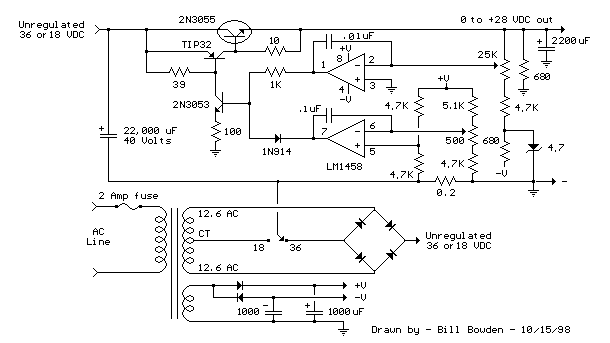
Variable Voltage and Current Power Supply circuit
An alternative approach to utilizing operational amplifiers (op-amps) for power supply regulation is presented. This method necessitates an additional winding on the power transformer to provide the op-amps with a bipolar voltage of +/- 8 volts. The negative voltage generated...
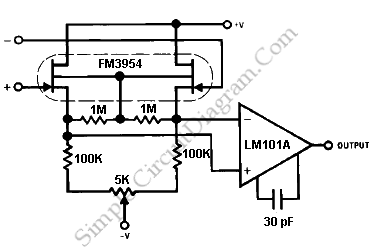
FET Op Amp
The FM3954 monolithic dual provides an ideal low-offset and low-drift buffer function for the LM101A operational amplifier. It operates effectively over its bias current range.
The FM3954 is a dual operational amplifier designed to serve as a buffer for the LM101A,...