


Inductor Choice Yields Performance Tradeoffs in DC-DC Converters
#DC-DC converter
#inductor
#switching converter
#stepdown converter
#power electronics
#performance tradeoffs
#current capability
#cost
#size
#resistance
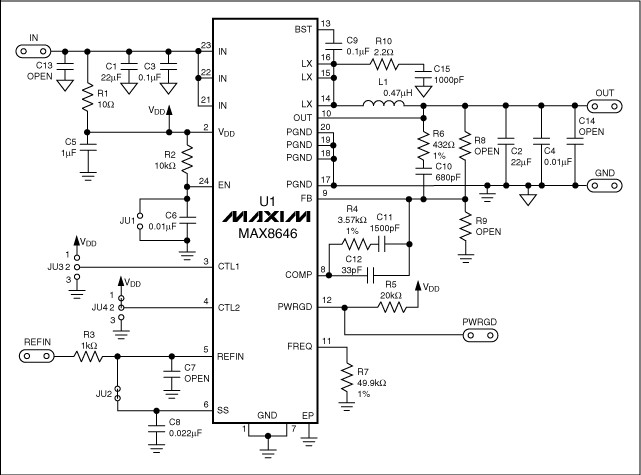
Description: Cost, size, resistance, and current capability drive the choice of inductor for most step-down DC-DC switching converters.
Inductors play a crucial role in the operation of step-down DC-DC switching converters, influencing performance parameters such as efficiency, output voltage stability, and transient response. When selecting an inductor for these applications, several key factors must be considered.
Cost is a significant factor, as it directly impacts the overall budget of the project. Inductors can vary widely in price depending on their specifications, material quality, and manufacturing processes. Therefore, a balance must be struck between performance requirements and the available budget.
Size is another critical consideration. The physical dimensions of the inductor affect the overall footprint of the converter circuit. In applications where space is limited, smaller inductors may be preferred, even if they come with trade-offs in terms of efficiency or current handling capability.
Resistance, specifically the DC resistance (DCR) of the inductor, influences the power losses during operation. Lower resistance inductors are generally favored to minimize losses, which can lead to improved efficiency and thermal performance. However, lower resistance inductors may also be larger or more expensive, necessitating a careful evaluation of trade-offs.
Current capability is vital for ensuring that the inductor can handle the maximum load current without saturating. Inductor saturation occurs when the magnetic core material cannot store additional magnetic energy, leading to a significant drop in inductance and potential failure of the converter. Selecting an inductor with an adequate current rating is essential to maintain stable operation under varying load conditions.
In summary, the selection of an inductor for step-down DC-DC switching converters requires a comprehensive evaluation of cost, size, resistance, and current capability to optimize performance and reliability in the final design.Cost, size, resistance, and current capability drive the choice of inductor for most stepdown dc-dc switching converters..
Inductors play a crucial role in the operation of step-down DC-DC switching converters, influencing performance parameters such as efficiency, output voltage stability, and transient response. When selecting an inductor for these applications, several key factors must be considered.
Cost is a significant factor, as it directly impacts the overall budget of the project. Inductors can vary widely in price depending on their specifications, material quality, and manufacturing processes. Therefore, a balance must be struck between performance requirements and the available budget.
Size is another critical consideration. The physical dimensions of the inductor affect the overall footprint of the converter circuit. In applications where space is limited, smaller inductors may be preferred, even if they come with trade-offs in terms of efficiency or current handling capability.
Resistance, specifically the DC resistance (DCR) of the inductor, influences the power losses during operation. Lower resistance inductors are generally favored to minimize losses, which can lead to improved efficiency and thermal performance. However, lower resistance inductors may also be larger or more expensive, necessitating a careful evaluation of trade-offs.
Current capability is vital for ensuring that the inductor can handle the maximum load current without saturating. Inductor saturation occurs when the magnetic core material cannot store additional magnetic energy, leading to a significant drop in inductance and potential failure of the converter. Selecting an inductor with an adequate current rating is essential to maintain stable operation under varying load conditions.
In summary, the selection of an inductor for step-down DC-DC switching converters requires a comprehensive evaluation of cost, size, resistance, and current capability to optimize performance and reliability in the final design.Cost, size, resistance, and current capability drive the choice of inductor for most stepdown dc-dc switching converters..
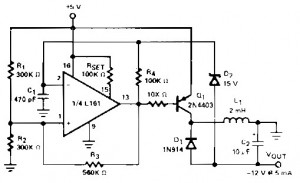
regulated dc to dc converter
A regulated DC to DC converter utilizing the Micro Power Quad Comparator L161 integrated circuit, which features ultra-low power consumption. This circuit is designed to convert 5V DC to 12V DC at a current output of 5mA.
The circuit employs the...
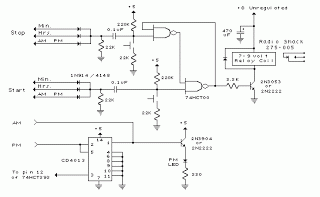
Dc to Dc converter using 555 Timer IC
When the power supply is connected to IC1, the output pin 3 operates at a frequency of 1 kHz. The components Q1 and Q2 work in a push-pull configuration. When a positive output signal is generated, Q1 and Q2 execute...
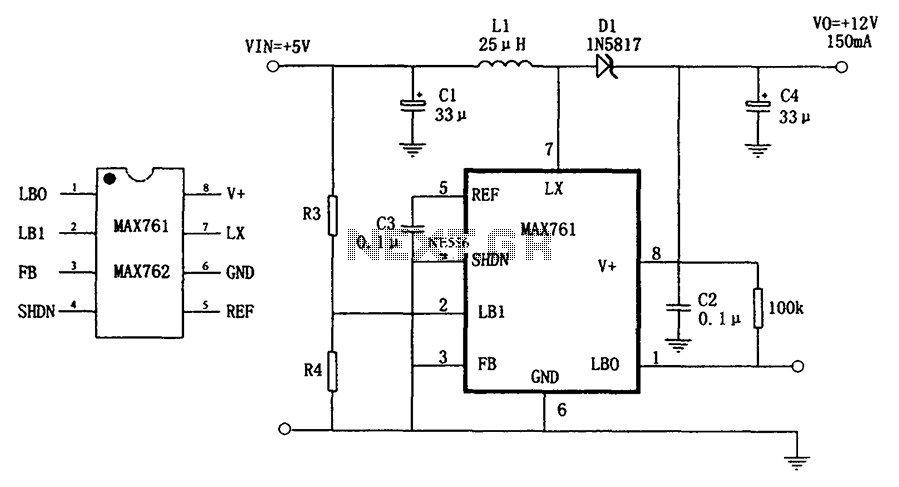
+5V + 12V boost power supply MAX761
The circuit depicted in the figure illustrates an efficient, low-power step-up DC-DC converter, the MAX761, along with a few external components, which functions as a +5V to +12V boost power supply. Its characteristics include a conversion efficiency of 86% and...
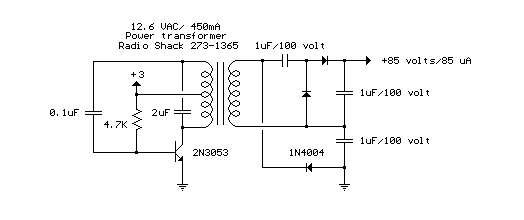
dc to dc converter
The circuit is a DC to DC converter utilizing a standard 12 VAC center-tapped power transformer configured as a blocking oscillator. Although the circuit exhibits low efficiency, it generates a high voltage suitable for low power applications. The input battery...
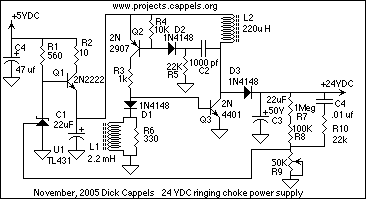
DC to DC Converter
The intended use of the 24 volts is to power an amplifier that will supply wave forms of up to a couple hundred Hz to bias a varactor or pair of varactors in an RF circuit. This meant that the...
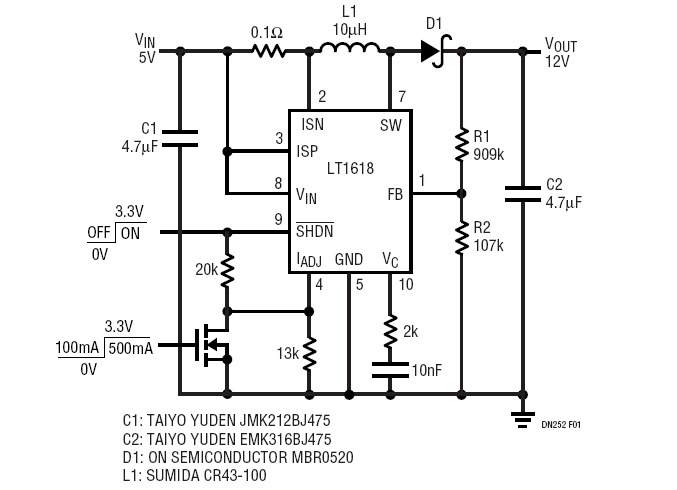
usb 5v to 12v dc dc step up converter
This is a 5V to 12V DC-DC step-up (boost) converter circuit that is particularly suitable for USB-powered applications. Initially, a USB port has two current supply modes. Before detecting the connected device, it supplies a maximum of 100mA to the...
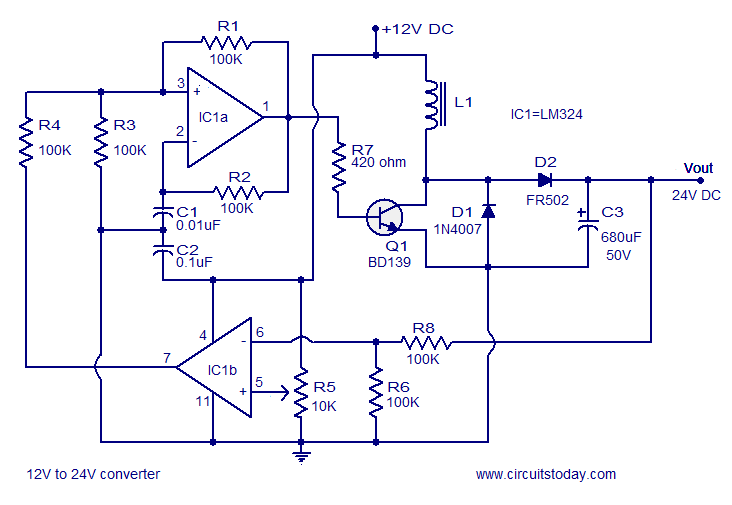
Simple 12V to 24V DC DC converter using LM324 and transistor
A simple 12V to 24V DC-DC converter circuit diagram built around the LM324. This boost converter schematic can provide up to 800mA output current and a steady 24V DC.
The described circuit utilizes the LM324 operational amplifier as the core component...
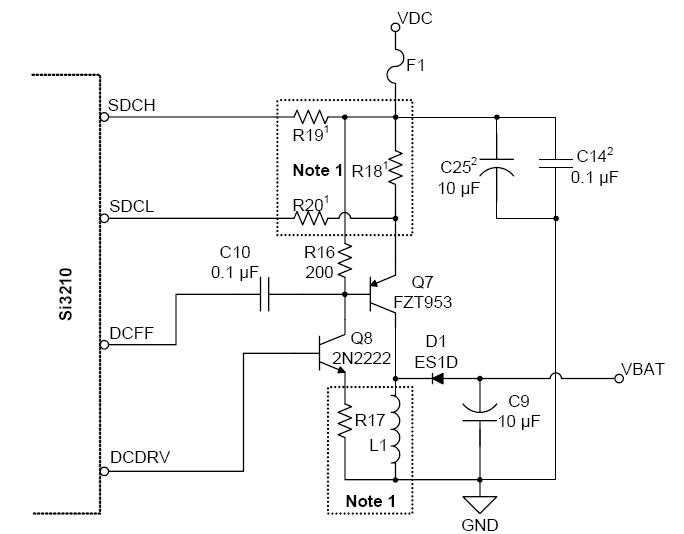
chasing an elusive bug around
Since the last update, significant efforts have been directed towards debugging the board. Multiple issues have been identified in the implementation of the DC-DC converter circuitry. However, sufficient evidence has been collected regarding the bug, indicating that it is neither...
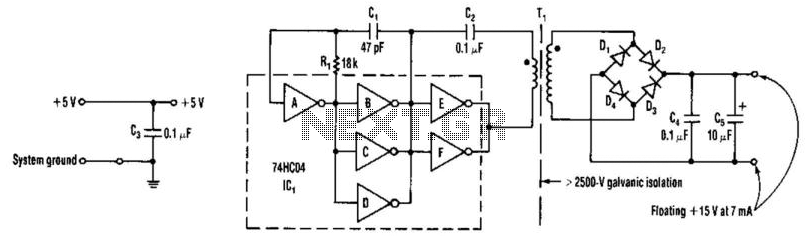
Isolated 15V To 2500V Supply
A DC-DC converter utilizes a 74HC04 to drive transformer Tl. Tl is a ferrite-core transformer from Fair-Rite, Inc., with part number 597-5000201, featuring a 7-turn primary winding and a 25-turn secondary winding. Kynar #30 wire wrap wire is employed in...