


Polarity converter
#polarity converter
#voltage converter
#capacitor-diode
#-5V supply
#+15V input
#current limited
#20mA output
#no boost transistors
#simple circuit
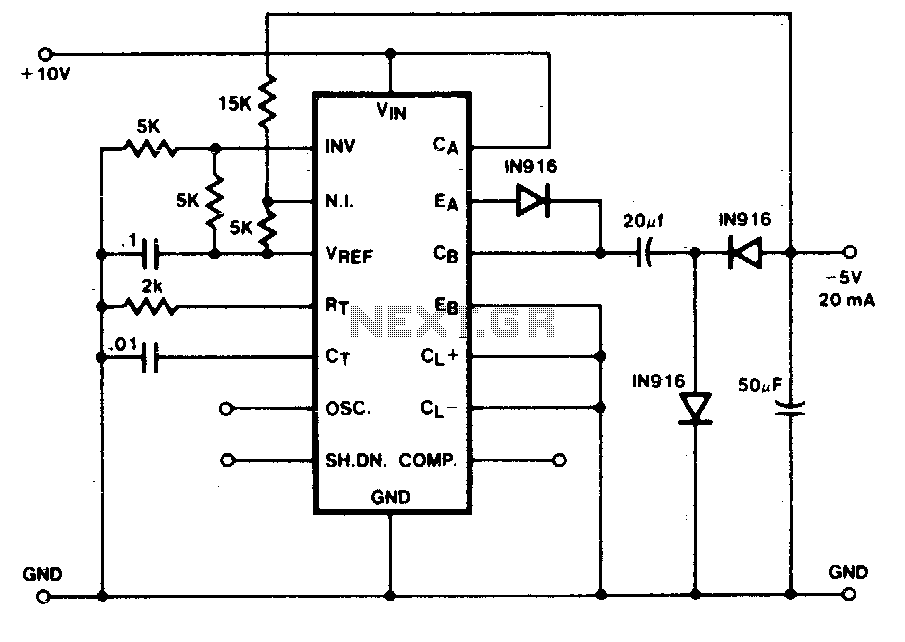
Description: The capacitor-diode output circuit functions as a polarity converter, generating a -5 volt supply from a +15 volt input. This circuit can provide an output current of up to 20 mA without requiring additional boost transistors. The output transistors are current-limited, eliminating the need for extra protection. Furthermore, the absence of an inductor enables the circuit to be stabilized solely with the output capacitor.
The capacitor-diode output circuit operates by utilizing a combination of capacitors and diodes to achieve voltage conversion. The primary component, a capacitor, is charged to the input voltage of +15 volts during one half of the AC cycle. When the polarity of the input changes, diodes are employed to discharge the capacitor, thus providing a negative voltage output of -5 volts.
In this configuration, the diodes serve to rectify the voltage, allowing current to flow in a controlled manner while preventing backflow. The output capacitor plays a crucial role in smoothing the output voltage, ensuring a stable -5 volt supply is delivered to the load. The design allows for an output current of up to 20 mA, making it suitable for various applications that require a negative voltage rail without the complexity of additional components such as boost transistors.
The current-limiting feature of the output transistors is essential for protecting the circuit from overcurrent conditions. This built-in protection mechanism ensures that the circuit operates within safe limits, thus enhancing reliability. The decision to exclude an inductor simplifies the design and reduces component count, which can be beneficial in applications where space and weight are critical factors.
Overall, this capacitor-diode output circuit is an efficient and straightforward solution for generating a negative voltage supply, leveraging the properties of capacitors and diodes to achieve the desired electrical characteristics while maintaining stability and safety.The capacitor-diode output circuit is used here as a polarity converter to generate a - 5 volt supply from +15 volts. This circuit is useful for an output current of up to 20 mA with no additional boost transistors required.
Since the output transistors are current limited, no additional protection is necessary Also, the lack of an inductor allows the circuit to be stabilized with only the output capacitor.
The capacitor-diode output circuit operates by utilizing a combination of capacitors and diodes to achieve voltage conversion. The primary component, a capacitor, is charged to the input voltage of +15 volts during one half of the AC cycle. When the polarity of the input changes, diodes are employed to discharge the capacitor, thus providing a negative voltage output of -5 volts.
In this configuration, the diodes serve to rectify the voltage, allowing current to flow in a controlled manner while preventing backflow. The output capacitor plays a crucial role in smoothing the output voltage, ensuring a stable -5 volt supply is delivered to the load. The design allows for an output current of up to 20 mA, making it suitable for various applications that require a negative voltage rail without the complexity of additional components such as boost transistors.
The current-limiting feature of the output transistors is essential for protecting the circuit from overcurrent conditions. This built-in protection mechanism ensures that the circuit operates within safe limits, thus enhancing reliability. The decision to exclude an inductor simplifies the design and reduces component count, which can be beneficial in applications where space and weight are critical factors.
Overall, this capacitor-diode output circuit is an efficient and straightforward solution for generating a negative voltage supply, leveraging the properties of capacitors and diodes to achieve the desired electrical characteristics while maintaining stability and safety.The capacitor-diode output circuit is used here as a polarity converter to generate a - 5 volt supply from +15 volts. This circuit is useful for an output current of up to 20 mA with no additional boost transistors required.
Since the output transistors are current limited, no additional protection is necessary Also, the lack of an inductor allows the circuit to be stabilized with only the output capacitor.
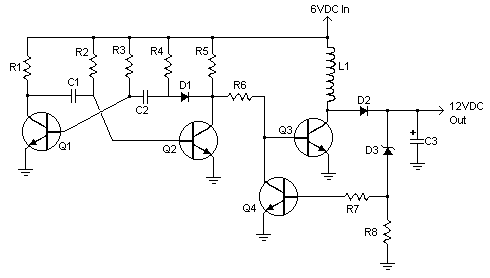
6v to 12v converter circuits
A 6V to 12V DC converter circuit is designed to convert a lower voltage of approximately 6 volts to a higher voltage of 12 volts, albeit with a reduced current rating. This inverter circuit can deliver up to 800mA of...
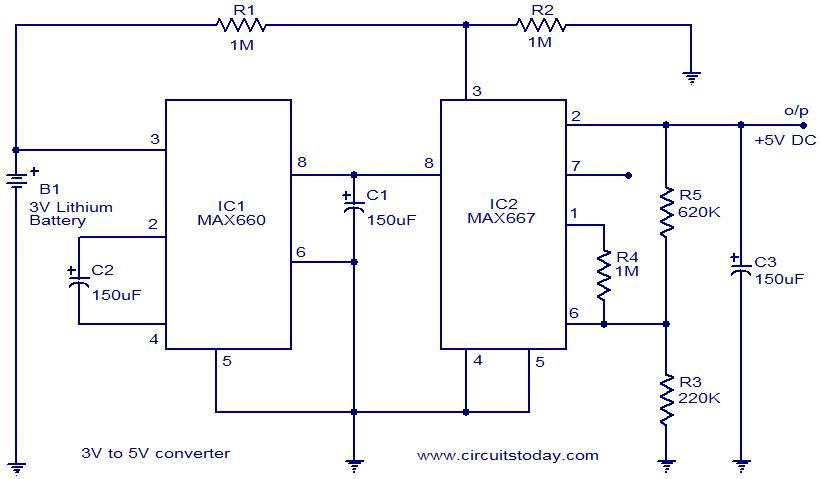
Voltage Converter 3V to 5V using MAX660
Voltage converter circuit diagram for converting 3 volts to 5 volts using CMOS monolithic ICs MAX660 and MAX667, which functions as a positive voltage regulator.
The voltage converter circuit utilizes the MAX660 and MAX667 integrated circuits to step up a 3-volt...
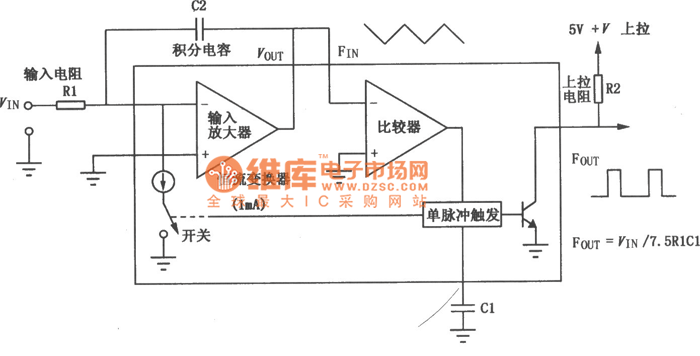
VFC62 voltage / frequencyfrequency / voltage converter circuit
The VFC62 is a voltage-to-frequency and frequency-to-voltage converter that effectively transforms analog signals into digital signals. The digital output is presented in an open collector format, where the digital pulse repetition rate is directly proportional to the amplitude of the...
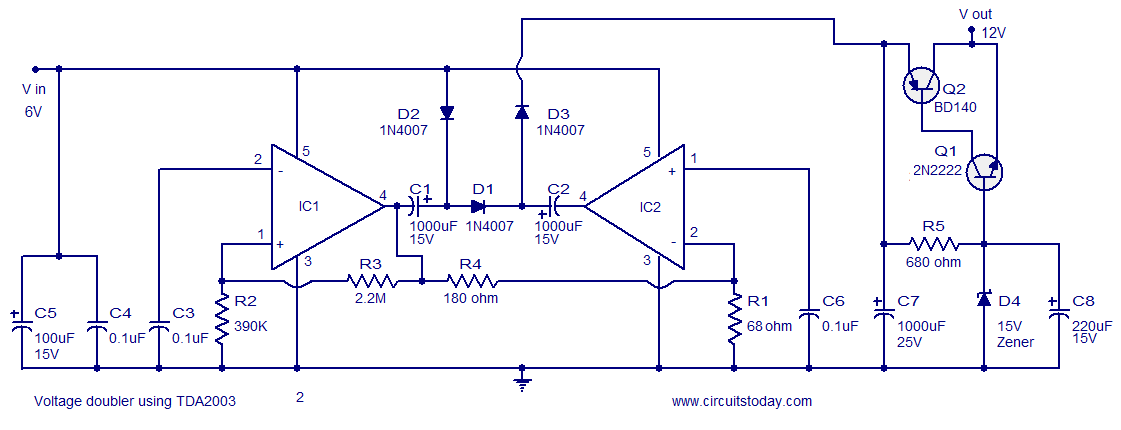
Voltage Converter 6 to 12 Volts -Using TDA 2003
A reliable voltage converter circuit that operates between 6 to 12 volts, utilizing the audio amplifier IC TDA 2003. This voltage doubler circuit can be assembled on a Vero board.
The voltage converter circuit designed with the TDA 2003 audio amplifier...

Buck Boost Voltage Converter
In some cases, it is necessary to power a circuit from a battery, where the required supply voltage falls within the battery's discharge curve. A new battery provides a higher voltage than needed, while a battery nearing the end of...
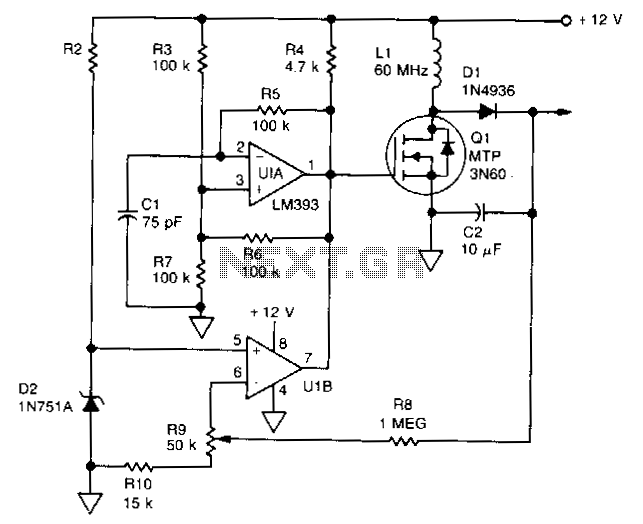
High-efficiency-flyback-voltage-converter
U1 is a dual voltage comparator with open collector outputs. The A side functions as an oscillator operating at 100 kHz, while the B side is part of the regulation circuit that compares a fraction of the output voltage to...
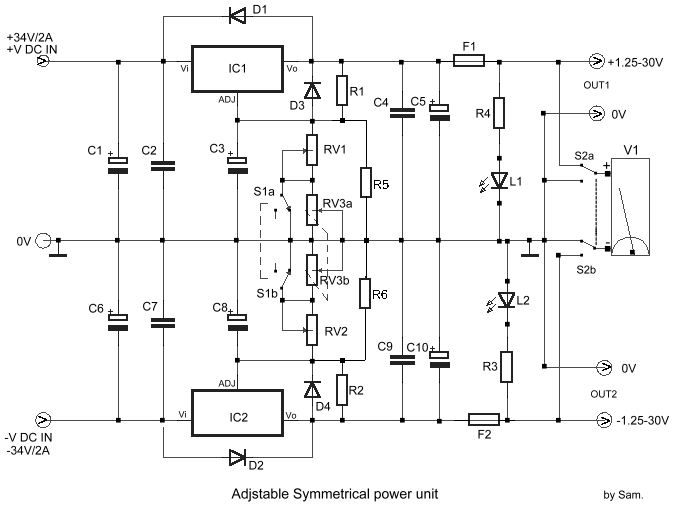
Adjustable Symmetrical Power Supply ?± 125 until ?±30V 1A circuit
This is a voltage converter designed to output a voltage range of ±1.25 to ±30V from an input voltage of ±35V. A three-terminal voltage regulator is utilized to achieve the desired voltage transformation in this unit.
The voltage converter employs a...
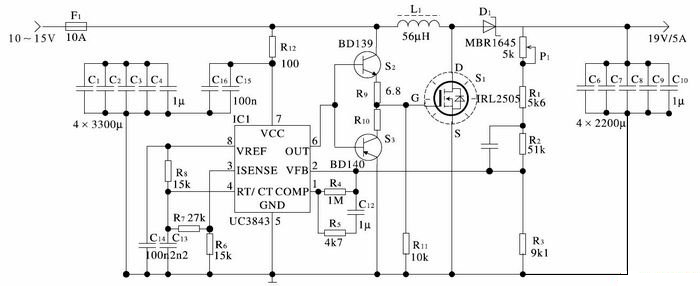
notebook power car adapter 19 volt
The car cigarette lighter outputs a DC voltage of 12 V, which does not exceed 13.8 V even when the engine is running. A voltage of 19 V is lower than the normally required levels.
The car cigarette lighter circuit is...
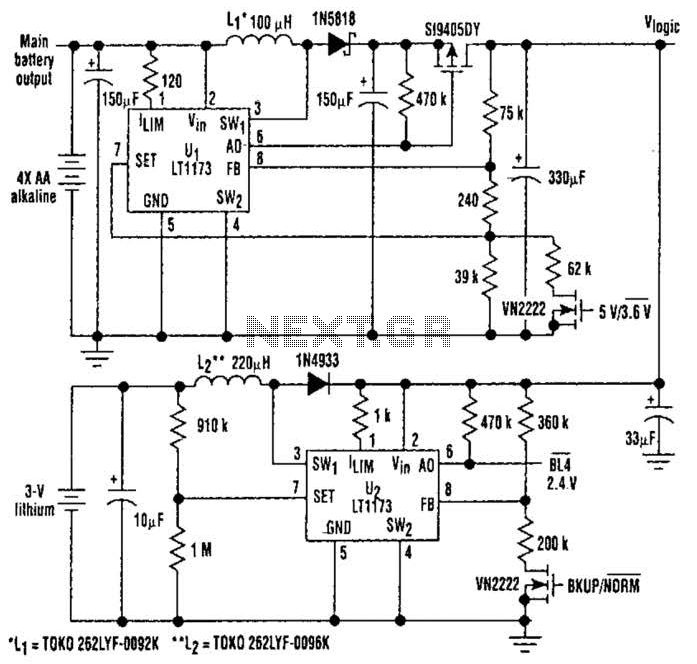
5V From 4Aa Cells Circuit
This unique logic-power-converter design allows for a switchable output of 3.6 V or 5 V at 200 mA using four AA cells. The supply features a MOSFET switch that can connect to a lithium backup battery, providing a 3.4 V...