


Super Cheap 1.5V Joule Thief circuit
#joule thief
#boost circuit
#1.5V
#low voltage
#energy efficient
#DIY
#electronics
#power conversion
#battery
#circuit design
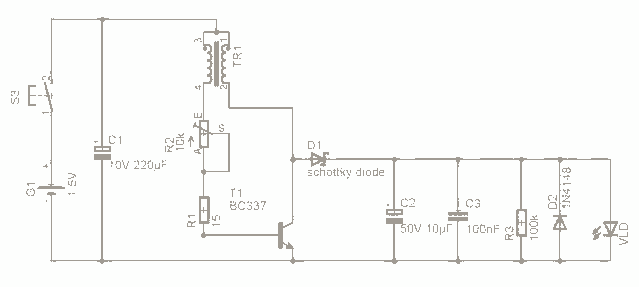
Description: For the past few days, research has been conducted on an intriguing boost circuit known as the Joule Thief. The original schematic can be found through online resources.
The Joule Thief is a simple yet effective boost converter circuit designed to extract energy from low-voltage power sources, such as depleted batteries. It operates on the principle of oscillation, utilizing a transistor to switch current through an inductor, which stores energy in its magnetic field. When the transistor turns off, this stored energy is released and stepped up to a higher voltage, allowing it to power devices that require more voltage than the source can provide.
The basic components of a Joule Thief circuit include a NPN transistor, a toroidal inductor or a ferrite core inductor, a resistor, and a diode. The transistor serves as the main switching element, while the inductor is crucial for energy storage and voltage boosting. The resistor is typically connected to the base of the transistor to limit the current and ensure proper operation. The diode is used to rectify the output voltage, allowing the energy to flow to the load.
When constructing a Joule Thief, the inductor is often wound with a specific number of turns, typically around 10 to 20 turns, depending on the desired output voltage and current. The choice of the transistor is also important; commonly used transistors include the 2N3904 or BC547. The circuit can operate efficiently with input voltages as low as 0.5V, making it ideal for scavenging energy from nearly depleted batteries.
The output voltage can vary depending on the load and the input voltage, but it can often exceed the input voltage by a factor of two or more, making it suitable for powering low-voltage LEDs or small electronic devices. The simplicity of the Joule Thief circuit, combined with its ability to utilize otherwise wasted energy, makes it a popular choice among hobbyists and engineers interested in low-power applications.For the past few days Ive been researching in this very interesting boost circuit called the joule thief (google it) and done allot of. The original schematic from google
The Joule Thief is a simple yet effective boost converter circuit designed to extract energy from low-voltage power sources, such as depleted batteries. It operates on the principle of oscillation, utilizing a transistor to switch current through an inductor, which stores energy in its magnetic field. When the transistor turns off, this stored energy is released and stepped up to a higher voltage, allowing it to power devices that require more voltage than the source can provide.
The basic components of a Joule Thief circuit include a NPN transistor, a toroidal inductor or a ferrite core inductor, a resistor, and a diode. The transistor serves as the main switching element, while the inductor is crucial for energy storage and voltage boosting. The resistor is typically connected to the base of the transistor to limit the current and ensure proper operation. The diode is used to rectify the output voltage, allowing the energy to flow to the load.
When constructing a Joule Thief, the inductor is often wound with a specific number of turns, typically around 10 to 20 turns, depending on the desired output voltage and current. The choice of the transistor is also important; commonly used transistors include the 2N3904 or BC547. The circuit can operate efficiently with input voltages as low as 0.5V, making it ideal for scavenging energy from nearly depleted batteries.
The output voltage can vary depending on the load and the input voltage, but it can often exceed the input voltage by a factor of two or more, making it suitable for powering low-voltage LEDs or small electronic devices. The simplicity of the Joule Thief circuit, combined with its ability to utilize otherwise wasted energy, makes it a popular choice among hobbyists and engineers interested in low-power applications.For the past few days Ive been researching in this very interesting boost circuit called the joule thief (google it) and done allot of. The original schematic from google
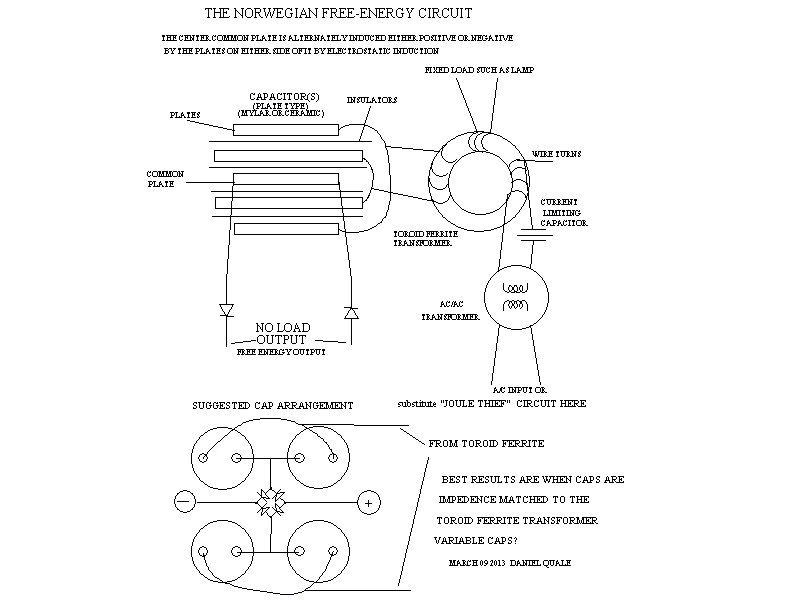
Joule Thief Circuit Explanations
Joule thief circuit along with videos, circuit diagrams, and explanations.
The Joule thief circuit is a minimalist boost converter designed to extract energy from low-voltage sources, such as depleted batteries. This circuit is particularly effective for powering small electronic devices,...
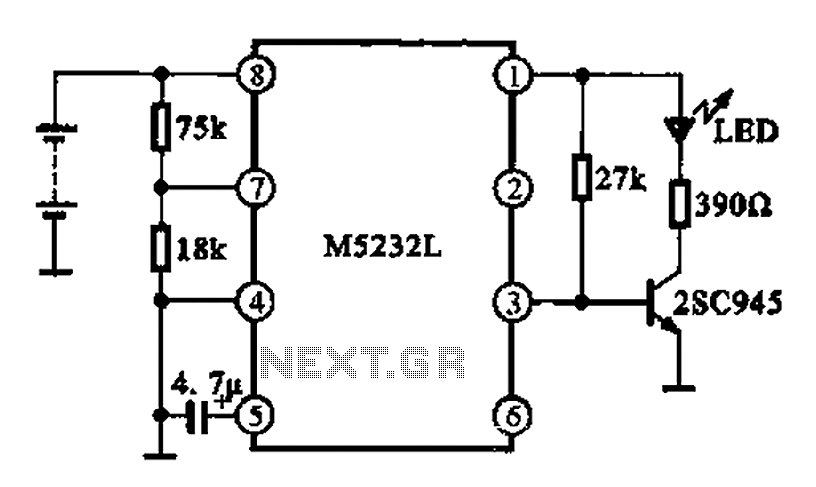
Battery voltage indication circuit
A battery voltage indication circuit that changes the status display. When the battery voltage is normal, an additional transistor drives an LED, which remains off. However, if the battery voltage falls below a critical threshold, the LED begins to flash,...
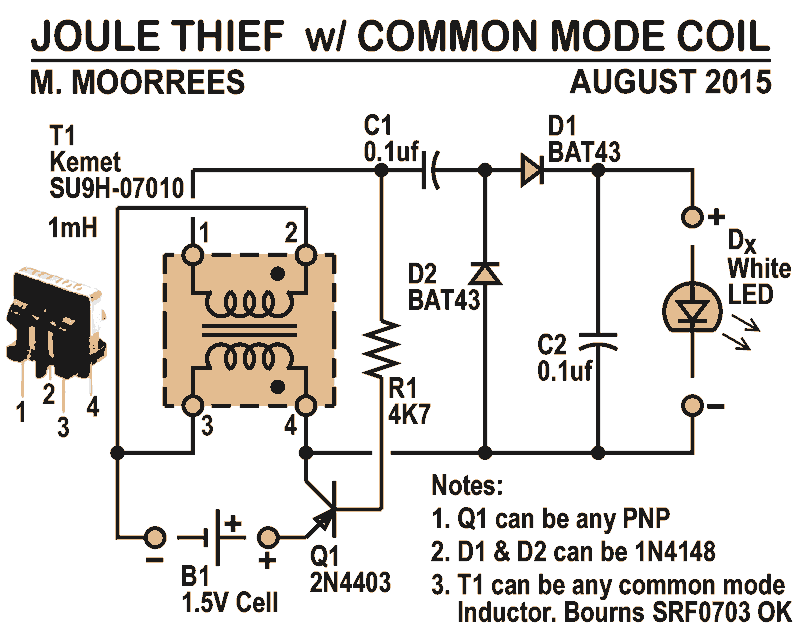
joule thief circuit boosts voltage from 1.5V battery
Like all joule thieves, this circuit boosts the voltage from a single 1.5V dry cell battery high enough to illuminate ultrabright GaN blue, green, or white LEDs. Instead of requiring a custom coil, it utilizes an off-the-shelf standard Kemet SU9H-07010...

Joule Thief Circuit board
Battery vampires are circuits designed to extract as much energy as possible from batteries or cells. They are not regulated drivers; rather, they are boost circuits that create a higher output voltage from a low input voltage and provide current...
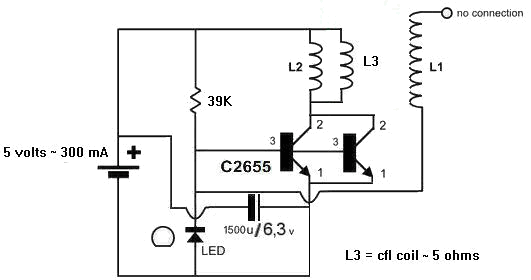
Joulethief SEC exciter circuit
A 1N4148 diode and a 1-megohm resistor are included in the circuit. The inquiry pertains to how to power LED(s) using a 1.5-volt battery. There is also a question regarding the role of an additional coil, L3, and its effect...
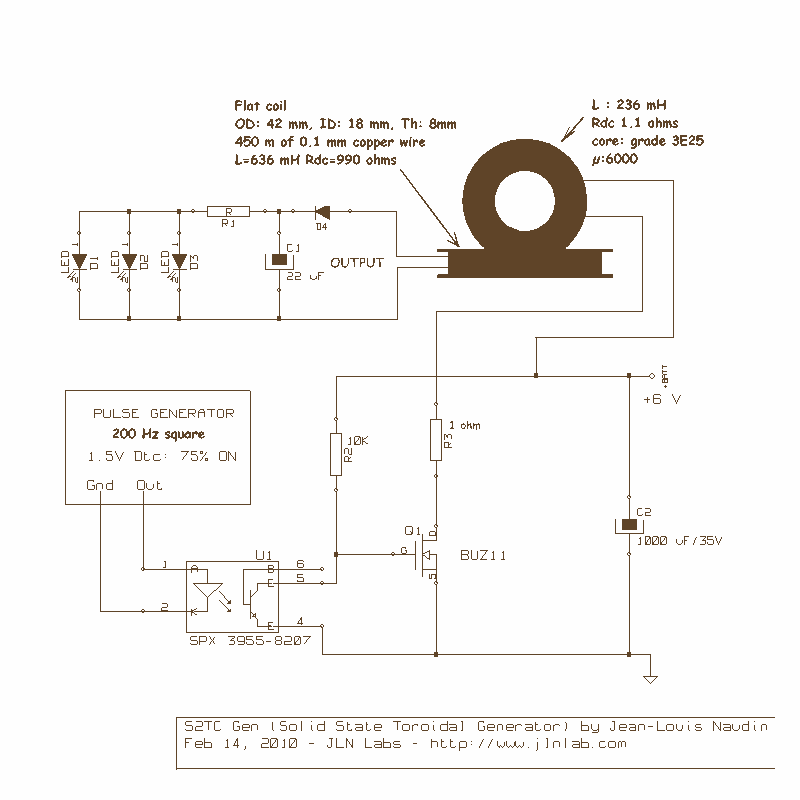
Joule Thief Circuit Experiment
R1, D3, and C1 are optional components. Only one LED is necessary. If the LED does not illuminate, try reversing its polarity. Initially, a single 555 circuit was used, but high current consumption was a concern. Additionally, the R5 resistor...

Coin cell battery to 3.3V with Joule Thief circuit
It is a self-oscillating voltage booster. It is relatively simple to build and it will allow you to use almost all the power in the battery, even when its voltage is low.
The self-oscillating voltage booster is a circuit designed to...
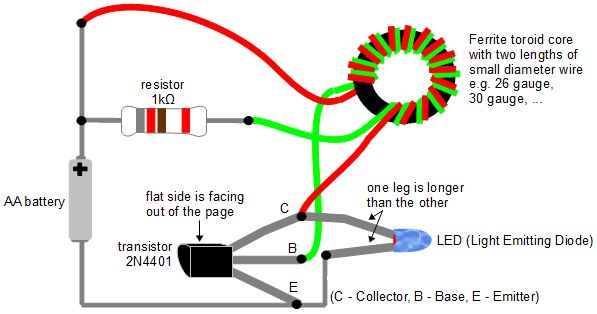
joule thief
The Joule Thief is an electronic circuit designed to utilize batteries that are typically deemed dead. A battery is often labeled "dead" when it can no longer power a specific device. However, the underlying issue is that the battery voltage...

Joule ThiefCircuits
This topic will be locked and will display all of the circuits and some photos of the devices being worked on in the Joule Thief topic. This process will take some time, so patience is appreciated. If any errors are...