


TC1043C Voltage-to-Frequency / Frequency-to-Voltage Converters
#voltage-to-frequency
#frequency-to-voltage
#CMOS
#analog signal
#pulse train
#converter
#TC1043C
#TC9402
#low-power
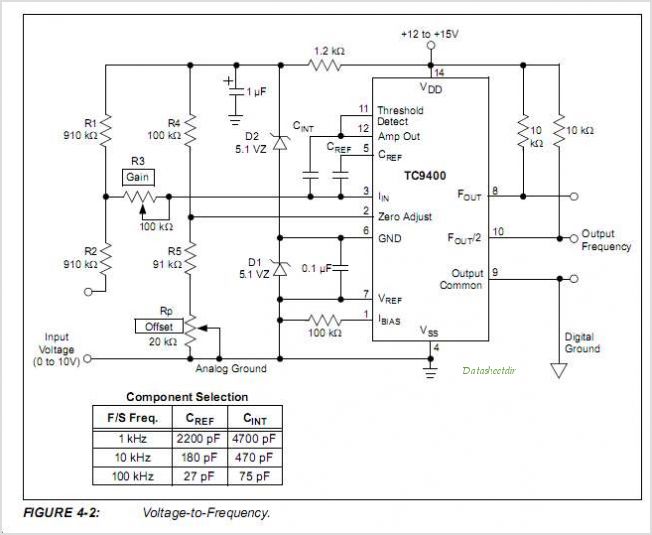
Description: The TC9400, TC9401, and TC9402 are low-cost voltage-to-frequency (V/F) converters that utilize low-power CMOS technology. These converters accept a variable analog input signal and generate an output pulse train, with a frequency that is linearly proportional to the input voltage. Additionally, these devices can function as highly accurate frequency-to-voltage (F/V) converters, capable of accepting virtually any input frequency waveform and providing a linearly proportional voltage output. To create a complete V/F or F/V system, only two capacitors, three resistors, and a reference voltage are required. This technology is provided by Microchip Technology Inc.
The TC9400 series of converters are designed to transform an analog voltage into a corresponding frequency output, which is particularly useful in applications where signal transmission over long distances is required without degradation. The output frequency can be easily measured using standard frequency counters or microcontroller input capture features, allowing for precise monitoring and control.
The primary operational principle of the TC9400 series is based on the conversion of an analog input voltage into a digital pulse frequency. This is achieved through the internal circuitry, which includes a voltage comparator and a timing circuit that generates a pulse train. The frequency of this pulse train is directly proportional to the input voltage applied to the converter, allowing for linear operation over a specified range.
For applications requiring frequency-to-voltage conversion, the TC9400 series can be configured to accept various frequency waveforms, including square, sine, and triangle waves. The output voltage produced is also linear, making it suitable for feedback control systems and analog signal processing.
To implement a complete voltage-to-frequency or frequency-to-voltage conversion system, the addition of two capacitors and three resistors is necessary. These passive components help to stabilize the operation of the converter and set the desired gain and frequency response characteristics. A reference voltage is also required to establish the baseline for the input signal.
Overall, the TC9400 series offers a versatile and cost-effective solution for converting analog signals to frequency or vice versa, making it an excellent choice for a wide range of electronic applications, including sensor interfacing, data acquisition, and signal conditioning.TC9402 The TC9400 TC9401 TC9402 are low-cost Voltage-to-Fre- quency (V/F) converters, utilizing low-power CMOS technology. The converters accept a variable Analog input signal and generate an output pulse train, whose frequency is linearly proportional to the input voltage.
The devices CAN also be used as highly accurate Frequency-to-Voltage (F/V) converters, accepting virtually any input frequency waveform and providing a linearly proportional voltage output. A complete V/F or F/V system only requires the addition of two capacitors, three resistors, and refer- ence voltage.
By Microchip Technology Inc.
The TC9400 series of converters are designed to transform an analog voltage into a corresponding frequency output, which is particularly useful in applications where signal transmission over long distances is required without degradation. The output frequency can be easily measured using standard frequency counters or microcontroller input capture features, allowing for precise monitoring and control.
The primary operational principle of the TC9400 series is based on the conversion of an analog input voltage into a digital pulse frequency. This is achieved through the internal circuitry, which includes a voltage comparator and a timing circuit that generates a pulse train. The frequency of this pulse train is directly proportional to the input voltage applied to the converter, allowing for linear operation over a specified range.
For applications requiring frequency-to-voltage conversion, the TC9400 series can be configured to accept various frequency waveforms, including square, sine, and triangle waves. The output voltage produced is also linear, making it suitable for feedback control systems and analog signal processing.
To implement a complete voltage-to-frequency or frequency-to-voltage conversion system, the addition of two capacitors and three resistors is necessary. These passive components help to stabilize the operation of the converter and set the desired gain and frequency response characteristics. A reference voltage is also required to establish the baseline for the input signal.
Overall, the TC9400 series offers a versatile and cost-effective solution for converting analog signals to frequency or vice versa, making it an excellent choice for a wide range of electronic applications, including sensor interfacing, data acquisition, and signal conditioning.TC9402 The TC9400 TC9401 TC9402 are low-cost Voltage-to-Fre- quency (V/F) converters, utilizing low-power CMOS technology. The converters accept a variable Analog input signal and generate an output pulse train, whose frequency is linearly proportional to the input voltage.
The devices CAN also be used as highly accurate Frequency-to-Voltage (F/V) converters, accepting virtually any input frequency waveform and providing a linearly proportional voltage output. A complete V/F or F/V system only requires the addition of two capacitors, three resistors, and refer- ence voltage.
By Microchip Technology Inc.
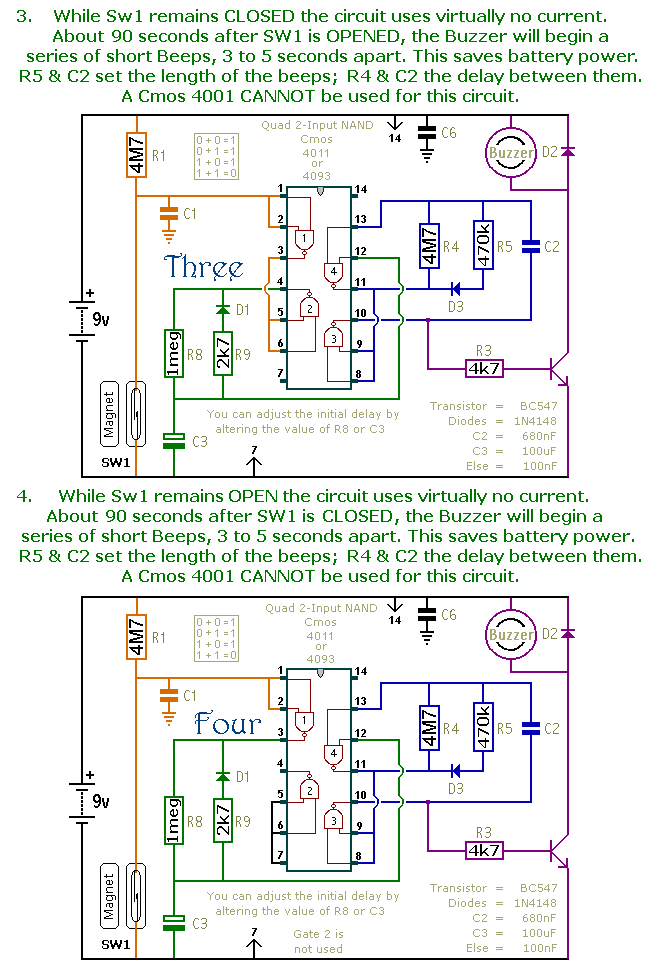
A Dozen Small Cmos Alarm Circuits circuit
This document presents a collection of compact, self-contained alarm circuits. These circuits are designed to operate with a very low standby current, making them ideal for battery-powered applications. They can be triggered by both normally-open and normally-closed switches, while some...
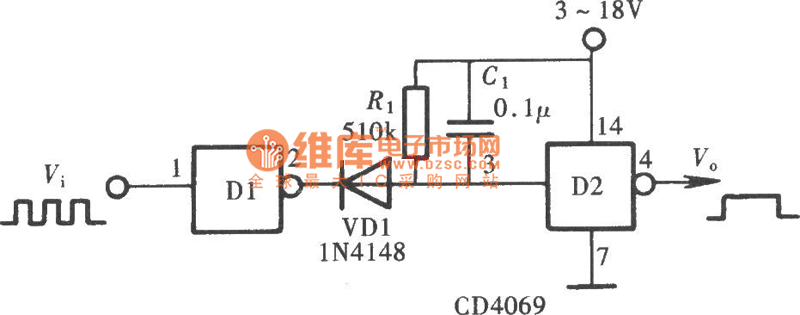
Pulse DemodulatorCircuit
The Pulse Demodulator, as illustrated in the accompanying image, consists of a CMOS Hex Inverter. This circuit is capable of performing envelope detection on amplitude pulses.
The Pulse Demodulator utilizing a CMOS Hex Inverter is designed to extract the envelope of...
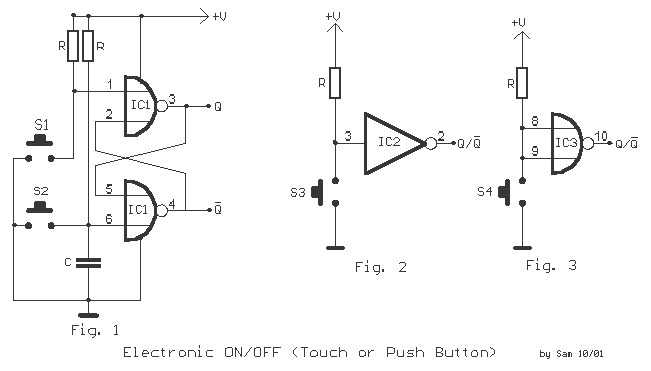
Electronic Switch ON-OFF
Here we have three choices, with which we can make electronic switches that use our touch or pressing (push button). We thus exploit the very big resistance of entry, that present the gates CMOS. In the fig.1 we have two...
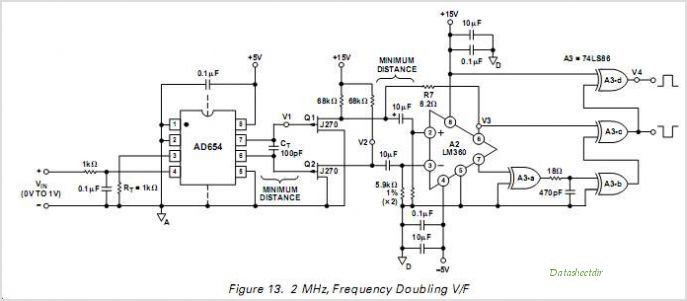
Low Cost Monolithic Voltage-to-Frequency Converter
The AD7740 is the smallest and most affordable 12-bit Voltage-to-Frequency Converter (VFC) available. As a synchronous converter, its output frequency is tied to a fixed master clock frequency, which enhances temperature stability compared to asynchronous VFCs. With a 1 MHz...

A CMOS the spot welding time adjustment circuit b
A CMOS-based circuit designed for adjusting the time of spot welding. This circuit utilizes a CMOS device that allows for cycle selection ranging from 1 to 99 cycles. In practical applications, most users find that adjustments within 10 cycles are...
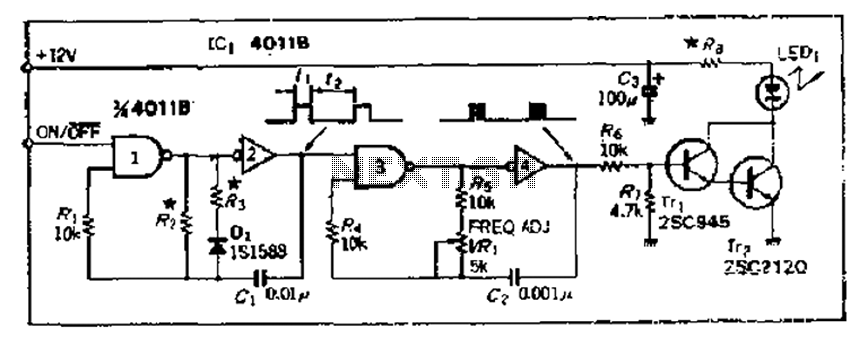
Using C-MOS light emitting diode drive circuit NAND gate pulse
The 4000 Series 4011B is a NAND gate used in conjunction with a 4AI NAND gate circuit group to create two loops of an unstable multivibrator. The first NAND gate and the second NAND gate operate at approximately 1 kHz,...
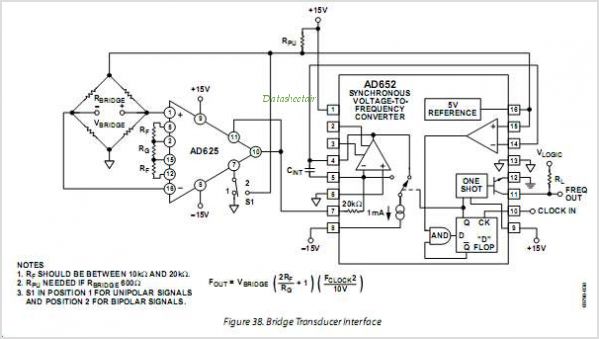
Monolithic Synchronous Voltage-to-Frequency Converter
The AD654 is a monolithic voltage-to-frequency (V/F) converter that comprises an input amplifier, a precision oscillator system, and a high-current output stage. A single resistor-capacitor (RC) network is all that is needed to configure any full-scale (FS) frequency up to...
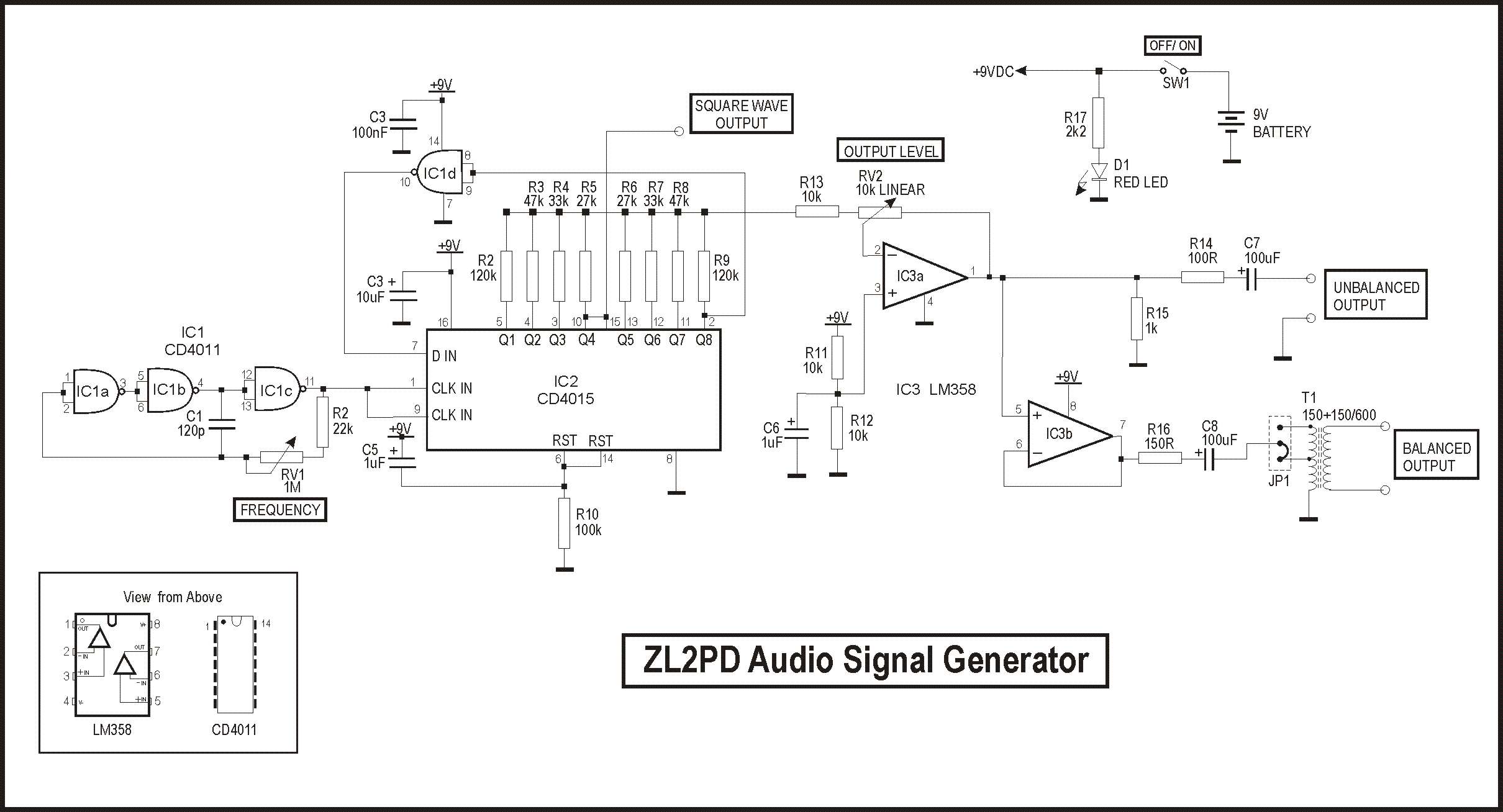
Audio Signal Generator
A couple of inexpensive CMOS integrated circuits are utilized to digitally generate audio sine waves across a broad frequency range in this compact battery-operated test instrument. The oscillator features both unbalanced and balanced outputs. Signal generators are frequently used in...
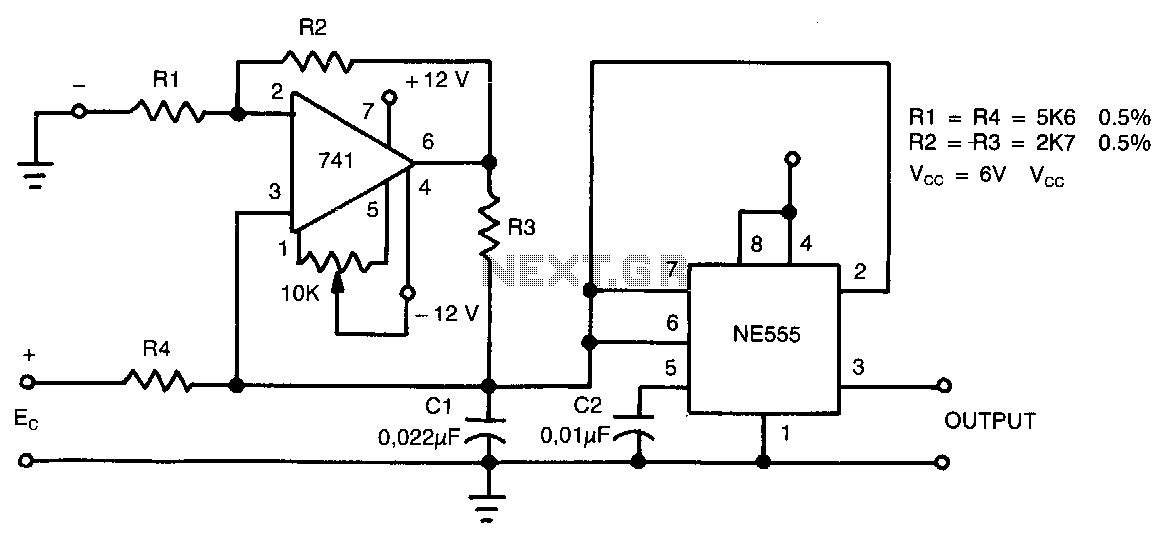
Voltage-to-frequency-converter
This circuit can accept positive, negative, or differential control voltages. The output frequency is zero when the control voltage is zero. The 741 operational amplifier forms a current source controlled by the voltage Ec to charge the timing capacitor C1...