


5 WAY AC FLASHER CIRCUIT DIAGRAM
#AC flasher
#light control
#festival lights
#wedding decorations
#christmas lights
#Wesak festival
#flashing circuit
#ceremonial lighting
#5-way flasher
#holiday lighting
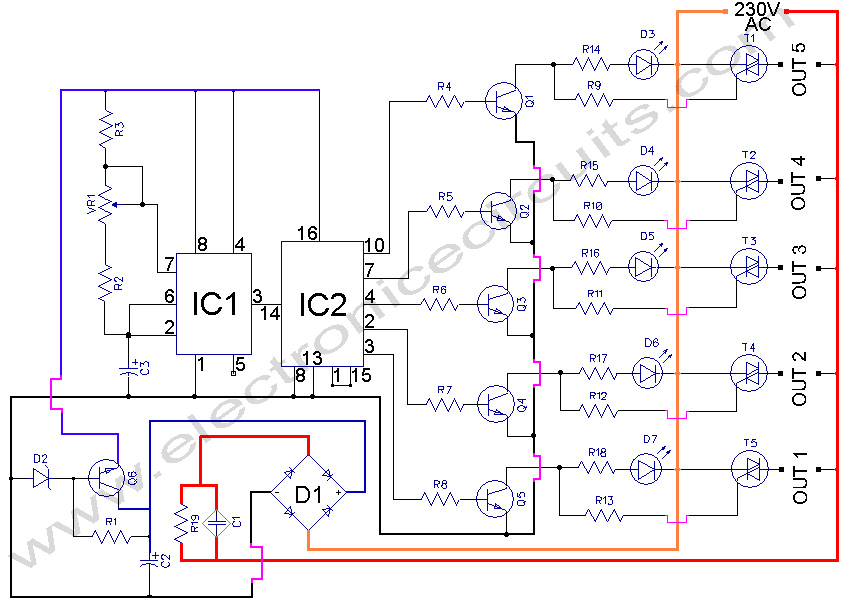
Description: 5 WAY AC FLASHER. These types of circuits are commonly used in various ceremonies such as the Wesak festival, Christmas, and weddings. This 5 WAY AC FLASHER circuit.
The 5 Way AC Flasher circuit is designed to produce a sequential lighting effect by controlling multiple light sources through alternating current (AC). This circuit typically employs a combination of relays or solid-state devices, such as transistors or triacs, to achieve the desired flashing pattern.
The circuit operates by utilizing a timer or a microcontroller to generate a control signal that activates the relays in a specific sequence. Each relay corresponds to a light source, and by turning them on and off in succession, the circuit creates an engaging visual display. The timing of the flashes can be adjusted to suit the occasion, allowing for flexibility in design.
For implementation, the circuit may include components such as resistors, capacitors, and diodes to manage the flow of current and protect sensitive components. The use of an AC power source is essential, as it allows for the operation of standard incandescent or LED bulbs, which are commonly used in decorative lighting.
In summary, the 5 Way AC Flasher circuit is ideal for festive occasions, providing a dynamic lighting experience that enhances the atmosphere of celebrations. Proper design and component selection are crucial for ensuring reliability and safety in its operation.5 WAY AC FLASHER We use these types of circuits in most ceremonies (wesak festival, christmas, wedding, ). This 5 WAY AC FLASHER circuit..
The 5 Way AC Flasher circuit is designed to produce a sequential lighting effect by controlling multiple light sources through alternating current (AC). This circuit typically employs a combination of relays or solid-state devices, such as transistors or triacs, to achieve the desired flashing pattern.
The circuit operates by utilizing a timer or a microcontroller to generate a control signal that activates the relays in a specific sequence. Each relay corresponds to a light source, and by turning them on and off in succession, the circuit creates an engaging visual display. The timing of the flashes can be adjusted to suit the occasion, allowing for flexibility in design.
For implementation, the circuit may include components such as resistors, capacitors, and diodes to manage the flow of current and protect sensitive components. The use of an AC power source is essential, as it allows for the operation of standard incandescent or LED bulbs, which are commonly used in decorative lighting.
In summary, the 5 Way AC Flasher circuit is ideal for festive occasions, providing a dynamic lighting experience that enhances the atmosphere of celebrations. Proper design and component selection are crucial for ensuring reliability and safety in its operation.5 WAY AC FLASHER We use these types of circuits in most ceremonies (wesak festival, christmas, wedding, ). This 5 WAY AC FLASHER circuit..
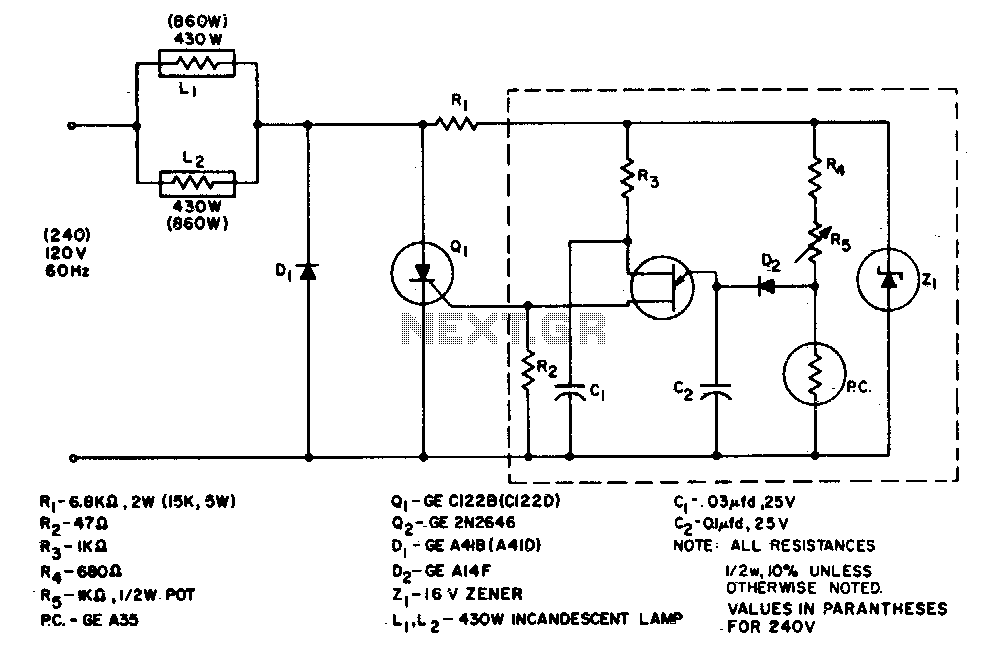
860 Watt limited-range light control
The system is designed to regulate an 860-watt lamp load from half to full power. This is achieved through the controlled half-plus-fixed half-wave phase control method. Applying half power to an incandescent lamp results in 30% of the full light...
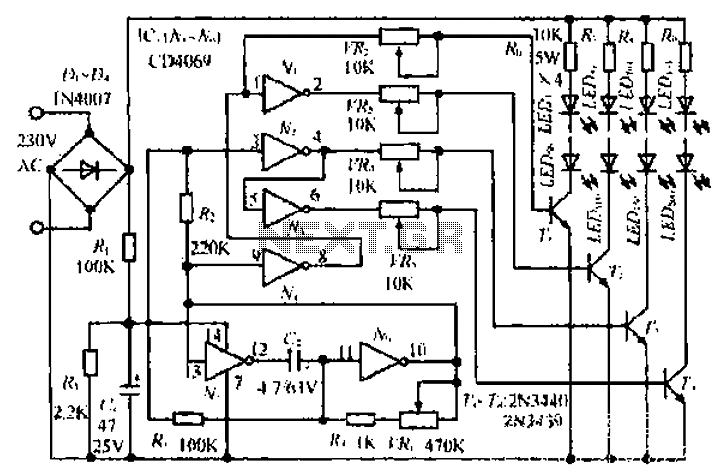
A Christmas lights circuit
An air bridge after the bullock Phi Beach in Sichuan utilizes direct beam lights. Control is implemented for six buildings with filtered output at specific voltage levels. The system includes a small 4H servant for pressure control, and components such...
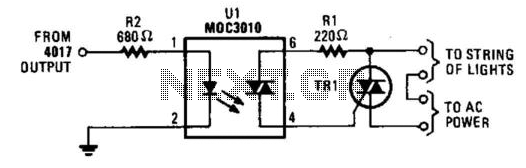
Christmas Light Driver
This circuit enables a CMOS logic chip, such as a 4017 decode driver, to control a string of Christmas lights or other lighting. The triac should be rated at 200 V and 3 A or higher. The 4017 should be...
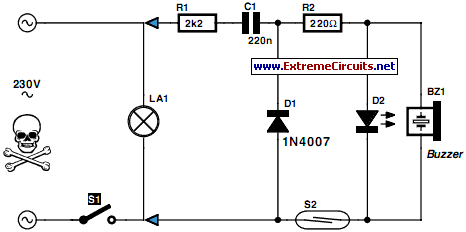
Put That Light Out
If the light in a seldom-used room, such as a loft, is forgotten and left on, it can remain illuminated for extended periods, leading to significant electricity costs. To address this issue, electronics enthusiasts can design a simple circuit to...
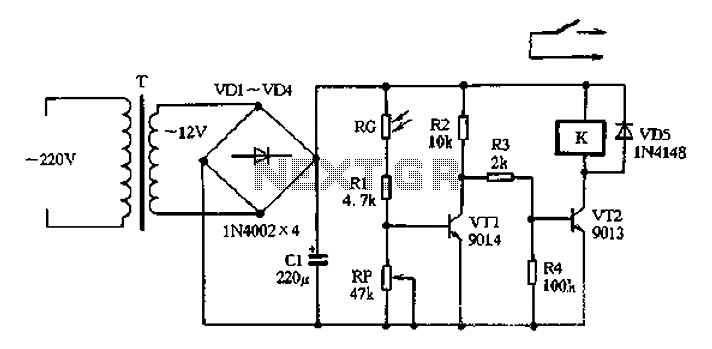
Light control relay control lamp
The circuit operates on 220V AC input, which is transformed to approximately 12V DC using a step-down transformer (T), a diode bridge rectifier (VDI-VD4), and a filter capacitor (C1). This setup is designed to power the entire circuit. The light...
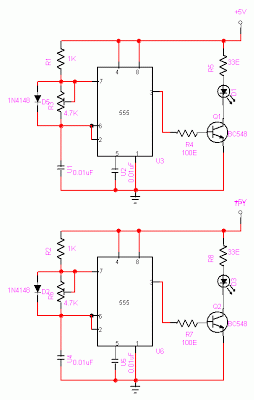
automatic room light controller with
The objective of this project is to create a controller-based model that counts the number of individuals entering a specific room and activates the lighting accordingly. A sensor will be utilized to determine the current number of persons present. In...
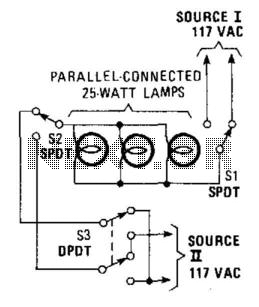
3-Way Light Control
This hookup is useful in certain house wiring situations where only two wires are available between switches, rather than the usual three-way setup that requires three wires. SI and S2 are standard three-way switches, while S3, a double-pole double-throw (DPDT)...
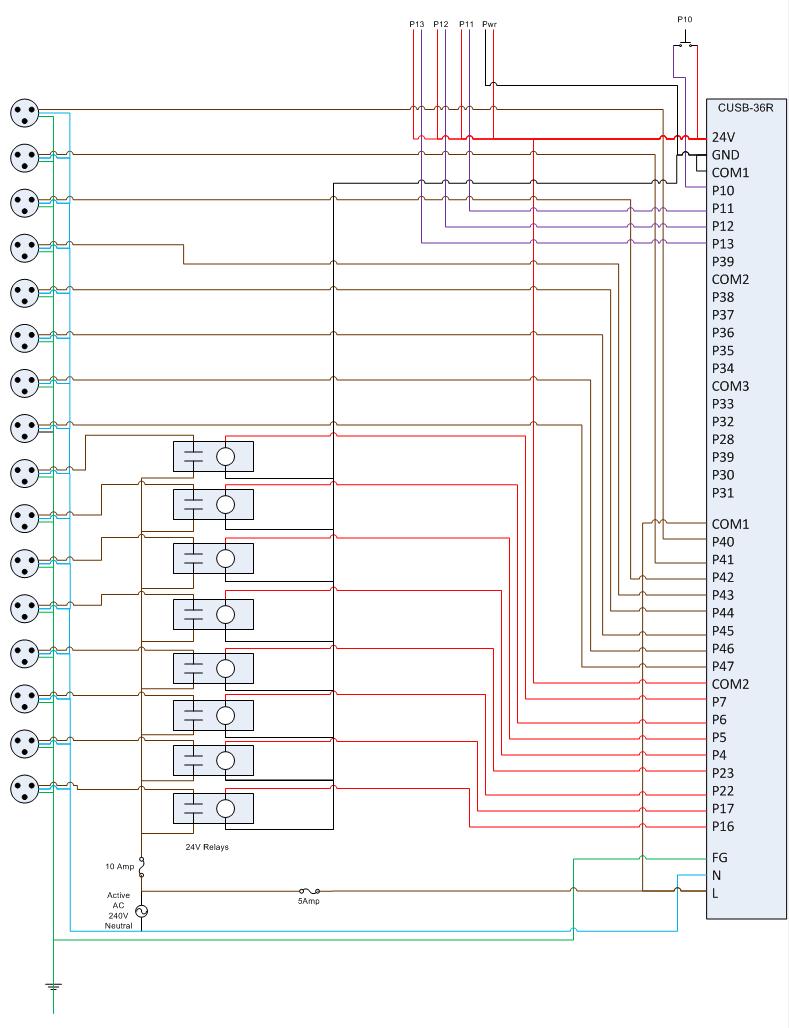
The CUSB-36R Christmas Light Circuit
This is the circuit diagram for the Comfile CUSB-36R Programmed Christmas Lights. If it is difficult to read, please contact me via email at [email protected], and I will provide a more detailed schematic. The Comfile CUSB-36R can either drive mains-powered...
Light control relay control lamp
The circuit operates on 220V AC input, which is transformed to approximately 12V DC using a step-down transformer (T), a diode bridge rectifier (VDI-VD4), and a filter capacitor (C1). This setup is designed to power the entire circuit. The light...