


Circuit Diagram for Mini Emergency Lamp
#emergency lamp
#white LED
#power failure
#backup light
#1 watt LED
#room lighting
#energy efficient
#portable light
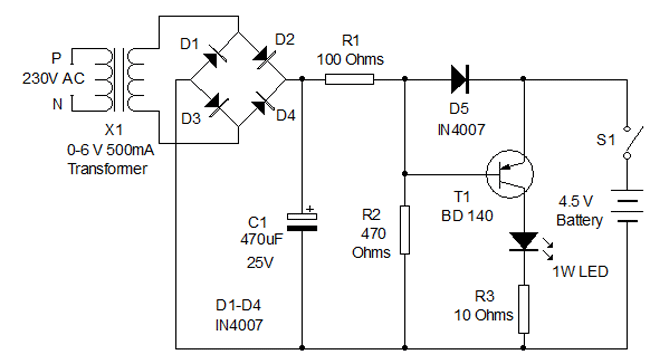
Description: Circuit diagram for a mini emergency lamp. This mini emergency lamp activates during power failures to provide cool white light in the room. It utilizes a 1-watt white LED to deliver adequate illumination.
The circuit for the mini emergency lamp is designed to be simple yet effective for providing illumination during power outages. The primary components include a 1-watt white LED, a rechargeable battery, a charging circuit, a power switch, and a control circuit that detects power failure.
When the main power supply is operational, the charging circuit ensures that the rechargeable battery is kept at full charge. This can be achieved using a small solar panel or a conventional AC-DC adapter, depending on the intended use and design preferences. The charging circuit typically consists of a diode to prevent backflow of current, a voltage regulator to maintain the battery voltage within safe limits, and a current limiting resistor to protect the LED from excessive current.
Upon detection of a power failure, the control circuit activates, switching the LED on to provide light. This can be accomplished through a relay or a MOSFET that connects the LED to the battery. The LED is chosen for its efficiency and long life, making it suitable for emergency lighting applications. The output of the LED should be connected through a current-limiting resistor to ensure that it operates within its rated specifications.
To enhance usability, the lamp may also include features such as an indicator LED to show when the unit is charging or fully charged, as well as a switch to allow the user to turn the lamp on or off manually. Additional components may include a fuse for overcurrent protection, ensuring the safety and reliability of the device during operation.
Overall, the mini emergency lamp circuit is a practical solution for providing essential lighting in times of need, with a focus on simplicity, efficiency, and reliability.Circuit Diagram for Mini Emergency Lamp. This Mini Emergency Lamp turns on when power fails to give cool white light in the room. It uses 1 watt White LED to provide sufficient light in the room
The circuit for the mini emergency lamp is designed to be simple yet effective for providing illumination during power outages. The primary components include a 1-watt white LED, a rechargeable battery, a charging circuit, a power switch, and a control circuit that detects power failure.
When the main power supply is operational, the charging circuit ensures that the rechargeable battery is kept at full charge. This can be achieved using a small solar panel or a conventional AC-DC adapter, depending on the intended use and design preferences. The charging circuit typically consists of a diode to prevent backflow of current, a voltage regulator to maintain the battery voltage within safe limits, and a current limiting resistor to protect the LED from excessive current.
Upon detection of a power failure, the control circuit activates, switching the LED on to provide light. This can be accomplished through a relay or a MOSFET that connects the LED to the battery. The LED is chosen for its efficiency and long life, making it suitable for emergency lighting applications. The output of the LED should be connected through a current-limiting resistor to ensure that it operates within its rated specifications.
To enhance usability, the lamp may also include features such as an indicator LED to show when the unit is charging or fully charged, as well as a switch to allow the user to turn the lamp on or off manually. Additional components may include a fuse for overcurrent protection, ensuring the safety and reliability of the device during operation.
Overall, the mini emergency lamp circuit is a practical solution for providing essential lighting in times of need, with a focus on simplicity, efficiency, and reliability.Circuit Diagram for Mini Emergency Lamp. This Mini Emergency Lamp turns on when power fails to give cool white light in the room. It uses 1 watt White LED to provide sufficient light in the room
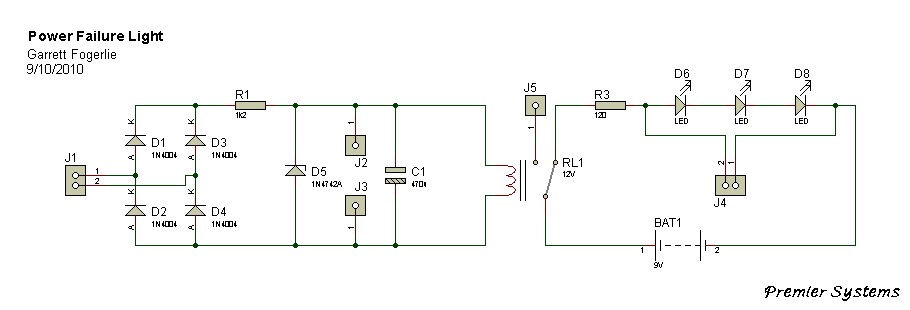
Power Failure Light
This is a very basic power failure lighting circuit based around a relay. This simple circuit has many uses, from lighting up rooms and walkways in the case of a power failure, to monitoring and security uses. There are many...
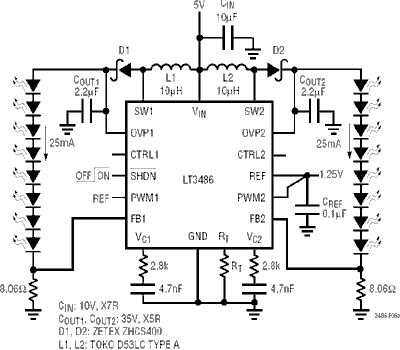
White led driver
After collecting several white LEDs from damaged mobile phones, a project was initiated to construct an LED searchlight. There are two approaches to achieve this: the first is a basic method, which involves connecting white LEDs directly to a battery...
White LED Drive Circuit
A minimum number of parts yields a compact switching converter that can provide sufficient voltage to drive white LEDs. The resulting lamp is much more efficient, in terms of lumen hours per pound of battery, than incandescent bulbs, and because...
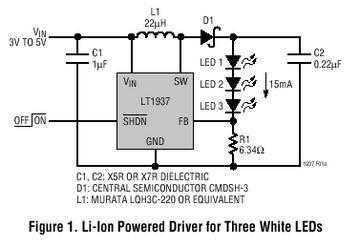
White LED Step-Up Converter in SC70 and ThinSOT
The LT1937 is a step-up DC/DC converter specifically designed to drive white LEDs with a constant current. The device can drive two, three or four LEDs in series from a Li-Ion cell. Series connection of the LEDs provides identical LED...
White LED Step-Up Converter in SC70 and ThinSOT
The LT1937 is a step-up DC/DC converter specifically designed to drive white LEDs with a constant current. The device can drive two, three or four LEDs in series from a Li-Ion cell. Series connection of the LEDs provides identical LED...
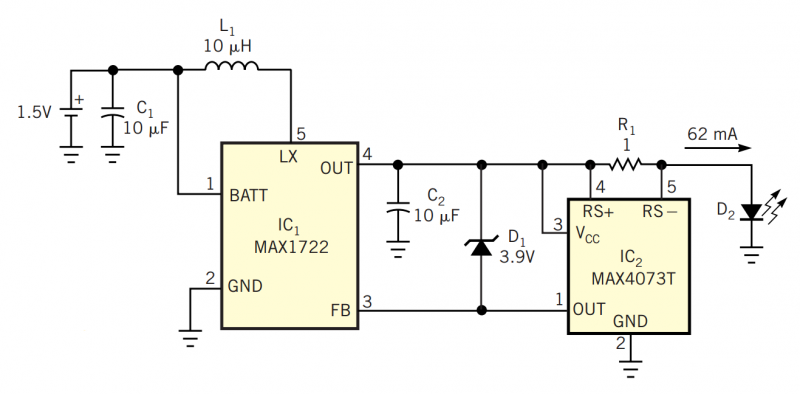
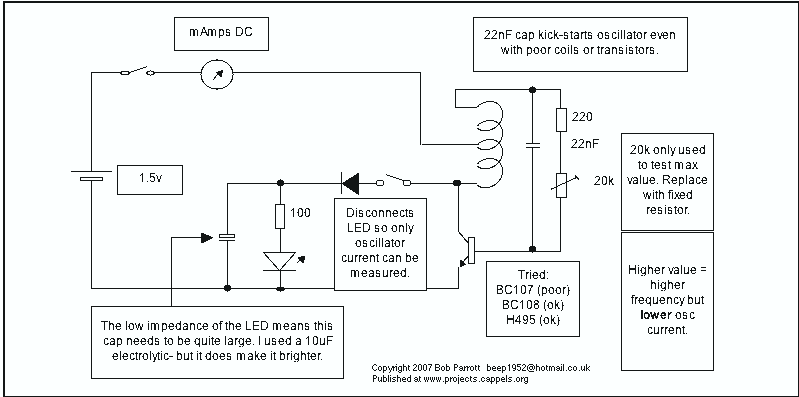
1.5V battery powers white-LED driver
Although white LEDs are common in a variety of lighting applications, their 3 to 4V forward-voltage drop makes low-voltage applications challenging. Charge pumps and other ICs are available for driving white LEDs, but they generally don't work with the low...

Power Resumption Alarm circuit
This is a simple power resumption alarm circuit that can be installed within the switch box. It emits beeping sounds when power is restored following a power failure.
The power resumption alarm circuit is designed to provide an audible alert upon...
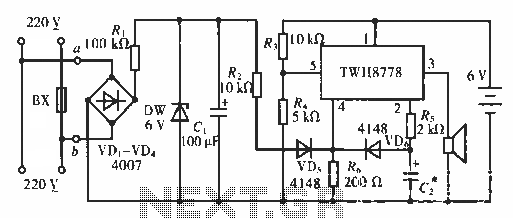
Multi power failure alarm circuit
The circuit functions as an AC blown fuse alarm. When the fuse (BX) is intact, 220 V AC voltage passes through a bridge rectifier composed of diodes VD1 to VD4. Resistor R1 limits the current, and the output is converted...
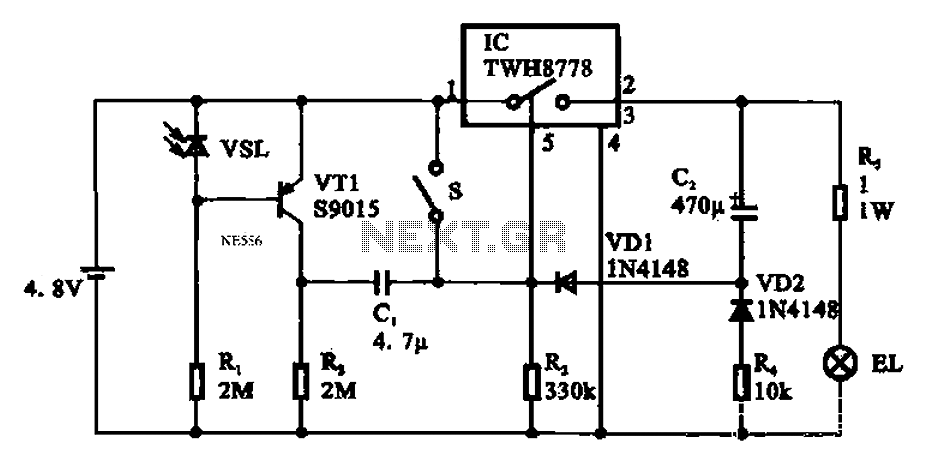
Automatic emergency lamp circuit
Automatic emergency lamp circuit featuring an electronic switch integrated circuit. This circuit is designed for automatic emergency lighting. The system operates based on ambient light conditions; when light levels are low at night, the circuit activates the emergency lamp. The...