


Eight multi-function lights synchronized chain of circuit SH803
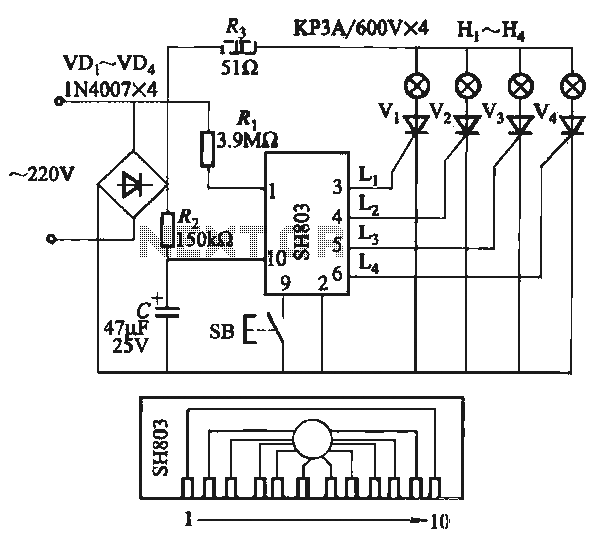
Description: The circuit utilizes the SH803 flash IC, which can store eight different programs and offers various dimming options and light speed adjustments. A button is provided to trigger the control terminal SB on the 9-pin connector for program selection, ensuring ease of operation. The SH803 operates within a voltage range of 3 to 5V, with a typical value of 4.5V. It features eight distinct programs that can adjust the speed of light dimming, enabling effects such as cycling beats, rolling waves, chasing, blinking, slow fades, quick flashes, and a full brightness mode.
The SH803 flash IC is a versatile component designed for lighting applications, capable of generating a wide array of visual effects suitable for decorative or signaling purposes. The device's ability to store multiple programs allows for dynamic lighting sequences, enhancing the aesthetic appeal of installations.
The control mechanism involves a simple push-button interface connected to the 9-pin control terminal (SB), facilitating user interaction. Each press of the button cycles through the available programs, allowing users to select their desired lighting effect effortlessly. This feature is particularly beneficial in applications where user preference for lighting patterns may vary.
Operating within a voltage range of 3 to 5 volts, the SH803 is compatible with a variety of power sources, making it suitable for both battery-operated and mains-powered applications. The typical operating voltage of 4.5V ensures optimal performance while maintaining energy efficiency.
The eight programs include various lighting effects that can be categorized into dynamic and static patterns. Dynamic patterns may involve effects such as cycling beats, which create a rhythmic light display, and rolling waves that simulate the movement of light across a surface. Static patterns, on the other hand, may include modes like full brightness or slow fade, which provide a more stable lighting condition.
In summary, the SH803 flash IC circuit is a highly functional and user-friendly solution for creating diverse lighting effects, making it ideal for decorative lighting, stage performances, or any application where visual impact is essential. The combination of program selection, ease of operation, and a wide voltage range significantly enhances its versatility and usability in various electronic projects.It uses pattern SH803 flash IC, within reservoir eight kinds of programs and a variety of dimming, change the speed of light, a button to trigger a control terminal SB 9-pin to select a program, easy to operate. SH803 working voltage of 3 ~ 5V, the typical value 4.SV. There are eight ways and a variety of programs the speed of light becomes dimmer degree, can form a cycle beating, rolling waves, chasing, blinking, slowly fades, flashes quickly, all bright and so many flash effect.
The SH803 flash IC is a versatile component designed for lighting applications, capable of generating a wide array of visual effects suitable for decorative or signaling purposes. The device's ability to store multiple programs allows for dynamic lighting sequences, enhancing the aesthetic appeal of installations.
The control mechanism involves a simple push-button interface connected to the 9-pin control terminal (SB), facilitating user interaction. Each press of the button cycles through the available programs, allowing users to select their desired lighting effect effortlessly. This feature is particularly beneficial in applications where user preference for lighting patterns may vary.
Operating within a voltage range of 3 to 5 volts, the SH803 is compatible with a variety of power sources, making it suitable for both battery-operated and mains-powered applications. The typical operating voltage of 4.5V ensures optimal performance while maintaining energy efficiency.
The eight programs include various lighting effects that can be categorized into dynamic and static patterns. Dynamic patterns may involve effects such as cycling beats, which create a rhythmic light display, and rolling waves that simulate the movement of light across a surface. Static patterns, on the other hand, may include modes like full brightness or slow fade, which provide a more stable lighting condition.
In summary, the SH803 flash IC circuit is a highly functional and user-friendly solution for creating diverse lighting effects, making it ideal for decorative lighting, stage performances, or any application where visual impact is essential. The combination of program selection, ease of operation, and a wide voltage range significantly enhances its versatility and usability in various electronic projects.It uses pattern SH803 flash IC, within reservoir eight kinds of programs and a variety of dimming, change the speed of light, a button to trigger a control terminal SB 9-pin to select a program, easy to operate. SH803 working voltage of 3 ~ 5V, the typical value 4.SV. There are eight ways and a variety of programs the speed of light becomes dimmer degree, can form a cycle beating, rolling waves, chasing, blinking, slowly fades, flashes quickly, all bright and so many flash effect.
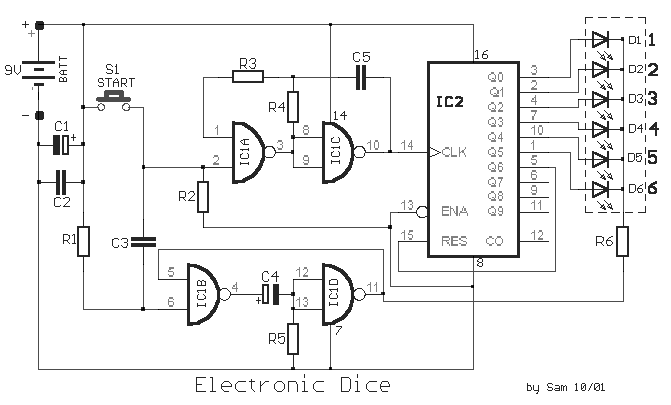
Electronic Dice circuit
The circuit functions as a random number generator, producing numbers from 1 to 6. It features a line of LEDs, each corresponding to a number in the range of 1 to 6. When the push button S1 is pressed and...
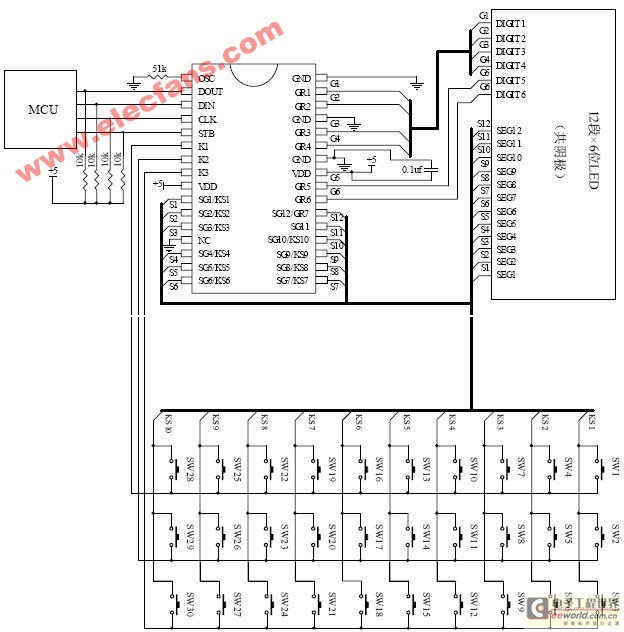
LED control drive circuit diagram
The ET6201 is a LED display control drive circuit with a duty cycle of 1/7 to 1/8. It features 11 segment output gates and 1 segment/gate output, along with a display memory, control circuit, and key scanning circuit, which collectively...
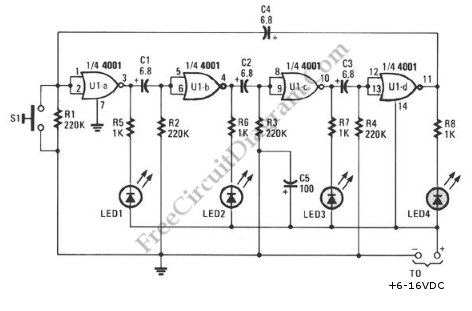
Ring-Around LED Flasher
This schematic diagram illustrates a ring-around LED flasher circuit. The circuit operates by turning off two LEDs while activating the other two, continuing this pattern until the timing cycle reverses.
The ring-around LED flasher circuit is designed to create a visually...
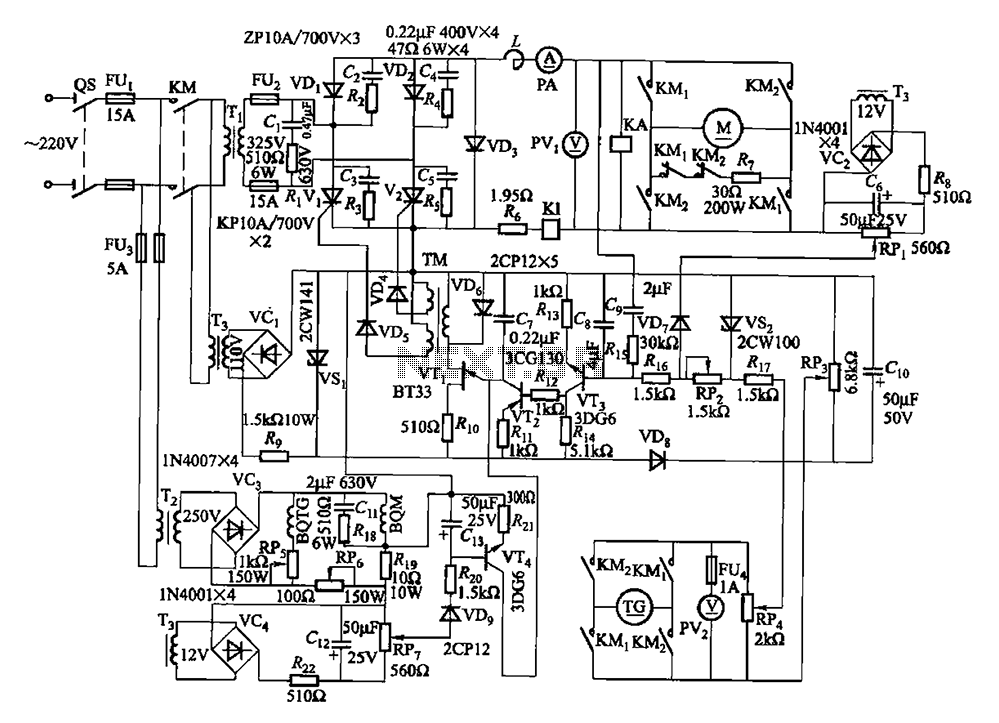
Quadruple semi-continuous casting machine speed control circuit
The circuit encompasses a main circuit, a trigger circuit, speed negative feedback, negative feedback differential voltage, a current cut-off circuit, loss of field protection, and other components. Given that the motor power is small (1.1 kW), a single-phase circuit is...
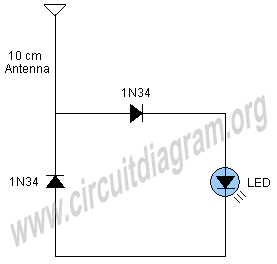
cell phone signal activated led
A simple and interesting project schematic for a cell phone signal-activated LED circuit. The circuit will illuminate an LED when a call is made from a cell phone.
This cell phone signal-activated LED circuit utilizes a basic principle of detecting the...
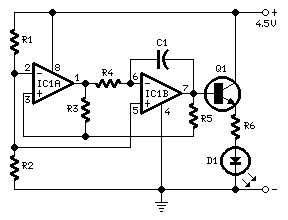
LED or Lamp Pulser
This circuit operates a LED in pulsing mode, i.e. the LED goes from off state, lights up gradually, then dims gradually, etc. This operation mode is obtained by a triangular wave generator formed by two op-amps contained in a very...
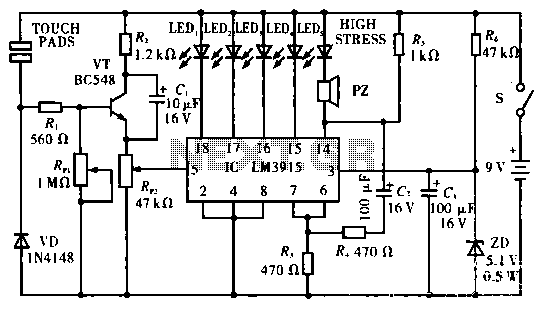
Stress self-test circuit
The circuit operates by utilizing two self-test table contact pads that detect electric pressure changes across the skin. The input voltage is 5 volts, which can drive up to 10 LEDs (the current configuration includes only 5 LEDs). When the...
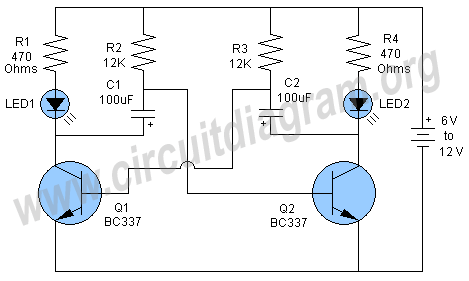
flip flop led flashing circuit
A schematic of a flip-flop LED flashing circuit is presented. This circuit functions as an astable multivibrator that activates LEDs sequentially upon power application. It is compatible with voltage inputs ranging from 6 to 12 volts, and can also operate...
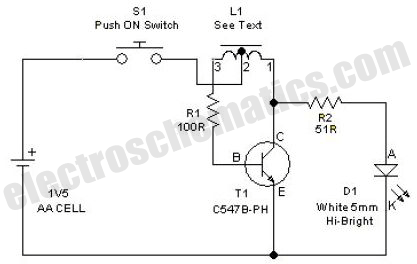
LED Driver Circuit with 555 Timer
This simple LED driver circuit allows the operation of up to seven LEDs using a single NiMH (Nickel Metal Hydride) AA cell. The circuit generates voltage pulses.
The LED driver circuit is designed to efficiently power multiple LEDs while maintaining optimal...