


IR illuminator for night-vision tv cameras and scopes
#IR illuminator
#LED
#astable oscillator
#night-vision
#duty-cycle
#TV cameras
#scopes
#infrared
#illumination control
#lighting
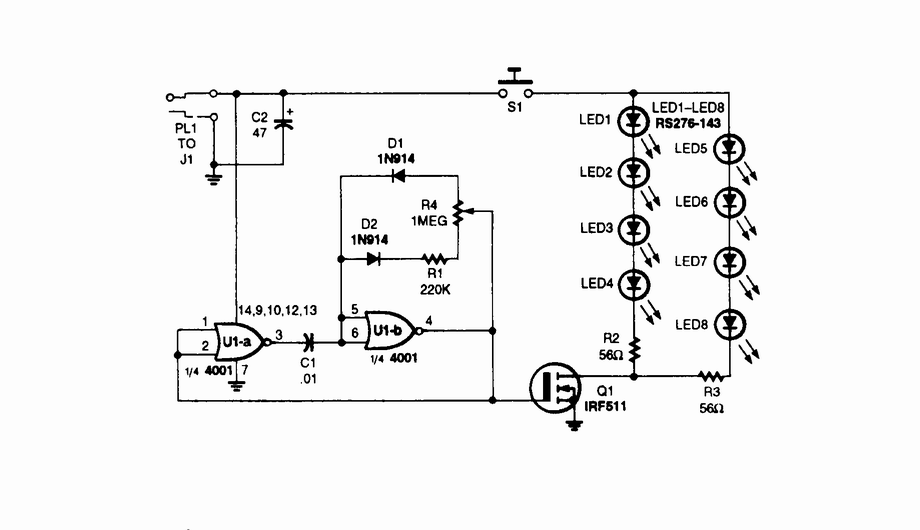
Description: An infrared (IR) illuminator designed for night-vision television cameras and scopes. This device employs light-emitting diodes (LEDs) and an astable oscillator to manage the switch, duty cycle, and overall effective IR illumination output.
The IR illuminator functions by emitting infrared light, which is invisible to the naked eye but can be detected by night-vision devices. The core component of this system is the array of LEDs, which are selected for their efficiency in producing IR light at specific wavelengths that align with the sensitivity range of night-vision equipment.
The astable oscillator is crucial in this circuit as it generates a continuous square wave signal. This signal is used to drive the LEDs, effectively controlling their on and off states. The duty cycle of the oscillator determines the ratio of the time the LEDs are on versus the time they are off within each cycle. By adjusting the duty cycle, the intensity of the IR illumination can be modulated, allowing for optimal performance depending on the ambient light conditions and the specific requirements of the application.
The circuit typically includes a power supply unit that provides the necessary voltage and current to the LEDs and the oscillator. Additional components may include resistors to limit current, capacitors for smoothing the power supply, and possibly a photodiode or phototransistor to provide feedback for automatic brightness adjustment.
In applications where precise control over IR illumination is necessary, the integration of a microcontroller may be considered. This would allow for programmable settings, enabling features such as varying the intensity based on environmental conditions or user preferences.
Overall, the design of the IR illuminator is focused on maximizing the effectiveness of night-vision systems by providing a reliable and adjustable source of infrared light, ensuring enhanced visibility in low-light conditions.IR illuminator for night-vision tv cameras and scopes. This source uses LEDs and an astable oscillator to control the switch, duty-cycle, and effective IR illumination output
The IR illuminator functions by emitting infrared light, which is invisible to the naked eye but can be detected by night-vision devices. The core component of this system is the array of LEDs, which are selected for their efficiency in producing IR light at specific wavelengths that align with the sensitivity range of night-vision equipment.
The astable oscillator is crucial in this circuit as it generates a continuous square wave signal. This signal is used to drive the LEDs, effectively controlling their on and off states. The duty cycle of the oscillator determines the ratio of the time the LEDs are on versus the time they are off within each cycle. By adjusting the duty cycle, the intensity of the IR illumination can be modulated, allowing for optimal performance depending on the ambient light conditions and the specific requirements of the application.
The circuit typically includes a power supply unit that provides the necessary voltage and current to the LEDs and the oscillator. Additional components may include resistors to limit current, capacitors for smoothing the power supply, and possibly a photodiode or phototransistor to provide feedback for automatic brightness adjustment.
In applications where precise control over IR illumination is necessary, the integration of a microcontroller may be considered. This would allow for programmable settings, enabling features such as varying the intensity based on environmental conditions or user preferences.
Overall, the design of the IR illuminator is focused on maximizing the effectiveness of night-vision systems by providing a reliable and adjustable source of infrared light, ensuring enhanced visibility in low-light conditions.IR illuminator for night-vision tv cameras and scopes. This source uses LEDs and an astable oscillator to control the switch, duty-cycle, and effective IR illumination output
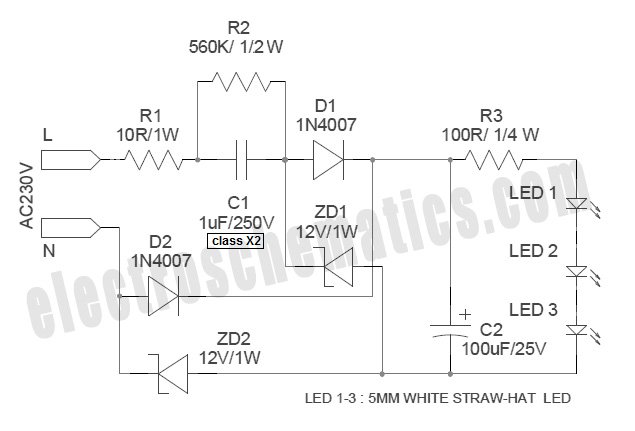
White LED Night Light Circuit
White Light Emitting Diodes (LEDs) now available can serve as a strong alternative to incandescent lamps in lighting applications. Today's White LEDs are...
White Light Emitting Diodes (LEDs) represent a significant advancement in lighting technology, offering energy efficiency, longevity, and reduced...

LED Speedometer circuit
The circuit schematics operate at 12 Volts, sourced from a car battery. The ground connection is tied to the car chassis, while the signal is received from a sensor connected to a stepper motor. The No. 5 pin of the...
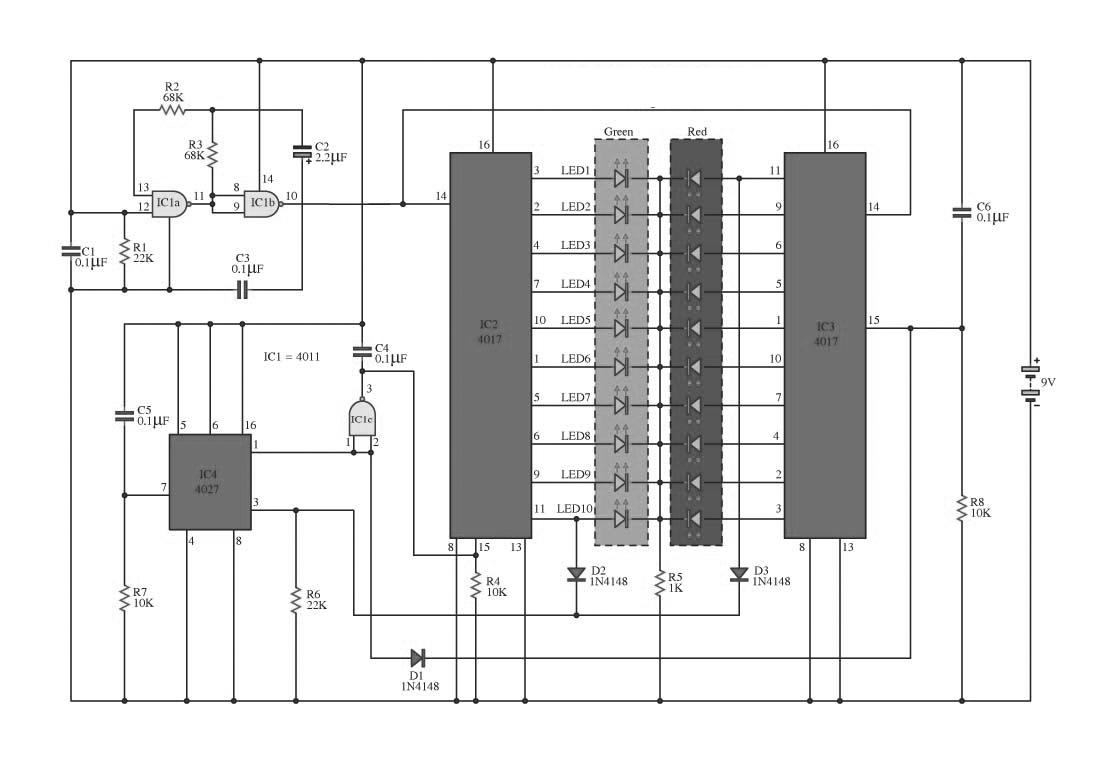
Two Colour LED Light Bar Circuit Schematic Diagram
This circuit operates on alternating two colors using a 2-color LED with a built-in 3-pin configuration. It alternates the glow of each LED until the base, switching between two colors. The circuit comprises a NAND gate IC, two 10-counter circuit...

Remote Infrared Switch Circuit
The SFH505A, manufactured by Siemens, integrates an infrared diode receiver, amplifier, demodulator, and a band-pass filter to minimize interferences. This circuit operates effectively in various applications.
The SFH505A is a versatile optical receiver module designed for infrared communication systems. It is...

Bluish Flasher
The circuit demonstrates how a combination of a blue LED and a white LED can realistically imitate a camera flashlight. It utilizes the classic 555 integrated circuit (IC) in an innovative manner, functioning alternately in mono-stable and astable modes with...
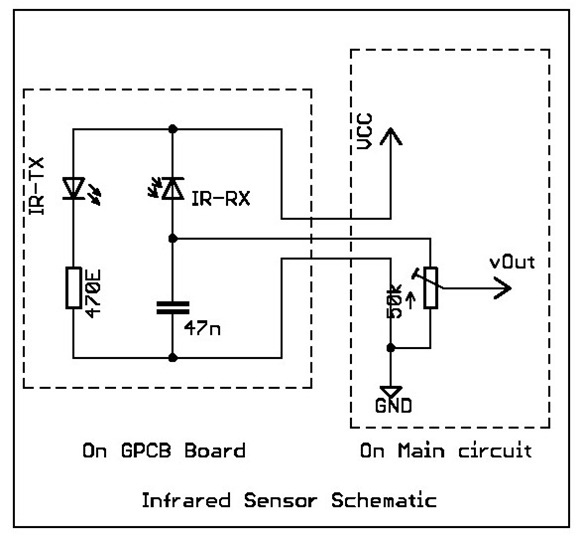
How to make simple Infrared Sensor Modules
Overview: This tutorial demonstrates the creation of a simple infrared sensor module designed to detect reflecting surfaces. This sensor is capable of identifying reflective materials such as silver or white strips, as well as serving applications in obstacle detection and...

Lighting designs with flicker-free LED dimming
LED lighting is becoming increasingly prominent in both residential and commercial lighting markets. To enhance the success and adoption of solid-state lighting in retrofit lamps, it is essential for LED lamps to support dimming with existing controllers and wiring. However,...

High Volt LED Flasher
This is a flasher circuit that directly derives power from AC to produce brilliant flashes at a rate of one flash per second. It utilizes a DIAC as the main element.
The flasher circuit operates by converting alternating current (AC) into...

led sign
This sign design does not utilize a microprocessor. Instead, it employs an EPROM and multiple counters. Similar to most electronic signs, the LEDs are arranged in a matrix and are stroboscopically activated at a high frequency to create the illusion...