


LED Light Pen
#LED
#light pen
#visual examination
#durable
#long life
#physicians
#repair tools
#low power
#compact
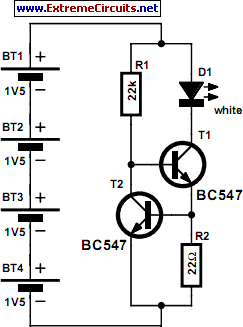
Description: Physicians and repair engineers frequently utilize small light pens for visual examination purposes. Although these pens are rugged and can be expensive, their vulnerability lies in the bulb, which is a replaceable component. In practice, this often translates to the bulb being costly or difficult to obtain when needed. Light Emitting Diodes (LEDs) possess a significantly longer lifespan than traditional bulbs, and the latest ultra-bright white LEDs also provide superior energy-to-light conversion efficiency. However, LEDs necessitate a small electronic circuit known as a constant-current source to operate optimally. In this configuration, transistor T1 and resistor R1 activate the LED. Resistor R2 functions as a current sensor, with transistor T2 diverting most of T1's base bias current when the voltage across R2 exceeds approximately 0.65 V. The constant current flowing through the white LED can be calculated using the formula R2 = 0.65 / I_LED. With appropriate skill, the entire circuit can be designed to occupy a space equivalent to that of an AA battery, with four button cells replacing the single AA battery that was previously used in the light pen.
The proposed circuit for replacing the traditional bulb in a light pen with an LED involves several key components that work together to ensure efficient operation. The use of a constant-current source is critical for maintaining the LED's brightness and prolonging its lifespan. The circuit begins with the activation of transistor T1, which is controlled by resistor R1. This resistor limits the base current to T1, allowing it to turn on and subsequently energize the LED.
Resistor R2 plays a pivotal role as a current sensing element. As the current through the LED increases, the voltage across R2 rises. When this voltage exceeds the threshold of approximately 0.65 V, it signals transistor T2 to turn on, which effectively shunts off the base current to T1. This feedback mechanism ensures that the current through the LED remains constant, preventing it from exceeding its rated specifications and thereby avoiding potential damage.
The mathematical relationship governing the LED's current is derived from Ohm's Law, specifically, the equation I_LED = 0.65 / R2. By selecting an appropriate value for R2, the desired current through the LED can be achieved. This design allows for flexibility in choosing different LED types, as long as their forward voltage and current ratings are taken into account.
The compact nature of this circuit enables it to be integrated into the light pen's housing, taking up minimal space—approximately the size of an AA battery. The use of four button cell batteries not only provides the necessary power but also contributes to the overall reduction in size compared to the original AA battery configuration. This design not only enhances the functionality of the light pen by ensuring a reliable light source but also simplifies maintenance due to the improved availability of LED components compared to traditional bulbs.Physicians and repair engineers often use small light pens for visual examination Spurposes. Rugged and expensive as these pens may be, their weak point is the bulb, which is a serviceable` part. In practice, that nearly always equates to expensive` and / or impossible to find` when you need one.
LEDs have a much longer life than bulbs and the lat est ultra bright white ones also offer higher energy-to-light conversion efficiency. On the down side, LEDs require a small electronic helper circuit called constant-current source` to get the most out of them. Here, T1 and R1 switch on the LED. R2 acts as a current sensor with T2 shunting off (most of) T1`s base bias current when the voltage developed across R2 exceeds about 0.
65 V. The constant current through the white LED is calculated from R2 = 0. 65 / I LED With some skill the complete circuit can be built such that its size is equal to an AA battery. The four button cells take the place of the other AA battery that used to be inside the light pen.
The proposed circuit for replacing the traditional bulb in a light pen with an LED involves several key components that work together to ensure efficient operation. The use of a constant-current source is critical for maintaining the LED's brightness and prolonging its lifespan. The circuit begins with the activation of transistor T1, which is controlled by resistor R1. This resistor limits the base current to T1, allowing it to turn on and subsequently energize the LED.
Resistor R2 plays a pivotal role as a current sensing element. As the current through the LED increases, the voltage across R2 rises. When this voltage exceeds the threshold of approximately 0.65 V, it signals transistor T2 to turn on, which effectively shunts off the base current to T1. This feedback mechanism ensures that the current through the LED remains constant, preventing it from exceeding its rated specifications and thereby avoiding potential damage.
The mathematical relationship governing the LED's current is derived from Ohm's Law, specifically, the equation I_LED = 0.65 / R2. By selecting an appropriate value for R2, the desired current through the LED can be achieved. This design allows for flexibility in choosing different LED types, as long as their forward voltage and current ratings are taken into account.
The compact nature of this circuit enables it to be integrated into the light pen's housing, taking up minimal space—approximately the size of an AA battery. The use of four button cell batteries not only provides the necessary power but also contributes to the overall reduction in size compared to the original AA battery configuration. This design not only enhances the functionality of the light pen by ensuring a reliable light source but also simplifies maintenance due to the improved availability of LED components compared to traditional bulbs.Physicians and repair engineers often use small light pens for visual examination Spurposes. Rugged and expensive as these pens may be, their weak point is the bulb, which is a serviceable` part. In practice, that nearly always equates to expensive` and / or impossible to find` when you need one.
LEDs have a much longer life than bulbs and the lat est ultra bright white ones also offer higher energy-to-light conversion efficiency. On the down side, LEDs require a small electronic helper circuit called constant-current source` to get the most out of them. Here, T1 and R1 switch on the LED. R2 acts as a current sensor with T2 shunting off (most of) T1`s base bias current when the voltage developed across R2 exceeds about 0.
65 V. The constant current through the white LED is calculated from R2 = 0. 65 / I LED With some skill the complete circuit can be built such that its size is equal to an AA battery. The four button cells take the place of the other AA battery that used to be inside the light pen.
Mains Blinking LED
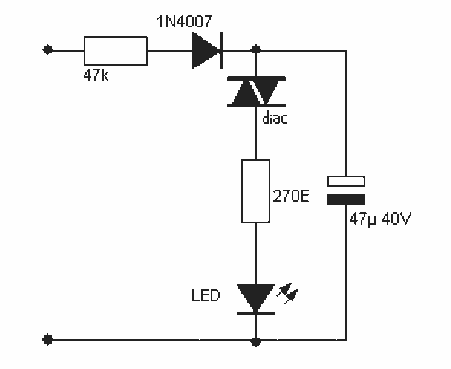
I needed a pulsating light for a certain signaling. Voltage was 230V. So I decided to make a simple circuit, consisted of a LED diode, two capacitors, two resistors, a diac and a diode. Activity of the circuit is extraordinarily...
8x8x8 LED Cube
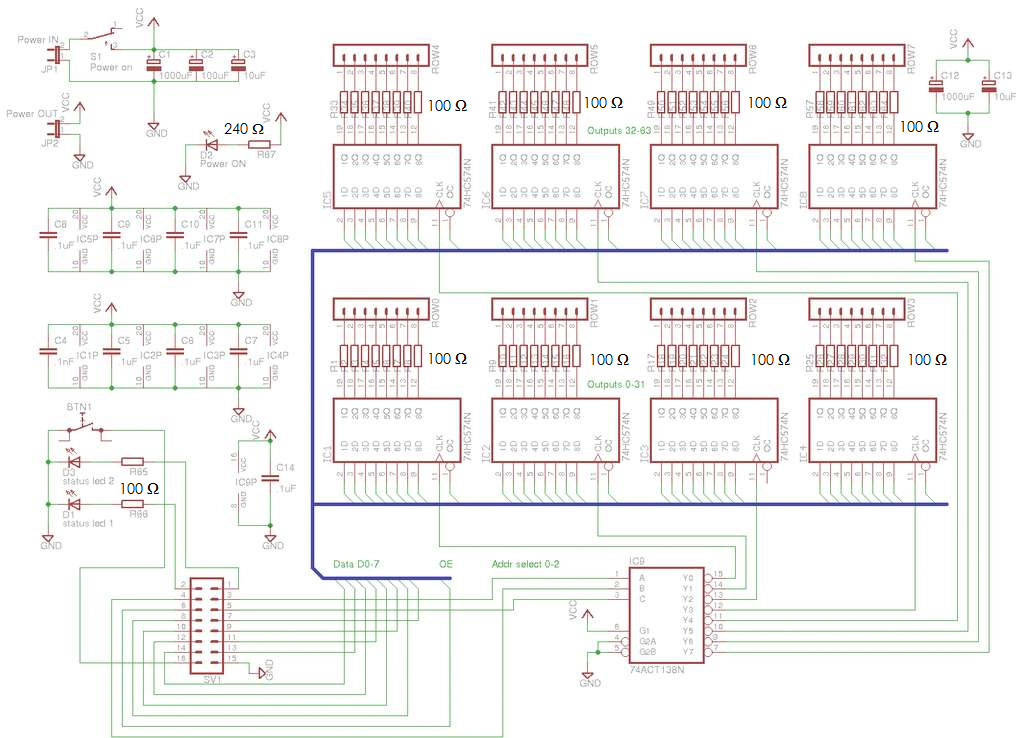
A total of 512 functional LEDs is required for the lattice assembly. These LEDs must be stable and bright. This section outlines the process for identifying faulty LEDs among the usable ones. Often, there are defective LEDs, particularly when purchased...
LED Bar Off Indicator
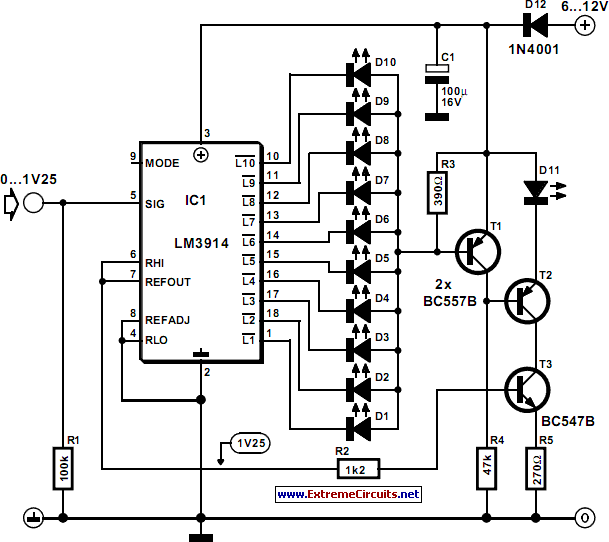
The simple indicator described in this article can be integrated with any circuit that features an LED bar display powered by a Type LM3914 IC. It ensures that an LED will illuminate when all LEDs driven by the LM3914 are...
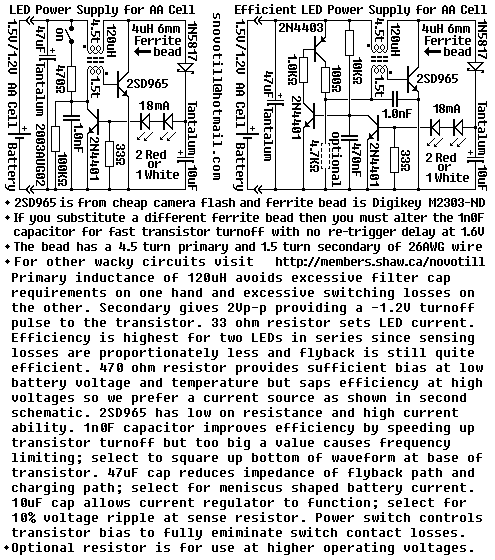
LED power supply
Efficiency can be increased by using a germanium transistor at the 33 ohm current sense resistor, and by using a proper torroid core in place of the crappy ferrite bead. Single AA cell powers two LEDs at constant current.
The circuit...
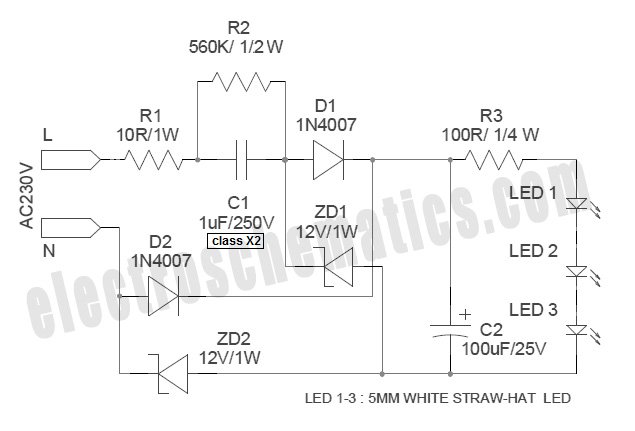
White LED Night Light Circuit
White Light Emitting Diodes (LEDs) now available can serve as a strong alternative to incandescent lamps in lighting applications. Today's White LEDs are...
White Light Emitting Diodes (LEDs) represent a significant advancement in lighting technology, offering energy efficiency, longevity, and reduced...
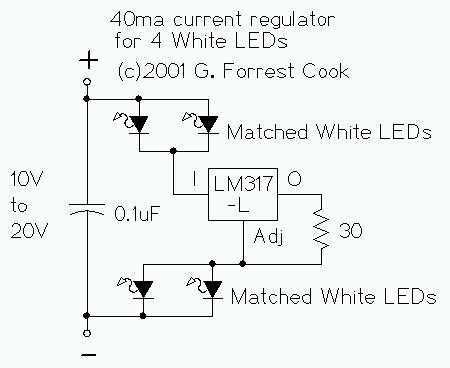
Regulated LED Lamp
The LM317L and resistor act as a current regulator set to 40ma. Current flows from the battery through one pair of LEDs, through the regulator, through the other pair of LEDs, and back to the battery. The capacitor filters out...
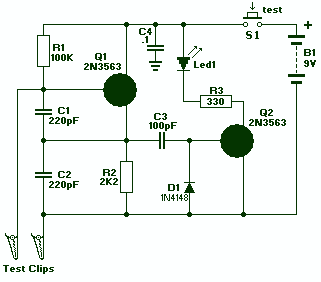
LED Crystal Tester
Transistor Q1, a 2N3563, and its associated components form an oscillator circuit that will oscillate if, and only if, a good crystal is connected to the test clips. The output from the oscillator is then rectified by the 1N4148 signal...
LED Dimmer Lighting
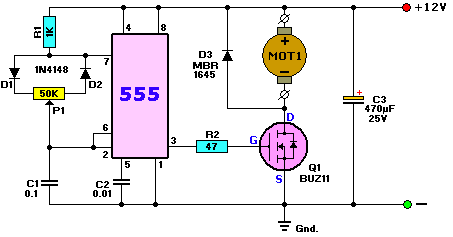
A dimmer for individual LED bulbs. LEDs (light emitting diodes) are very sensitive components; exceeding their rated current or voltage can drastically reduce their lifespan from over 50,000 hours to mere microseconds. LEDs are current-driven, meaning that the intensity of...
LED Lighting For Consumer Unit Cupboard
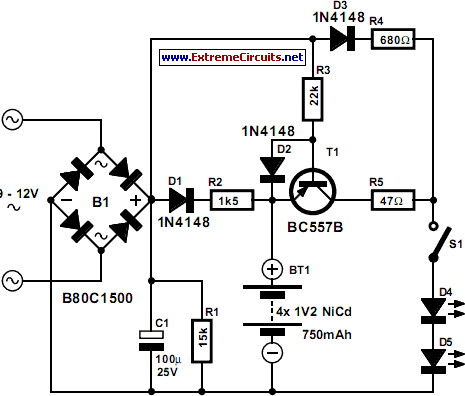
The consumer unit cupboard in some older houses is poorly illuminated. If a bell transformer is also situated in this cupboard, it can be utilized to provide emergency lighting using two high-current LEDs. These diodes are powered through a small...