


simple self-powered circuit
#self-powered
#LED
#battery
#energy
#circuit
#experimental
#twelve volt
#light-emitting diode
#unconventional
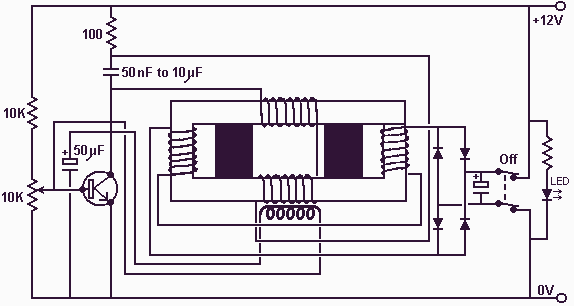
Description: This simple circuit is started running by connecting a twelve volt battery across the terminals, causing the large diameter Light-Emitting Diode to light up. When the battery is removed, the LED stays lit up because the circuit has become self-powering. While, at this scale, this is not a particularly useful project, it is an interesting one because conventional science says that it is quite impossible to do this.
The circuit described operates on the principle of energy storage and self-sustaining operation. Initially, a twelve-volt battery is connected to the circuit, providing the necessary voltage and current to power a large diameter Light-Emitting Diode (LED). The LED serves as a visual indicator that the circuit is operational.
Upon powering the circuit, the LED lights up, indicating that current is flowing. The unique aspect of this circuit is its ability to maintain LED illumination even after the battery is disconnected. This phenomenon can be attributed to the incorporation of a capacitive or inductive element that stores energy when the circuit is powered.
When the battery is removed, the stored energy is released, allowing the LED to continue emitting light for a brief period. The duration of the LED's illumination depends on the capacitance or inductance used in the circuit, as well as the current draw of the LED itself.
The self-powering characteristic of this circuit challenges conventional electrical principles, as it suggests a form of perpetual energy that defies standard expectations of energy conservation. However, it is important to note that this circuit does not create energy; it merely utilizes stored energy, which will eventually deplete.
This circuit can serve as a fundamental educational tool for understanding basic electronic principles, including voltage, current, and energy storage. It also raises interesting discussions regarding circuit design and the limitations imposed by the laws of physics. Further exploration could involve experimenting with different energy storage components, such as capacitors or inductors, to observe variations in performance and LED illumination duration.This simple circuit is started running by connecting a twelve volt battery across the terminals, causing the large diameter Light-Emitting Diode to light up. When the battery is removed, the LED stays lit up because the circuit has become self-powering. While, at this scale, this is not a particularly useful project, it is an interesting one because conventional science says that it is quite impossible to do this.
If you decide to start some project, then whatever project you pick, the most important thing is that it should be one which interests you. You will notice that the projects suggested here generally have moving parts which make it easy to see how the device is operating.
The more difficult projects where there are no moving parts and meters need to be used can be left for a later time. If you decide to build something, then let me wish you good luck with your project.
The circuit described operates on the principle of energy storage and self-sustaining operation. Initially, a twelve-volt battery is connected to the circuit, providing the necessary voltage and current to power a large diameter Light-Emitting Diode (LED). The LED serves as a visual indicator that the circuit is operational.
Upon powering the circuit, the LED lights up, indicating that current is flowing. The unique aspect of this circuit is its ability to maintain LED illumination even after the battery is disconnected. This phenomenon can be attributed to the incorporation of a capacitive or inductive element that stores energy when the circuit is powered.
When the battery is removed, the stored energy is released, allowing the LED to continue emitting light for a brief period. The duration of the LED's illumination depends on the capacitance or inductance used in the circuit, as well as the current draw of the LED itself.
The self-powering characteristic of this circuit challenges conventional electrical principles, as it suggests a form of perpetual energy that defies standard expectations of energy conservation. However, it is important to note that this circuit does not create energy; it merely utilizes stored energy, which will eventually deplete.
This circuit can serve as a fundamental educational tool for understanding basic electronic principles, including voltage, current, and energy storage. It also raises interesting discussions regarding circuit design and the limitations imposed by the laws of physics. Further exploration could involve experimenting with different energy storage components, such as capacitors or inductors, to observe variations in performance and LED illumination duration.This simple circuit is started running by connecting a twelve volt battery across the terminals, causing the large diameter Light-Emitting Diode to light up. When the battery is removed, the LED stays lit up because the circuit has become self-powering. While, at this scale, this is not a particularly useful project, it is an interesting one because conventional science says that it is quite impossible to do this.
If you decide to start some project, then whatever project you pick, the most important thing is that it should be one which interests you. You will notice that the projects suggested here generally have moving parts which make it easy to see how the device is operating.
The more difficult projects where there are no moving parts and meters need to be used can be left for a later time. If you decide to build something, then let me wish you good luck with your project.
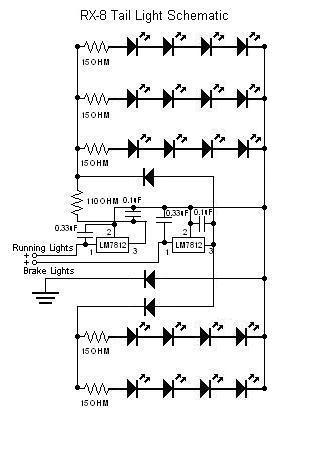
RX-8 LED
The circuit has been successfully recreated and functions properly when the line connected to the 1 µF capacitor of the "2" terminal of the running lights' LM7812 is not grounded. This line is also connected to the 33 µF capacitor...

220V LED Flasher Circuit
This is an AC-powered LED flasher that can drive two high-bright LEDs directly from the power obtained from the AC lines. The high-bright LED flasher can be...
The AC-powered LED flasher circuit is designed to illuminate two high-bright LEDs using the...
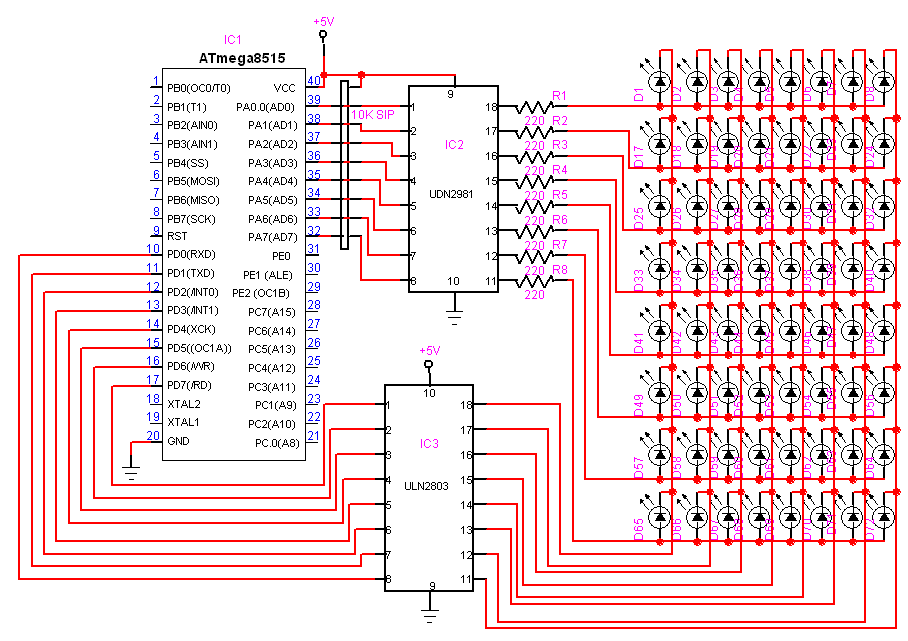
8G—8 Dotmatrix Scrolling LED display using atmega8515
Here is another project that creates a scrolling LED display. This display consists of 64 LEDs arranged in a matrix configuration. The anodes are driven through a driver circuit.
The scrolling LED display project utilizes a matrix of 64 LEDs, typically...
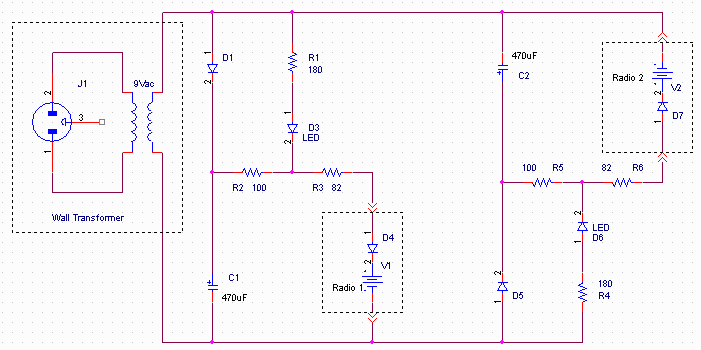
Replacing Motorola Batteries
The battery packs were approximately $60 per pair, including a charger and batteries, and feature a three-bar battery gauge. Through experimentation, it was found that a voltage greater than 4.28V activates all three bars, while a voltage above 3.47V activates...
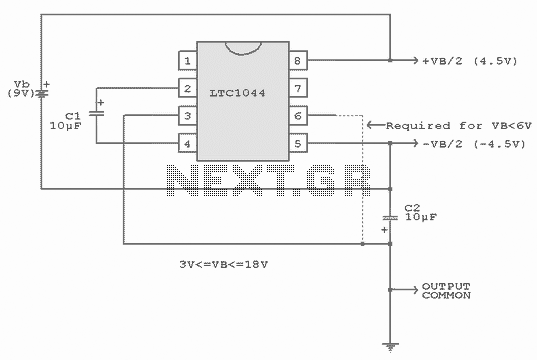
Positive and negative from a battery LT1010
A common need in many systems is to obtain positive and negative supplies from a single battery. Where current requirements are small, the circuit shown is a simple solution. It provides symmetrical +&- output voltages, both equal to one half...
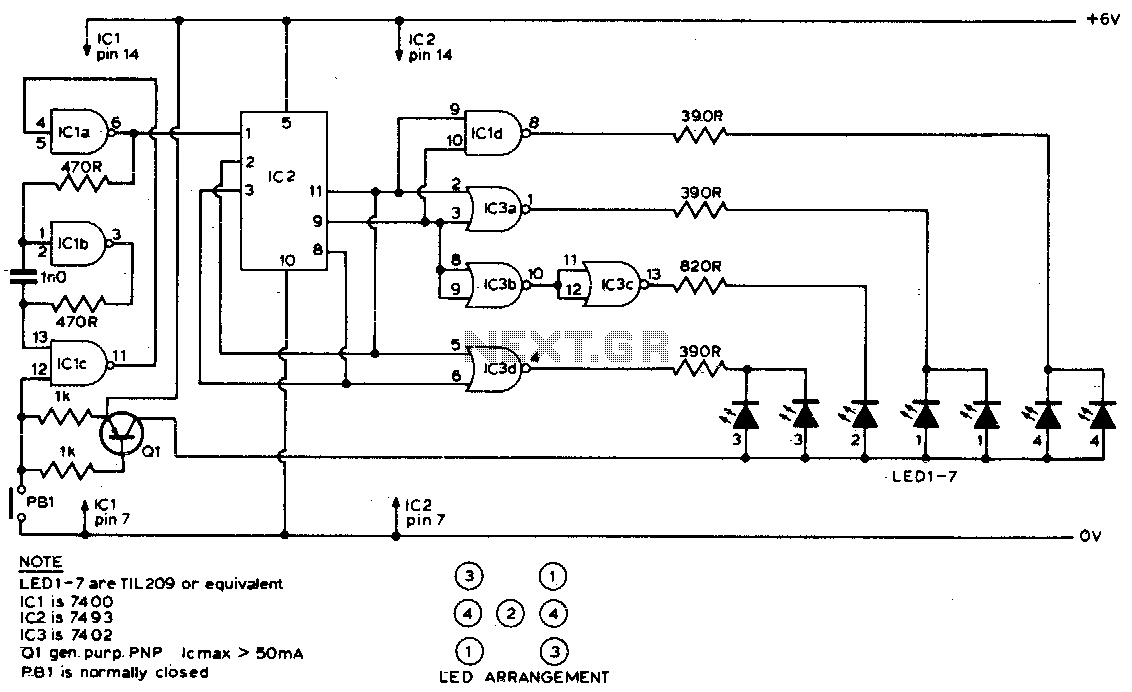
Electronic dice
Six LEDs are arranged to create a display that mimics the dots on a dice. When the push button input (PBI) is pressed, the display is turned off, and the oscillator (IC1 a, b, c) drives IC2 at approximately 1...
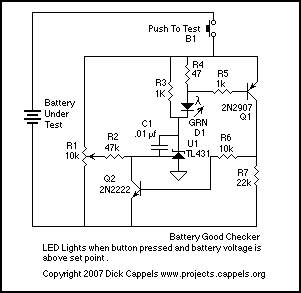
LED Battery Checkers
The Battery Good checker. When the button is pressed, the green LED will glow if the battery voltage is above the preset threshold. This version has a higher parts count than the Battery Low version, but a bonus is that...
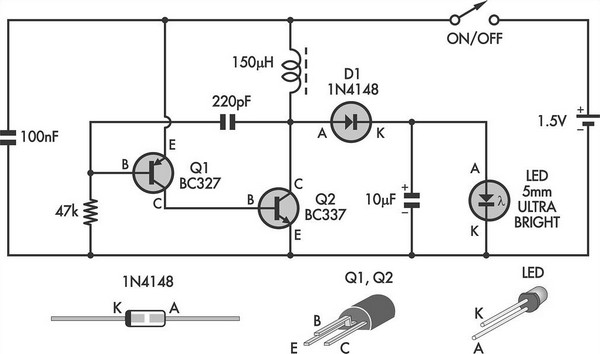
led torch uses blocking
This simple LED torch is powered by a 2-transistor blocking oscillator that increases the voltage from a 1.5V cell. The design utilizes the natural current limiting characteristics of a 150 µH choke to prevent the white LED from being overdriven....
LED As Photodiode
In the project LED Touch Sensing by Jeff Han, a remarkable phenomenon occurs with an LED matrix that not only illuminates but also detects finger touches. Initially, it was assumed that a special type of LED matrix was utilized, but...