


white light led driver with
#white light LED
#LED driver
#PWM dimming
#illumination
#backlighting
#TPS61040
#gradual illumination
#turnon
#turnoff
#Microprocessor
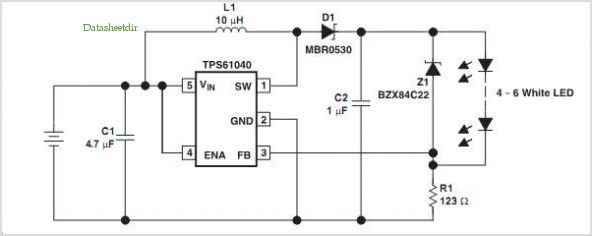
Description: Many consumer products that utilize white light LEDs for illumination and backlighting offer gradual LED illumination during both turn-on and turn-off phases. This gradual illumination is typically achieved through a microprocessor that provides PWM dimming control. However, the following circuit employs the Texas Instruments TPS61040 white light LED driver to enable gradual illumination at turn-on and turn-off without relying on a microprocessor. This circuit generates a constant current of 101 mA to drive up to six white LEDs, suitable for portable applications such as PDAs and digital cameras. The input operating range is from 1.8 V to 6 V, accommodating two-cell alkaline and NiMH inputs (1.8 V to approximately 3 V), three-cell alkaline and NiMH inputs (2.7 V to approximately 4.8 V), and single-cell Li-Ion inputs (3 V to 4.2 V). The boost converter utilizes resistor R1 to establish a constant current through the LEDs. A detailed description of this circuit can be found in the TPS61040 data sheet (SLVS413).
The circuit design utilizing the TPS61040 white light LED driver is an efficient solution for providing consistent and gradual illumination for white LEDs in portable devices. The TPS61040 is a step-up (boost) converter that is specifically engineered to drive LEDs with a regulated constant current, ensuring uniform brightness across multiple LEDs.
The circuit begins by taking a low voltage input, which can range from 1.8 V to 6 V, and boosts it to the necessary voltage levels required to drive the LEDs. This feature is particularly beneficial for battery-operated devices, as it allows for the efficient use of power from various battery configurations, including alkaline, NiMH, and Li-Ion cells.
The resistor R1 plays a crucial role in setting the output current flowing through the LEDs. By selecting an appropriate value for R1, the desired constant current of 101 mA can be achieved, which is optimal for driving up to six white LEDs in series. This configuration not only simplifies the design by eliminating the need for a microprocessor but also enhances reliability by reducing potential points of failure.
The gradual illumination feature is implemented by controlling the switching frequency and duty cycle of the TPS61040, which can be adjusted to create a soft start and soft stop effect when powering the LEDs on and off. This approach minimizes sudden changes in brightness, leading to a more aesthetically pleasing user experience.
Overall, the TPS61040 circuit design represents a robust solution for LED driving applications, combining efficiency, simplicity, and effective current regulation to meet the demands of modern portable electronic devices. For further technical details and specifications, the TPS61040 data sheet (SLVS413) should be consulted.Many consumer products using white light LEDs for illumination and backlighting provide gradual LED illumination at turnon and turnoff. This gradual illumination is usually achieved with the aid of a Microprocessor that provides PWM dimming control.
This circuit uses the Texas Instruments TPS61040 white light LED Driver to provide gradual illumina tion at turnon and turnoff without the use of a Microprocessor The following circuit generates a 101mA constant current to drive up to 6 white LEDs for portable applications such PDAs and digital cameras. The input operating range is 1. 8 V to 6 V, which covers two-cell alkaline and NiMh inputs (1. 8 V to ~3 V), three-cell alkaline and NiMh inputs (2. 7 V to ~4. 8 V), and single-cell Li-Ion inputs (3 V~4. 2 V). This boost converter uses R1 to set a constant current through the LEDs A detailed description of this circuit CAN be found in the TPS61040 data sheet ( SLVS413 ).
The circuit design utilizing the TPS61040 white light LED driver is an efficient solution for providing consistent and gradual illumination for white LEDs in portable devices. The TPS61040 is a step-up (boost) converter that is specifically engineered to drive LEDs with a regulated constant current, ensuring uniform brightness across multiple LEDs.
The circuit begins by taking a low voltage input, which can range from 1.8 V to 6 V, and boosts it to the necessary voltage levels required to drive the LEDs. This feature is particularly beneficial for battery-operated devices, as it allows for the efficient use of power from various battery configurations, including alkaline, NiMH, and Li-Ion cells.
The resistor R1 plays a crucial role in setting the output current flowing through the LEDs. By selecting an appropriate value for R1, the desired constant current of 101 mA can be achieved, which is optimal for driving up to six white LEDs in series. This configuration not only simplifies the design by eliminating the need for a microprocessor but also enhances reliability by reducing potential points of failure.
The gradual illumination feature is implemented by controlling the switching frequency and duty cycle of the TPS61040, which can be adjusted to create a soft start and soft stop effect when powering the LEDs on and off. This approach minimizes sudden changes in brightness, leading to a more aesthetically pleasing user experience.
Overall, the TPS61040 circuit design represents a robust solution for LED driving applications, combining efficiency, simplicity, and effective current regulation to meet the demands of modern portable electronic devices. For further technical details and specifications, the TPS61040 data sheet (SLVS413) should be consulted.Many consumer products using white light LEDs for illumination and backlighting provide gradual LED illumination at turnon and turnoff. This gradual illumination is usually achieved with the aid of a Microprocessor that provides PWM dimming control.
This circuit uses the Texas Instruments TPS61040 white light LED Driver to provide gradual illumina tion at turnon and turnoff without the use of a Microprocessor The following circuit generates a 101mA constant current to drive up to 6 white LEDs for portable applications such PDAs and digital cameras. The input operating range is 1. 8 V to 6 V, which covers two-cell alkaline and NiMh inputs (1. 8 V to ~3 V), three-cell alkaline and NiMh inputs (2. 7 V to ~4. 8 V), and single-cell Li-Ion inputs (3 V~4. 2 V). This boost converter uses R1 to set a constant current through the LEDs A detailed description of this circuit CAN be found in the TPS61040 data sheet ( SLVS413 ).

Constant Current LED Drive
Most LED driver circuits utilize a series resistor to regulate the current flowing through the LED. This method is optimal for applications that require only a few LEDs. However, for applications involving many LEDs, this approach becomes inefficient, leading to...
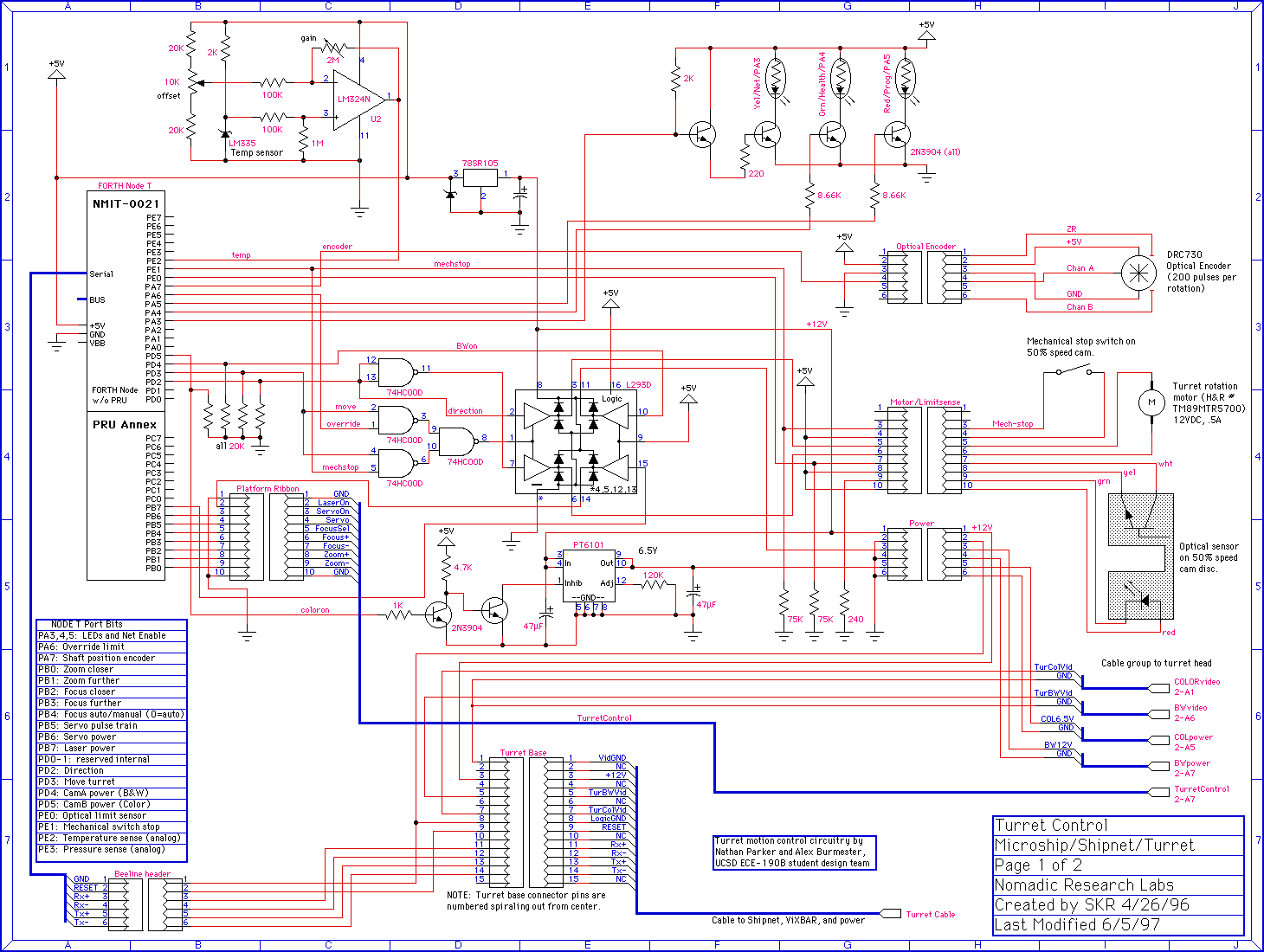
video turret
This document outlines the complete design for a microprocessor-controlled, environmentally sealed 8-inch video turret equipped with two cameras, offering remote or autofocus and zoom control. It features sun damage protection, 450-degree azimuth rotation, 9-speed scanning, point capability, multidrop network connection,...
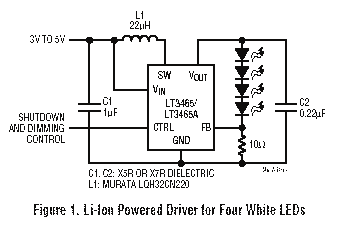
White LED Step-Up Converters with Schottky
The LT3465/LT3465A are step-up DC/DC converters designed to drive up to six LEDs in series from a Li-Ion cell. Series connection of the LEDs provides identical LED currents and eliminates the need for ballast resistors. These devices integrate the Schottky...
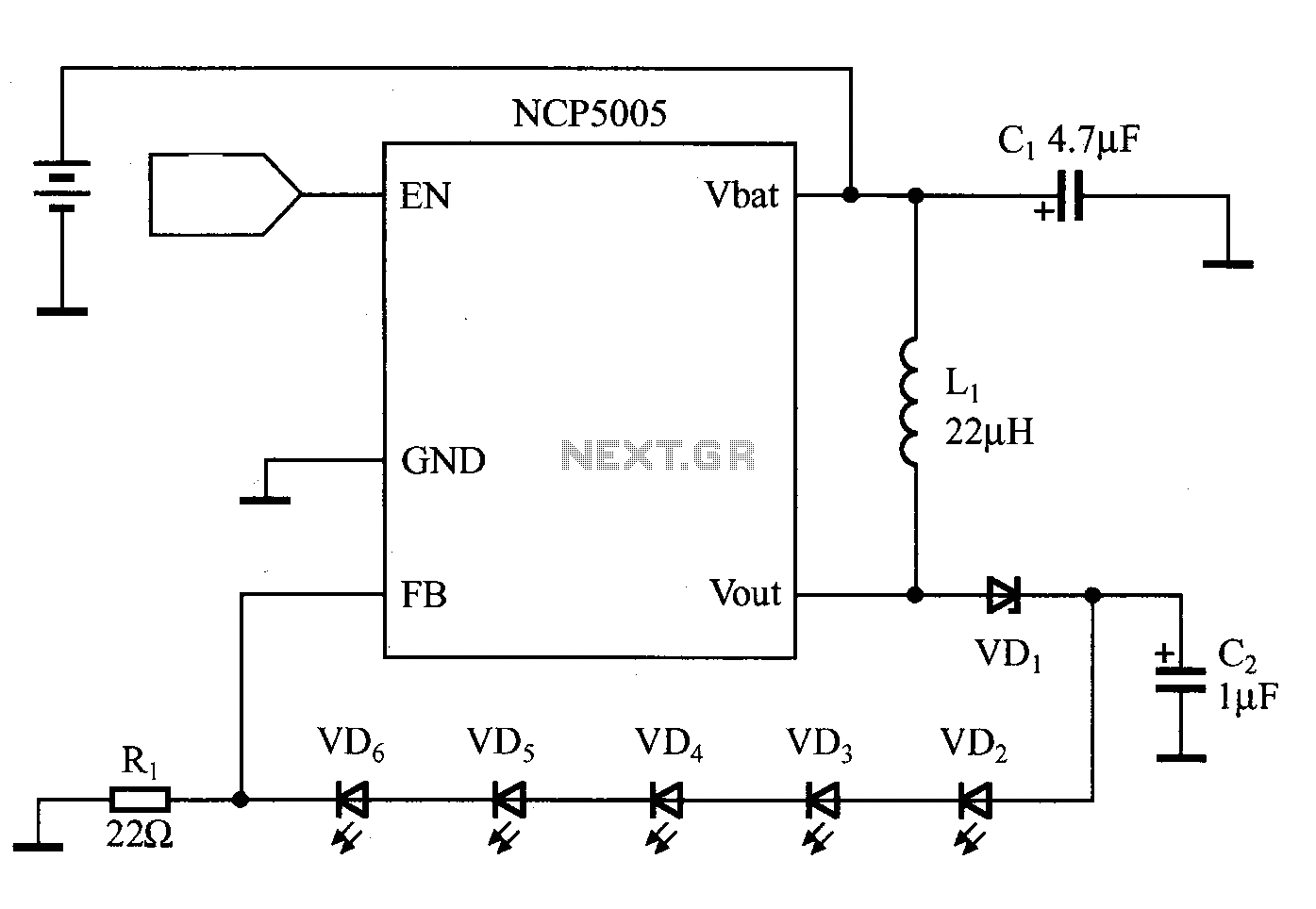
Changes inductive boost LED Driver
White LEDs can be connected in series or parallel, each method having its own advantages and disadvantages. A key disadvantage of the parallel connection is that the current and brightness of the LEDs do not automatically match. In contrast, series...
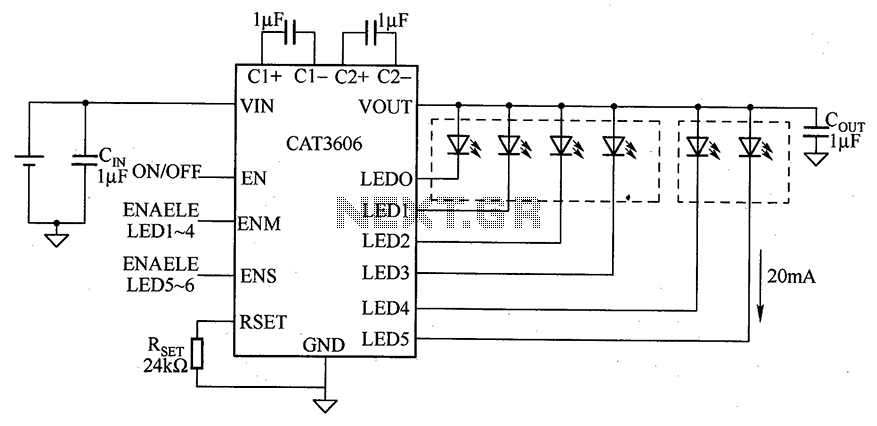
CAT3606 LED driver application circuit
CAT3606 is a high-efficiency white LED driver. This adjustable charge pump is suitable for general-purpose, large-panel, flicker-free white LED backlighting and dual-display systems. The CAT3606 inductor boost circuit can replace conventional high-brightness backlighting requirements, thereby simplifying system design. It has...
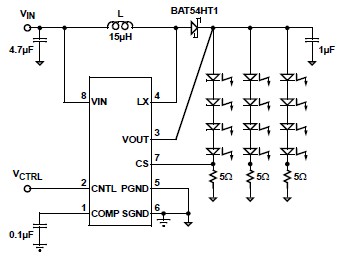
EL7513 led driver circuit design
A simple white LED driver schematic can be created using the EL7513 constant current boost regulator, which is specifically designed for driving white LEDs. This driver can manage 4 LEDs in series or up to 12 LEDs in a parallel...
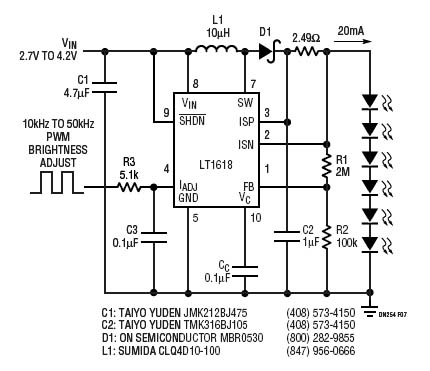
white led driver by lt1618
The LT1618 not only offers an accurate input current limit but can also be utilized to deliver a regulated output current suitable for current-source applications.
The LT1618 is a precision current limiting device that can be effectively employed in various electronic...
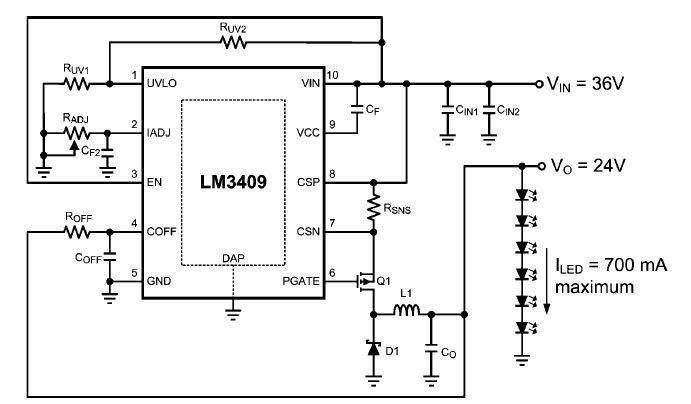
LM3409 dimming controlled LED driver circuit design
This dimming-controlled LED driver electronic circuit requires an input voltage of 36 volts and will provide an output voltage of 24 volts at a maximum current of 700 mA.
The described dimming-controlled LED driver circuit is designed to efficiently convert a...
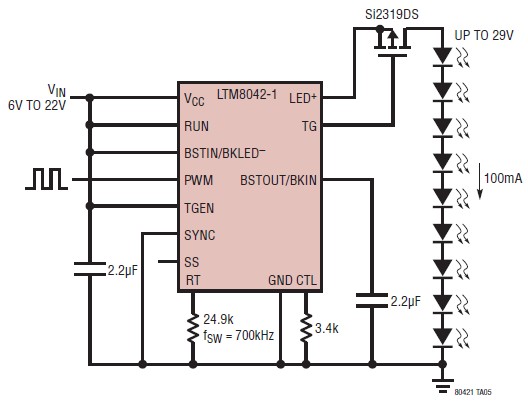
Led driver using LTM8042 ??Module Boost Driver
The LTM8042 integrates a boost power topology with a unique current loop to function as a constant-current source. The PWM input allows for LED dimming ratios of up to 3000:1, while analog dimming can be achieved with a single resistor...