


220V Mains Quality Monitor
#220V
#mains
#quality monitor
#noise detection
#voltage spike
#bicolor LED
#50Hz filter
#sensitivity adjustment
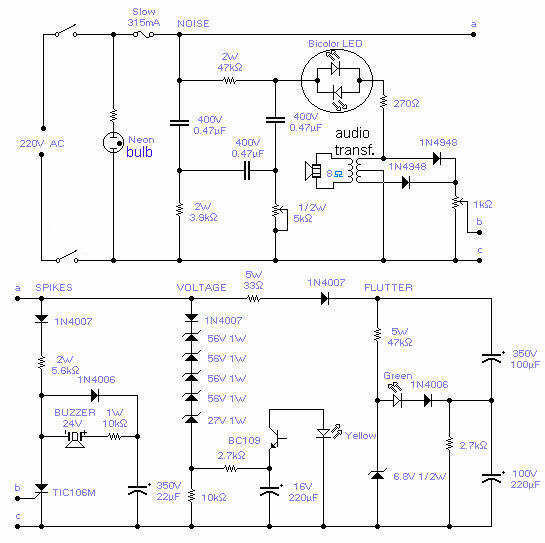
Description: With this circuit you will be able to monitor the quality of the mains. There are 4 distinct sections, each supervising a parameter pertinent to the quality of the supply line. The noise section consists of a 50Hz filter and a speaker where you will hear the noise present on the line. The bicolor LED should be adjusted for the least light with the 5k pot and gives a visual indication of noise or asymmetry in the wave. The second section will detect any spike which is overimposed on the mains voltage: adjust the pot so that it will not trip if you just switch on the light, sensitivity is high enough to detect a switching operation from a close neighbor. More: The buzzer will beep for about 1sec anytime there is a spike. The actual voltage is detected with section 3: the yellow led will blink at a rate of 6 Hz but will visibly double to 12 Hz for a 10% increase or will come to a halt for a 10% decrease of the voltage. The last section will show the flutter or slow variations of the mains voltage. The circuit will work for a 220V mains: for 230V operation, change the 27V zener to 39V and for 60Hz operation change the 3.9k resistor to 3.3k and the 47k resistor to 39k. Operation at 110V will call for a major redesign of the component values and has not been attempted.
The circuit is designed to monitor various parameters of mains quality, providing both auditory and visual feedback. It is divided into four primary sections, each responsible for assessing a specific aspect of the mains supply.
The first section focuses on noise detection and incorporates a 50Hz low-pass filter along with a speaker. This arrangement allows the user to hear any noise present in the mains supply. A bicolor LED, adjustable via a 5k potentiometer, provides a visual representation of noise levels or waveform asymmetry. The adjustment of the potentiometer is crucial for calibrating the LED to indicate minimal light in normal operating conditions.
The second section is dedicated to spike detection. It is designed to identify voltage spikes that may occur on the mains line. A potentiometer is included to set the sensitivity of the detection circuit, ensuring that it does not trigger false alarms during routine operations, such as switching on lights. However, it remains sensitive enough to detect nearby switching operations.
In the third section, the circuit monitors the actual mains voltage. A yellow LED is employed to indicate voltage levels, blinking at a frequency of 6 Hz under normal conditions. If a 10% increase in voltage is detected, the blinking rate increases to 12 Hz, while a 10% decrease in voltage causes the LED to stop blinking altogether. This provides an immediate visual reference for voltage stability.
The final section of the circuit is responsible for monitoring slow variations or 'flutter' in the mains voltage. This aspect is critical for assessing the overall stability of the supply.
For operation with a 220V mains supply, the circuit is appropriately configured. However, for a 230V supply, modifications are necessary: the 27V zener diode should be replaced with a 39V component, and for 60Hz operation, the resistor values must be adjusted from 3.9k to 3.3k and from 47k to 39k. It is noted that adapting the circuit for 110V operation would require significant redesign and has not been attempted.With this circuit you will be able to monitor the quality of the mains. There are 4 distinct sections, each supervising a parameter pertinent to the quality of the supply line. The noise section consists of a 50Hz filter and a speaker where you will hear the noise present on the line.
The bicolor LED should be adjusted for the least light with the 5k pot and gives a visual indication of noise or asymmetry in the wave. The second section will detect any spike which is overimposed on the mains voltage: adjust the pot so that it will not trip if you just switch on the light, sensitivity is high enough to detect a switching operation from a close neighbor.
The buzzer will beep for about 1sec anytime there is a spike. The actual voltage is detected with section 3: the yellow led will blink at a rate of 6 Hz but will visibly double to 12 Hz for a 10% increase or will come to a halt for a 10% decrease of the voltage. The last section will show the flutter or slow variations of the mains voltage. The circuit will work for a 220V mains: for 230V operation, change the 27V zener to 39V and for 60Hz operation change the 3.9k resistor to 3.3k and the 47k resistor to 39k.
Operation at 110V will call for a major redesign of the component values and has not been attempted.
The circuit is designed to monitor various parameters of mains quality, providing both auditory and visual feedback. It is divided into four primary sections, each responsible for assessing a specific aspect of the mains supply.
The first section focuses on noise detection and incorporates a 50Hz low-pass filter along with a speaker. This arrangement allows the user to hear any noise present in the mains supply. A bicolor LED, adjustable via a 5k potentiometer, provides a visual representation of noise levels or waveform asymmetry. The adjustment of the potentiometer is crucial for calibrating the LED to indicate minimal light in normal operating conditions.
The second section is dedicated to spike detection. It is designed to identify voltage spikes that may occur on the mains line. A potentiometer is included to set the sensitivity of the detection circuit, ensuring that it does not trigger false alarms during routine operations, such as switching on lights. However, it remains sensitive enough to detect nearby switching operations.
In the third section, the circuit monitors the actual mains voltage. A yellow LED is employed to indicate voltage levels, blinking at a frequency of 6 Hz under normal conditions. If a 10% increase in voltage is detected, the blinking rate increases to 12 Hz, while a 10% decrease in voltage causes the LED to stop blinking altogether. This provides an immediate visual reference for voltage stability.
The final section of the circuit is responsible for monitoring slow variations or 'flutter' in the mains voltage. This aspect is critical for assessing the overall stability of the supply.
For operation with a 220V mains supply, the circuit is appropriately configured. However, for a 230V supply, modifications are necessary: the 27V zener diode should be replaced with a 39V component, and for 60Hz operation, the resistor values must be adjusted from 3.9k to 3.3k and from 47k to 39k. It is noted that adapting the circuit for 110V operation would require significant redesign and has not been attempted.With this circuit you will be able to monitor the quality of the mains. There are 4 distinct sections, each supervising a parameter pertinent to the quality of the supply line. The noise section consists of a 50Hz filter and a speaker where you will hear the noise present on the line.
The bicolor LED should be adjusted for the least light with the 5k pot and gives a visual indication of noise or asymmetry in the wave. The second section will detect any spike which is overimposed on the mains voltage: adjust the pot so that it will not trip if you just switch on the light, sensitivity is high enough to detect a switching operation from a close neighbor.
The buzzer will beep for about 1sec anytime there is a spike. The actual voltage is detected with section 3: the yellow led will blink at a rate of 6 Hz but will visibly double to 12 Hz for a 10% increase or will come to a halt for a 10% decrease of the voltage. The last section will show the flutter or slow variations of the mains voltage. The circuit will work for a 220V mains: for 230V operation, change the 27V zener to 39V and for 60Hz operation change the 3.9k resistor to 3.3k and the 47k resistor to 39k.
Operation at 110V will call for a major redesign of the component values and has not been attempted.
Mains Remote Alarm
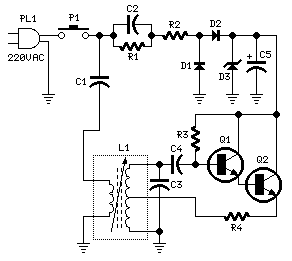
Beeper and/or LED remotely-operated via mains supply line. Pressing the pushbutton of the transmitter, a sound and/or light alert is activated in the receiver. The system uses no wiring or radio frequencies: the transmitted signal is conveyed into the mains...
220V live wire-in-wall scanner
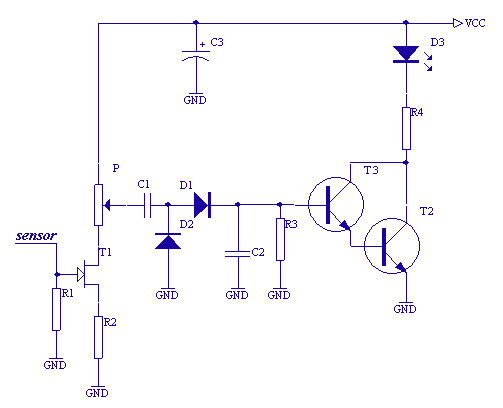
This little circuit will help you to scan the line of a 220V live wire in the wall. The FET gate is connected to a capacitive metal sensor (which is usually a simple metal plate). When you hold the sensor...
Mains Remote-Alert circuit
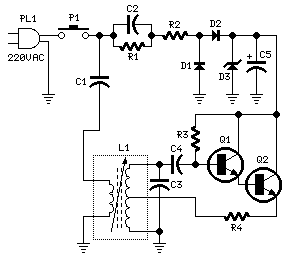
Pressing the pushbutton on the transmitter activates a sound and/or light alert in the receiver. This system operates without wiring or radio frequencies; instead, the transmitted signal is conveyed through the mains supply line. It is suitable for use in...
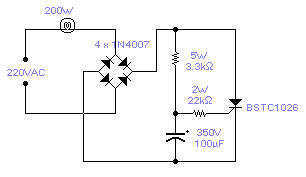
220V 200W Bulb flasher
There is no need to resort to complex circuitry if what you are looking for is a simple power flasher. The light will flash at around 1Hz with a 100W bulb at a duty cycle of 50%. The max. load...

DZW75-48/5050II input circuit
220V (50Hz) alternating voltage passes through the Z1 circuit filter, which filters the signal before sending it to the connection point of the AC overvoltage and undervoltage protection relay K2. During normal operation, the K2 connection point should be closed,...
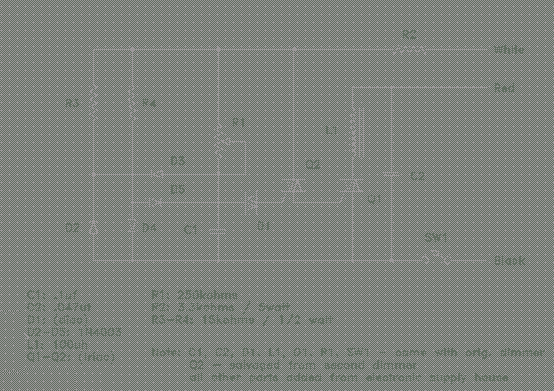
Mains Light dimmer
A simple mains Light dimmer.
A simple mains light dimmer is an electronic device used to adjust the brightness of incandescent and some LED lights by varying the voltage and current supplied to the light bulb. The typical operation of a...

A simple control circuit Lantern
A 220V mains power supply is reduced using a control circuit designed by N. Guanidine D. Yi. The circuit features a spike Bode and provides a +9V voltage supply. It includes components such as a control port (G), a transistor...
A simple control circuit Lantern
A 220V mains power supply is reduced using a control circuit designed by N. Guanidine D. Yi. The circuit features a spike Bode and provides a +9V voltage supply. It includes components such as a control port (G), a transistor...
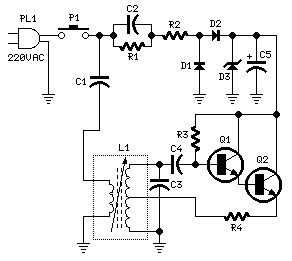
Mains Remote Tranciever Alarm
Pressing the pushbutton of the transmitter, a sound and/or light alert is activated in the receiver. The system uses no wiring or radio frequencies: the transmitted signal is conveyed into the mains supply line. It can be used at home,...