


Block Diagram of the CT Scanner
#CT scanner
#x-ray
#high voltage
#capacitors
#ionization
#medical imaging
#xenon
#minicomputers
#tomography
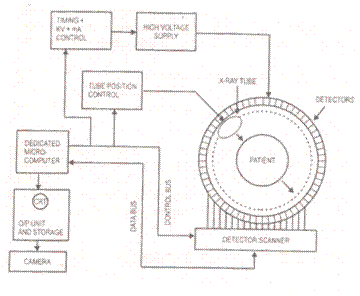
Description: The CT Scanner, short for computed tomography scanner, was invented in 1970, building on prior advancements in dedicated minicomputers. A high DC voltage is applied to the capacitors as X-rays enter the system. The chamber ionizes the xenon gas, causing it to migrate to the capacitor plates, which generates a current in the high voltage load. This current is proportional to the radiation and is sent to the computer as data for image computation.
The CT Scanner operates based on the principles of X-ray imaging and advanced computational algorithms. The system consists of several key components, including an X-ray tube, detector array, high-voltage power supply, and a data acquisition system.
When the CT Scanner is activated, the X-ray tube emits a controlled beam of X-rays that passes through the object being scanned, typically a human body. As the X-rays pass through different tissues, they are attenuated to varying degrees, depending on the density and composition of the tissues. The remaining X-rays are detected by the detector array positioned opposite the X-ray source.
The detector array often consists of numerous individual detectors that convert incoming X-ray photons into electrical signals. The ionization of xenon gas within the chamber plays a crucial role in this process. When X-rays interact with the xenon gas, they ionize it, causing electrons to be released. These electrons migrate towards the capacitor plates, generating a measurable current. The current produced is proportional to the intensity of the radiation, thereby providing vital information about the internal structure of the scanned object.
This electrical signal is then processed by the data acquisition system, which digitizes the information and sends it to the computer. The computer uses sophisticated algorithms to reconstruct the data into cross-sectional images, or slices, of the scanned object. These images can then be displayed on a monitor for analysis by medical professionals, allowing for accurate diagnosis and treatment planning.
In summary, the CT Scanner represents a significant advancement in medical imaging technology, combining the principles of physics, electronics, and computer science to produce detailed images of internal structures with high precision and clarity.The CT Scanner is the abbreviation of computer tomography scanner. The invention of CT Scanner in 1970 was made possible by a previously established insight and development of the dedicated minicomputers. A high DC voltage is applied to the capacitors an x-rays entry. The chamber ionizes the xenon item causing it to migrate to capacitor plate and causing a current in the high voltage load. This current is proportional to the radiation and is fed to the computer as data for computing the image.
The CT Scanner operates based on the principles of X-ray imaging and advanced computational algorithms. The system consists of several key components, including an X-ray tube, detector array, high-voltage power supply, and a data acquisition system.
When the CT Scanner is activated, the X-ray tube emits a controlled beam of X-rays that passes through the object being scanned, typically a human body. As the X-rays pass through different tissues, they are attenuated to varying degrees, depending on the density and composition of the tissues. The remaining X-rays are detected by the detector array positioned opposite the X-ray source.
The detector array often consists of numerous individual detectors that convert incoming X-ray photons into electrical signals. The ionization of xenon gas within the chamber plays a crucial role in this process. When X-rays interact with the xenon gas, they ionize it, causing electrons to be released. These electrons migrate towards the capacitor plates, generating a measurable current. The current produced is proportional to the intensity of the radiation, thereby providing vital information about the internal structure of the scanned object.
This electrical signal is then processed by the data acquisition system, which digitizes the information and sends it to the computer. The computer uses sophisticated algorithms to reconstruct the data into cross-sectional images, or slices, of the scanned object. These images can then be displayed on a monitor for analysis by medical professionals, allowing for accurate diagnosis and treatment planning.
In summary, the CT Scanner represents a significant advancement in medical imaging technology, combining the principles of physics, electronics, and computer science to produce detailed images of internal structures with high precision and clarity.The CT Scanner is the abbreviation of computer tomography scanner. The invention of CT Scanner in 1970 was made possible by a previously established insight and development of the dedicated minicomputers. A high DC voltage is applied to the capacitors an x-rays entry. The chamber ionizes the xenon item causing it to migrate to capacitor plate and causing a current in the high voltage load. This current is proportional to the radiation and is fed to the computer as data for computing the image.
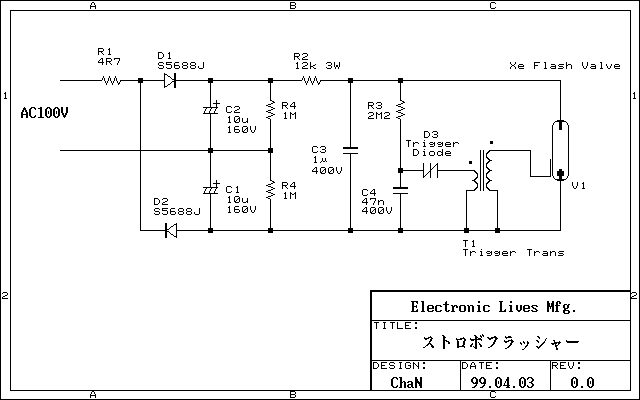
Xenon light pulser
Flash lamp is made with experimental parts removed from a disposable camera flash circuit. Xenon try to use what I think is easily affordable experiment. AC100V to a voltage doubler rectifier, DC voltage of about 270V is derived. This voltage...
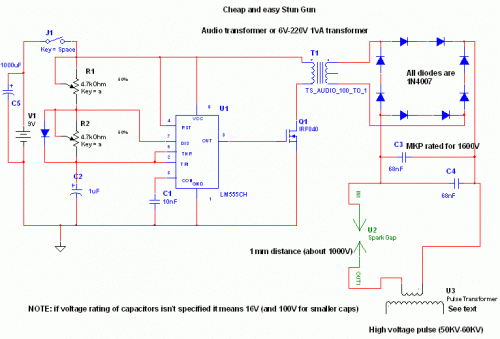
High Voltage Stun Gun
This device can be used against aggressive animals or attackers; however, it is important to note that it may be illegal in certain states.
The device in question is designed for personal protection and can serve as a deterrent against aggressive...
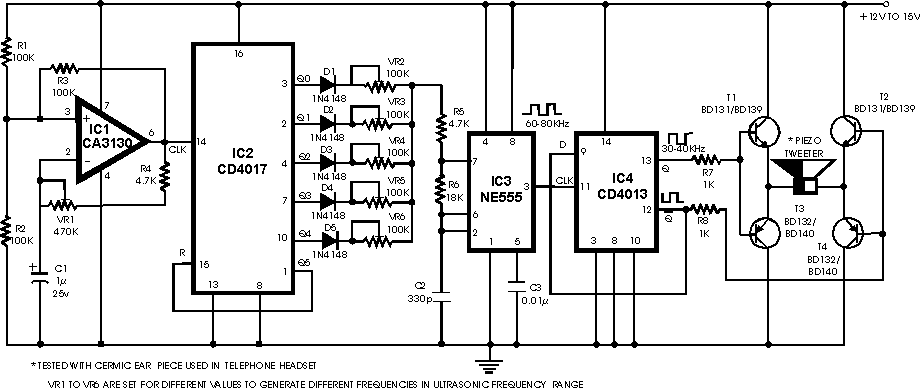
high voltage low current supply circuit diagram
A high voltage power supply is a valuable source that can be effectively used in various applications, such as biasing gas-discharge tubes and radiation detectors. This type of power supply can also serve as a protective measure, such as electrically...
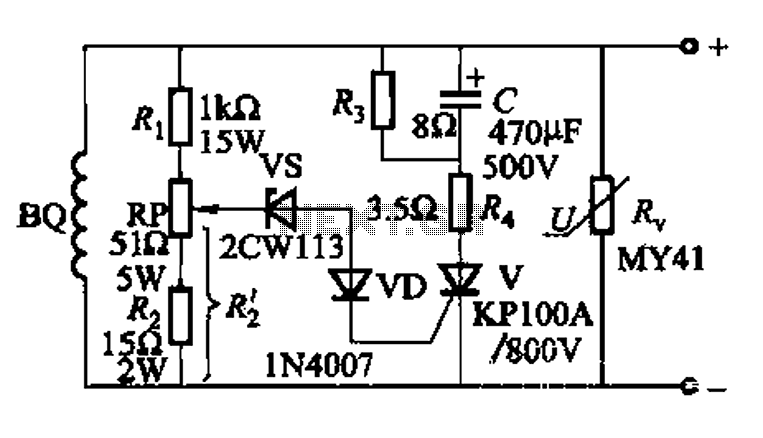
High voltage generator excitation set overvoltage protection circuit
The DC voltage for the generator field winding is supplied by a three-phase thyristor rectifier. In instances of incorrect operation, phase misalignment, or system failure, the rectifier may generate hazardous conditions, leading to over-voltage insulation issues on the DC side...
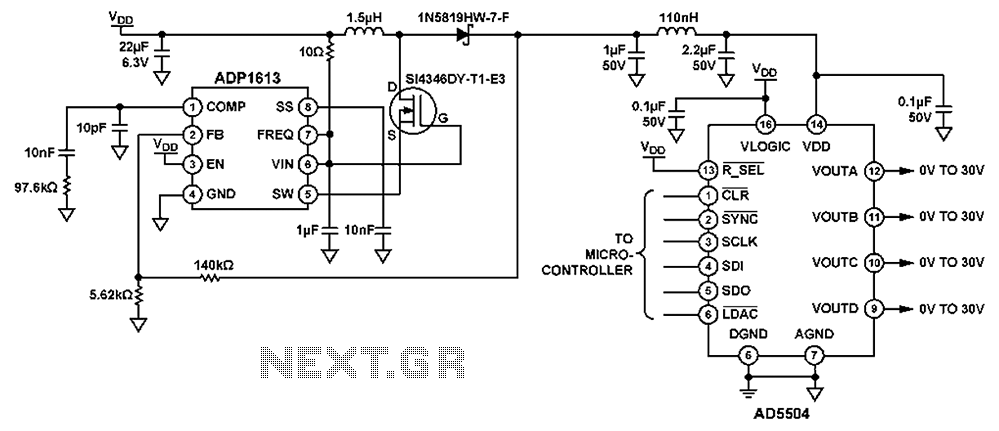
High voltage power supply and boost for the BST capacitor DAC provides a tuning signal circuit diagram
The circuit depicted in FIG. 1 generates a high-voltage signal for controlling the capacitance of barium strontium titanate (BST) capacitors. By applying voltages of V and 3V to the appropriate terminals, the capacitance of the BST can be modified. This...
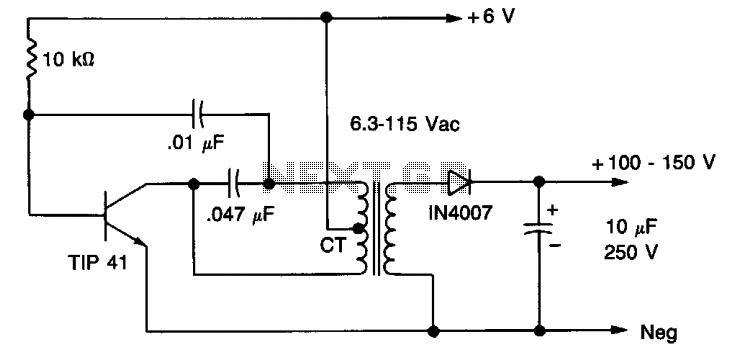
High voltage supply
A 6 V battery can provide 100-150 Vdc center-tapped at a high internal impedance (not dangerous though it can inflict an unpleasant jolt). A 6.3 V transformer is connected in reverse with a transistor used in a Hartley oscillator configuration....
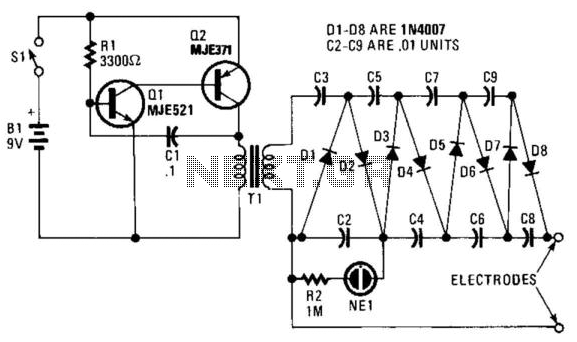
2000V Low-Current Power Supply
This circuit consists of components Q1, Q2, R1, and C1, which together create a multivibrator. The oscillation produced results in a square wave with a voltage peak-to-peak (Vpp) ranging from 20 to 30 volts. This output is then amplified by...
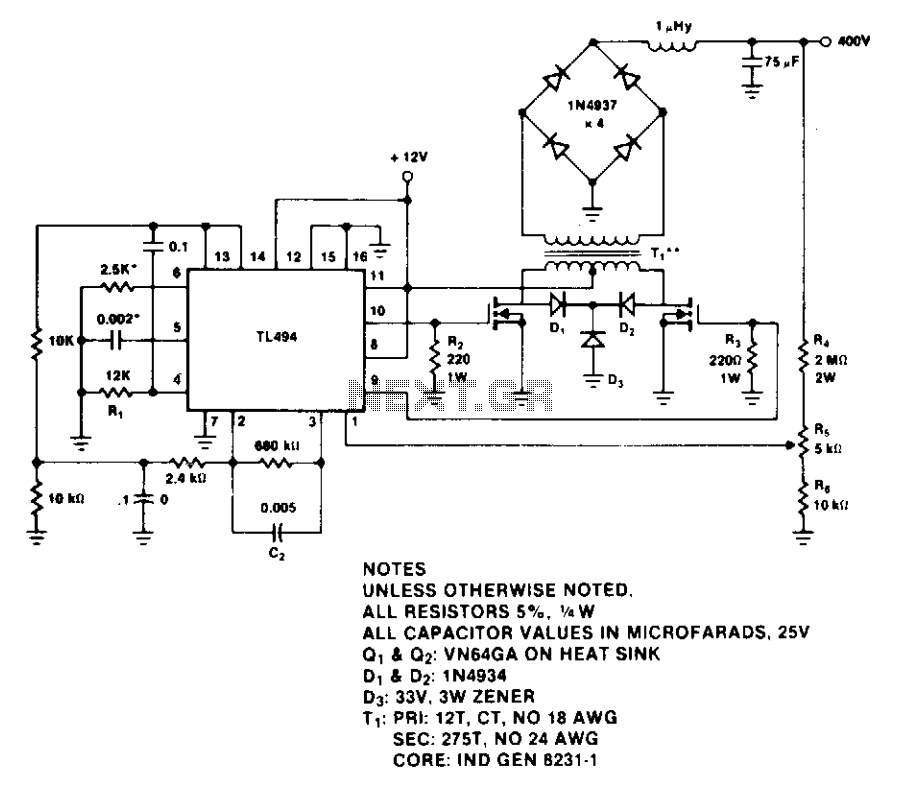
400-Volt 60-watt push-pull power supply
The design provides a regulated output of 400 V and 60 W. The TL494 switching regulator controls the operating frequency and output voltage regulation. Resistor R1 and capacitor C1 set the switching frequency, which is approximately 0.5 to 100 kHz...

Low Voltage to 30 kV Out
The circuit detailed in this document is designed to produce up to 30 kilovolts or more from a low-voltage DC source using a flyback transformer (LOPT) salvaged from a black-and-white or color television or computer monitor. With a typical 12...