


Cycle 100 MHz frequency counter circuit diagram
#frequency counter
#CD4016
#100 MHz
#digital output
#multiplexed
#measurement
#signal processing
#electronics
#circuit design
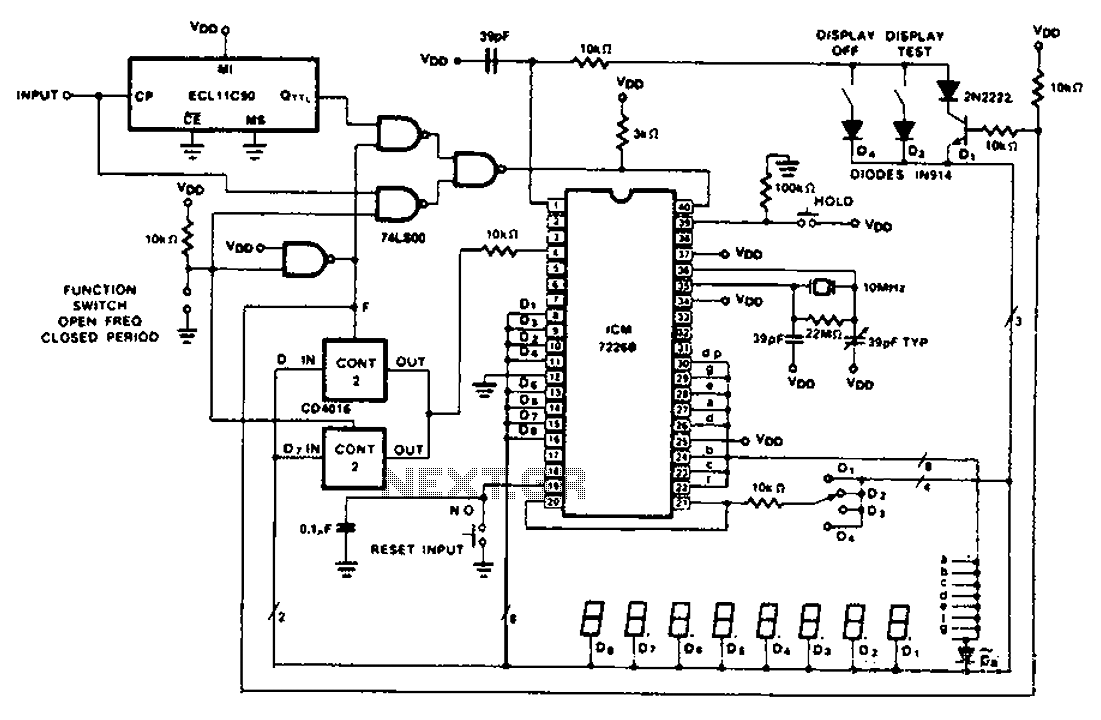
Description: A CD4016 analog instrument is utilized as a multiplexed digital output, transferring the output function back to the input. The CD4016 operates as a digitally controlled analog transmission gate, eliminating the need for a digital output level shift. Alternatives such as the CD4051 or CD4052 can also be employed to select the appropriate input from the ICM7226 multiplexed input.
The CD4016 is a quad bilateral switch that allows for the simultaneous control of multiple analog signals. Each switch in the CD4016 is controlled by a digital signal, enabling the selection of input signals based on the logic levels applied. This capability makes it suitable for applications requiring the multiplexing of signals without the necessity of additional level shifting circuitry, thereby simplifying the design and reducing component count.
In scenarios where the CD4016 may not meet specific requirements, the CD4051 or CD4052 can serve as viable alternatives. These devices are also analog multiplexers/demultiplexers, capable of routing multiple input signals to a single output or vice versa. The CD4051 can handle up to eight inputs, while the CD4052 can manage two sets of four inputs, providing flexibility based on the application needs.
When integrating these components with an ICM7226, which is a high-performance analog-to-digital converter (ADC), it is essential to ensure that the selected multiplexer aligns with the input signal characteristics and the desired sampling rate. Proper configuration and selection of the appropriate multiplexer will contribute to optimal system performance, ensuring accurate signal representation and minimal distortion during the analog-to-digital conversion process.
In summary, the CD4016, CD4051, and CD4052 play crucial roles in multiplexing applications, particularly in conjunction with devices like the ICM7226, facilitating efficient signal management in digital systems. As shown, a CD4016 analog instrument is used here as a multiple multiplexed digital output, these output transfer function back to the input. Since the CD4016 is a digitally co ntrolled analog transmission gate, so do not need a digital electrical output level shift. CD4051 or CD4052 can also be used to select the appropriate input ICM7226 multiplexed input.
The CD4016 is a quad bilateral switch that allows for the simultaneous control of multiple analog signals. Each switch in the CD4016 is controlled by a digital signal, enabling the selection of input signals based on the logic levels applied. This capability makes it suitable for applications requiring the multiplexing of signals without the necessity of additional level shifting circuitry, thereby simplifying the design and reducing component count.
In scenarios where the CD4016 may not meet specific requirements, the CD4051 or CD4052 can serve as viable alternatives. These devices are also analog multiplexers/demultiplexers, capable of routing multiple input signals to a single output or vice versa. The CD4051 can handle up to eight inputs, while the CD4052 can manage two sets of four inputs, providing flexibility based on the application needs.
When integrating these components with an ICM7226, which is a high-performance analog-to-digital converter (ADC), it is essential to ensure that the selected multiplexer aligns with the input signal characteristics and the desired sampling rate. Proper configuration and selection of the appropriate multiplexer will contribute to optimal system performance, ensuring accurate signal representation and minimal distortion during the analog-to-digital conversion process.
In summary, the CD4016, CD4051, and CD4052 play crucial roles in multiplexing applications, particularly in conjunction with devices like the ICM7226, facilitating efficient signal management in digital systems. As shown, a CD4016 analog instrument is used here as a multiple multiplexed digital output, these output transfer function back to the input. Since the CD4016 is a digitally co ntrolled analog transmission gate, so do not need a digital electrical output level shift. CD4051 or CD4052 can also be used to select the appropriate input ICM7226 multiplexed input.
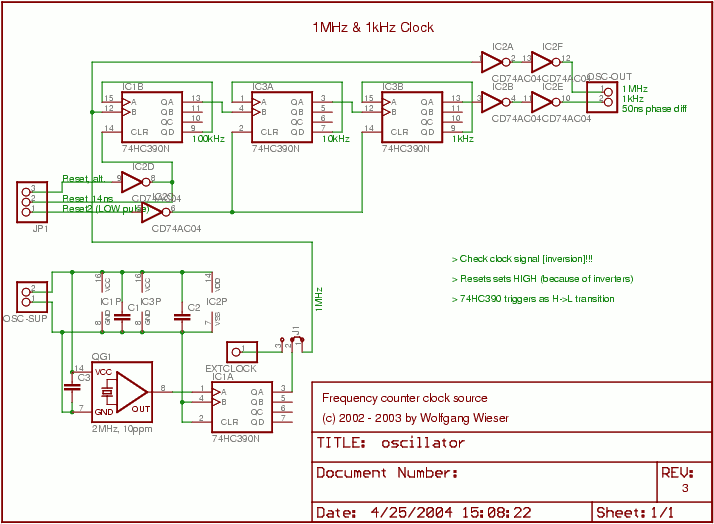
Frequency counter Oscillator schematic
The oscillator generates a 1 MHz and a 1 kHz clock signal. The 1 MHz clock serves as the primary clock for the microcontroller and provides a time base for millisecond measurements. A 2 MHz signal is divided by 2...
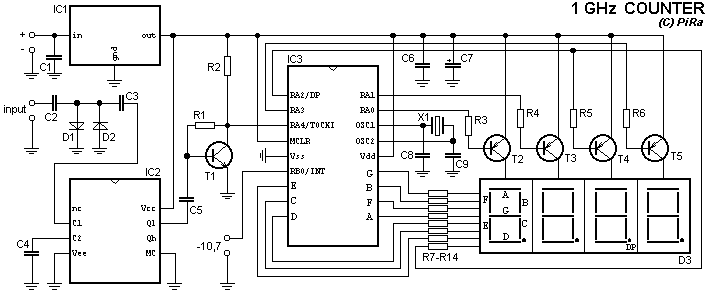
1 GHz Frequency Counter
This very simple counter can be used to measure the frequency of various wireless devices. Applies in reviving the transmitter and its operation as a control monitor frequency. It can be used as a scale to the receiver. Due to...
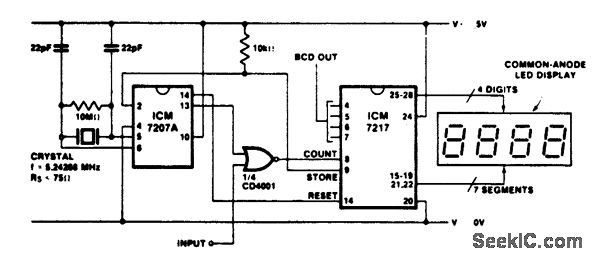
Precision frequency counter tachometer
Precision frequency counter/tachometer. The ICM7207A provides a 1-second gating window along with the store and reset signals. The display reads hertz directly. When pin 11 of the ICM7207A is connected to V+, the gating time will be 0.1 seconds, resulting...
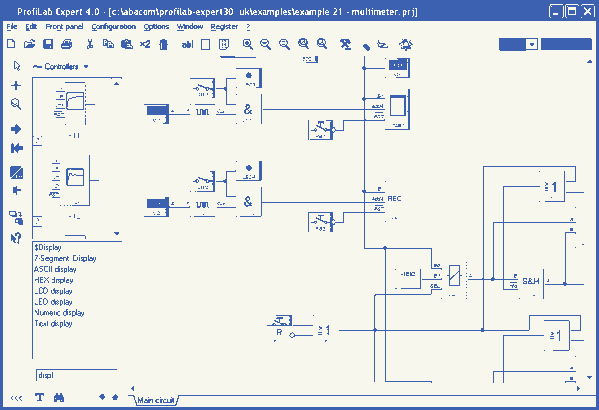
ProfiLab-Expert 4.0
The ProfiLab-Expert software allows you to develop your own digital or analogue measuring technology projects. It doesn't matter if you want to create analogue measurements or digital controls - you can realize it all. And for all this you don't...
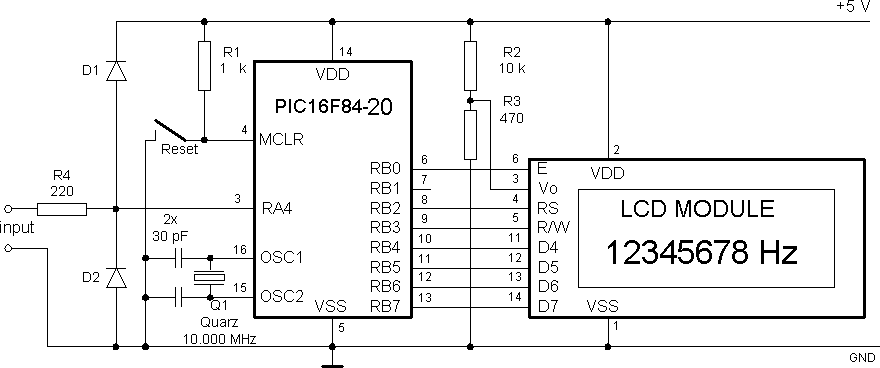
Frequency counter 400Hz to 50MHz with PIC 16F84
It consists only from Microchip PIC 16F84 cpu and LCD text module. Author states that this counter is capable metering frequencies from 400Hz to 50MHz. I used faster, 20MHz version of 16F84A-20I/P, and it managed to count 80MHz oscillator output....
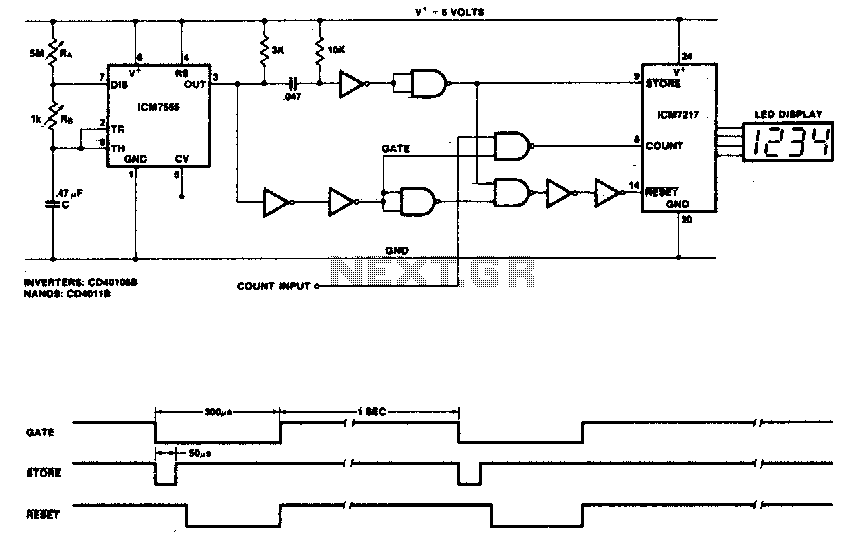
Inexpensive frequency counter-tachometer
This circuit utilizes the low-power ICM7555 (CMOS 555) to generate the gating, STORE, and RESET signals. The timer is configured as an astable multivibrator to provide the gating signal. Calibration of the system is achieved using a 5 MΩ potentiometer...
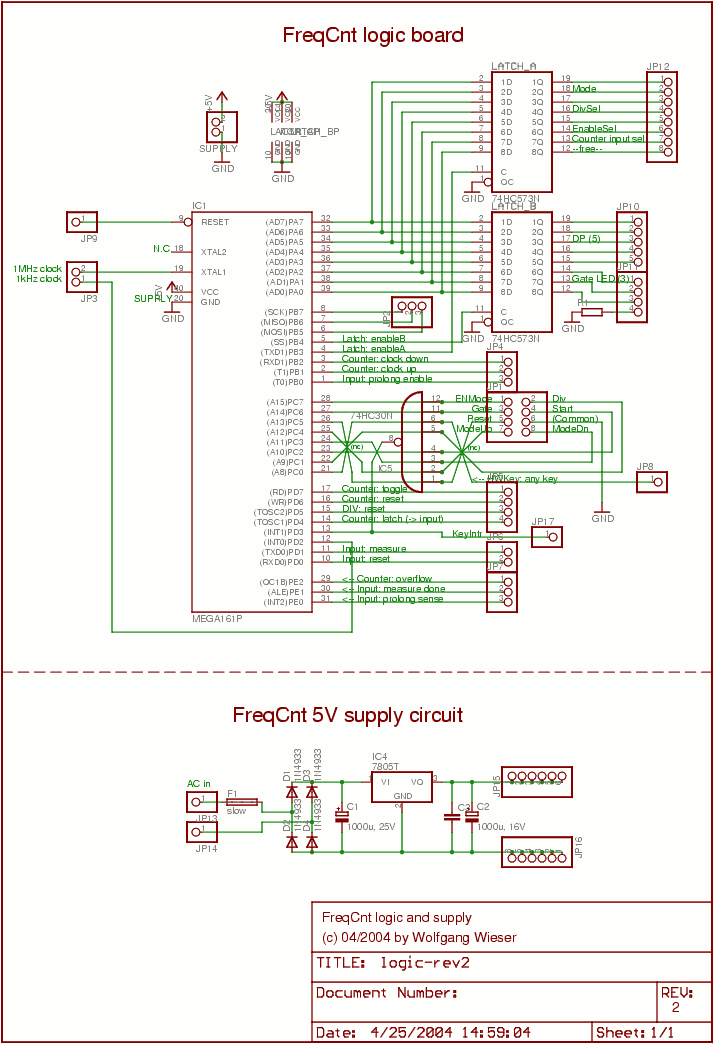
Frequency counter Logic schematic
The lower schematic represents a standard bidirectional rectifier along with capacitors and a 7805 voltage regulator, which provides a stable 5V source to power the electronic components of the frequency counter. A fuse is included for security purposes. The upper...
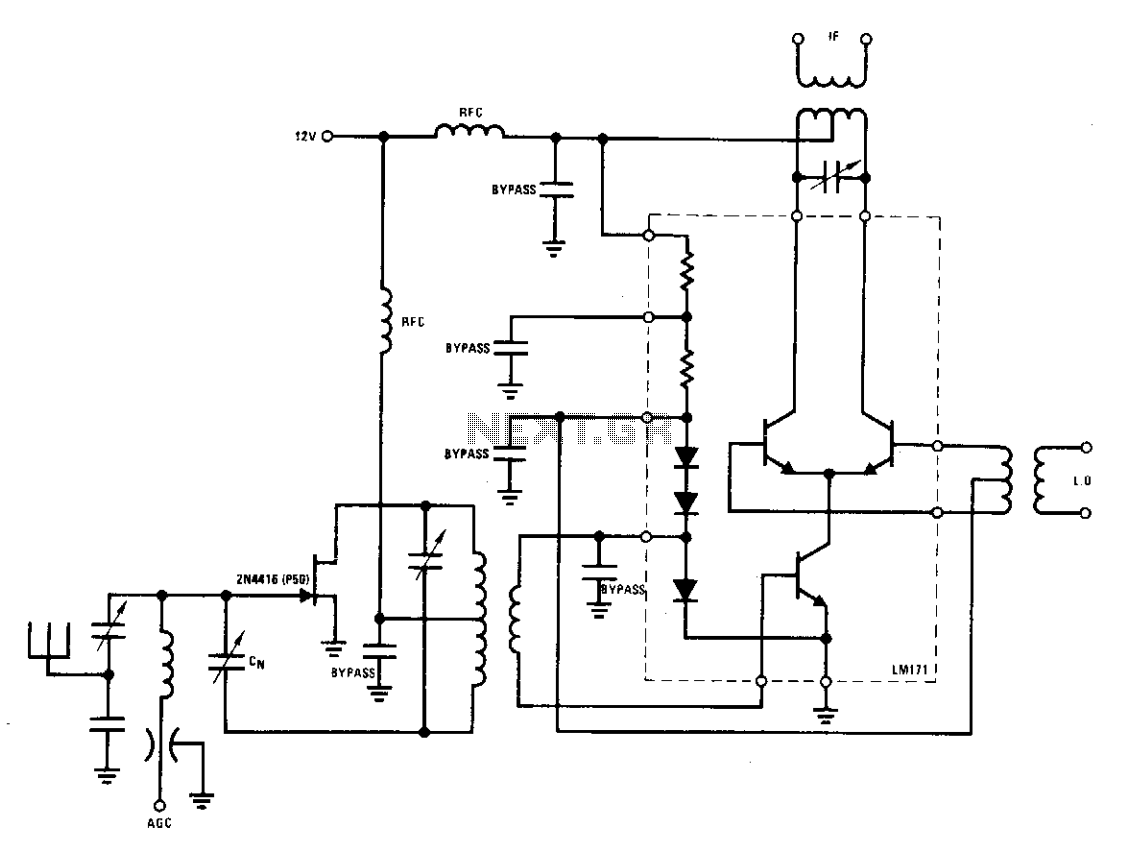
100 Mhz converter
The 2N4416 JFET offers noise figures below 3 dB and a power gain exceeding 20 dB. Its exceptional low crossmodulation and low intermodulation distortion make it an ideal choice for an input stage. The output connects to an LM171, which...
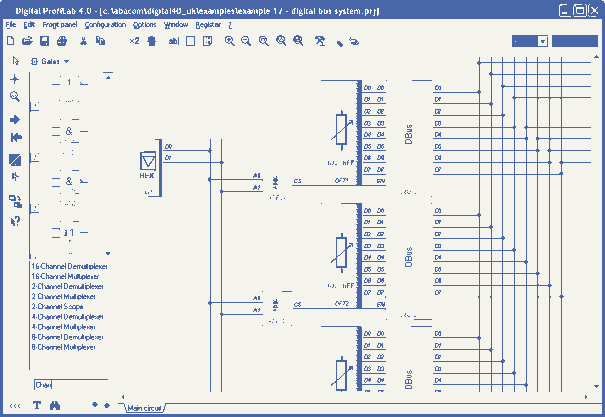
Digital-ProfiLab 4.0
Digital-ProfiLab was designed for measurement and control applications, combining features like circuit and logic simulation, front panel design, and hardware control to one powerful tool. Incoming signals from external devices may be processed and displayed. A circuit editor is used...