


Dynamic Testing of High-Speed ADCs Part 2
#ADC
#high-speed
#dynamic testing
#performance measurement
#test setup
#signal integrity
#data acquisition
#electronic testing
#application note
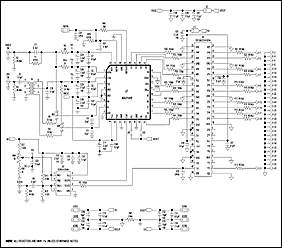
Description: The following article is a continuation of the application note titled "Defining and Testing Dynamic Parameters in High-Speed ADCs, Part 1." It outlines the test conditions and setup recommendations necessary for effectively measuring the dynamic performance parameters of high-speed analog-to-digital converters (ADCs).
This article provides essential guidelines for testing high-speed ADCs, focusing on the dynamic performance metrics crucial for evaluating their operational efficiency. Key parameters such as signal-to-noise ratio (SNR), total harmonic distortion (THD), and spurious-free dynamic range (SFDR) are discussed in detail. The recommended test conditions include specific configurations for input signals, sampling rates, and environmental factors that may influence measurement accuracy.
To achieve reliable results, the article emphasizes the importance of using calibrated test equipment and appropriate signal sources. It suggests employing high-quality oscilloscopes and signal generators that can operate at the ADC's specified frequency range. Additionally, proper grounding and shielding techniques are recommended to minimize noise and interference during the testing process.
The article also addresses the setup of the test environment, highlighting the need for stable power supplies and controlled temperature conditions to ensure consistent performance across multiple measurements. By following these guidelines, engineers can obtain a comprehensive understanding of the dynamic performance of high-speed ADCs, facilitating better design and optimization of electronic systems that incorporate these components.The following article is a follow-up application note to `Defining and Testing Dynamic Parameters in High-Speed ADCs, Part 1`. It details test conditions and setup recommendations to efficiently measure the dynamic performance parameters of high-spee..
This article provides essential guidelines for testing high-speed ADCs, focusing on the dynamic performance metrics crucial for evaluating their operational efficiency. Key parameters such as signal-to-noise ratio (SNR), total harmonic distortion (THD), and spurious-free dynamic range (SFDR) are discussed in detail. The recommended test conditions include specific configurations for input signals, sampling rates, and environmental factors that may influence measurement accuracy.
To achieve reliable results, the article emphasizes the importance of using calibrated test equipment and appropriate signal sources. It suggests employing high-quality oscilloscopes and signal generators that can operate at the ADC's specified frequency range. Additionally, proper grounding and shielding techniques are recommended to minimize noise and interference during the testing process.
The article also addresses the setup of the test environment, highlighting the need for stable power supplies and controlled temperature conditions to ensure consistent performance across multiple measurements. By following these guidelines, engineers can obtain a comprehensive understanding of the dynamic performance of high-speed ADCs, facilitating better design and optimization of electronic systems that incorporate these components.The following article is a follow-up application note to `Defining and Testing Dynamic Parameters in High-Speed ADCs, Part 1`. It details test conditions and setup recommendations to efficiently measure the dynamic performance parameters of high-spee..
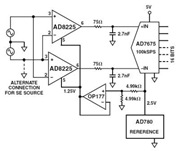
AD8225 High Resolution Analog/Digital Converter (ADC)Circuit and Datasheet
The Common Mode Rejection Ratio (CMRR) facilitates the rejection of high-frequency common-mode voltages, leading to the attenuation of elevated ambient noise levels from utility lines, industrial machinery, and other sources of radiation. The circuit diagram presented illustrates the advantages of...
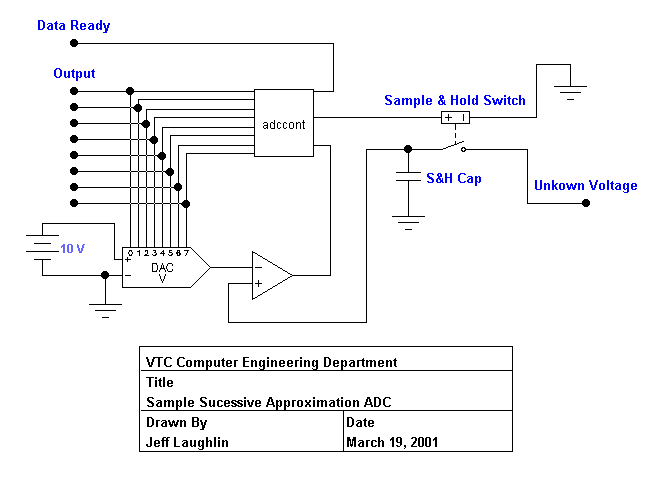
Analog to Digital Converters
The successive approximation Analog to Digital Converter (ADC) is one of the most common types of ADC. It requires few components and is straightforward to operate. Additionally, it always takes the same amount of time to calculate the result. Essentially,...
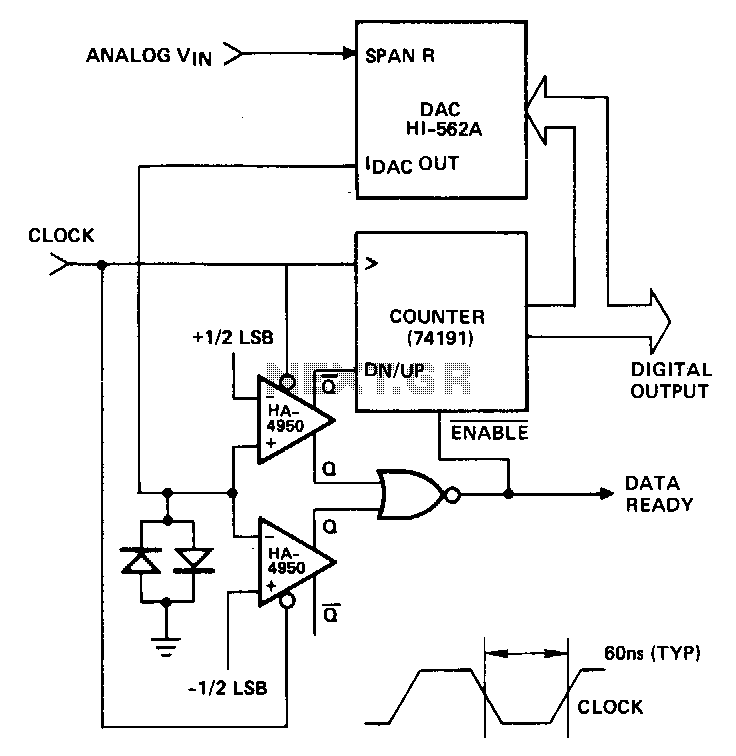
Tracking-adc
The analog input is connected to the span resistor of a Digital-to-Analog Converter (DAC). The voltage range of the analog input is selectable, mirroring the output voltage range of the DAC. The current flowing through the ladder termination resistance, which...
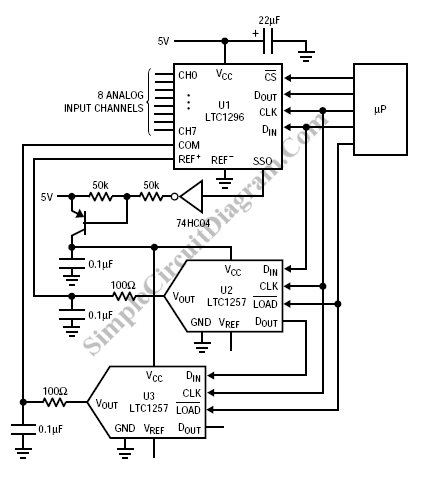
Autoranging Circuit
To extend the measurement range of an available ADC (analog to digital converter), autoranging can be utilized. If implemented on multiplexed input, this...
Autoranging is a technique employed in electronic measurement systems to automatically adjust the range of an analog-to-digital converter...
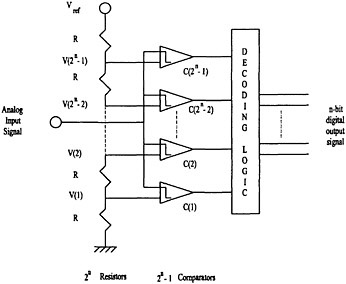
TYPES OF ANALOG-TO-DIGITAL CONVERTERS
Analog-to-digital converters are categorized into one-step architectures, including flash, folding, and interpolative topologies, as well as multi-step architectures, such as successive approximation and pipeline topologies. The flash architecture is considered the fastest type of analog-to-digital converter due to its parallel...
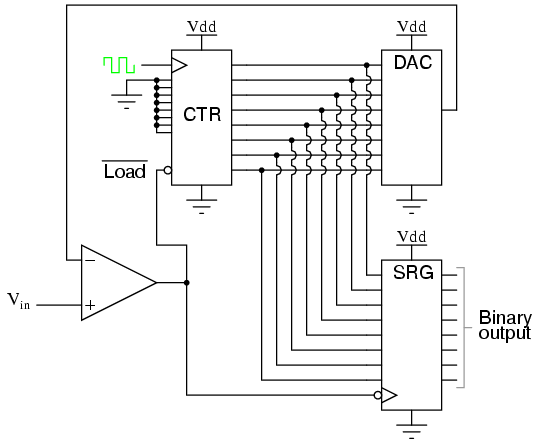
Digital Ramp ADC
Also known as the stairstep-ramp or simply counter A/D converter, this type of converter is relatively straightforward to comprehend but unfortunately has several limitations.
The stairstep-ramp or counter A/D converter operates on the principle of comparing an analog input voltage to...
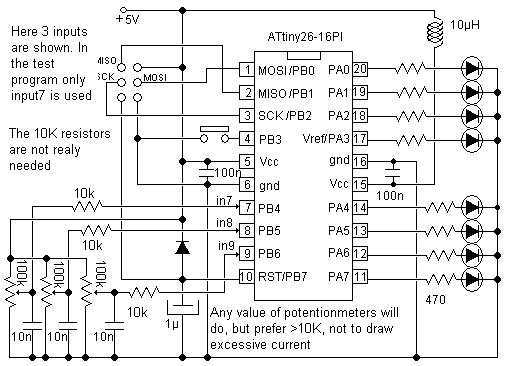
10 Bit analog to digital converter
Study the Analog to Digital capabilities of Atmel ATtiny26. This tiny but mighty IC is really a miracle. One special thing is the internal 10-inputs multiplexed ADC circuit which can convert analog voltages to bytes. This check circuit uses only...
Autoranging Circuit
To extend the measurement range of an available ADC (analog to digital converter), autoranging can be utilized. If implemented on multiplexed input, this...
Autoranging is a technique employed in electronic measurement systems to automatically adjust the range of an analog-to-digital converter...
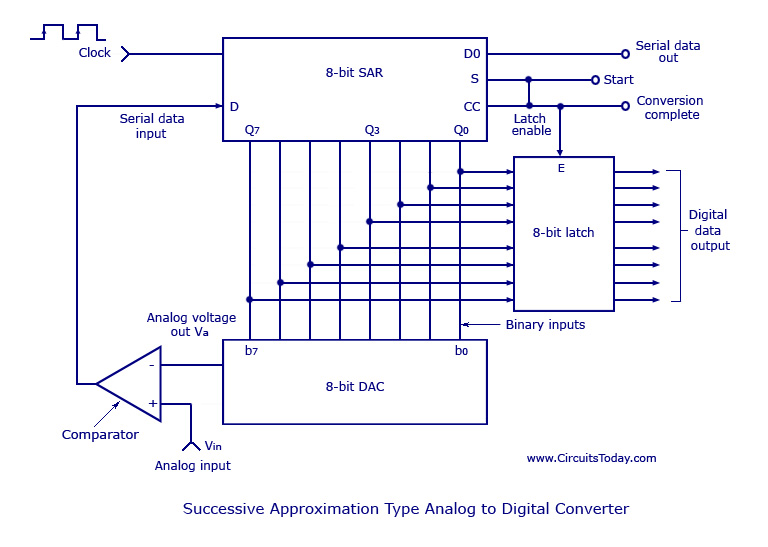
Analog to Digital Converters - Successive Approximation Typeworking
Analog to Digital Converters - Successive Approximation Type Analog to Digital Converter, working, circuit diagram.
The Successive Approximation Register (SAR) Analog to Digital Converter (ADC) is a widely used type of ADC that converts an analog signal into a digital output....