


Optical-pick-up-tachometer
#optical
#tachometer
#noncontact
#speed measurement
#rotating objects
#portable
#light pulses
#calibration
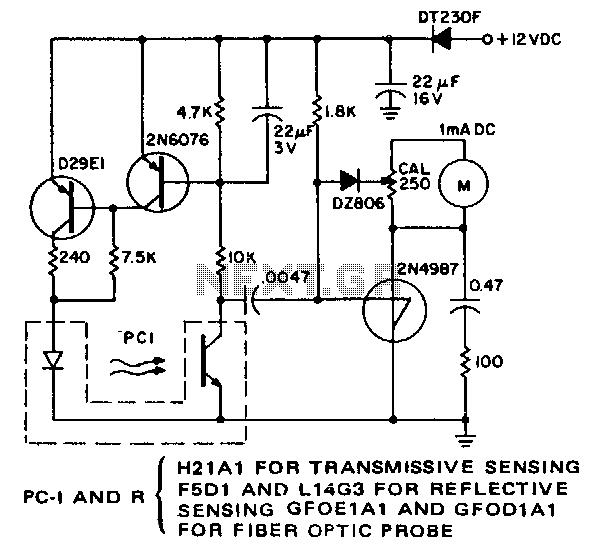
Description: The purpose of this simple circuit is to enable remote, non-contact measurement of the speed of rotating objects. The circuit exhibits high linearity and accuracy, typically constrained by the milliammeter utilized and the initial calibration process. It is configured to count the leading edge of light pulses while disregarding normal ambient light levels. Designed for portable operation, the tachometer is not sensitive to supply voltage variations within the specified voltage tolerance. Full scale at maximum sensitivity of the calibration resistance is achieved at approximately 300 light pulses per second. A digital voltmeter can be employed on the 100 mV full-scale range instead of the milliammeter. To adapt the input of the digital voltmeter, it should be shunted with a 100-ohm resistor in parallel with a 100 microfarad capacitor. This RC network serves as a substitute for the filtering typically provided by the analog meter.
The circuit operates by detecting light pulses emitted by a rotating object, which can be achieved using a phototransistor or photodiode positioned to capture the reflected light. When the light beam is interrupted or reflected, the circuit registers a pulse corresponding to the rotation. The configuration allows for a high degree of sensitivity, ensuring that even low light levels from the object can be detected effectively while filtering out ambient light interference.
The calibration process involves adjusting the resistance to achieve the desired sensitivity, allowing the circuit to accurately reflect the speed of rotation in terms of light pulse count. The output can be displayed on a digital voltmeter, which provides a clear and precise reading of the speed. The use of a 100-ohm shunt resistor and a 100 microfarad capacitor creates a low-pass filter, smoothing out any rapid fluctuations in the signal and enhancing measurement stability.
This portable tachometer circuit is particularly useful in applications where traditional contact methods are impractical, such as in high-speed machinery or delicate components that cannot be physically touched. The design ensures reliable operation across a range of supply voltages, making it versatile for various environments and conditions.Remote, noncontact, measurement of the speed of rotating objects is the purpose of this simple circuit. Linearity and accuracy are extremely high and normally limited by the milliammeter used and the initial calibration.
This circuit is configured to count the leading edge of light pulses and to ignore normal ambient light levels. It is designed for portable operation since the tachometer is not sensitive to supply voltage within the supply voltage tolerance.
Full scale at the maximum sensitivity of the calibration resistance is read at about 300 light pulses per second. A digital voltmeter.can be used, on the 100-mV full-scale range, in place of the milliammeter. Shunt its input with a 100-0 resistor in parallel with a 100-~F capacitor. This rc network replaces the filtering supplied by the analog meter.
The circuit operates by detecting light pulses emitted by a rotating object, which can be achieved using a phototransistor or photodiode positioned to capture the reflected light. When the light beam is interrupted or reflected, the circuit registers a pulse corresponding to the rotation. The configuration allows for a high degree of sensitivity, ensuring that even low light levels from the object can be detected effectively while filtering out ambient light interference.
The calibration process involves adjusting the resistance to achieve the desired sensitivity, allowing the circuit to accurately reflect the speed of rotation in terms of light pulse count. The output can be displayed on a digital voltmeter, which provides a clear and precise reading of the speed. The use of a 100-ohm shunt resistor and a 100 microfarad capacitor creates a low-pass filter, smoothing out any rapid fluctuations in the signal and enhancing measurement stability.
This portable tachometer circuit is particularly useful in applications where traditional contact methods are impractical, such as in high-speed machinery or delicate components that cannot be physically touched. The design ensures reliable operation across a range of supply voltages, making it versatile for various environments and conditions.Remote, noncontact, measurement of the speed of rotating objects is the purpose of this simple circuit. Linearity and accuracy are extremely high and normally limited by the milliammeter used and the initial calibration.
This circuit is configured to count the leading edge of light pulses and to ignore normal ambient light levels. It is designed for portable operation since the tachometer is not sensitive to supply voltage within the supply voltage tolerance.
Full scale at the maximum sensitivity of the calibration resistance is read at about 300 light pulses per second. A digital voltmeter.can be used, on the 100-mV full-scale range, in place of the milliammeter. Shunt its input with a 100-0 resistor in parallel with a 100-~F capacitor. This rc network replaces the filtering supplied by the analog meter.
Digital-tach-dwell-meter
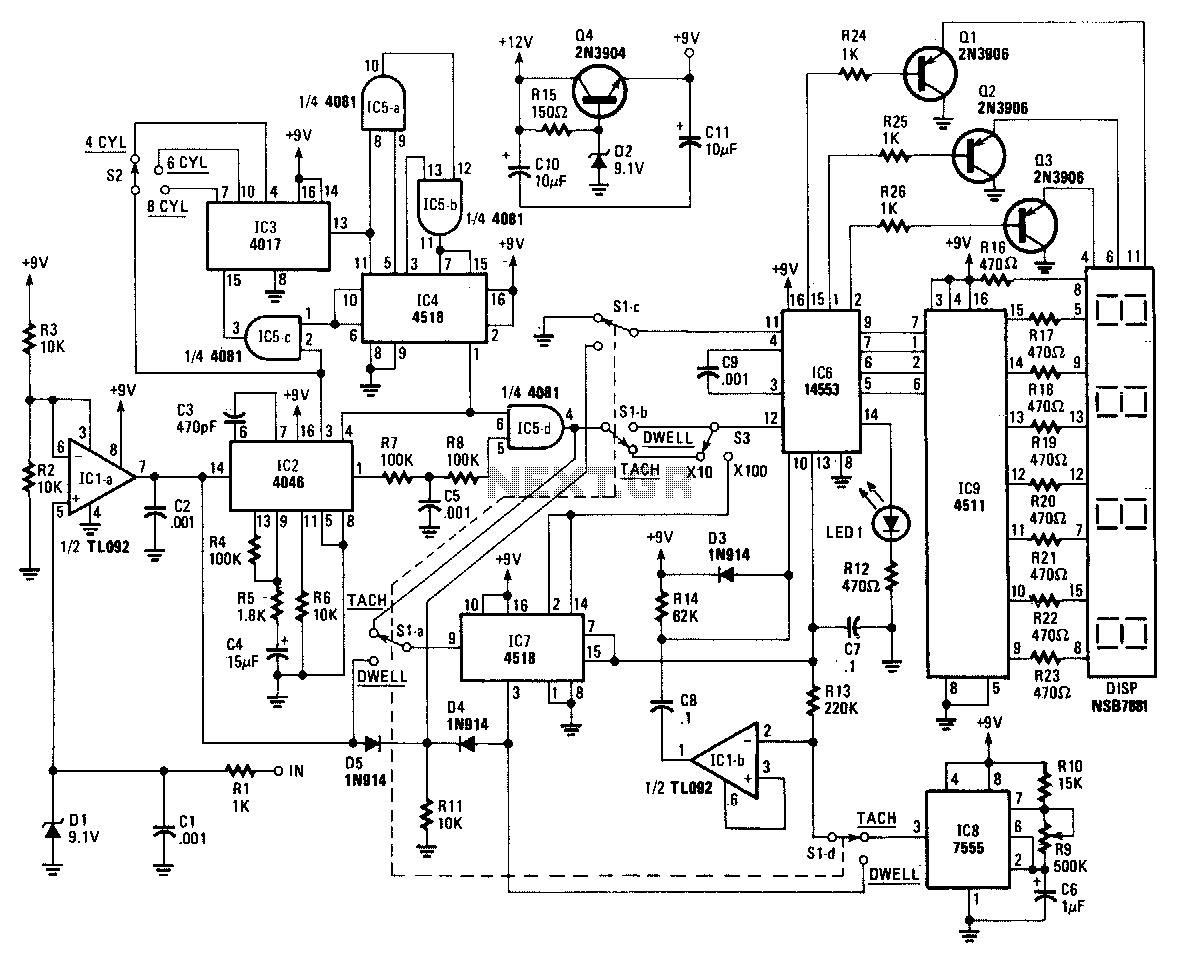
The core component of the circuit is ICZ, a 4046 micropower phase-locked loop (PLL). The incoming signals are processed through a buffer, IC1a, and its associated components before being fed into the PLL. The frequency of the incoming signal is...
rear wheel tachometer
One of the goals of Movable Party is to provide an interactive experience for audiences and participants. Power will be generated from a hub motor attached to the rear wheel of each bike, with the speed of the rear wheel...
Electronic Tachometer
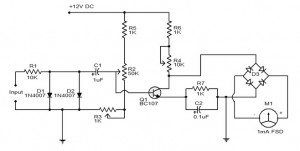
The electronic tachometer frequency converter circuit operates by converting the input signal into a proportional current that can be measured by a pointer device.
The electronic tachometer frequency converter circuit is designed to accurately measure the rotational speed of a mechanical...
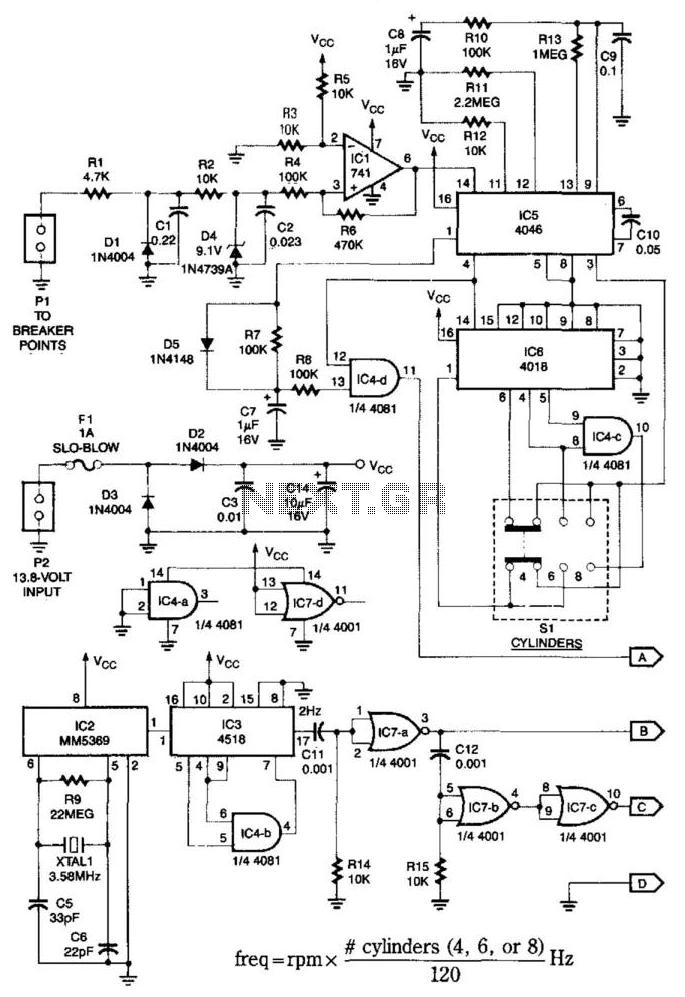
Digital Tachometer Circuitry
This system is compatible with 4-, 6-, or 8-cylinder automobiles. The timebase generated by IC5 functions as an oscillator that drives counter IC6, which divides the frequency by 6, 4, or 3 for 4-, 6-, or 8-cylinder engines, respectively. Switch...
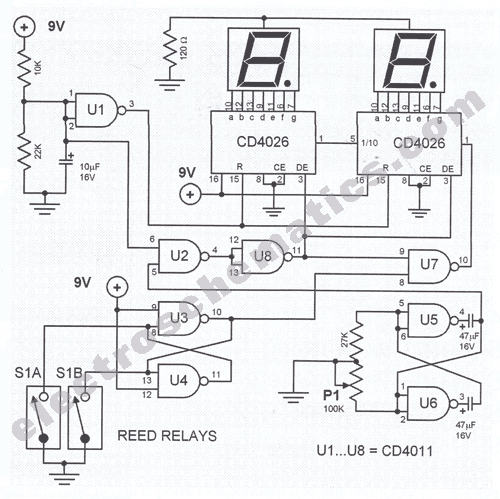
Digital Bike Tachometer Circuit
This digital DIY tachometer for bicycles utilizes two reed switches to gather speed information. The reed switches are positioned near the wheel rim, where permanent magnets are mounted on the wheel spokes. As the spokes rotate, the magnets pass by...
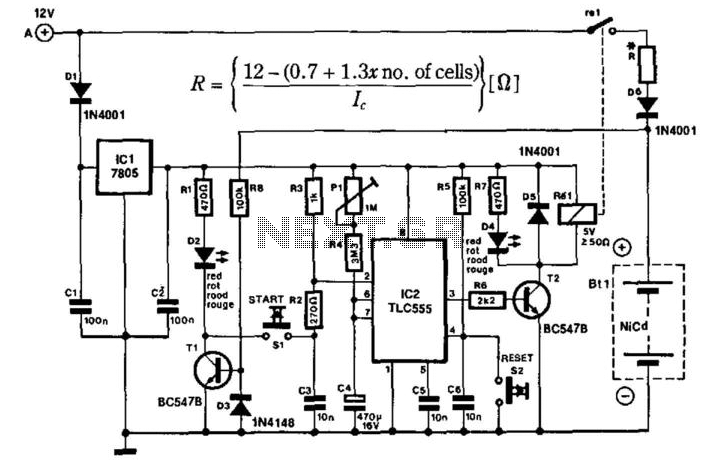
Portable Nicad Charger
The portable charger is designed primarily for model enthusiasts to charge their NiCad batteries using a car battery outdoors. The circuit's supply voltage is regulated by IC1. When connected to the car battery, LED D2 illuminates only if the NiCad...
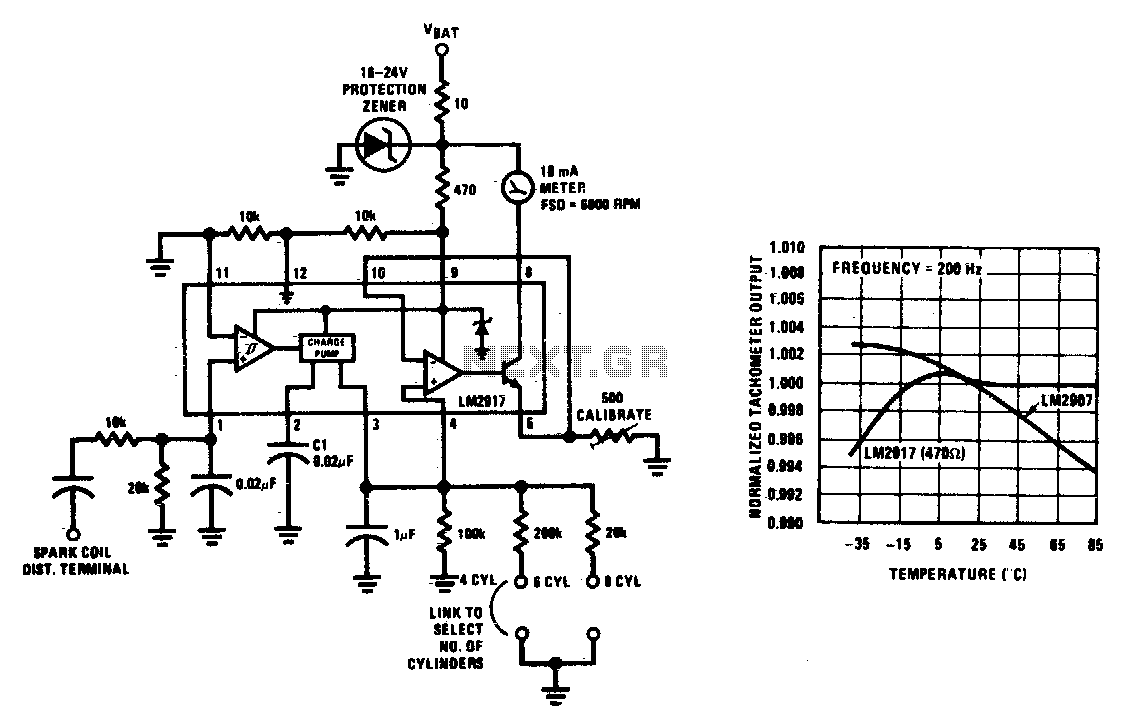
Gasoline engine tachometer
This tachometer can be configured for any number of cylinders by connecting the appropriate timing resistor as illustrated. A 500-ohm trim resistor can be utilized for final calibration. Additionally, a protection circuit consisting of a 10-ohm resistor and a Zener...
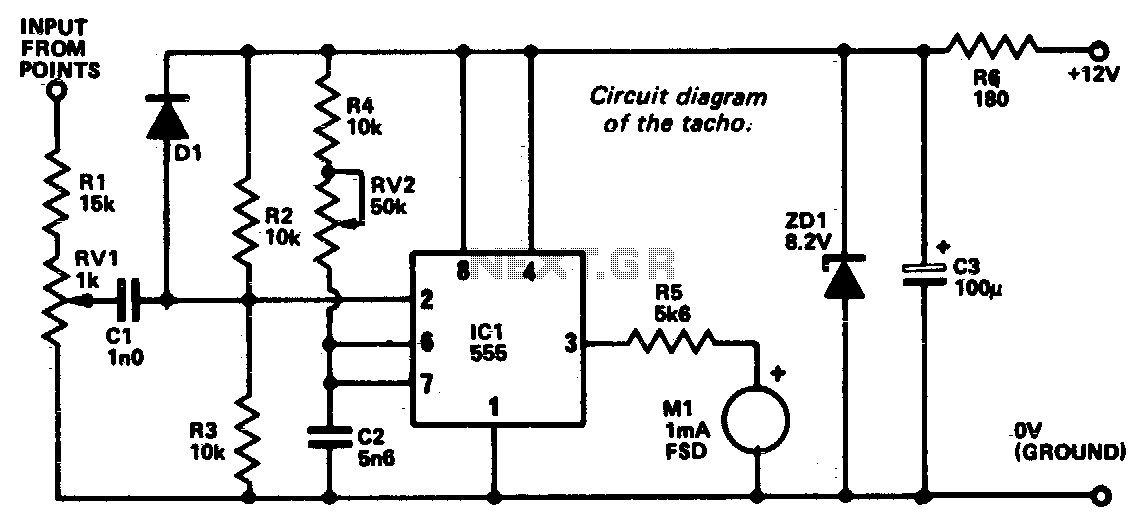
Tachometer
An electrical signal from the low tension side of the distributor is converted into a voltage that is proportional to engine RPM, and this voltage is displayed on a meter calibrated accordingly. The 555 timer integrated circuit (IC) operates in...
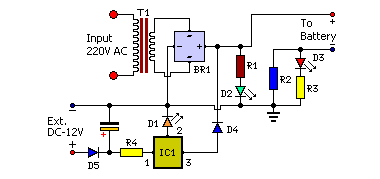
Mobile Phone Battery Charger
A small and portable unit that can be assembled on a veroboard. Mobile phone chargers available in the market are quite expensive. The circuit presented here comes...
The described circuit is a compact and cost-effective mobile phone charger designed for assembly...