


Pocket-sized geiger counter
#geiger counter
#regulated power supply
#multivibrator
#comparator
#step-up transformer
#pulse generator
#high voltage
#battery powered
#count-rate meter
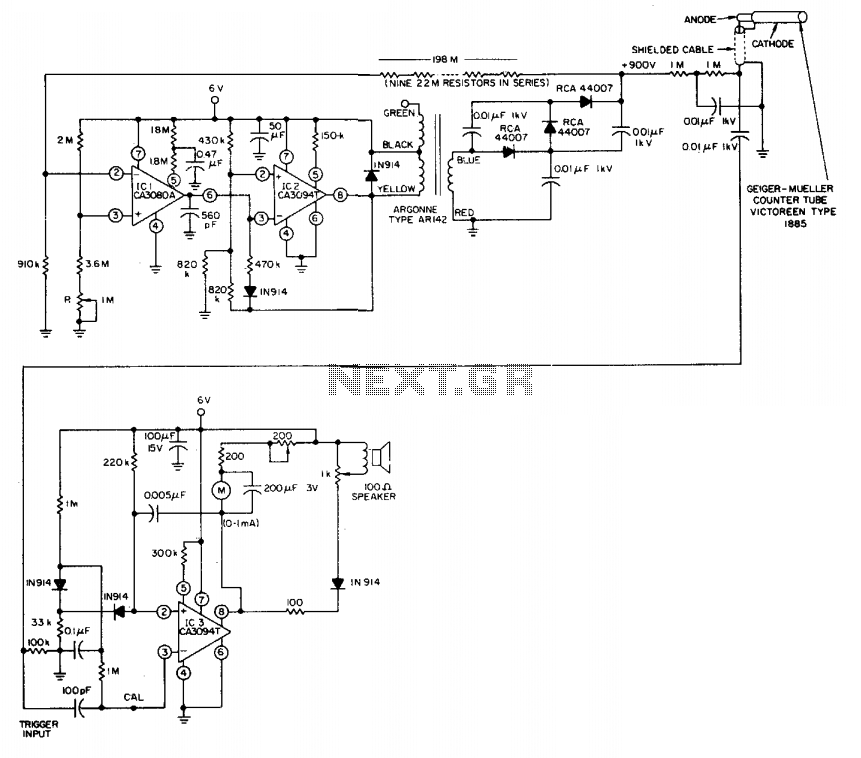
Description: A single 6.75 V mercury battery powers the counter, which features a 1 mA count-rate meter as well as an aural output. A regulated 900 V supply provides stable operation of the counter tube. A multivibrator, built around a differential power amplifier IC2, drives the step-up transformer. Comparator IC1 varies the multivibrator duty cycle to provide a constant 900 V. The entire regulated supply draws less than 2 mA. A one-shot multivibrator, built with IC3, provides output pulses that have constant width and amplitude. Thus, the average current through the meter is directly proportional to the pulse-rate output from the counter tube. The constant-width pulses also drive the speaker. Full-scale meter deflection (1 mA) represents 5000 counts/min, or 83.3 pulses/s. A convenient calibration checkpoint can be provided on the meter scale for 3600 ppm (60 pulses/s).
The described circuit operates on a 6.75 V mercury battery, which is a compact power source suitable for low-power applications. The counter is designed to measure pulse rates, with the output displayed on a 1 mA analog meter and an associated audible signal. The use of a regulated 900 V supply is critical for maintaining the performance of the counter tube, ensuring consistent operation and accuracy in pulse detection.
The multivibrator circuit, constructed using a differential power amplifier (IC2), is responsible for generating the necessary high-voltage pulses to drive a step-up transformer. This transformer increases the voltage to the required 900 V for the counter tube. The comparator circuit (IC1) plays a vital role in controlling the duty cycle of the multivibrator, which in turn stabilizes the output voltage, ensuring that the counter tube operates efficiently without fluctuations that could affect measurement accuracy.
The regulated supply is designed to be energy-efficient, drawing less than 2 mA, which is particularly advantageous for battery-operated devices, extending their operational lifespan. The one-shot multivibrator (IC3) produces output pulses of fixed width and amplitude, which are essential for providing a reliable pulse rate to the meter. The average current through the meter correlates directly with the pulse rate output from the counter tube, facilitating straightforward interpretation of the measurements.
At full-scale deflection, the meter reads 1 mA, which corresponds to a pulse rate of 5000 counts per minute or approximately 83.3 pulses per second. For ease of use and calibration, a specific checkpoint is marked on the meter scale to indicate a pulse rate of 3600 parts per million (ppm), equating to 60 pulses per second. This feature enhances the usability of the device by allowing users to quickly reference standard measurement rates during operation.A single 6.75 V mercury battery powers the counter, which features a 1 mA count-rate meter as well as an aural output. A regulated 900 V supply provides stable operation of the counter tube. A multivibrator, built around a differential power amplifier IC2, drives the step-up transformer. Comparator IC1 varies the multivibrator duty cycle to provide a constant 900 V. The entire regulated supply draws less than 2 mA. A one-shot multivibrator, built with IC3, provides output pulses that have constant width and amplitude.
Thus the average current through the meter is directly proportional to the pulse-rate output from the counter tube. And the constant-width pulses also drive the speaker. Full-scale meter deflection (1 mA) represents 5000 counts/min, or 83.3 pulses/s. A convenient calibration checkpoint can be provided on the meter scale for 3600 ppm (60 pulses/s.)
The described circuit operates on a 6.75 V mercury battery, which is a compact power source suitable for low-power applications. The counter is designed to measure pulse rates, with the output displayed on a 1 mA analog meter and an associated audible signal. The use of a regulated 900 V supply is critical for maintaining the performance of the counter tube, ensuring consistent operation and accuracy in pulse detection.
The multivibrator circuit, constructed using a differential power amplifier (IC2), is responsible for generating the necessary high-voltage pulses to drive a step-up transformer. This transformer increases the voltage to the required 900 V for the counter tube. The comparator circuit (IC1) plays a vital role in controlling the duty cycle of the multivibrator, which in turn stabilizes the output voltage, ensuring that the counter tube operates efficiently without fluctuations that could affect measurement accuracy.
The regulated supply is designed to be energy-efficient, drawing less than 2 mA, which is particularly advantageous for battery-operated devices, extending their operational lifespan. The one-shot multivibrator (IC3) produces output pulses of fixed width and amplitude, which are essential for providing a reliable pulse rate to the meter. The average current through the meter correlates directly with the pulse rate output from the counter tube, facilitating straightforward interpretation of the measurements.
At full-scale deflection, the meter reads 1 mA, which corresponds to a pulse rate of 5000 counts per minute or approximately 83.3 pulses per second. For ease of use and calibration, a specific checkpoint is marked on the meter scale to indicate a pulse rate of 3600 parts per million (ppm), equating to 60 pulses per second. This feature enhances the usability of the device by allowing users to quickly reference standard measurement rates during operation.A single 6.75 V mercury battery powers the counter, which features a 1 mA count-rate meter as well as an aural output. A regulated 900 V supply provides stable operation of the counter tube. A multivibrator, built around a differential power amplifier IC2, drives the step-up transformer. Comparator IC1 varies the multivibrator duty cycle to provide a constant 900 V. The entire regulated supply draws less than 2 mA. A one-shot multivibrator, built with IC3, provides output pulses that have constant width and amplitude.
Thus the average current through the meter is directly proportional to the pulse-rate output from the counter tube. And the constant-width pulses also drive the speaker. Full-scale meter deflection (1 mA) represents 5000 counts/min, or 83.3 pulses/s. A convenient calibration checkpoint can be provided on the meter scale for 3600 ppm (60 pulses/s.)
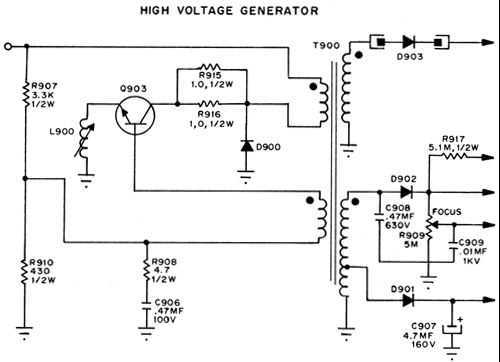
High Voltafe Generator
This is a series regulator with Q900 being the control element, Q901 a driver, and Q902 an error amp. ZD900 forms the emitter reference voltage source. Since the generated high voltage and other voltages are linked by means of the...
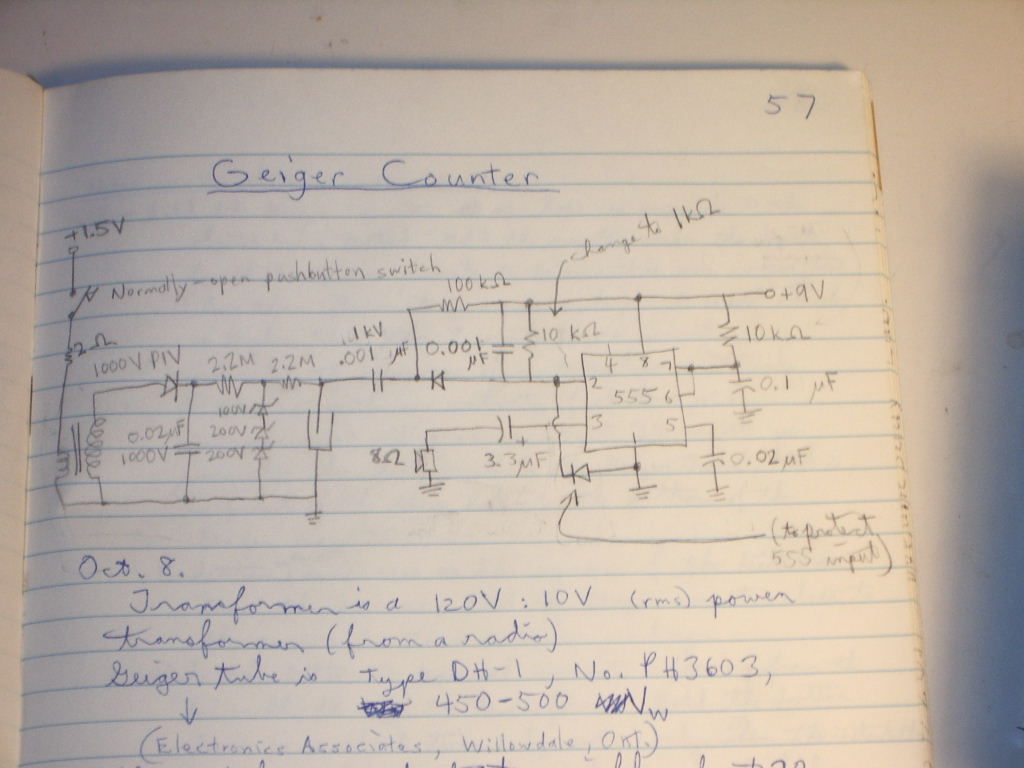
Geiger Counter
This is a simple Geiger counter circuit designed for quick publication, potentially useful for individuals in Japan. It requires some specialized components.
The simple Geiger counter circuit typically consists of a Geiger-Müller (GM) tube, which is the primary sensing element that...
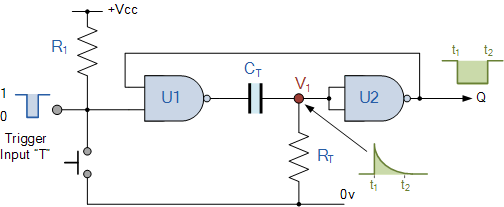
Multivibrators including Monostable Astable and Bistable
Electronics tutorial about multivibrators, including monostable multivibrator circuits, astable multivibrators, bistable oscillators, and clocks.
Multivibrators are essential electronic circuits that generate specific output waveforms based on their configuration. They are classified into three primary types: monostable, astable, and bistable multivibrators. Each...
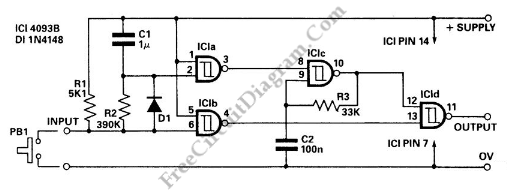
Pulse Delay Generator
This circuit is a delayed pulse generator that provides pulse rate and independent control of the initial delay. The pulse generator of this circuit is.
The delayed pulse generator circuit is designed to produce a pulse output after a specified delay,...
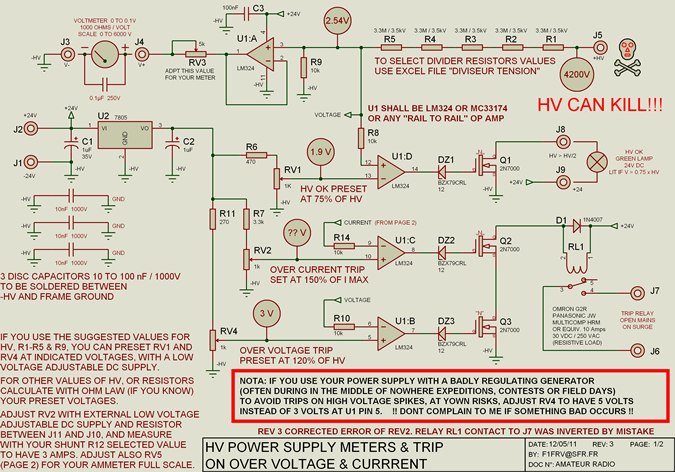
HV SUPPLY METERING & OVERVOLTAGE TRIP
High voltage resistors for the high voltage divider are SFERNICE or PHILIPS type VR37 (3.5 kV - 0.4 W). They are not expensive (even if they are sold in quantities of 25 or 50 units), and it is always useful...
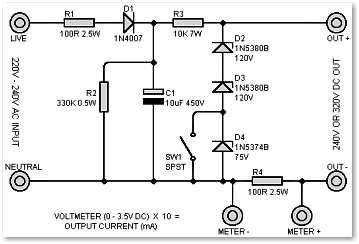
High Voltage Electrolytic Capacitor Reformer
High voltage electrolytic capacitors in valve equipment can deteriorate if the equipment is unused for an extended period. This deterioration manifests as reduced capacitance and significantly increased leakage current. In some instances, the capacitor may become nearly short-circuited. Using equipment...
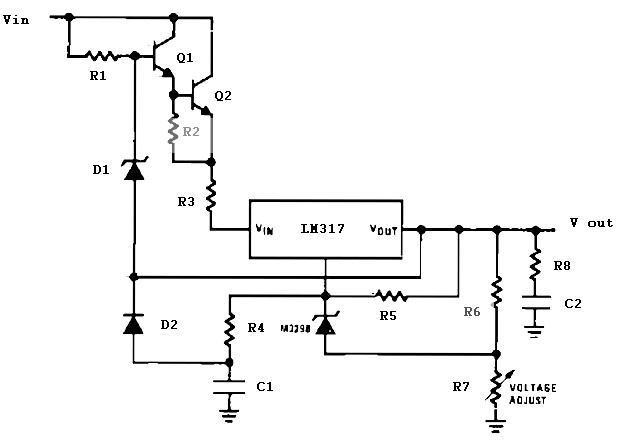
precision high voltage regulator
Precision high voltage regulator power supply. Refer to the corresponding page for an explanation of the related circuit diagram for the power supply. This simple switching regulator circuit provides a 5 V output, with the input supplied by a 9...
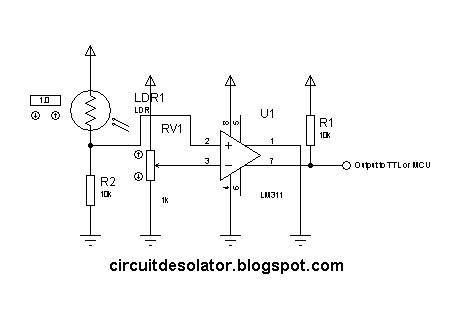
simple analog comparator
This is a common circuit block utilized in both digital and analog electronics. Its output depends on the relationship between its two input pins. One input is designated to provide the reference voltage, while the other is typically connected to...

Low Voltage to 30 kV Out
The circuit detailed in this document is designed to produce up to 30 kilovolts or more from a low-voltage DC source using a flyback transformer (LOPT) salvaged from a black-and-white or color television or computer monitor. With a typical 12...