


Signal Meter Circuit
#signal meter
#CA3189
#logarithmic detector
#shortwave receivers
#audio amplifier
#phase demodulator
#symmetrical limiter
#signal reading
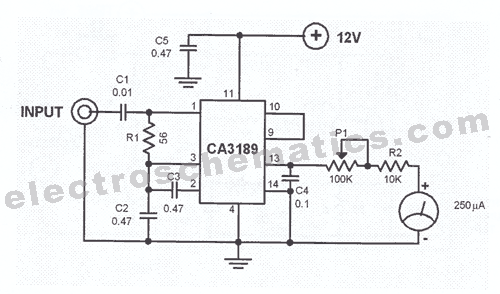
Description: The CA3189 integrated circuit (IC) incorporates a symmetrical limiter, a phase demodulator, an audio amplifier, and a logarithmic detector-amplifier. The logarithmic detector-amplifier is particularly noteworthy for enhancing the logarithmic signal meter of shortwave receivers, thereby improving signal reading accuracy. Constructing the circuit is straightforward, with the requirement that it operates effectively up to 30 MHz. To achieve this, specific guidelines should be followed: connect the input to a 50-ohm line, minimize circuit wiring length, and ensure that the input signal is shielded.
The CA3189 IC is designed for applications requiring precise signal processing, particularly in radio frequency (RF) environments. The symmetrical limiter within the IC serves to prevent signal distortion by clipping the amplitude of incoming signals that exceed a predetermined threshold. This function is crucial in maintaining signal integrity, especially in environments with varying signal strengths.
The phase demodulator included in the CA3189 allows for the extraction of phase information from modulated signals, making it suitable for applications in communication systems where phase modulation is utilized. The audio amplifier component enhances the output signal, providing sufficient gain for further processing or listening applications.
The logarithmic detector-amplifier is a standout feature, enabling the conversion of input signal levels into a logarithmic scale. This characteristic is particularly beneficial in shortwave receiver applications, where signal strength can vary significantly. By utilizing this feature, users can obtain more accurate readings of signal levels, which is essential for effective signal monitoring and analysis.
When constructing a circuit using the CA3189, it is imperative to adhere to specific guidelines to ensure optimal performance. The circuit must be designed to operate within the frequency range of up to 30 MHz. Connecting the input to a 50-ohm line is critical for impedance matching, which minimizes signal reflections and maximizes power transfer. Additionally, keeping circuit wiring as short as possible reduces parasitic capacitance and inductance, which can adversely affect performance at high frequencies. Lastly, shielding the input signal is essential to prevent interference from external electromagnetic sources, ensuring that the measurements obtained are both accurate and reliable.
In summary, the CA3189 IC is a versatile component for RF applications, offering functionalities that enhance signal processing capabilities. Following the outlined construction guidelines will facilitate the development of an effective circuit that leverages the IC's strengths for improved signal accuracy in shortwave receivers.The CA3189 IC integrates a symmetrical limiter, a phase demodulator, an audio amplifier, and a logarithmic detector-amplifier. The logarithmic detector-amplifier is the most interesting part of the IC for the above featured circuit.
It can be used to enhance the logarithmic signal meter of shortwave receivers to make the signal reading more acc urate. Building the circuit is very simple. It must be built in such a way that it will work up to 30 MHz. To do that, follow these guidelines: connect the input to a 50 © line; make the circuit wiring as short as possible; and the input signal must be shielded.
The CA3189 IC is designed for applications requiring precise signal processing, particularly in radio frequency (RF) environments. The symmetrical limiter within the IC serves to prevent signal distortion by clipping the amplitude of incoming signals that exceed a predetermined threshold. This function is crucial in maintaining signal integrity, especially in environments with varying signal strengths.
The phase demodulator included in the CA3189 allows for the extraction of phase information from modulated signals, making it suitable for applications in communication systems where phase modulation is utilized. The audio amplifier component enhances the output signal, providing sufficient gain for further processing or listening applications.
The logarithmic detector-amplifier is a standout feature, enabling the conversion of input signal levels into a logarithmic scale. This characteristic is particularly beneficial in shortwave receiver applications, where signal strength can vary significantly. By utilizing this feature, users can obtain more accurate readings of signal levels, which is essential for effective signal monitoring and analysis.
When constructing a circuit using the CA3189, it is imperative to adhere to specific guidelines to ensure optimal performance. The circuit must be designed to operate within the frequency range of up to 30 MHz. Connecting the input to a 50-ohm line is critical for impedance matching, which minimizes signal reflections and maximizes power transfer. Additionally, keeping circuit wiring as short as possible reduces parasitic capacitance and inductance, which can adversely affect performance at high frequencies. Lastly, shielding the input signal is essential to prevent interference from external electromagnetic sources, ensuring that the measurements obtained are both accurate and reliable.
In summary, the CA3189 IC is a versatile component for RF applications, offering functionalities that enhance signal processing capabilities. Following the outlined construction guidelines will facilitate the development of an effective circuit that leverages the IC's strengths for improved signal accuracy in shortwave receivers.The CA3189 IC integrates a symmetrical limiter, a phase demodulator, an audio amplifier, and a logarithmic detector-amplifier. The logarithmic detector-amplifier is the most interesting part of the IC for the above featured circuit.
It can be used to enhance the logarithmic signal meter of shortwave receivers to make the signal reading more acc urate. Building the circuit is very simple. It must be built in such a way that it will work up to 30 MHz. To do that, follow these guidelines: connect the input to a 50 © line; make the circuit wiring as short as possible; and the input signal must be shielded.
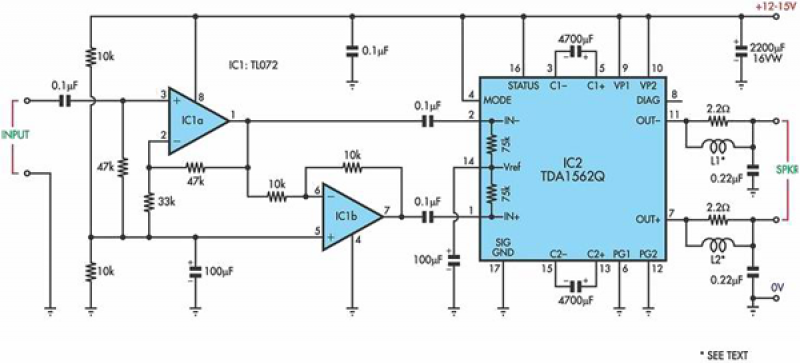
36 Watt Amplifier circuit with TDA1562Q
This circuit is based on a Philips class-H audio amplifier integrated circuit (IC) and can deliver 36W RMS or 70W music power, all from a 13.8V supply. The Mighty Midget Amplifier is capable of providing approximately 36W RMS continuous power...
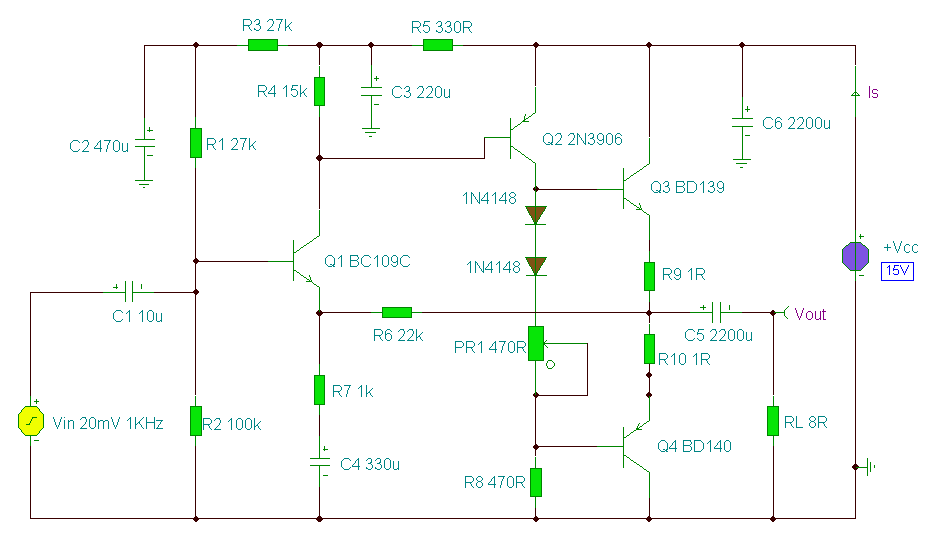
2 Watt Audio Amplifier
A 2 Watt audio amplifier made from discrete components. This was one of the earliest circuits that I ever designed and built, in Spring 1982. At that time I had only an analogue meter and a calculator to work with....
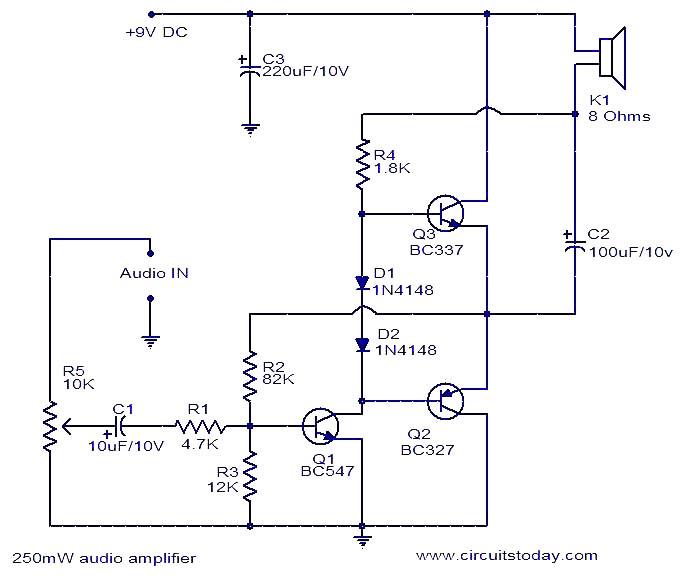
250mW audio amplifier
This is a simple three-transistor audio amplifier circuit capable of delivering 250 mW to an 8-ohm speaker. Complementary transistors BC337 and BC227 (Q3 and Q2) are utilized as the output pair, while transistor Q1 (BC547) functions as the preamplifier. The...
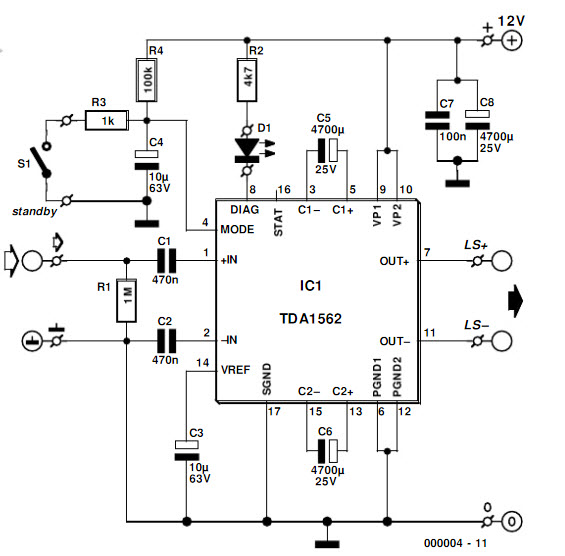
50w audio amplifier using ic tda1562
The integrated output amplifier presented in this article consists primarily of a single integrated circuit. It is specifically designed for application in motor vehicles and other battery-operated devices. Despite its seemingly simple design, the amplifier is capable of delivering significant...
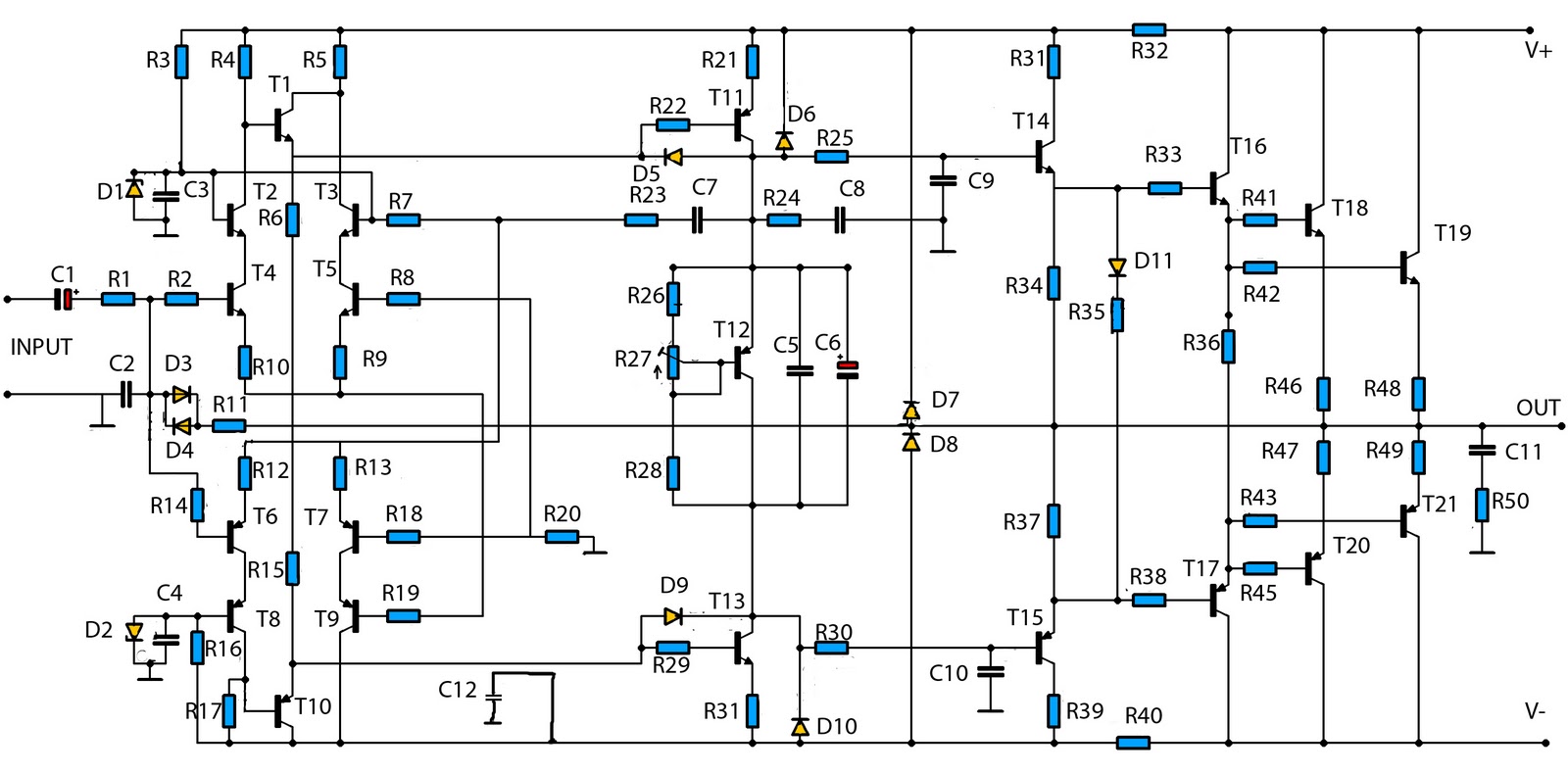
1400w audio power amplifier
This is a mono amplifier circuit with a high output power of 1400W. It is well-suited for use in large rooms with woofer and full-range speakers, delivering a loud and clear sound with minimal noise. The amplifier utilizes high-quality transistors,...
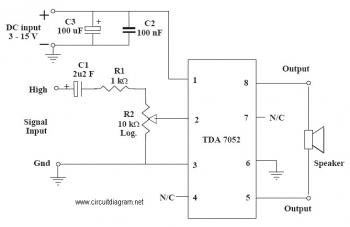
1W Mono Amplifier with TDA7052 circuit diagram
This is an audio amplifier circuit that uses the TDA7052 as the main component, along with five additional components to support its operation. The ideal supply voltage for this circuit is approximately 6-12V, and it does not require a heatsink.
The...
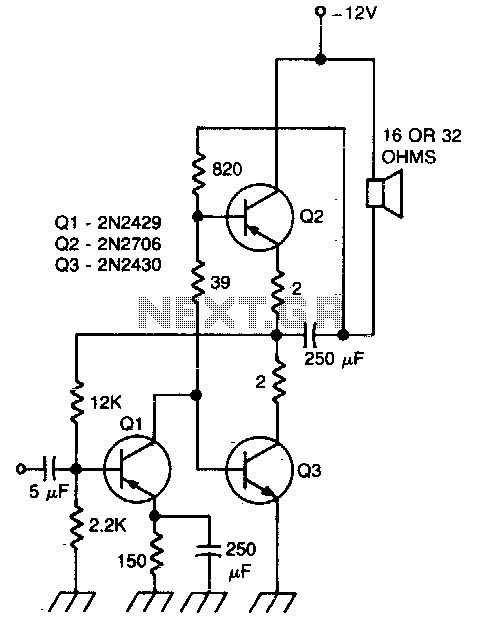
470 Mw complementary-symmetry audio amplifier
This circuit exhibits less than 2% distortion and maintains a flat response within 3 dB from 15 Hz to 130 kHz.
The described circuit is engineered to provide high fidelity audio performance, characterized by minimal distortion and a wide frequency response....
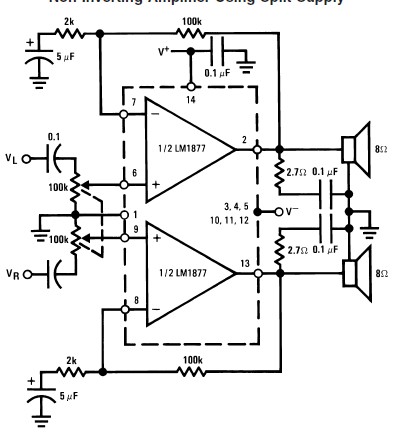
Schematic Diagram LM1877 Audio power amplifier circuit
This audio amplifier circuit is designed to deliver 2W per channel continuously into 8-ohm loads. The LM1877 is engineered to function with a minimal number of external components while still offering flexibility for applications in stereo phonographs, tape recorders, AM-FM...
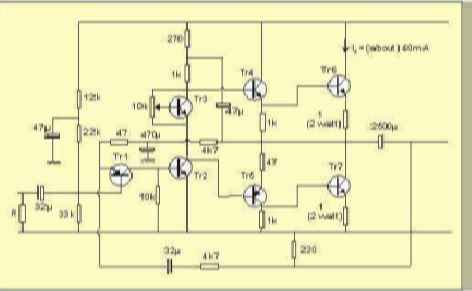
10w audio amplifier
The table below illustrates the expected voltages when utilizing a 24V supply, with the variable resistor adjusted to provide an output current of approximately 40mA.
The circuit operates with a 24V DC power supply, where a variable resistor (also known as...