


pic programmer circuit
#PIC
#programmer
#long cables
#PC interface
#microcontroller programming
#serial communication
#hardware programming
#embedded systems
#ICSP
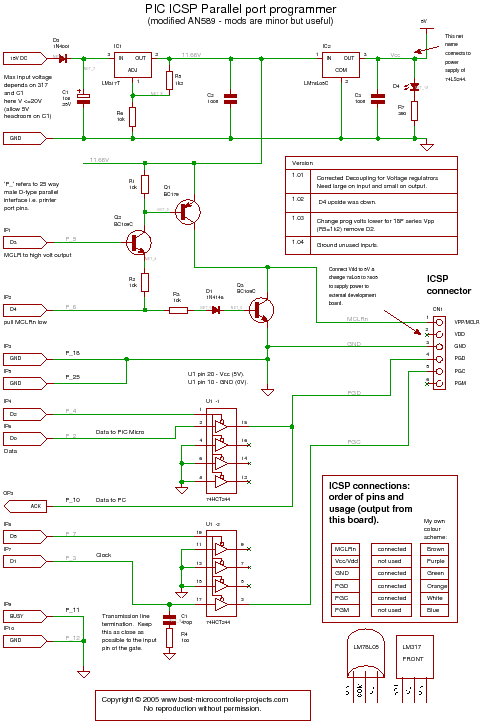
Description: A PIC programmer circuit that operates using long cables from a PC to the programmer.
The PIC programmer circuit is designed to facilitate the programming of PIC microcontrollers via a connection to a personal computer (PC) using extended cabling. This design allows for flexibility in the placement of the programmer relative to the PC, which can be beneficial in various testing and development environments.
The circuit typically includes a USB or serial interface that connects to the PC, providing the necessary communication protocols for data transfer. Inside the programmer, a microcontroller manages the programming sequence, ensuring that the correct voltages and signals are delivered to the target PIC microcontroller.
Key components of the circuit may include:
1. **Voltage Regulator**: To ensure that the circuit operates at a stable voltage, a voltage regulator is used. This component is crucial for protecting the microcontroller from voltage fluctuations that may occur due to the long cable runs.
2. **Signal Conditioning Circuitry**: Long cables can introduce noise and signal degradation. Therefore, signal conditioning components such as capacitors and resistors may be included to filter and stabilize the signals being sent and received.
3. **Isolation**: To protect the PC and the programmer from potential damage due to faults in the target microcontroller, isolation techniques such as opto-isolators may be implemented.
4. **Programming Interface**: The programmer will include a dedicated interface for connecting the target PIC microcontroller. This may consist of a pin header or socket that aligns with the microcontroller's programming pins.
5. **LED Indicators**: To provide visual feedback during the programming process, the circuit may feature LED indicators that signal power status, data transmission, and programming success or failure.
The overall layout of the circuit should be optimized for minimal interference and signal integrity, taking into account the potential for crosstalk and attenuation over long cable lengths. Proper shielding and twisted pair configurations may be employed in the cabling to enhance performance.
In summary, this PIC programmer circuit is a robust solution for programming microcontrollers from a distance, featuring essential components to ensure reliable operation and effective communication over long distances.A pic programmer circuit that works using long cables from PC to programmer..
The PIC programmer circuit is designed to facilitate the programming of PIC microcontrollers via a connection to a personal computer (PC) using extended cabling. This design allows for flexibility in the placement of the programmer relative to the PC, which can be beneficial in various testing and development environments.
The circuit typically includes a USB or serial interface that connects to the PC, providing the necessary communication protocols for data transfer. Inside the programmer, a microcontroller manages the programming sequence, ensuring that the correct voltages and signals are delivered to the target PIC microcontroller.
Key components of the circuit may include:
1. **Voltage Regulator**: To ensure that the circuit operates at a stable voltage, a voltage regulator is used. This component is crucial for protecting the microcontroller from voltage fluctuations that may occur due to the long cable runs.
2. **Signal Conditioning Circuitry**: Long cables can introduce noise and signal degradation. Therefore, signal conditioning components such as capacitors and resistors may be included to filter and stabilize the signals being sent and received.
3. **Isolation**: To protect the PC and the programmer from potential damage due to faults in the target microcontroller, isolation techniques such as opto-isolators may be implemented.
4. **Programming Interface**: The programmer will include a dedicated interface for connecting the target PIC microcontroller. This may consist of a pin header or socket that aligns with the microcontroller's programming pins.
5. **LED Indicators**: To provide visual feedback during the programming process, the circuit may feature LED indicators that signal power status, data transmission, and programming success or failure.
The overall layout of the circuit should be optimized for minimal interference and signal integrity, taking into account the potential for crosstalk and attenuation over long cable lengths. Proper shielding and twisted pair configurations may be employed in the cabling to enhance performance.
In summary, this PIC programmer circuit is a robust solution for programming microcontrollers from a distance, featuring essential components to ensure reliable operation and effective communication over long distances.A pic programmer circuit that works using long cables from PC to programmer..
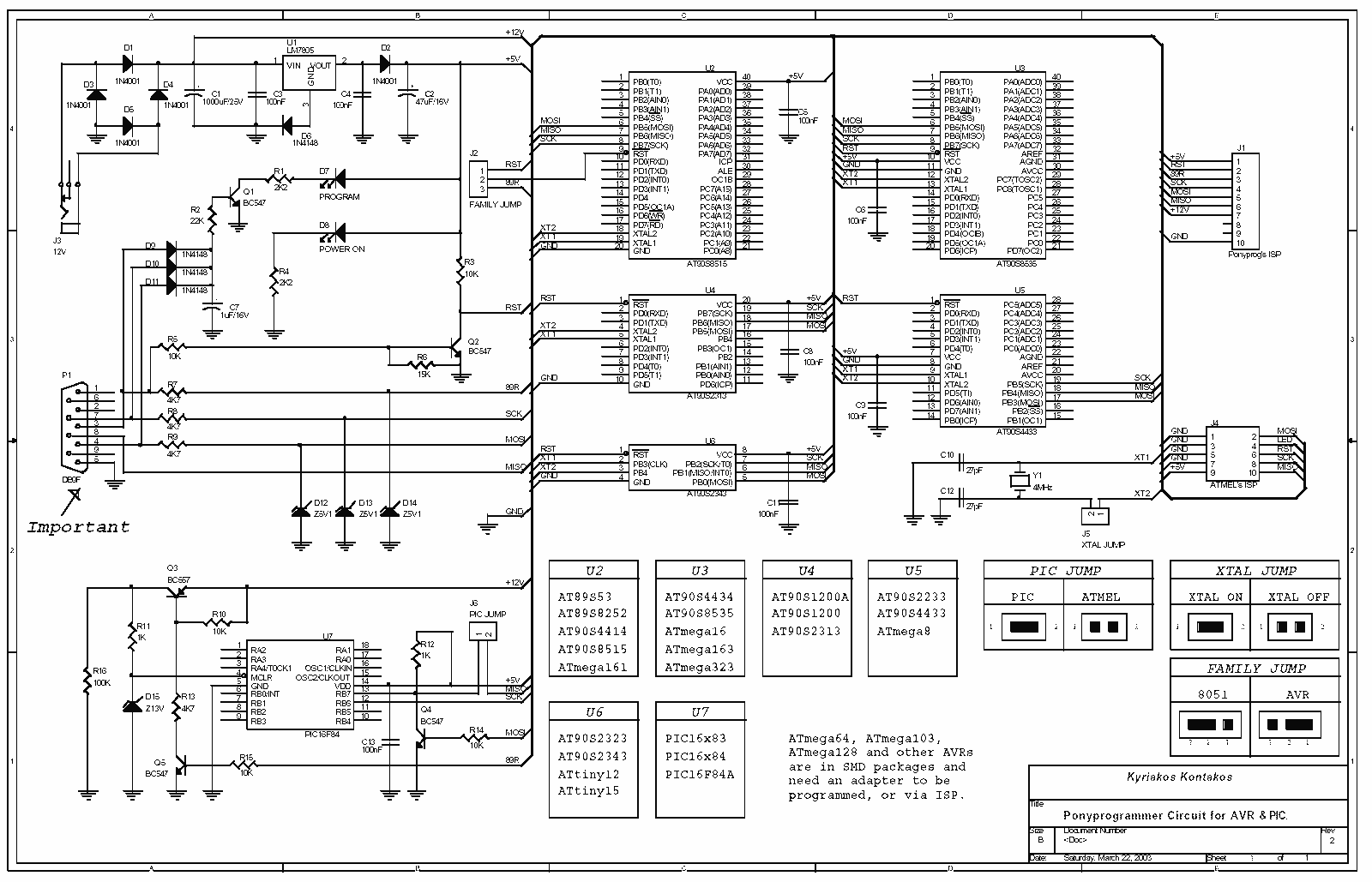
Ponyprog for AVR & PIC16F84
All resistors are 1/4W. The circuit is powered by 9...15V DC or AC. When In Circuit Programming (ISP) connectors are used, it is possible for the programmer to be powered from the target's power source. Diodes D2 and D6 protect...
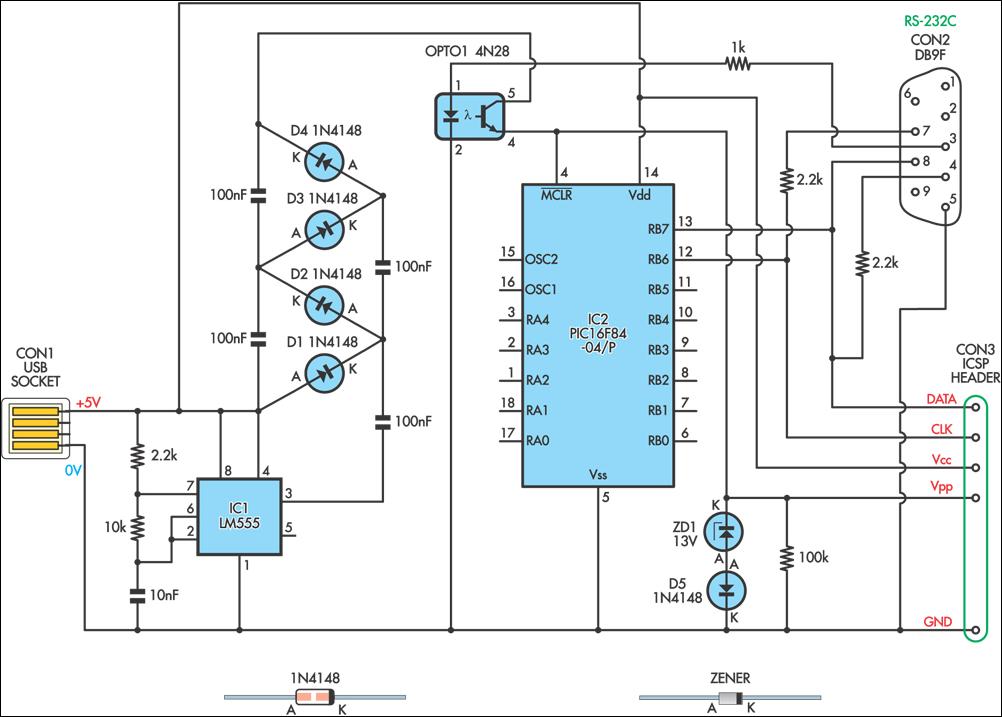
USB-Powered PIC Programmer
This simple circuit can be used to program the PIC16F84 and similar "flash memory" type parts. It utilizes a 555 timer IC to generate the programming voltage from a +5V rail, allowing the circuit to be powered from a computer's...
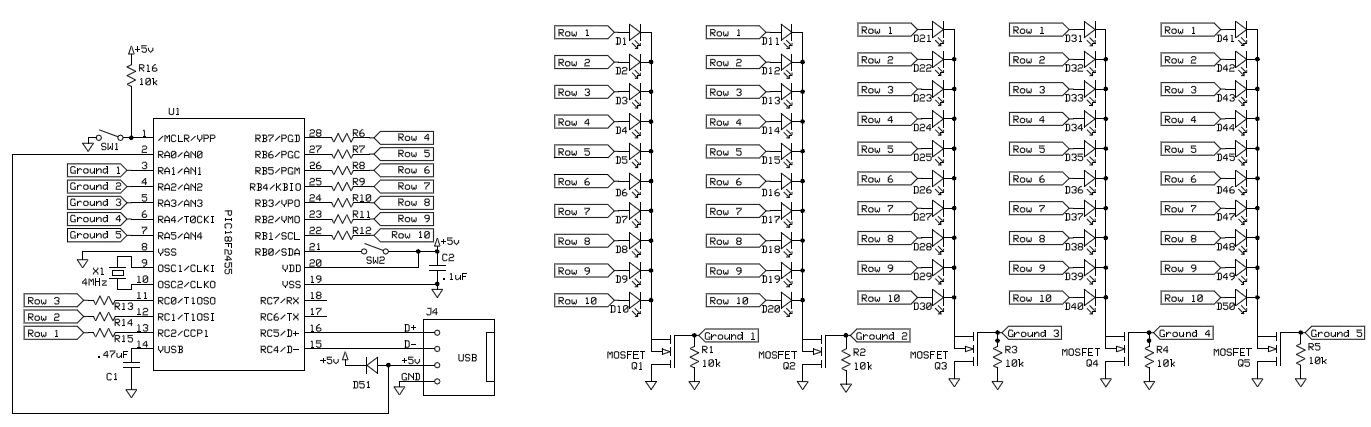
LED control system for 40 LEDs using a single PIC
To control 40 LEDs using a single PIC 18F2455 microcontroller, the LEDs were organized into a configuration of four columns, each containing 10 rows of LEDs. Each LED in a column was connected to a separate pin on the PIC....
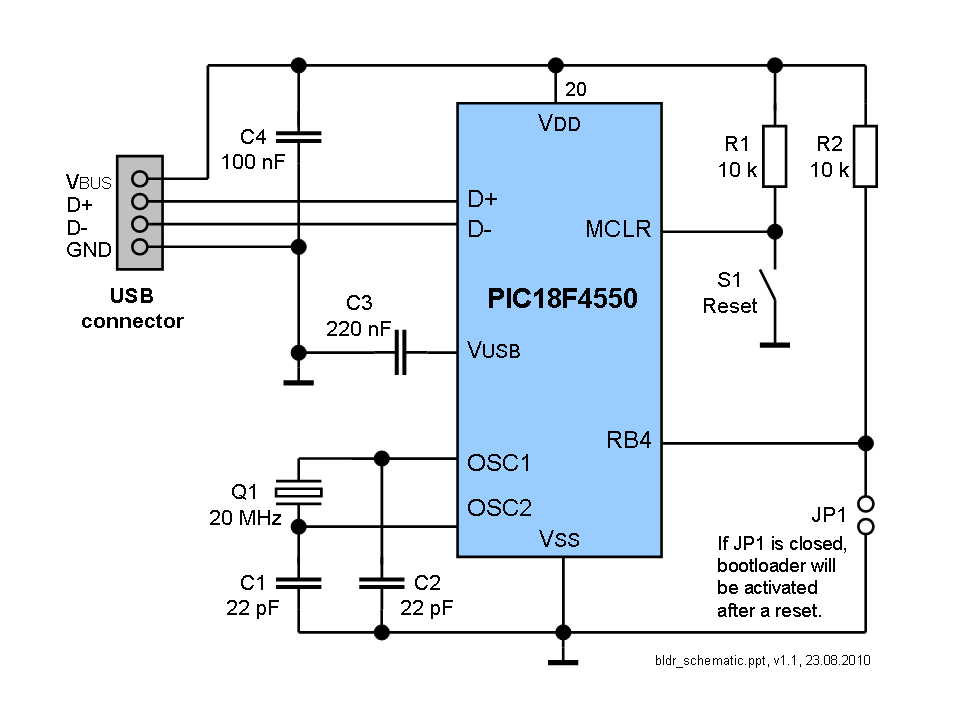
USB Bootloader
The bootloader is compatible with all USB PIC devices, including PIC18F4550, PIC18F4455, PIC18F2550, PIC18F2455, PIC18F4553, PIC18F4458, PIC18F2553, and PIC18F2458. However, since the bootloader is designed for the Microchip demo board, its configuration may not be suitable for specific projects. For...
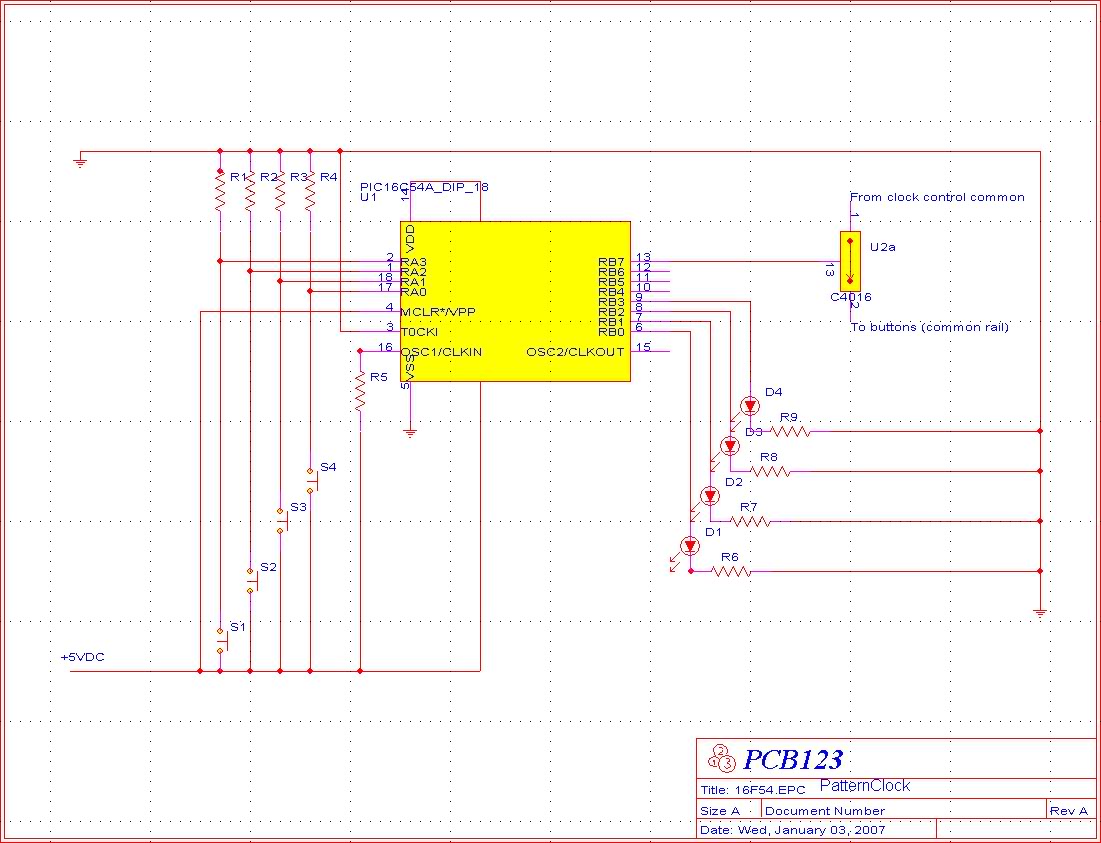
16F54 fickle!
The primary issue observed is that the circuit runs code, but several input/output (I/O) components are non-functional. For instance, only half of the LEDs driven by the circuit operate, and this appears to be random. Attempts to implement the slow...
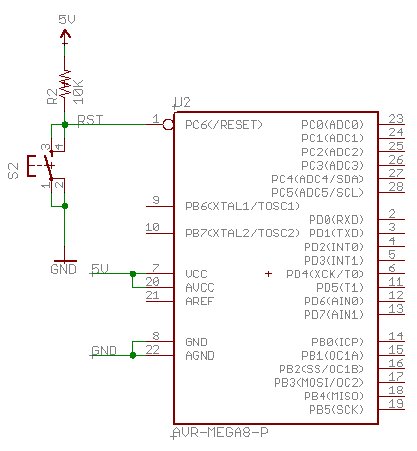
Beginning Embedded Electronics - 2
Acquire all the components required for this lecture here. It is highly recommended to obtain a multimeter with a continuity setting. A quality multimeter with this feature typically costs around $60, while premium models can reach $300. The $60 option...
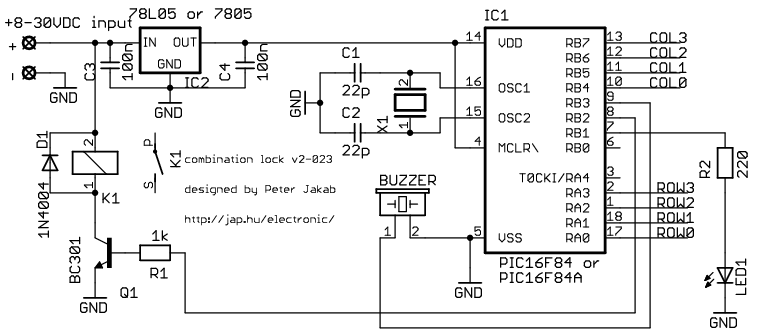
Electronic combination lock with PIC
This is my electronic combination lock to use with an outdoor gate. The functionality is implemented in software. It turns on a relay (usually to open a door) for a few seconds if someone enters the valid code. This relay...
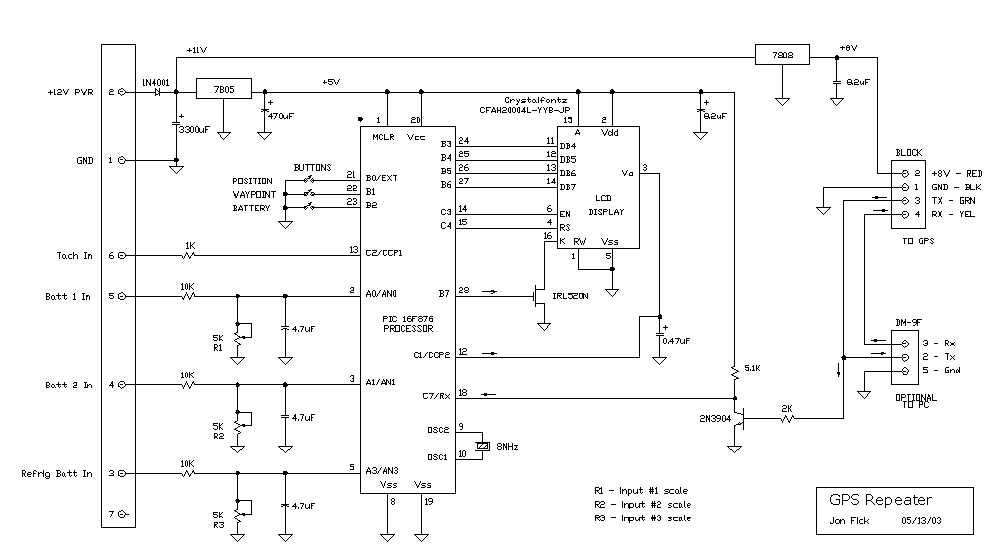
PIC-based applications from Westford MicroSystems descriptions C source code and schematics
PIC C Compilers are utilized to compile source code, leveraging the extensive built-in functions offered by these compilers. A single C statement can produce multiple pages of PIC RISC instructions, eliminating the need for manual coding. CCS charges $125 for...
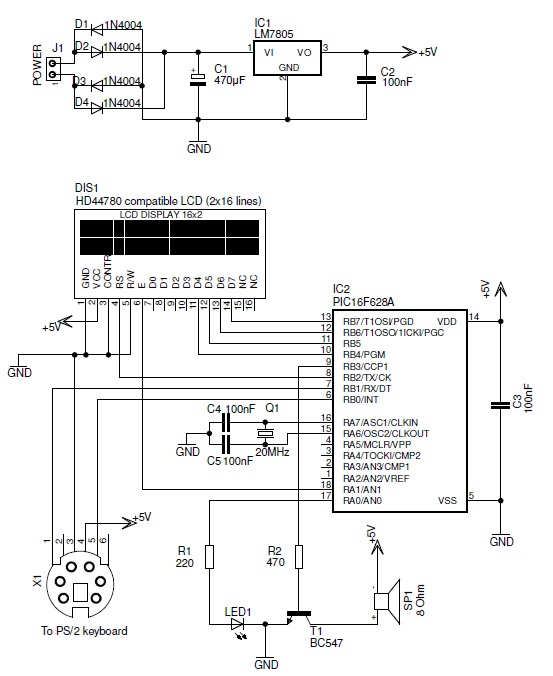
morse Circuit
This PIC-based hardware circuit accepts texts from a PS/2 keyboard and converts it into a Morse code audio signal.
The described circuit utilizes a PIC microcontroller to interface with a PS/2 keyboard, allowing for the input of alphanumeric characters. The microcontroller...