


picpov persistence of vision with a pic18f1220
#PIC18F1220
#persistence of vision
#LED display
#microcontroller
#PIC
#embedded
#visual effect
#DIY
#electronics project
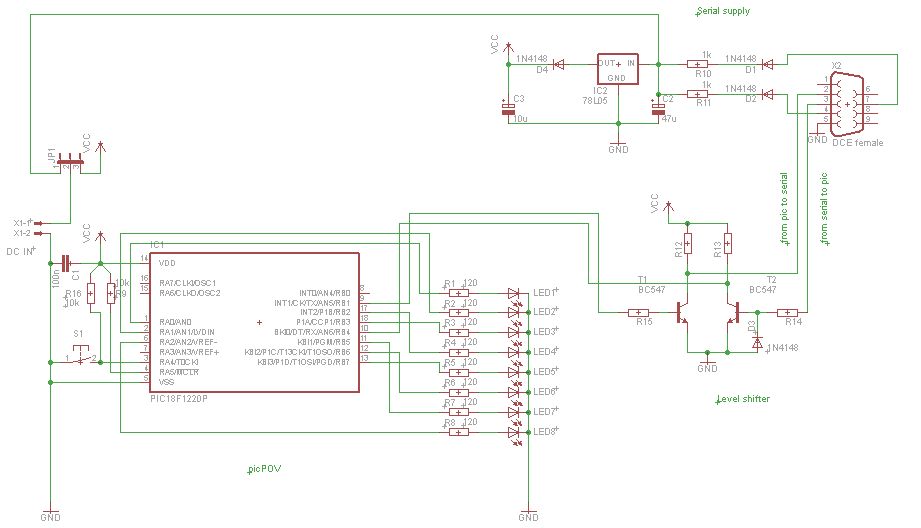
Description: PicPOV is a project based on "persistence of vision." A PIC microcontroller blinks 8 LEDs on and off so that when waved through the air, a message is displayed.
The PicPOV project utilizes the principle of persistence of vision to create the illusion of a solid image through the rapid blinking of LEDs. The core component of this project is a PIC microcontroller, which is programmed to control the timing and sequence of the LED illumination.
In this circuit, eight LEDs are arranged in a linear format and connected to the output pins of the PIC microcontroller. The microcontroller is programmed to turn each LED on and off at a specific timing interval, synchronized with the movement of the device. When the device is waved through the air, the human eye perceives the rapidly blinking LEDs as a continuous image due to the persistence of vision effect.
The circuit design typically includes a power supply, which can be provided by batteries or an external source, ensuring that the microcontroller and LEDs receive adequate voltage and current. Current-limiting resistors are also included in series with each LED to prevent excessive current flow, which could damage the LEDs.
To enhance the user experience, the message displayed can be pre-programmed into the microcontroller's memory, allowing for flexibility in the designs and messages that can be shown. The programming can be done using various development environments compatible with PIC microcontrollers, enabling the integration of different patterns and sequences.
The overall design of the PicPOV project not only demonstrates the application of microcontrollers in visual displays but also serves as an educational platform for understanding the fundamentals of electronics, programming, and optical phenomena.PicPOV is a project based on ""persistence of vision"". A PIC microcontroller blinks 8 LEDs on and off so that when waved through the air, a mes..
The PicPOV project utilizes the principle of persistence of vision to create the illusion of a solid image through the rapid blinking of LEDs. The core component of this project is a PIC microcontroller, which is programmed to control the timing and sequence of the LED illumination.
In this circuit, eight LEDs are arranged in a linear format and connected to the output pins of the PIC microcontroller. The microcontroller is programmed to turn each LED on and off at a specific timing interval, synchronized with the movement of the device. When the device is waved through the air, the human eye perceives the rapidly blinking LEDs as a continuous image due to the persistence of vision effect.
The circuit design typically includes a power supply, which can be provided by batteries or an external source, ensuring that the microcontroller and LEDs receive adequate voltage and current. Current-limiting resistors are also included in series with each LED to prevent excessive current flow, which could damage the LEDs.
To enhance the user experience, the message displayed can be pre-programmed into the microcontroller's memory, allowing for flexibility in the designs and messages that can be shown. The programming can be done using various development environments compatible with PIC microcontrollers, enabling the integration of different patterns and sequences.
The overall design of the PicPOV project not only demonstrates the application of microcontrollers in visual displays but also serves as an educational platform for understanding the fundamentals of electronics, programming, and optical phenomena.PicPOV is a project based on ""persistence of vision"". A PIC microcontroller blinks 8 LEDs on and off so that when waved through the air, a mes..
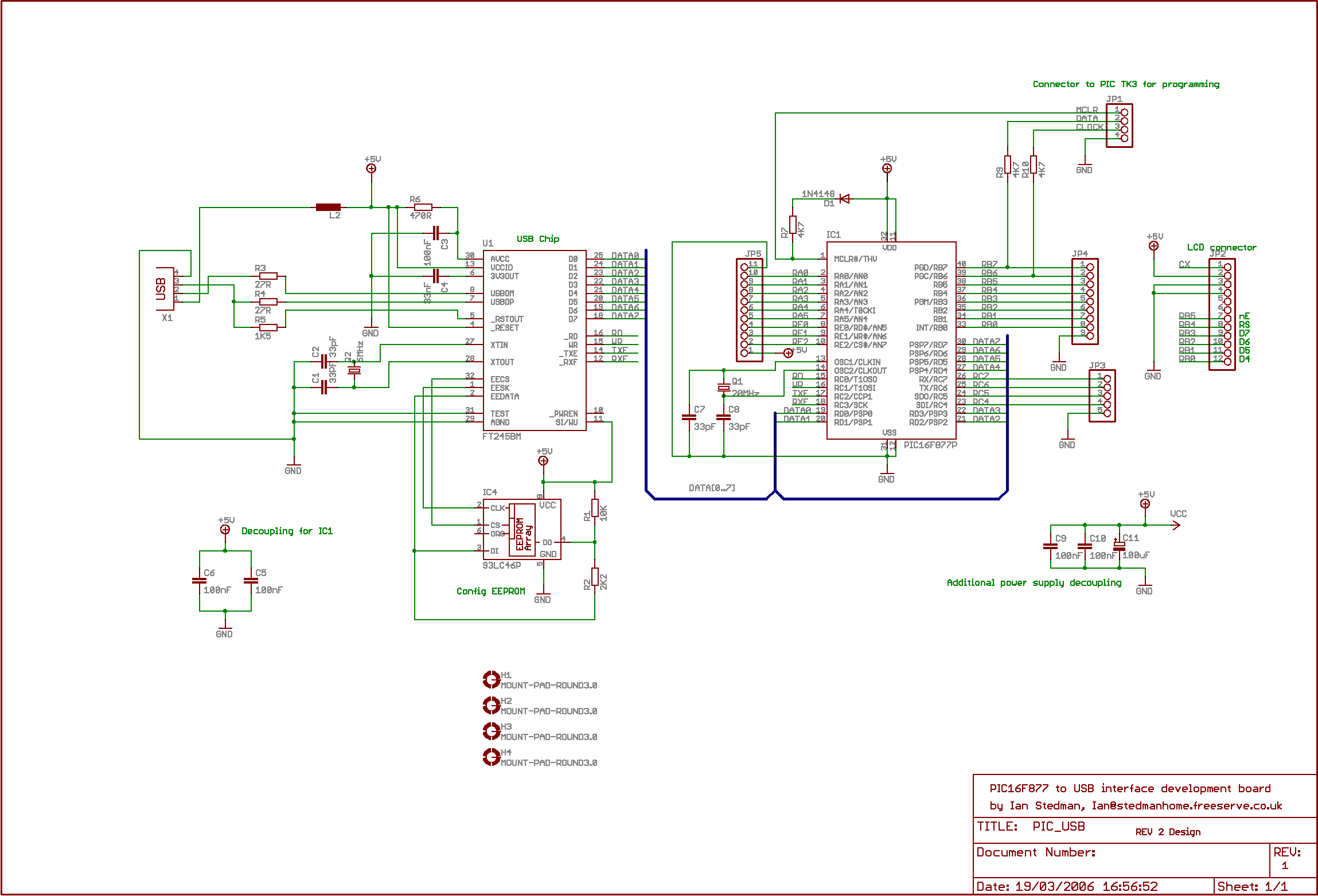
PIC USB Interface
The second program sends "Hello world" to the PC. By default, the board utilizes the Virtual COM Port (VCP) driver, allowing output to be viewed using Hyperterminal or similar software; PuTTY is recommended. The setup is straightforward: upon connecting the...
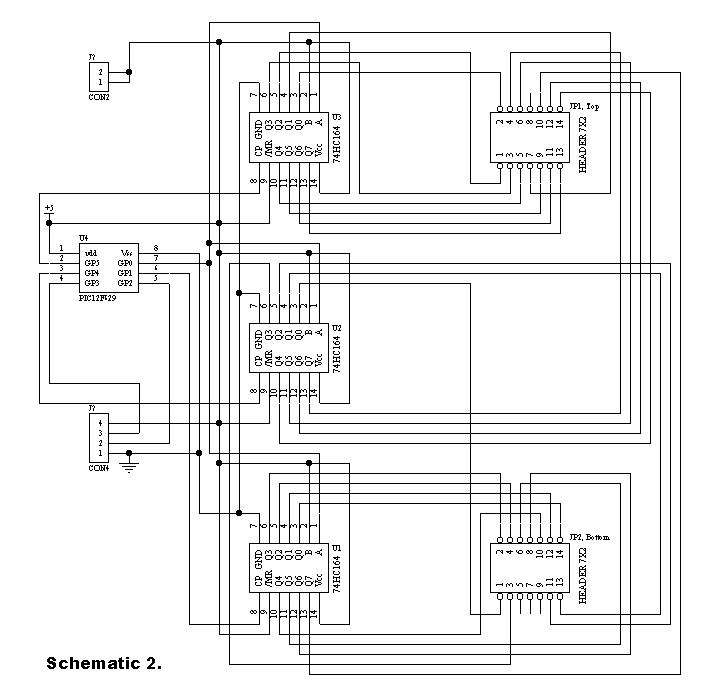
Pic microcontroller project
Communication with the MCP3028 ADC chip is achieved through a straightforward serial interface that adheres to the SPI protocol. The PIC16F84 or PIC16F628 does not possess a hardware SPI peripheral. However, a software-implemented SPI protocol can facilitate communication with the...

turret diy
For maximum mini-security, this RC Tupperware Turret delivers a formidable deterrent against food theft. While it lacks motion sensors, potential food thieves will think twice before attempting to swipe baked goods. This 11-hour project, designed by Chris of PyroElectro, emphasizes...
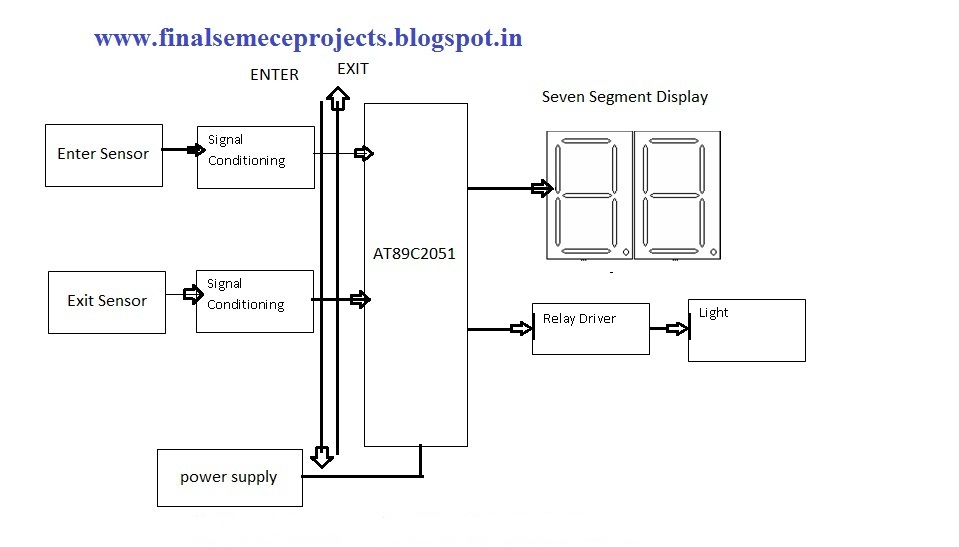
MICROCONTROLLER BASED AUTOMATIC ROOM LIGHT CONTROLLER
This project involves an automatic room light controller with a bidirectional visitor counter using a microcontroller. It is designed to manage room lighting and accurately count the number of individuals present. When a person enters the room, the counter increments...
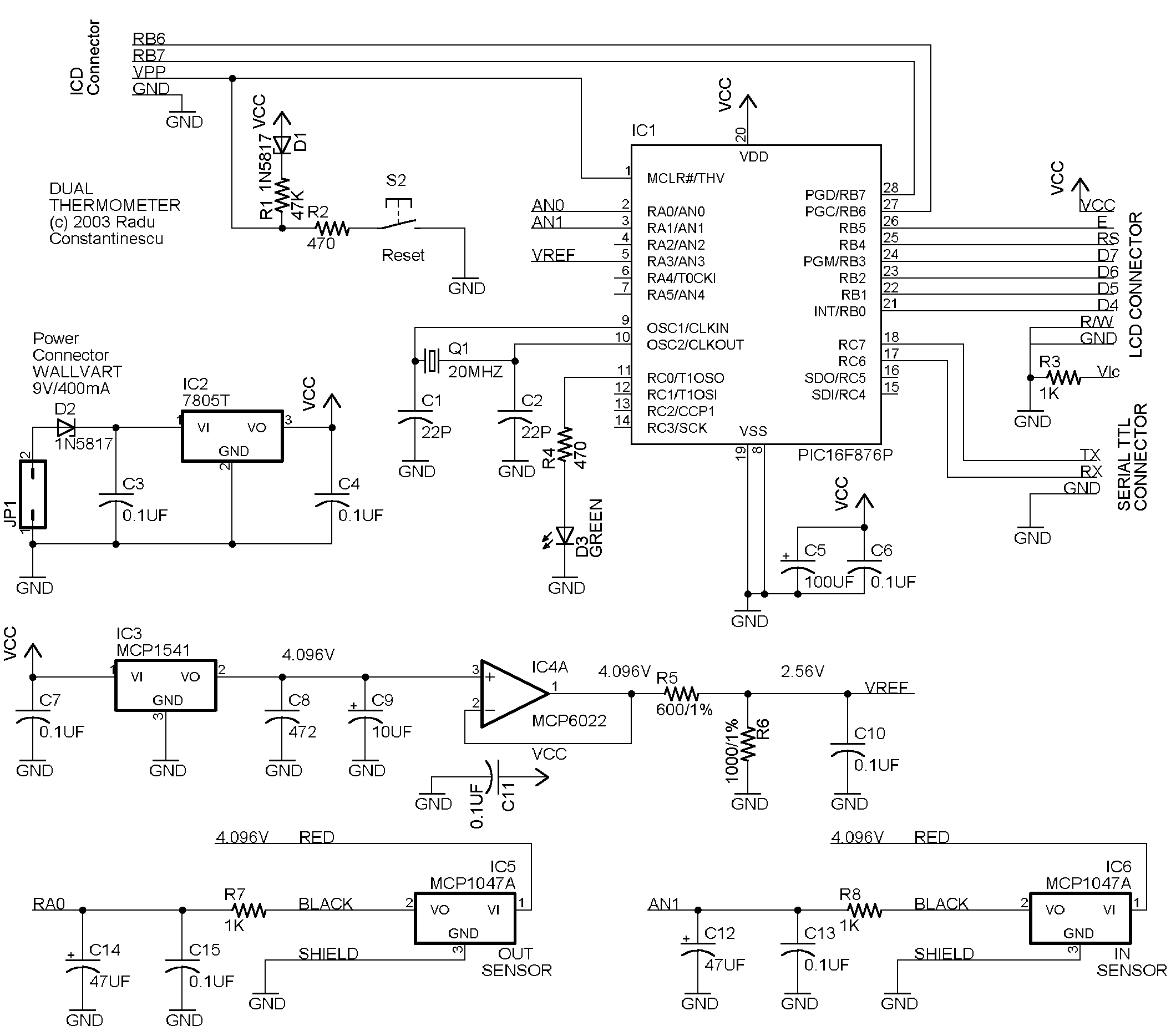
PIC dual Thermometer
This circuit utilizes a PIC16F876 microcontroller, two MCP1047A temperature sensors, an MCP1541 voltage reference, and a MCP6022A operational amplifier. The display is a 2-row HD74780-based 2x16 character display (SII L1652BIJ2), though any HD74780 compatible display can be used. The thermometer,...
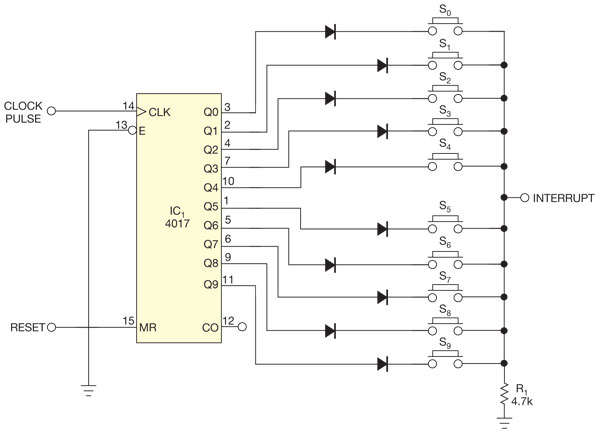
10 or more switches using a microcontroller
There are several methods to read multiple switch inputs using a reduced number of microcontroller unit (MCU) pins. One approach involves using an analog MCU pin to read multiple switches by assigning a unique voltage to each switch through a...
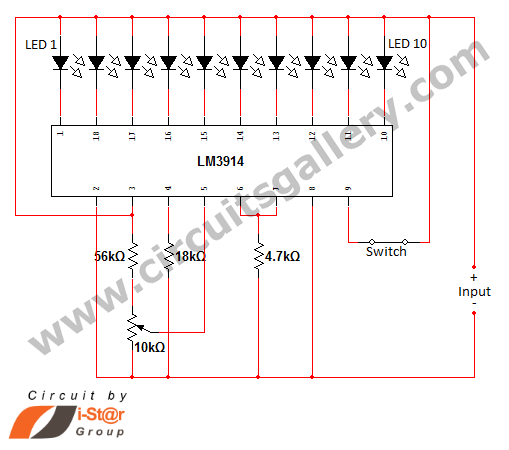
LED dot display based Battery charge level indicator circuit diagram
In various situations, it is necessary to indicate the amount of battery charge using methods such as LED dot displays or LED bar displays. This circuit utilizes the LM3914 integrated circuit to serve as a battery charge indicator with an...
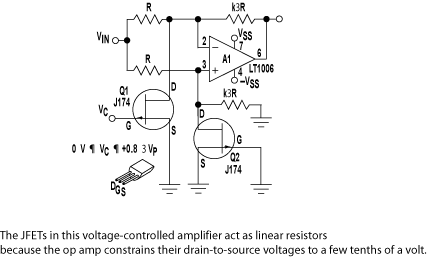
µP-Controlled Oscillator Delivers Rock-Bottom Distortion
Function generators are essential in the design, testing, and operation of encoders, modulators, demodulators, and measurement instruments. This document presents an economical method to construct a bus-controlled sinewave oscillator that exhibits exceptionally low distortion. The circuit produces a sinusoidal output...
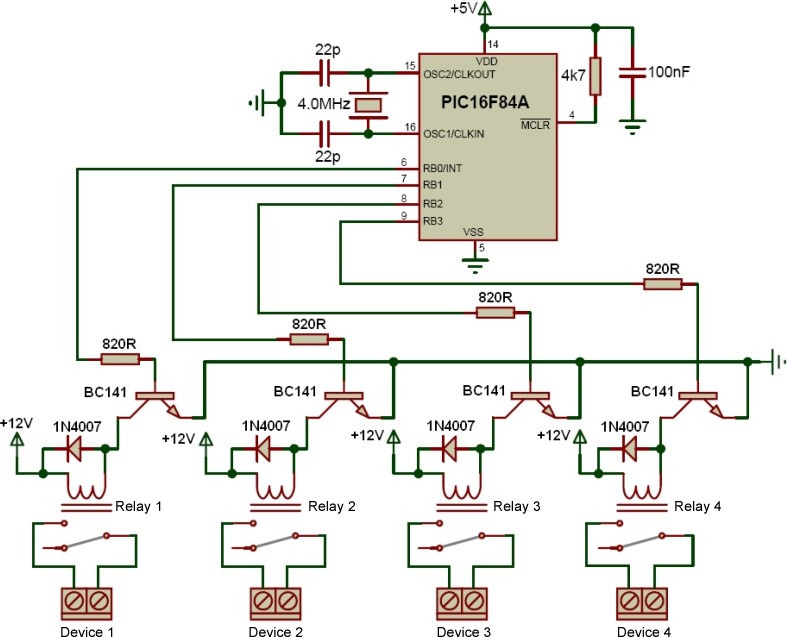
PIC Controlled Relay Driver
The transformer is a 220V to 12V, 50Hz, and 3.6VA PCB type transformer. The model depicted is HRDiemen E3814056. Being encapsulated, it is isolated from external influences. A 250V 400mA glass fuse protects the circuit from damage caused by excessive...