


Traffic-light application in C language (AVR-007)
#AVR-007
#traffic light
#microcontroller
#C language
#hardware specs
#programming
#embedded systems
#circuit design
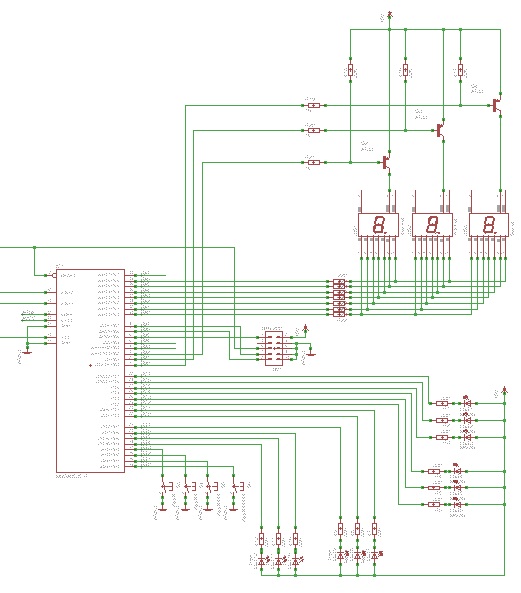
Description: Learn to use microcontrollers to create traffic-light applications. In this project, the AVR-007 microcontroller from Circuits-Home will be utilized. Before developing the program, it is essential to understand the hardware specifications.
The project focuses on developing a traffic-light control system using the AVR-007 microcontroller. The AVR-007 is a versatile microcontroller that offers multiple input and output pins, allowing for efficient control of various components such as LEDs, sensors, and switches. A fundamental understanding of the microcontroller's architecture, including its pin configuration, memory allocation, and peripheral interfaces, is crucial for successful implementation.
The traffic-light application will involve programming the microcontroller to manage the timing and sequencing of the traffic lights. The typical traffic light consists of three colored LEDs: red, yellow, and green. Each LED will be connected to a designated output pin on the AVR-007. The microcontroller will be programmed to turn on each LED for a specified duration, simulating real-world traffic light behavior.
To begin, the hardware setup will require the following components: the AVR-007 microcontroller, three LEDs (red, yellow, and green), current-limiting resistors for the LEDs, a breadboard for prototyping, and jumper wires for connections. The LEDs should be connected to the output pins of the microcontroller with the appropriate resistors to prevent excessive current flow.
The programming aspect will involve writing code in a suitable language, such as C or assembly, that instructs the microcontroller to control the LEDs based on defined timing intervals. The code will include initialization routines, where the pins connected to the LEDs are configured as outputs. A loop will be created to cycle through the states of the LEDs, ensuring that the red light is displayed for a longer duration, followed by the yellow and green lights.
Testing the circuit will involve verifying the correct operation of each LED according to the programmed timing. Adjustments may be made to the timing intervals based on practical observations to achieve the desired traffic control functionality.
Overall, this project serves as an excellent introduction to microcontroller programming and hardware interfacing, providing hands-on experience in creating a functional traffic-light control system.learn to use microcontrollers to create traffic-light applications. In this project we will use microcontroller AVR-007 from Circuits-Home. Before creating the program, the first job we have to do is understand about the hardware specs.
The project focuses on developing a traffic-light control system using the AVR-007 microcontroller. The AVR-007 is a versatile microcontroller that offers multiple input and output pins, allowing for efficient control of various components such as LEDs, sensors, and switches. A fundamental understanding of the microcontroller's architecture, including its pin configuration, memory allocation, and peripheral interfaces, is crucial for successful implementation.
The traffic-light application will involve programming the microcontroller to manage the timing and sequencing of the traffic lights. The typical traffic light consists of three colored LEDs: red, yellow, and green. Each LED will be connected to a designated output pin on the AVR-007. The microcontroller will be programmed to turn on each LED for a specified duration, simulating real-world traffic light behavior.
To begin, the hardware setup will require the following components: the AVR-007 microcontroller, three LEDs (red, yellow, and green), current-limiting resistors for the LEDs, a breadboard for prototyping, and jumper wires for connections. The LEDs should be connected to the output pins of the microcontroller with the appropriate resistors to prevent excessive current flow.
The programming aspect will involve writing code in a suitable language, such as C or assembly, that instructs the microcontroller to control the LEDs based on defined timing intervals. The code will include initialization routines, where the pins connected to the LEDs are configured as outputs. A loop will be created to cycle through the states of the LEDs, ensuring that the red light is displayed for a longer duration, followed by the yellow and green lights.
Testing the circuit will involve verifying the correct operation of each LED according to the programmed timing. Adjustments may be made to the timing intervals based on practical observations to achieve the desired traffic control functionality.
Overall, this project serves as an excellent introduction to microcontroller programming and hardware interfacing, providing hands-on experience in creating a functional traffic-light control system.learn to use microcontrollers to create traffic-light applications. In this project we will use microcontroller AVR-007 from Circuits-Home. Before creating the program, the first job we have to do is understand about the hardware specs.
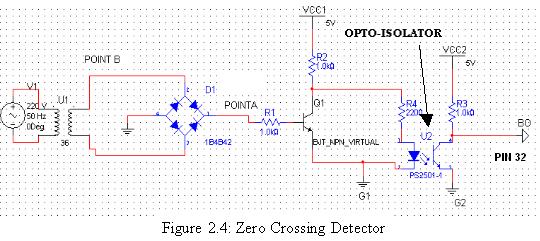
Industrial Building Automation System (IBAS) - 4
The two optical sensors will provide a count of individuals to the microcontroller, which will relay this value to MCU-II. The microcontroller will detect the entrance of any person through high-to-low pulse transitions on input pins A3 and A4.
The circuit...
graphical LCDs with a microcontroller
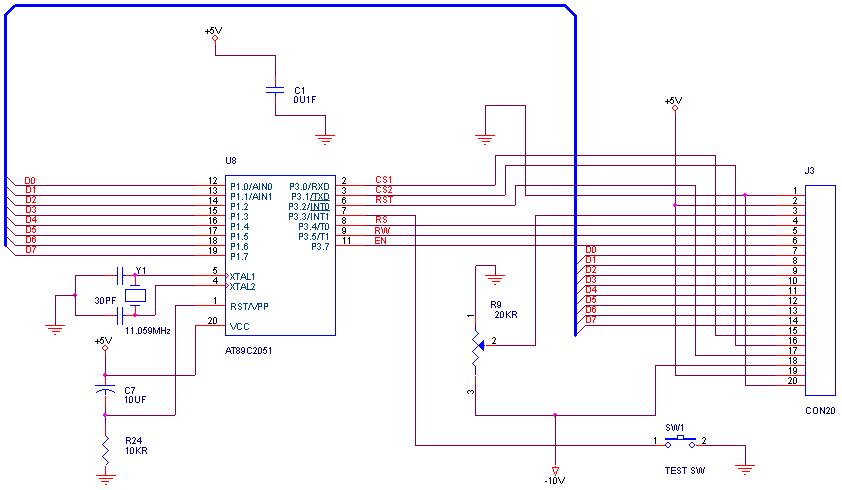
How can graphical LCDs be controlled using a microcontroller? Is there any datasheet available?
Graphical LCDs (Liquid Crystal Displays) are widely used in various electronic applications for displaying complex graphics and text. To control these displays with a microcontroller, several steps...
home security system
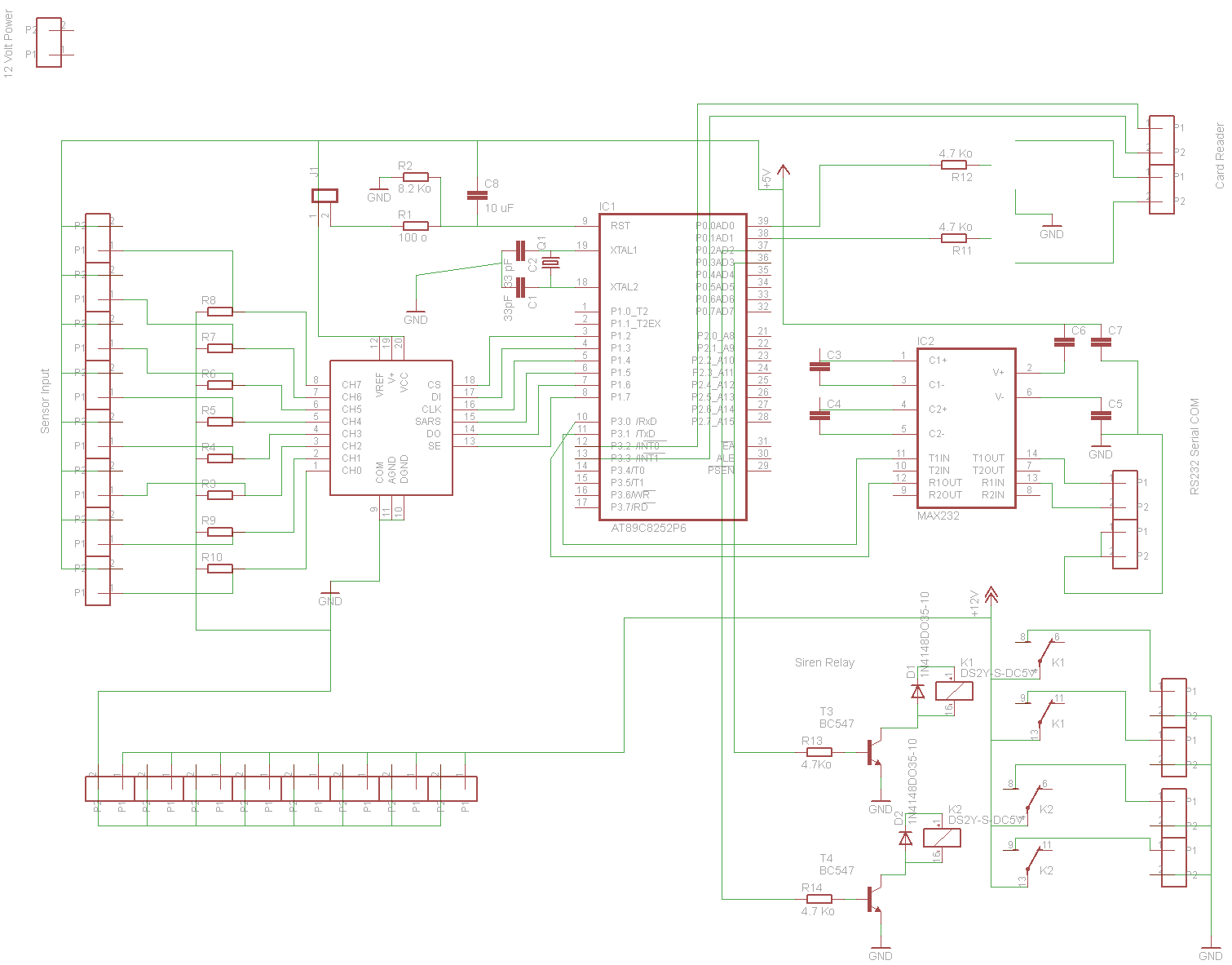
The fundamental design of this project employs an Atmel AT89S8252-24PC Microcontroller, which features 2KB of EEPROM for runtime data storage. An ADC0838CCN analog-to-digital converter will be utilized to process up to eight inputs from sensor devices, including passive infrared sensors...

repair microcontroller circuit
The difference between these two ICs. A microcontroller is a specialized type of microprocessor designed to be self-sufficient and cost-effective, while a microprocessor is typically intended for general-purpose use, such as in personal computers (PCs). The microcontroller integrates several useful...
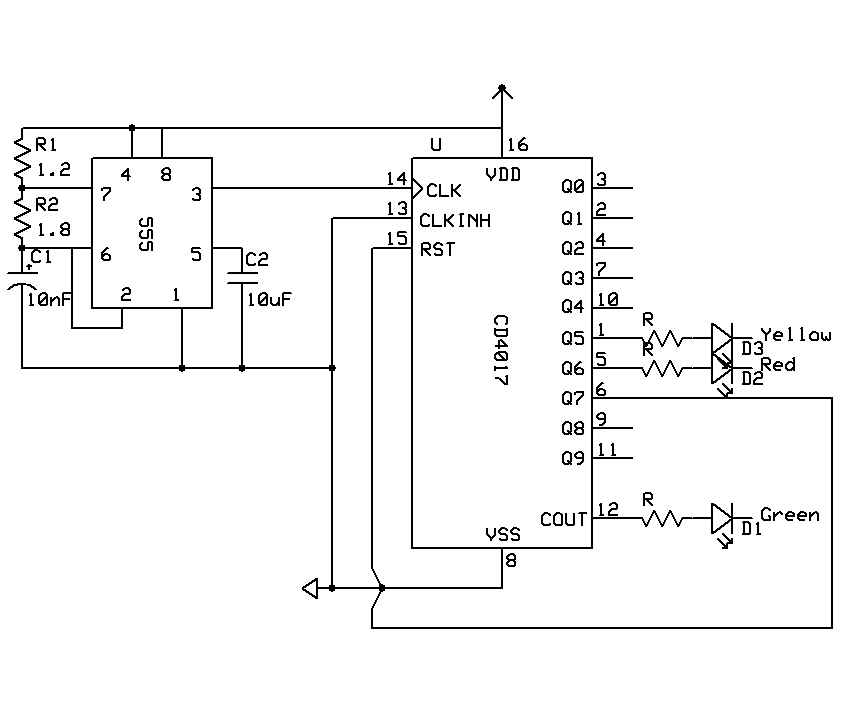
Training Boxing timer schematic
A timer is being developed for circuit training or boxing training. The timer does not require any external input, except for a reset function. The project can be simplified using a microcontroller, such as the PIC12F635, which is cost-effective at...
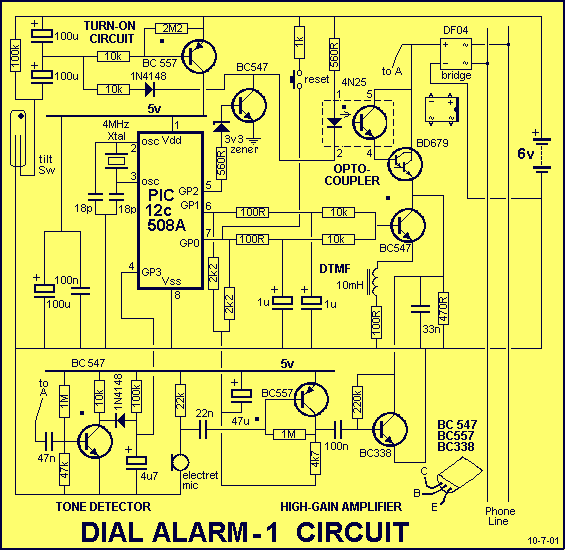
DIAL ALARM-1
This is the lowest cost dialing alarm on the market and shows what can be done with an 8-pin microcontroller. The complete circuit is shown below. You cannot see all the features of this project by looking at the circuit...
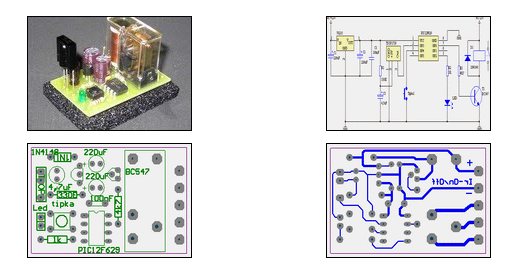
IR On/Off Switch Using Microcontroller
The ability to turn electrical devices ON or OFF using a remote control is a well-established concept, with numerous devices effectively performing this function.
To implement a remote control system for switching electrical devices, a typical schematic would include several key...
DC motor driver for DCMP(AVR-008)
A microcontroller is used to control various types of DC motors, including permanent magnet DC motors, DC servo motors, and stepper motors. This project utilizes the AVR-008 microcontroller from Circuits-Home, which is frequently referred to as the 3-in-1 driver motor...
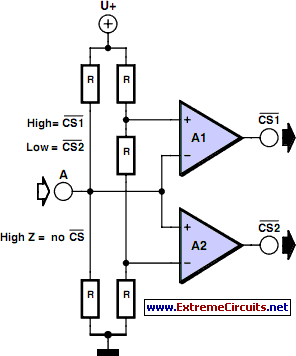
Multitasking Pins circuit
It is entirely logical that low-cost miniature microcontrollers have fewer pins than their larger counterparts, sometimes too few. Consideration has been given to how to economize on pins by making them perform the work of several. It was noted that...