


batcopter
#mechatronics
#game
#two-player
#interactive
#Stanford
#ME218A
#Batman
#Robin
#Helicopter game
#enemies
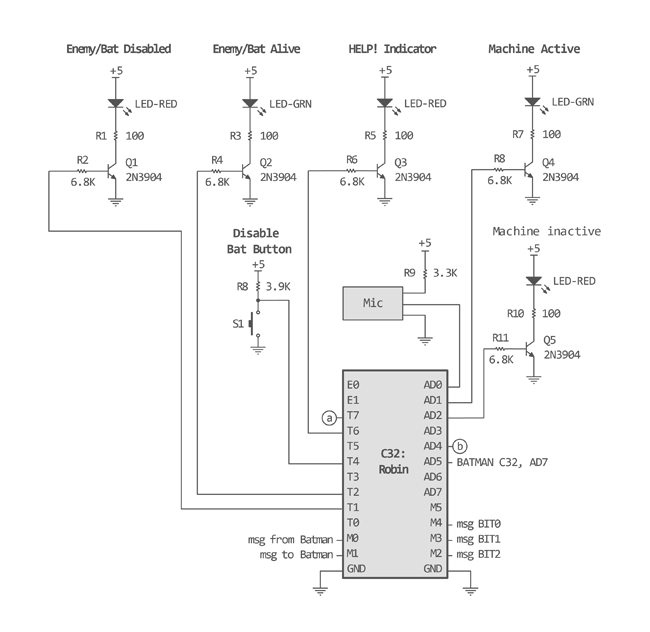
Description: The Batcopter was developed for Stanford's inaugural Mechatronics course, ME218A. It serves as a mechanical adaptation of the classic flash game Helicopter, featuring enhanced interactions that introduce complexity, including enemies and various difficulty levels. The game accommodates two players, with one assuming the role of Batman and the other as Robin. It employs two C32 microcontrollers, one dedicated to Batman's interactions and the other to Robin's. The software is built upon an event-driven finite-state-machine framework. The objective of the game is to manage the helicopter's vertical position to evade obstacles while gravity exerts a downward pull. The initial concept of transforming this flash game into a physical experience involved a rotating backdrop and buttons for controlling Batman's vertical movement and eliminating enemies. A storyboard illustrating the user experience was created. The player begins by spinning a wheel to elevate Batman to his starting position, after which the backdrop begins to scroll. The player can press a button to raise Batman, while gravity continuously pulls him down. Concurrently, Robin is responsible for neutralizing incoming enemies. The game is housed within a cube measuring approximately 18 inches on each side. The design was crafted in Solidworks and subsequently processed with a laser cutter. All dimensions mentioned are in inches. The rotating backdrop transitions between the Bat Cave and Gotham City and was designed using Illustrator. The whimsical backdrop is represented as a 12 x 81 array, where each of the 81 columns defines upper and lower boundaries for Batman's safe flight. The column index indicates horizontal progression through the cave and city. One servo motor rotates the backdrop while tracking horizontal position, and another servo controls Batman's vertical movement. If Batman "collides" with an obstacle, he loses a life. Specifically, if Batman's vertical position falls outside the defined upper or lower boundaries, a life is lost. Circuit A features an infrared detector that activates the game by receiving a Morse code infrared signal known as the "Bat ID." This circuit utilizes a phototransistor to convert light levels into voltage levels. A small capacitor transforms these voltage changes into spikes, and a hysteresis circuit converts the spikes into a 0 or 5V logic level, resulting in a logic signal that is independent of ambient light. Circuit B detects the laser used by Robin to disable enemies. This circuit also employs a phototransistor to convert the laser signal into a voltage level, and if the voltage meets or exceeds a certain threshold, an enemy is disabled. The entire structure was constructed using laser-cut 1/4" duron, a composite material, providing a cost-effective and efficient method for fabricating the majority of the Batcopter's structure. The backdrop was created from black vinyl attached to transparent mylar, with yellow vinyl covering the rear of the mylar. The backdrop measures 40 inches by 8 inches and is wrapped around two cement tubes, each with a diameter of 7.75 inches.
The Batcopter project integrates mechanical design, electronics, and software engineering to create an interactive gaming experience. The use of two C32 microcontrollers allows for the independent control of both players, facilitating real-time responses to game dynamics. The event-driven finite-state-machine framework ensures that the game logic is efficiently managed, allowing for smooth transitions between different game states and interactions.
The mechanical design features a rotating backdrop that enhances the visual appeal and immersion of the game. The servo motors are critical components, providing precise control over the movement of the backdrop and Batman's vertical position. The design of the backdrop as a 12 x 81 array allows for a scalable and flexible approach to representing the game environment, with each column providing specific flight boundaries that challenge the player.
The infrared detection system is a pivotal aspect of the game, ensuring reliable activation and interaction. The use of phototransistors in both Circuit A and Circuit B highlights the importance of light-based sensing in the game's functionality. The hysteresis circuit in Circuit A is particularly noteworthy, as it ensures that the game remains functional under varying ambient light conditions, thereby enhancing the reliability of the game activation mechanism.
Overall, the Batcopter project exemplifies the intersection of mechanical, electronic, and software engineering, resulting in an engaging and interactive gaming experience that challenges players' reflexes and coordination. The thoughtful integration of these elements demonstrates a comprehensive understanding of mechatronic systems and their applications in entertainment technology.Batcopter was built for Stanford`s first of three Mechatronics courses, ME218A. It is a mechanical version of the classic flash game Helicopter. The game has additional interactions for added complexity including enemies & different modes of difficulty. It is designed for two players. One player serves as Batman and the other as Robin. It uses two C32 microcontrollers, one for Batman`s interactions & the other for Robin`s. The software was designed using event-driven finite-state-machine framework. An example of the game Helicopter can be seen below. The goal of the game is to control a helicopter`s vertical position to avoid any obstacle, while gravity pulls you down. The initial concept to convert this flash computer game to a physical game can be seen below. The idea featured a rotating backdrop and buttons to control batmans vertical position and to kill enemies.
A simple storyboard of what a user might see was sketched out. The user would first spin a wheel to raise batman up to his starting position. Then the backdrop would begin to scroll. The user would press a button to raise batman up and gravity would pull him down. At the same time, robin would be in charge of killing enemies that present themselves. The game was to be contained to a cube of roughly 18" sides. The design was created in Solidworks and later sent to the laser cutter. All dimensions below are in inches. The rotating backdrop transitions from the Bat Cave to Gotham City and was designed in Illustrator. The cartoonish backdrop was represented as a 12 x 81 array. Each of the 81 columns contains an upper and lower boundary where Batman can safely fly. The column index represents the horizontal progress through the cave and city. One servo rotates the backdrop while tracking the horizontal position. A separate servo moves batman up and down, tracking his vertical position. If Batman "collides" with an obstacle, he loses a life. Essentially, if Batman`s vertical position isn`t within the upper or lower boundary, he loses a life. Circuit a is an Infrared detector. To activate the game, a morse code infrared signal was sent to our machine, this signal was called the "Bat ID.
" This circuit uses a phototransistor circuit to convert the light level into a voltage level. A small capacitor changes the voltage changes into spikes. Finally, a hysteresis circuit converts the spikes into a 0 or 5V logic level. The overall result is a logic signal independent of ambient light. Circuit b detects the presence of a laser that Robin uses to disable enemies. This circuit also uses a phototransister to convert the laser into a voltage level. If the voltage was at or above a certain level, an enemy would be disabled. The entire structure was laser cut out of 1/4" duron, a composite material. This was a cheap and efficient way to create the majority of the strcture for Batcopter. The backdrop was cut out of black vinyl and attached to transparent mylar. Yellow vinyl covered the back of the mylar. The backdrop measured 40" by 8". The backdrop was wrapped around two cement tubes, each 7. 75" in diameter.
The Batcopter project integrates mechanical design, electronics, and software engineering to create an interactive gaming experience. The use of two C32 microcontrollers allows for the independent control of both players, facilitating real-time responses to game dynamics. The event-driven finite-state-machine framework ensures that the game logic is efficiently managed, allowing for smooth transitions between different game states and interactions.
The mechanical design features a rotating backdrop that enhances the visual appeal and immersion of the game. The servo motors are critical components, providing precise control over the movement of the backdrop and Batman's vertical position. The design of the backdrop as a 12 x 81 array allows for a scalable and flexible approach to representing the game environment, with each column providing specific flight boundaries that challenge the player.
The infrared detection system is a pivotal aspect of the game, ensuring reliable activation and interaction. The use of phototransistors in both Circuit A and Circuit B highlights the importance of light-based sensing in the game's functionality. The hysteresis circuit in Circuit A is particularly noteworthy, as it ensures that the game remains functional under varying ambient light conditions, thereby enhancing the reliability of the game activation mechanism.
Overall, the Batcopter project exemplifies the intersection of mechanical, electronic, and software engineering, resulting in an engaging and interactive gaming experience that challenges players' reflexes and coordination. The thoughtful integration of these elements demonstrates a comprehensive understanding of mechatronic systems and their applications in entertainment technology.Batcopter was built for Stanford`s first of three Mechatronics courses, ME218A. It is a mechanical version of the classic flash game Helicopter. The game has additional interactions for added complexity including enemies & different modes of difficulty. It is designed for two players. One player serves as Batman and the other as Robin. It uses two C32 microcontrollers, one for Batman`s interactions & the other for Robin`s. The software was designed using event-driven finite-state-machine framework. An example of the game Helicopter can be seen below. The goal of the game is to control a helicopter`s vertical position to avoid any obstacle, while gravity pulls you down. The initial concept to convert this flash computer game to a physical game can be seen below. The idea featured a rotating backdrop and buttons to control batmans vertical position and to kill enemies.
A simple storyboard of what a user might see was sketched out. The user would first spin a wheel to raise batman up to his starting position. Then the backdrop would begin to scroll. The user would press a button to raise batman up and gravity would pull him down. At the same time, robin would be in charge of killing enemies that present themselves. The game was to be contained to a cube of roughly 18" sides. The design was created in Solidworks and later sent to the laser cutter. All dimensions below are in inches. The rotating backdrop transitions from the Bat Cave to Gotham City and was designed in Illustrator. The cartoonish backdrop was represented as a 12 x 81 array. Each of the 81 columns contains an upper and lower boundary where Batman can safely fly. The column index represents the horizontal progress through the cave and city. One servo rotates the backdrop while tracking the horizontal position. A separate servo moves batman up and down, tracking his vertical position. If Batman "collides" with an obstacle, he loses a life. Essentially, if Batman`s vertical position isn`t within the upper or lower boundary, he loses a life. Circuit a is an Infrared detector. To activate the game, a morse code infrared signal was sent to our machine, this signal was called the "Bat ID.
" This circuit uses a phototransistor circuit to convert the light level into a voltage level. A small capacitor changes the voltage changes into spikes. Finally, a hysteresis circuit converts the spikes into a 0 or 5V logic level. The overall result is a logic signal independent of ambient light. Circuit b detects the presence of a laser that Robin uses to disable enemies. This circuit also uses a phototransister to convert the laser into a voltage level. If the voltage was at or above a certain level, an enemy would be disabled. The entire structure was laser cut out of 1/4" duron, a composite material. This was a cheap and efficient way to create the majority of the strcture for Batcopter. The backdrop was cut out of black vinyl and attached to transparent mylar. Yellow vinyl covered the back of the mylar. The backdrop measured 40" by 8". The backdrop was wrapped around two cement tubes, each 7. 75" in diameter.
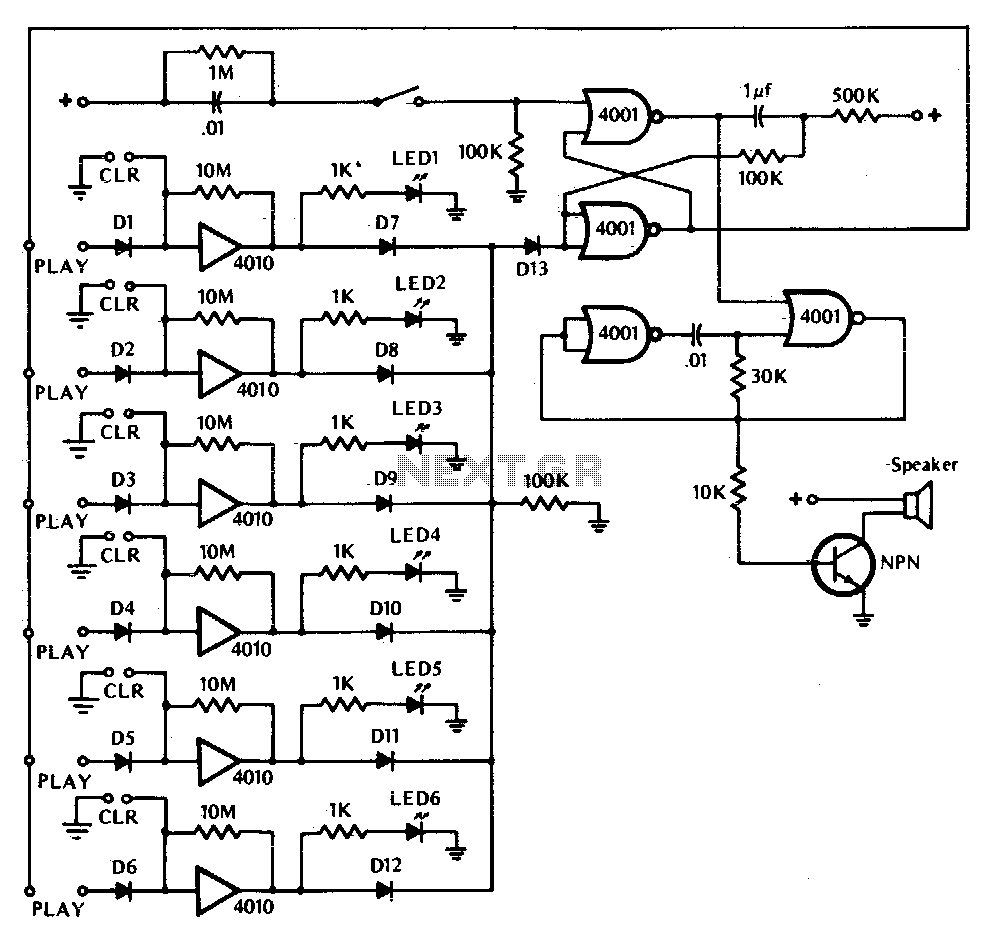
Ready set goi
This game tests a player's reaction time. It is activated by closing switch SI, which starts the tone generator and arms the circuit. The touchplate, labeled PLAY in the diagram, consists of two metal strips about 1/16th inch apart. The...
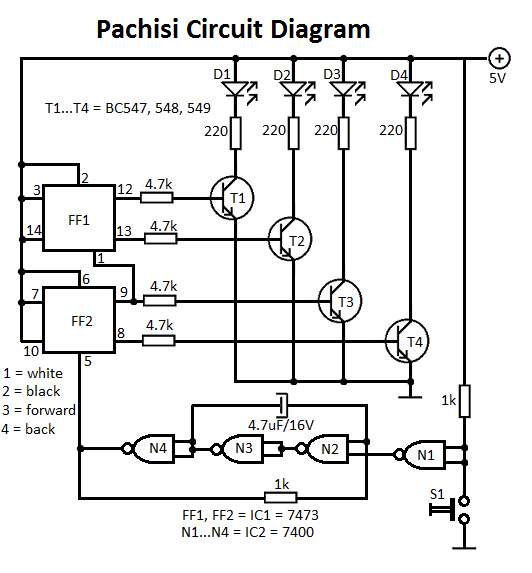
Pachisi Game Circuit
The Pachisi game is designed for two players. Each player has one figurine, which is initially placed on positions indicated by arrows on the game board.
The Pachisi game, often referred to as the "Royal Game of India," is a...

White Light
White Light is an interactive sound and light installation that combines elements of sculpture, musical instrument, and social engagement. It invites viewers to participate in a complex display of sound and light by manipulating controls on one of three podiums...
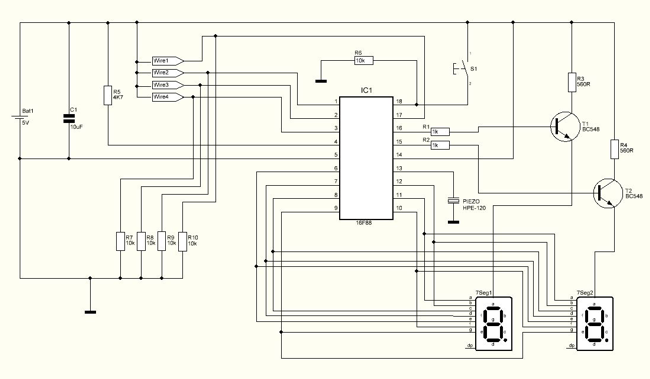
Bomb Deactivation Game
Should I cut the blue wire... or the red...? This is a very common phrase in many movies when the action hero has a bomb in front of him with little time left and he has to choose which wire...
HANGMAN schematic
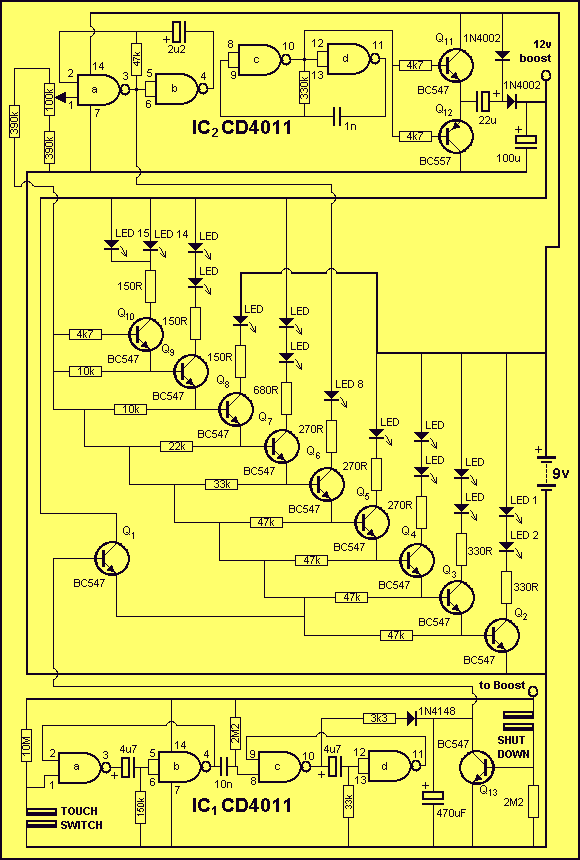
Everybody likes re-discovering something they did years ago. Here's a game we all played at school. Possibly under the name of HANG THE BUTCHER. The game is quite simple. One player thinks of a word and writes down the number...
Who is first
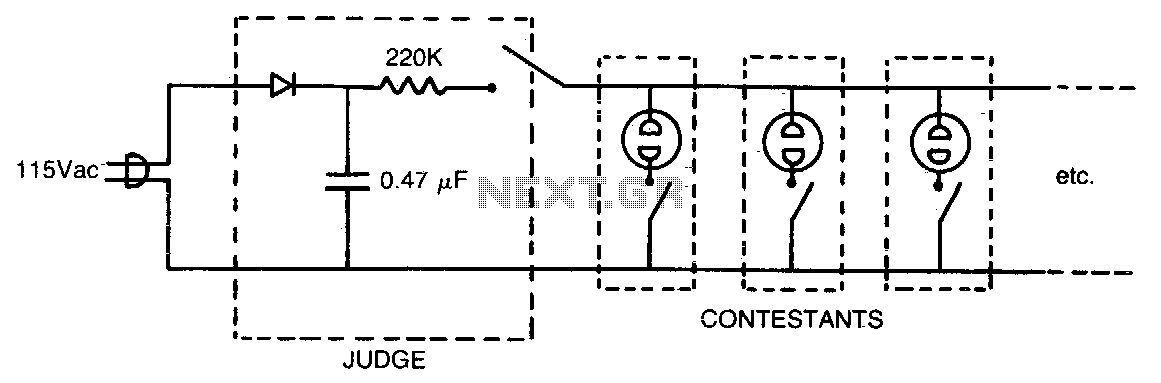
This circuit is designed for use in a question-and-answer party game. The first button pressed ionizes a neon bulb, causing the DC voltage across the parallel-connected neon bulbs (representing other contestants) to drop below the ionization threshold, thereby clearly identifying...
Steady Hands Game Project
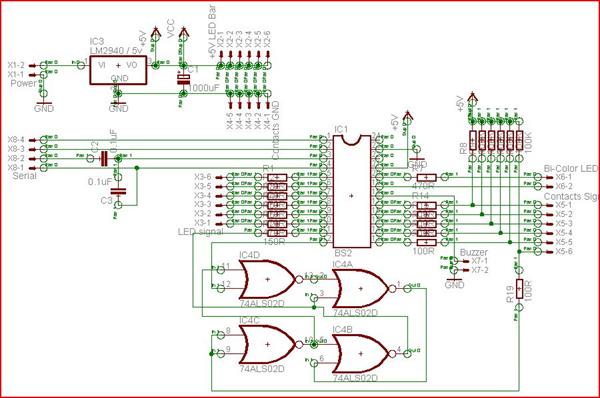
A "Steady Hands Game" was developed to meet the requirement for a cub-scout event. Initially prototyped on a homework board, a more permanent version of the game was created for educational purposes. The final version features a wand (black) that...
HANGMAN schematic
Everybody likes re-discovering something they did years ago. Here's a game we all played at school. Possibly under the name of HANG THE BUTCHER. The game is quite simple. One player thinks of a word and writes down the number...

Electronic Roulette Game
R14 is configured to establish an initial "starting" speed for the oscillators U1A and U1B. As capacitor C2 charges, the oscillation gradually slows down during the discharging phase of C2, creating a roulette-wheel effect on LED S1 through resistor R10....