


Display circuit
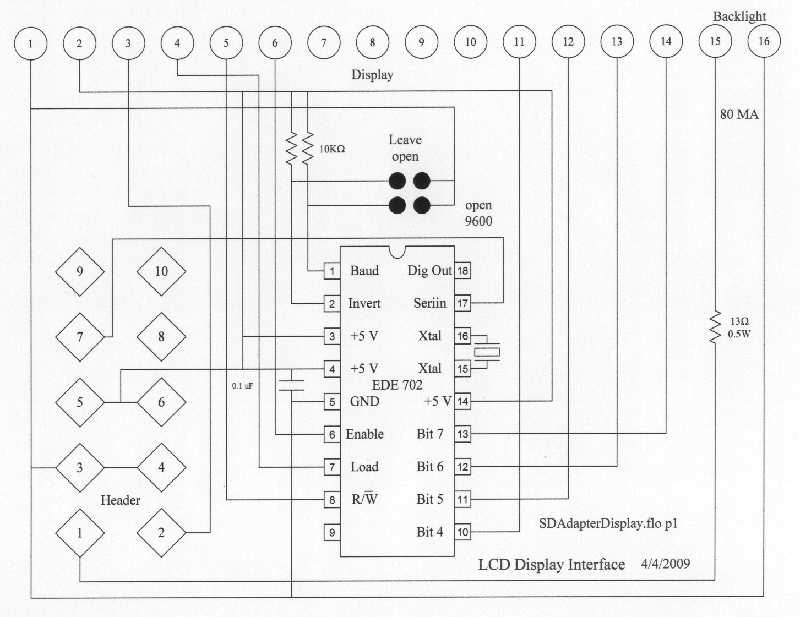
Description: A purchase was made of the EDE702 along with an LED-backlit LCD character display. After acquiring the EDE702, it was determined that it lacked sufficient integration with HD44780-compatible displays to justify its cost. However, utilizing it was preferable to leaving it unused. It was convenient to incorporate it into the Secure DigitalWriter box, as there was adequate space for the display and the existing serial infrastructure. Unfortunately, the display and the writer are incompatible due to their differing command requirements. Although the board has ample space for the EDE702, it was placed on a separate board due to the numerous connections needed for the display. The display board connects directly to the display using a single-row header. Uncertainty existed regarding the appropriate current for the LED backlight, as no data sheet matching the display's markings was available, and it lacked a dropping resistor. A data sheet for a similar display suggested a backlight current of 240 mA, which seemed excessive. After experimentation, a current of 80 mA was selected, necessitating modifications to the writer board to accommodate a heatsink on the regulator. The display features a black on yellow color scheme, providing excellent readability indoors and a wide field of view.
The EDE702 is a microcontroller that interfaces with various display technologies, including the HD44780-compatible LCDs. Its integration into the Secure DigitalWriter box allows for enhanced functionality, although the differences in command protocols between the EDE702 and the LED-backlit LCD character display necessitate careful consideration during design and implementation. The separation of the EDE702 onto its own board is a practical solution to manage the complex wiring required for the display, ensuring that each connection is secure and properly routed.
The single-row header used for connecting the display board simplifies the assembly process, allowing for a straightforward connection to the display. This design choice minimizes potential errors during installation and provides a clean interface for the user. The decision to operate the LED backlight at 80 mA, rather than the initially suggested 240 mA, demonstrates a thoughtful approach to power management and thermal considerations. By incorporating a heatsink on the regulator, the design mitigates the risk of overheating, ensuring reliable operation of the display.
The choice of a black on yellow display enhances visibility, particularly in indoor environments where lighting conditions can vary. The wide field of view is advantageous, as it allows multiple users to read the display from different angles without significant loss of contrast or clarity. Overall, the design considerations taken into account for the integration of the EDE702 and the LED-backlit LCD character display result in a functional and user-friendly interface suitable for various applications.Had bought this EDE702 some time ago, and a LED-backlit LCD character display. After buying the EDE702, I considered that it did not provide enough integration with HD44780-compatible displays to justify its price. Nevertheless I should use it, as it would be more use set up than lying in a box. It was convenient to put it in the Secure DigitalWriter box, as there was room for the display, and the
serial infrastructure already was in it. However, the display and the writer are not compatible, since they require different commands. Although the existing board has enough space for the EDE702, it was put on a separate board because of the large number of connections to the display. The display board plugs directly into the display with a single-row header. I was not sure how much current the LED backlight should have, since I did not have a data sheet which matched the marking on the display, and it did not have a dropping resistor.
A data sheet for a similar-appearing display gave 240 mA for the backlight, but this seemed excessive, so after experimenting I chose 80 MA, which did require rework of the writer board to put a heatsink on the regulator. This display is black on yellow, and is very readable indoors, with a good field of view.
The EDE702 is a microcontroller that interfaces with various display technologies, including the HD44780-compatible LCDs. Its integration into the Secure DigitalWriter box allows for enhanced functionality, although the differences in command protocols between the EDE702 and the LED-backlit LCD character display necessitate careful consideration during design and implementation. The separation of the EDE702 onto its own board is a practical solution to manage the complex wiring required for the display, ensuring that each connection is secure and properly routed.
The single-row header used for connecting the display board simplifies the assembly process, allowing for a straightforward connection to the display. This design choice minimizes potential errors during installation and provides a clean interface for the user. The decision to operate the LED backlight at 80 mA, rather than the initially suggested 240 mA, demonstrates a thoughtful approach to power management and thermal considerations. By incorporating a heatsink on the regulator, the design mitigates the risk of overheating, ensuring reliable operation of the display.
The choice of a black on yellow display enhances visibility, particularly in indoor environments where lighting conditions can vary. The wide field of view is advantageous, as it allows multiple users to read the display from different angles without significant loss of contrast or clarity. Overall, the design considerations taken into account for the integration of the EDE702 and the LED-backlit LCD character display result in a functional and user-friendly interface suitable for various applications.Had bought this EDE702 some time ago, and a LED-backlit LCD character display. After buying the EDE702, I considered that it did not provide enough integration with HD44780-compatible displays to justify its price. Nevertheless I should use it, as it would be more use set up than lying in a box. It was convenient to put it in the Secure DigitalWriter box, as there was room for the display, and the
serial infrastructure already was in it. However, the display and the writer are not compatible, since they require different commands. Although the existing board has enough space for the EDE702, it was put on a separate board because of the large number of connections to the display. The display board plugs directly into the display with a single-row header. I was not sure how much current the LED backlight should have, since I did not have a data sheet which matched the marking on the display, and it did not have a dropping resistor.
A data sheet for a similar-appearing display gave 240 mA for the backlight, but this seemed excessive, so after experimenting I chose 80 MA, which did require rework of the writer board to put a heatsink on the regulator. This display is black on yellow, and is very readable indoors, with a good field of view.
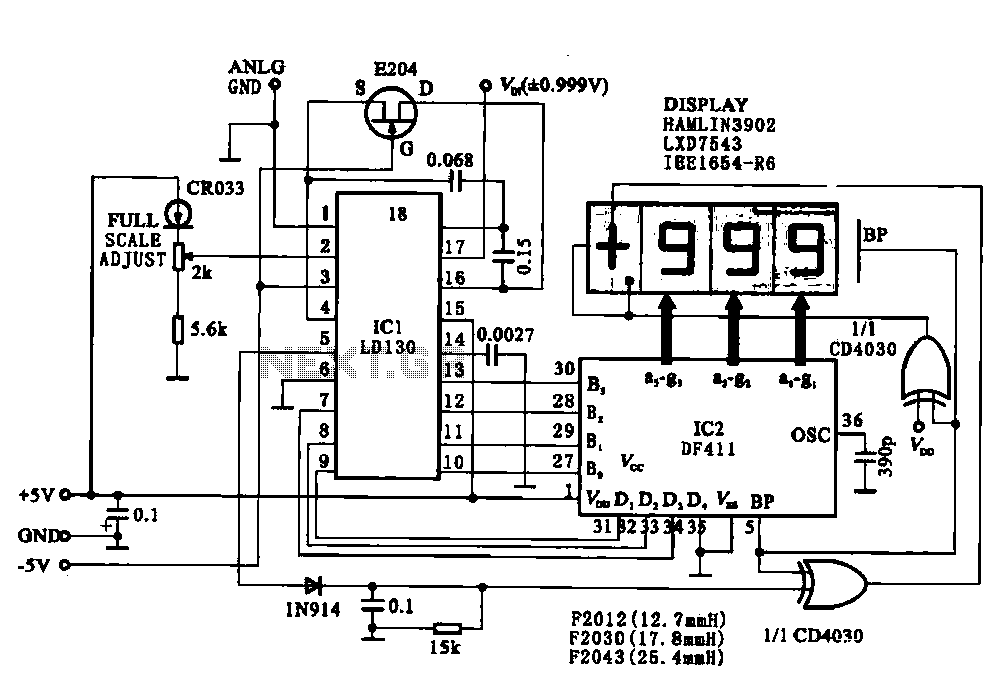
Display driver circuit digital voltmeter
This circuit illustrates a display driving system for a digital voltmeter. The liquid crystal display (LCD) does not emit light by itself; it relies on external incident light for visibility. The integrated circuit (IC) LD130 serves as an input voltage...
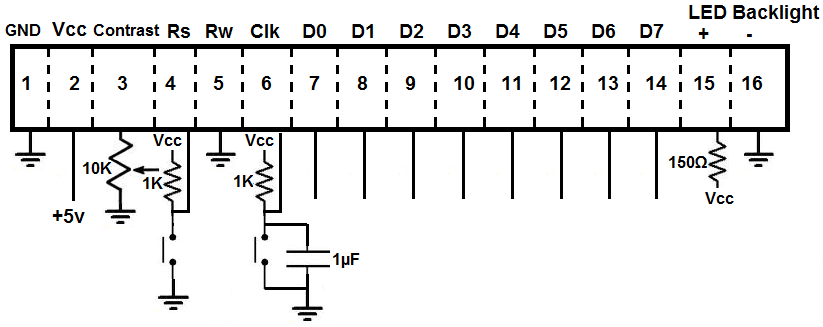
Adjust the Contrast of a HD44780 LCD
The 10KG potentiometer allows for the adjustment of screen contrast from dark to bright. When the potentiometer is set near 0G, the screen appears very dark. As the potentiometer is turned up to 10KG, the screen brightness increases.
The 10KG potentiometer...
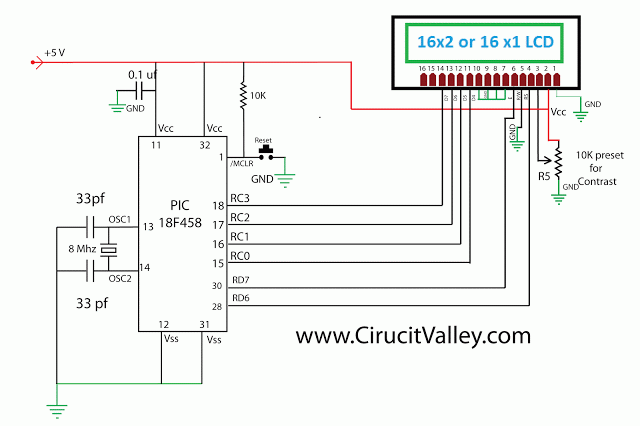
HD44780 16x2 Char LCD Interfacing with microcontroller
An alphanumeric low-cost LCD display is essential for many small and large projects to display various types of information. The Hitachi HD44780 chipset-based 16x2 character LCD is very affordable and easily available in the local market. This project covers various...
HD44780 Character LCD Displays Tutorial
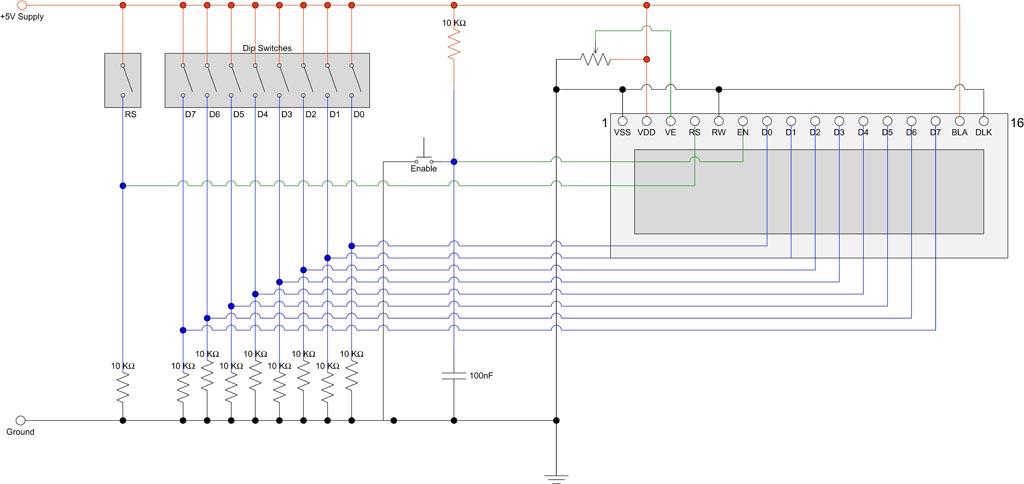
Interfacing with an HD44780 compatible display using DIP switches and a few other components. The module utilized is a 16 character x 2 line display that is in stock. It employs an ST7065C controller, which is compatible with the HD44780...

Display Driver circuit
This display driver circuit illustrates how a Seven Segment Display is driven using the 5-stage Johnson decade counter IC CD4033. The integrated circuit functions as a counter.
The CD4033 is a versatile decade counter that can be utilized to drive a...