


Donald Smith Devices too good to be true 1
#Donald Smith
#cold electricity
#Tesla
#experimental
#energy
#high voltage
#wire burning
#unconventional
#controversial
#DIY
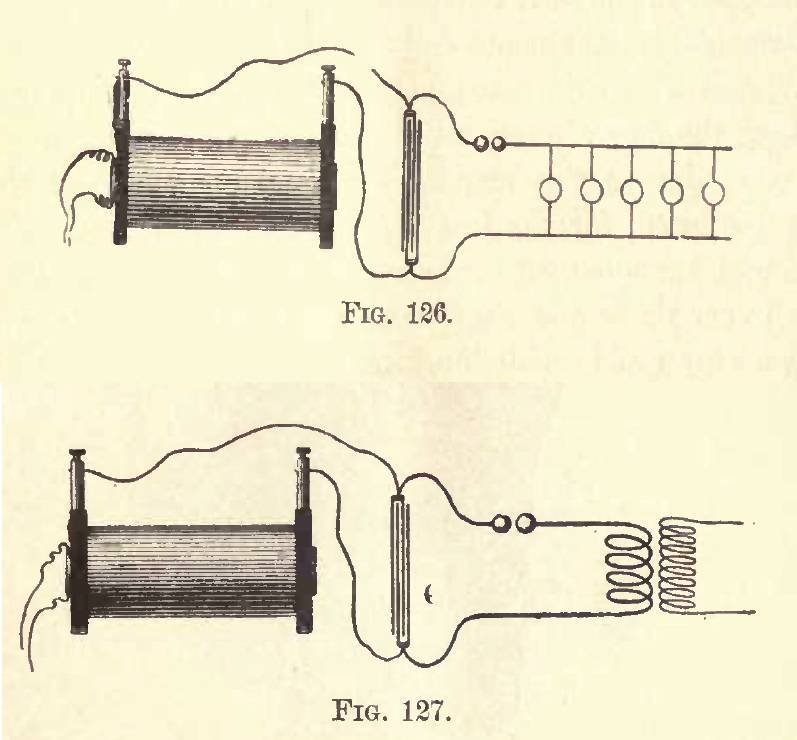
Description: In relation to cold electricity, it aligns precisely with Duncan's statements. During experiments, burning wires were observed as a result of Tesla's work.
Cold electricity refers to a phenomenon associated with electrical energy that exhibits distinct characteristics compared to conventional electrical currents. This concept is often linked to the work of Nikola Tesla, who explored various forms of electrical transmission and energy propagation. The term "cold" electricity does not imply a lack of energy but rather indicates an unusual behavior of electrical currents that can manifest under specific conditions, often leading to surprising effects.
In experimental setups, such as those mentioned, the application of cold electricity can lead to unexpected results, including the overheating and burning of wires. This can occur due to the unique properties of the electrical discharge, which may not conform to traditional expectations of current flow and resistance. The experiments may involve high-frequency oscillations, resonant circuits, or other specialized configurations that can amplify the effects of cold electricity.
To properly analyze and utilize cold electricity in electronic circuits, careful consideration must be given to the materials used, the design of the circuit, and the intended application. Components such as capacitors, inductors, and specialized wire materials can influence the performance and safety of the circuit. Additionally, it is essential to monitor thermal conditions and implement protective measures to prevent damage to components due to excessive heat generation. Understanding the underlying principles of cold electricity can lead to innovative applications in energy transmission, wireless power transfer, and advanced circuit design.Originally Posted by T-1000 In regards of cold electricity it is exactly what Duncan says. In our experiments we got burning wires from Tesla..
Cold electricity refers to a phenomenon associated with electrical energy that exhibits distinct characteristics compared to conventional electrical currents. This concept is often linked to the work of Nikola Tesla, who explored various forms of electrical transmission and energy propagation. The term "cold" electricity does not imply a lack of energy but rather indicates an unusual behavior of electrical currents that can manifest under specific conditions, often leading to surprising effects.
In experimental setups, such as those mentioned, the application of cold electricity can lead to unexpected results, including the overheating and burning of wires. This can occur due to the unique properties of the electrical discharge, which may not conform to traditional expectations of current flow and resistance. The experiments may involve high-frequency oscillations, resonant circuits, or other specialized configurations that can amplify the effects of cold electricity.
To properly analyze and utilize cold electricity in electronic circuits, careful consideration must be given to the materials used, the design of the circuit, and the intended application. Components such as capacitors, inductors, and specialized wire materials can influence the performance and safety of the circuit. Additionally, it is essential to monitor thermal conditions and implement protective measures to prevent damage to components due to excessive heat generation. Understanding the underlying principles of cold electricity can lead to innovative applications in energy transmission, wireless power transfer, and advanced circuit design.Originally Posted by T-1000 In regards of cold electricity it is exactly what Duncan says. In our experiments we got burning wires from Tesla..
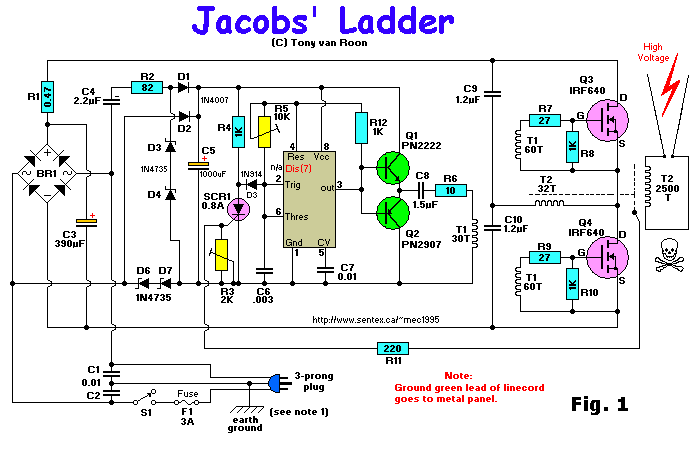
Jacobs Ladder
Construct this engaging Jacob's Ladder to observe electric arcs ascending the ladder and dissipating into the atmosphere. It operates using a sophisticated 12,000-volt power supply. The author, Robert Iannini, notes that electric arcs have long captivated and intimidated people, manifesting...
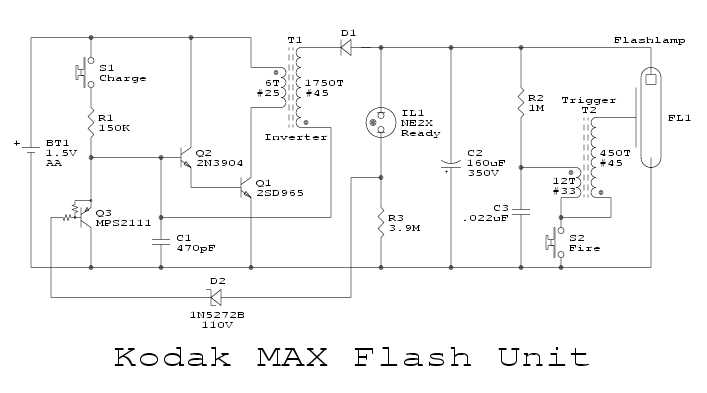
Salvaging Interesting Gadgets Components and Subsystems
The high voltage power supply is likely capable of delivering between 12 to 30 kVDC at a current of 1 or 2 mA. This output is suitable for various high voltage applications, including experiments, plasma globes, negative ion and ozone...
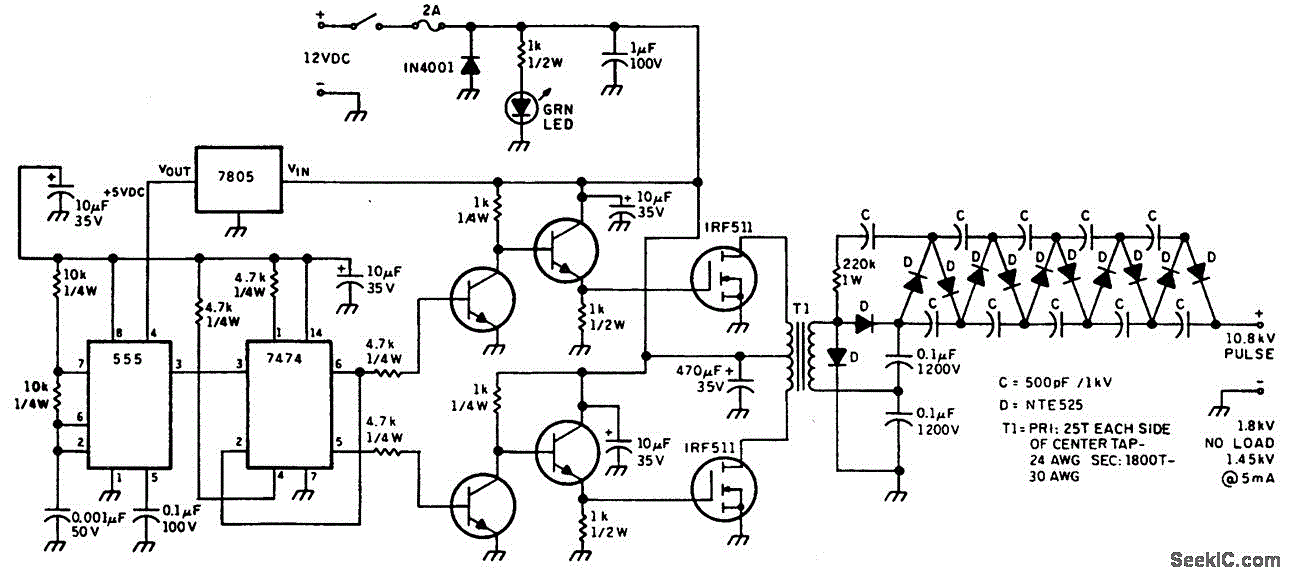
HELIUM NEON LASER SUPPLY
This figure illustrates a method for generating a momentary 10-kV voltage pulse to initiate plasma discharge across a laser tube. A diode voltage-multiplier circuit is connected in series with the main supply, obtaining its input power from one of the...

Circuit Project: 12KV High Voltage Generator
The hobby circuit described utilizes a unique approach to generate approximately 12,000 volts with a current of about 5 µA. It employs two silicon-controlled rectifiers (SCRs) that form dual pulse generator circuits. These SCRs discharge a 0.047 µF capacitor rated...
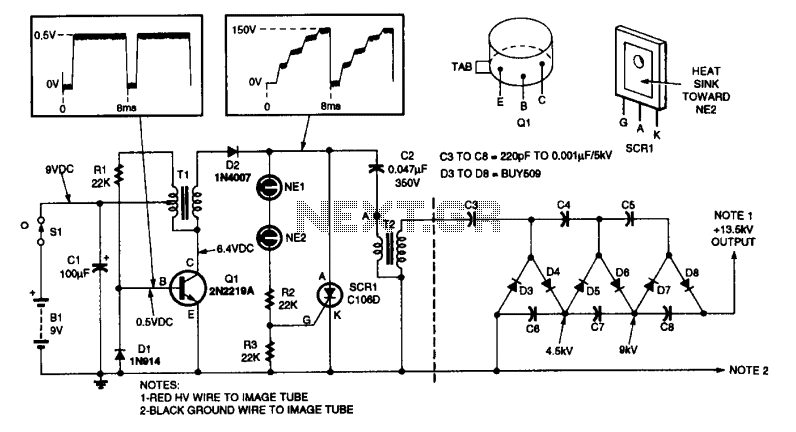
13KV High voltage power supply
This high-voltage power supply features an inverter circuit centered around Q1, which generates 150-V pulses for the converter SCR1 and capacitor C2. The output from component ?2 produces a 4.5-kV pulse, which is further amplified by a voltage-tripler network to...
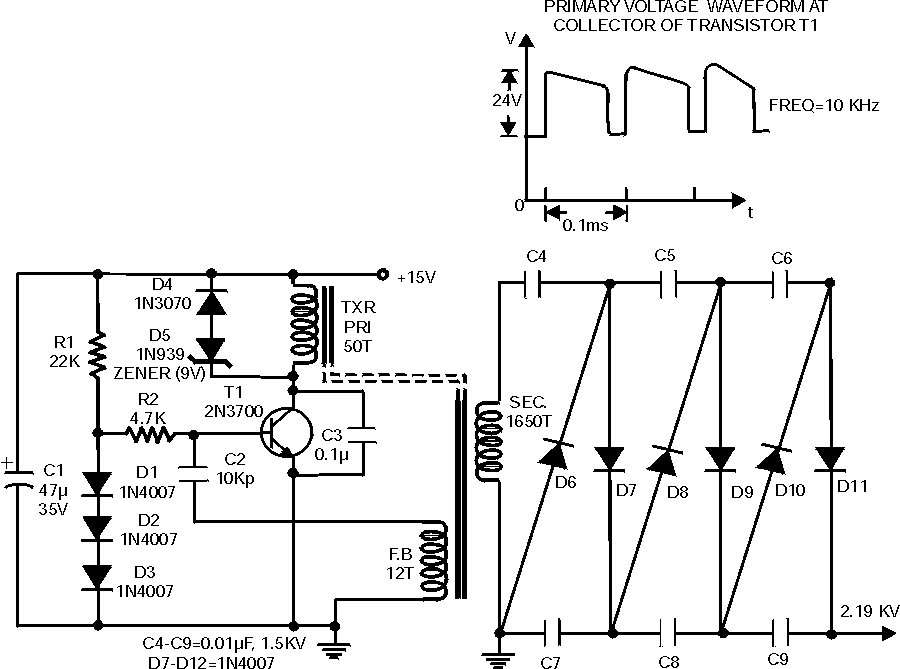
High Voltage Low Current Supply
The following circuit illustrates a High Voltage, Low Current Supply. Features: This circuit is utilized for applications such as biasing gas-discharge tubes, radiation detectors, and similar devices.
The High Voltage, Low Current Supply circuit is designed to provide a stable high...
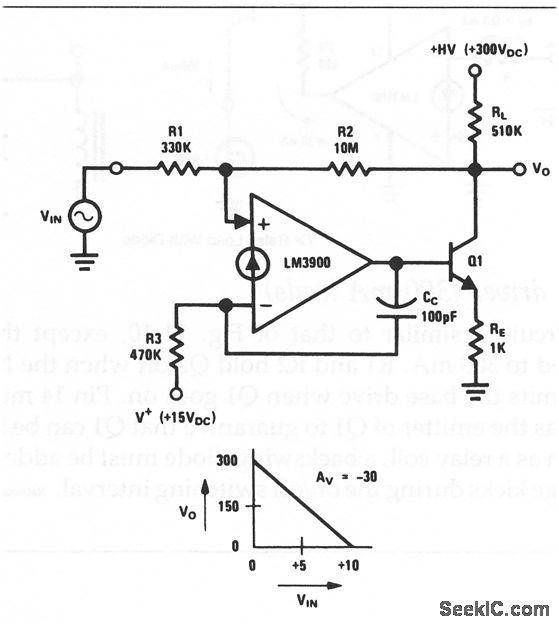
Norton high voltage inverting amplifier
This circuit is an inverting amplifier with an output voltage swing from approximately 0 to +300 V. Any transistor can be utilized for Q1, as long as the breakdown voltage exceeds 300 V (since the full high voltage will be...
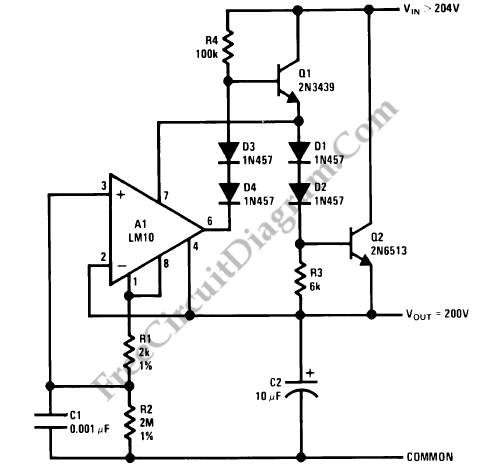
Direct High Voltage DC Regulator
This regulator circuit stabilizes the output voltage at 200V directly (without a transformer). Although the output voltage is high, this circuit only suffers a.
The circuit in question is designed to maintain a stable output voltage of 200V without the use...
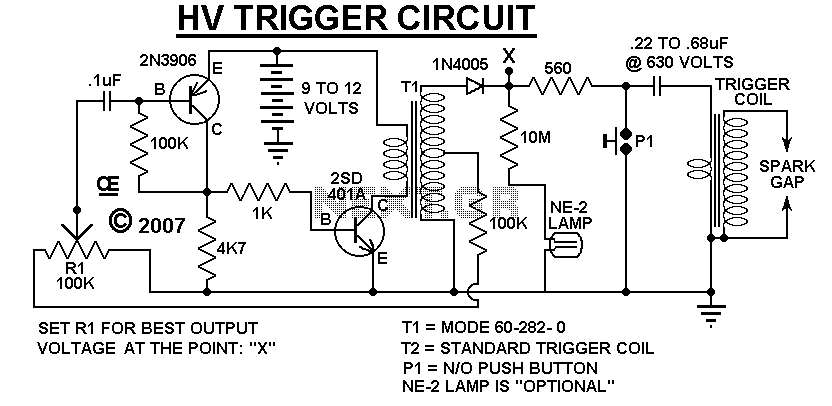
5000 Volts arc supply
A Very Low Current, High Voltage Spark, that is Manually Triggered. Although its not easily Measured, the Peak Output voltage will be over 5,000 Volts. T1 is a small audio transformer and it steps up the voltage to about 500...