


First Response Input Monitor Game Circuit
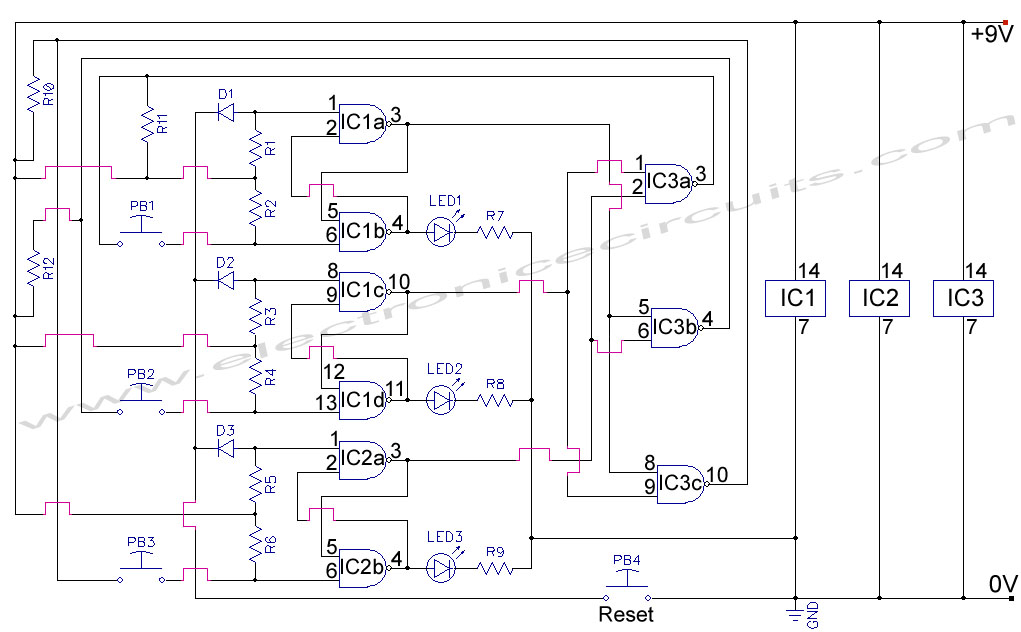
Description: First Response Monitor, Input Selector, Game Circuit. This circuit is utilized for first response applications as it aids in monitoring various responses in games.
The First Response Monitor circuit is designed to facilitate real-time monitoring and selection of input signals in gaming and response applications. It typically consists of an input selector that routes signals from multiple sources to a single output, allowing for efficient management of data inputs from different game components or sensors.
The circuit can include a microcontroller or a dedicated input multiplexer, which serves as the core component for selecting the active input. The input selector can be configured to switch between various input sources, such as buttons, sensors, or other electronic devices, enabling the system to respond dynamically based on user interaction or environmental changes.
Signal conditioning elements may also be incorporated to ensure that the input signals are correctly formatted and amplified for processing. This might involve the use of operational amplifiers to enhance signal integrity or filters to eliminate noise.
The output of the circuit typically connects to a display or an output device, which visualizes the selected input or the monitored response. This can be particularly useful in gaming scenarios where quick feedback is essential for gameplay dynamics.
Overall, the First Response Monitor circuit is a versatile tool that enhances the interactivity and responsiveness of electronic systems, making it a valuable component in both gaming and monitoring applications.First Response Monitor, Input Selector, Game Circuit You can find first response using this circuit, because it helps many response monitor, games..
The First Response Monitor circuit is designed to facilitate real-time monitoring and selection of input signals in gaming and response applications. It typically consists of an input selector that routes signals from multiple sources to a single output, allowing for efficient management of data inputs from different game components or sensors.
The circuit can include a microcontroller or a dedicated input multiplexer, which serves as the core component for selecting the active input. The input selector can be configured to switch between various input sources, such as buttons, sensors, or other electronic devices, enabling the system to respond dynamically based on user interaction or environmental changes.
Signal conditioning elements may also be incorporated to ensure that the input signals are correctly formatted and amplified for processing. This might involve the use of operational amplifiers to enhance signal integrity or filters to eliminate noise.
The output of the circuit typically connects to a display or an output device, which visualizes the selected input or the monitored response. This can be particularly useful in gaming scenarios where quick feedback is essential for gameplay dynamics.
Overall, the First Response Monitor circuit is a versatile tool that enhances the interactivity and responsiveness of electronic systems, making it a valuable component in both gaming and monitoring applications.First Response Monitor, Input Selector, Game Circuit You can find first response using this circuit, because it helps many response monitor, games..
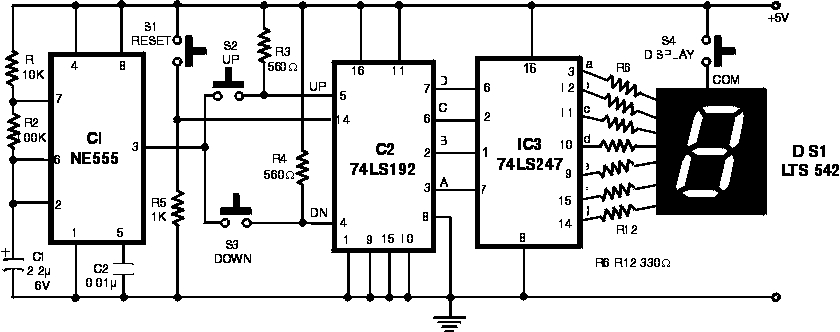
Simple Game Circuit
This is a simple game circuit designed for multiplayer enjoyment. The objective is to score one hundred points within a limited timeframe. To restart the game, the S1 button switch must be pressed. It is important to ensure that the...
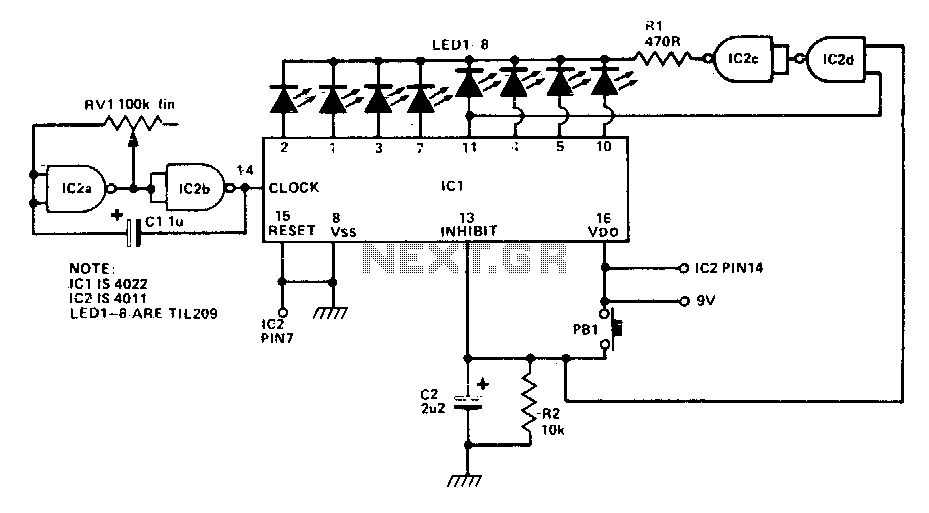
Pot shot
This circuit is designed for a shooting gallery-style game. IC2a and IC2b function as an astable multivibrator, generating a clock signal for IC1, which sequentially activates LEDs 1 through 8. LED 5 serves as the target LED, and the objective...
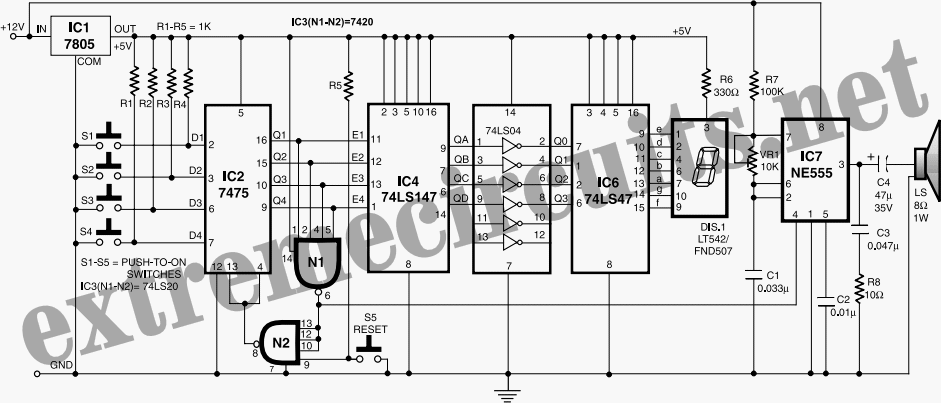
Fastest Finger First Indicator
Quiz-type game shows are increasingly popular on television. In these games, fastest finger first indicators (FFFIs) are used to test players' reaction times. When a player presses their entry button, their designated number is displayed alongside an audio alarm. The...
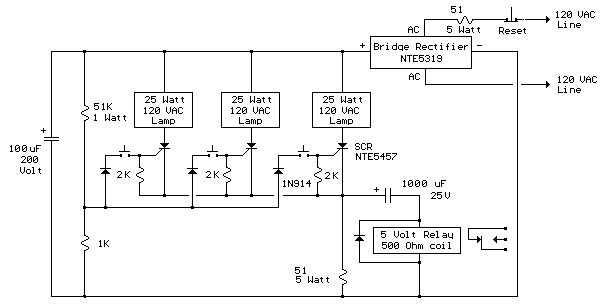
Who's First" game lights
The circuit below turns on a light corresponding to the first of several buttons pressed in a "Who's First" game. Three stages are shown but the circuit can be extended to include any number of buttons and lamps. Three SCRs...
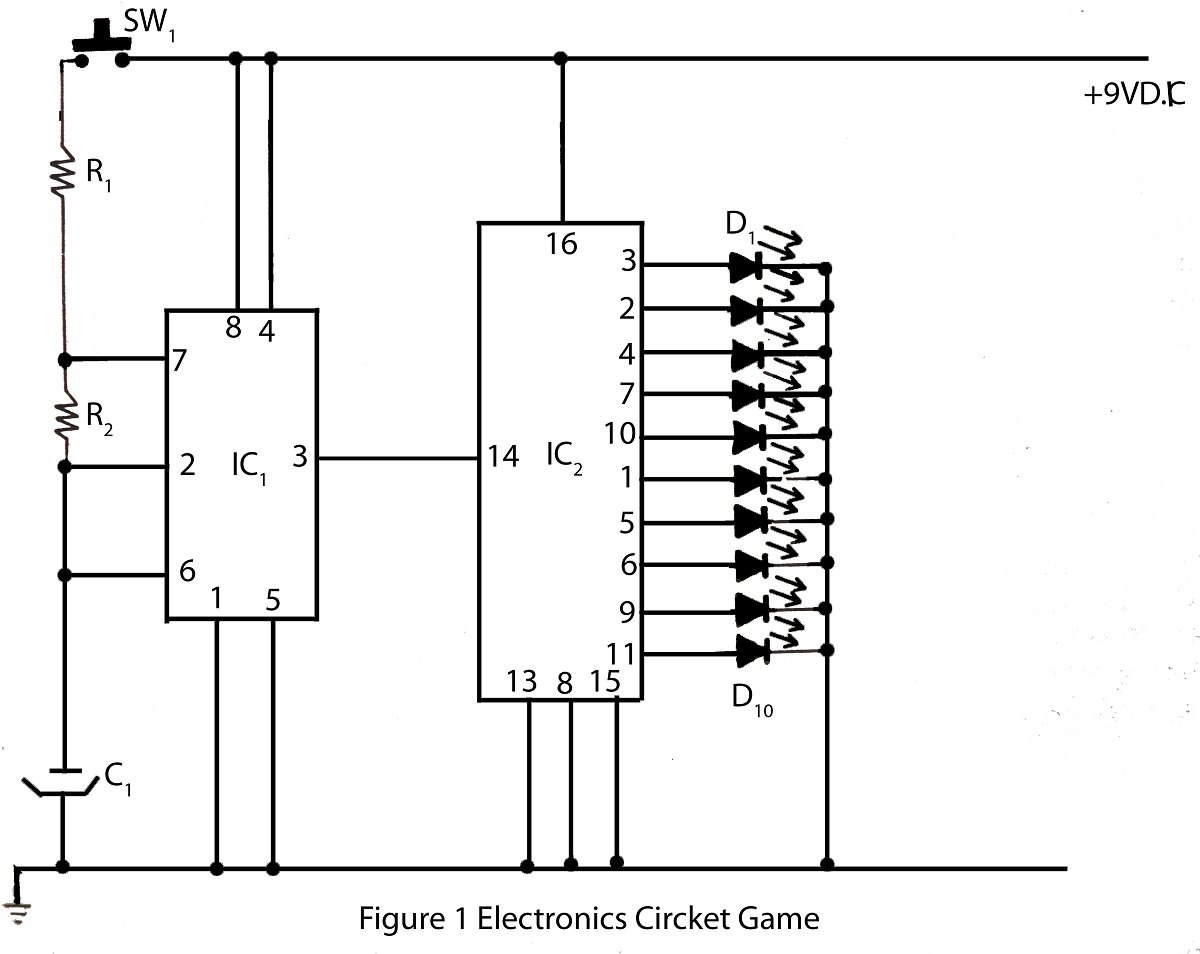
Electronics Cricket
The electronics cricket game circuit presented on this website is a straightforward and easy-to-build circuit diagram for an electronics cricket project, as well as various other game projects.
The electronics cricket game circuit typically consists of several key components that work...
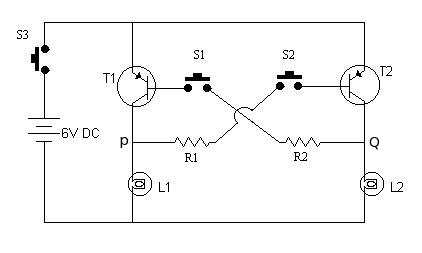
Reflex Action Game
This circuit is designed for quiz events where two participants press their buttons to answer questions. The participant who presses their button first gets the opportunity to answer first, as indicated by the lamps associated with each button. When switch...
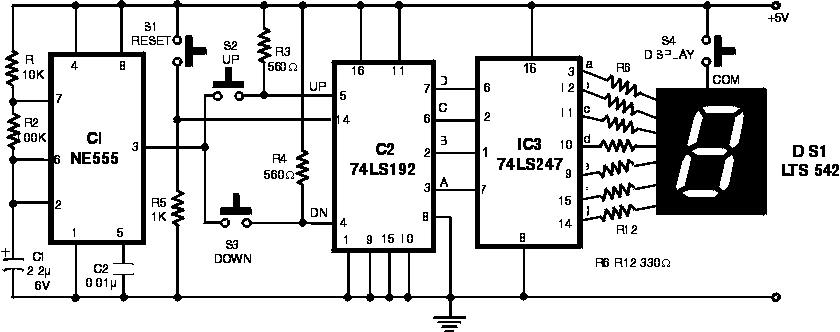
Scoring Game circuit
You can play this game alone or with your friends. The circuit comprises a timer IC, two decade counters and a display driver along with a 7-segment display. The game is simple. As stated above, it is a scoring game...
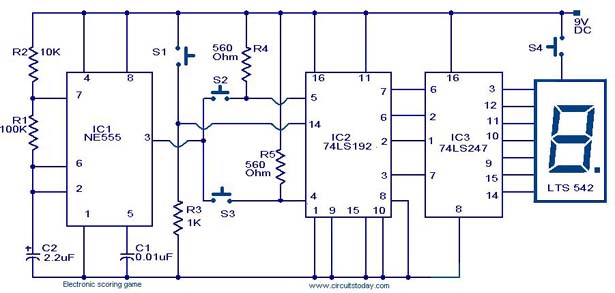
Scoring Game Circuit-DescriptionCircuit PartsDiagram
A scoring game circuit is explained with a circuit diagram and circuit parts.
The scoring game circuit is designed to track and display scores in a gaming environment. The primary components of this circuit typically include a microcontroller, a score display...

White Light
White Light is an interactive sound and light installation that combines elements of sculpture, musical instrument, and social engagement. It invites viewers to participate in a complex display of sound and light by manipulating controls on one of three podiums...