


Monochord Assembly Instructions
#monochord
#steel guitar string
#optical pickup
#magnetic pickup
#vibration measurement
#decay observation
#laboratory exercises
#assembly instructions

Description: This module outlines the assembly of the RealSimple monochord, which consists of a steel guitar string that is rigidly terminated and stretched to a variable tension. It utilizes both optical and magnetic pickups. Subsequent laboratory exercises focus on making elementary measurements and observations of the monochord's vibration and decay. The assembly requires a plank measuring 93 mm in width and 20 mm in thickness, from which several components are cut: a bottom plate measuring 600 mm in length (A), two transverse supports measuring 93 mm by 60 mm (B1, B2), two longitudinal supports measuring 100 mm by 60 mm (C1, C2), and a magnet support measuring 93 mm by 100 mm in height (D), featuring a cutout that is 14 mm wide and 55 mm deep. The magnet holder is held vertically by two small clamps for a horizontal magnetic field and can be easily adjusted along the string or rotated 90 degrees for a vertical magnetic field. The signal levels produced are low, and a 9V battery supply is recommended to minimize issues related to hum and ground loops. The output signal from the system is proportional to the string's velocity. Each transducer consists of a LED/phototransistor pair mounted facing each other, referred to as a "fork." This fork must be positioned so that the string, when at rest, partially obstructs the light path between the LED and the phototransistor. The string itself does not need to be electrically conductive. Optical transducers are employed to measure the string's displacement, and by mounting two of them at right angles, both horizontal and vertical deflections can be measured. It is advisable to mount the optical transducers near one end of the string, with the fork positioned on a small block so that the LED's light is shadowed by the string before reaching the phototransistor. Testing the fork involves measuring the output voltage when the light is unobstructed and when it is blocked by an opaque object, which will determine the working range of the system.
The RealSimple monochord assembly is designed to facilitate the study of string vibrations and their decay characteristics. The structural components are carefully dimensioned to provide stability and support for the string under tension. The choice of a steel guitar string allows for a range of frequencies to be explored, as varying the tension alters the pitch. The optical transducers, positioned strategically, enable precise measurements of the string's movement, capturing both amplitude and frequency of oscillation.
The transducer setup, consisting of the LED and phototransistor, operates on the principle of light interruption. When the string vibrates, it periodically obstructs the light path, resulting in variations in the phototransistor's output signal. This output is directly related to the string's velocity, allowing for accurate assessments of its dynamic behavior. The design emphasizes ease of adjustment, enabling researchers to reposition the magnet holder and transducers as needed to optimize performance and measurement accuracy.
The use of a 9V battery supply is crucial in ensuring reliable operation, as it mitigates the effects of electrical noise that could interfere with the low-level signals generated by the pickups. The modular nature of the assembly allows for straightforward modifications and enhancements, making it suitable for educational environments and experimental setups. Overall, the RealSimple monochord serves as an effective tool for investigating fundamental principles of acoustics and wave behavior in strings.This module describes assembly of the RealSimple monochord. The monochord consists of a steel guitar string, rigidly terminated and stretched to a variable tension. Both optical and magnetic pickups are used. Subsequent laboratory exercises are concerned with making elementary measurements and observations of monochord vibration and decay
. One plank 93 mm wide and 20 mm thick from which is sawn, Bottom plate, 600 mm long (A), 2 transverse supports 93 G— 60 mm (B1, B2), 2 longitudinal supports 100 G— 60 mm (C1, C2), Magnet support 93 G— 100 mm high (D). and with a cutout 14 mm wide and 55 mm deep. For a horizontal magnetic field, the Magnet Holder is held vertically by two small clamps (see photographs).
It can easily be moved along the string, and can also be rotated 90 degrees for a vertical magnetic field. The signal levels are low. Using a 9V battery supply reduces possible problems with hum and earth (ground) loops. The output signal is proportional to the string velocity. Each transducer is a LED/phototransistor pair that are mounted facing each other, in what is henceforth called a "fork.
" The fork must be carefully positioned such that the string at rest partially obstructs the light passing from LED to the phototransistor. The string does not need to be an electrical conductor. Optical transducers measure the string`s displacement. With two of them mounted at right angles, both horizontal and vertical deflection can be measured. Optical transducers are best mounted near one end of the string. Mount the fork on the small block, such that the light from the LED is shadowed by the string before reaching the phototransistor, see chapter 9, Figure 9.
14. Test the fork by measuring the output voltage both for unobstructed light and when the light is blocked by an opaque object. This will give the working range. An example is shown in the table.
The RealSimple monochord assembly is designed to facilitate the study of string vibrations and their decay characteristics. The structural components are carefully dimensioned to provide stability and support for the string under tension. The choice of a steel guitar string allows for a range of frequencies to be explored, as varying the tension alters the pitch. The optical transducers, positioned strategically, enable precise measurements of the string's movement, capturing both amplitude and frequency of oscillation.
The transducer setup, consisting of the LED and phototransistor, operates on the principle of light interruption. When the string vibrates, it periodically obstructs the light path, resulting in variations in the phototransistor's output signal. This output is directly related to the string's velocity, allowing for accurate assessments of its dynamic behavior. The design emphasizes ease of adjustment, enabling researchers to reposition the magnet holder and transducers as needed to optimize performance and measurement accuracy.
The use of a 9V battery supply is crucial in ensuring reliable operation, as it mitigates the effects of electrical noise that could interfere with the low-level signals generated by the pickups. The modular nature of the assembly allows for straightforward modifications and enhancements, making it suitable for educational environments and experimental setups. Overall, the RealSimple monochord serves as an effective tool for investigating fundamental principles of acoustics and wave behavior in strings.This module describes assembly of the RealSimple monochord. The monochord consists of a steel guitar string, rigidly terminated and stretched to a variable tension. Both optical and magnetic pickups are used. Subsequent laboratory exercises are concerned with making elementary measurements and observations of monochord vibration and decay
. One plank 93 mm wide and 20 mm thick from which is sawn, Bottom plate, 600 mm long (A), 2 transverse supports 93 G— 60 mm (B1, B2), 2 longitudinal supports 100 G— 60 mm (C1, C2), Magnet support 93 G— 100 mm high (D). and with a cutout 14 mm wide and 55 mm deep. For a horizontal magnetic field, the Magnet Holder is held vertically by two small clamps (see photographs).
It can easily be moved along the string, and can also be rotated 90 degrees for a vertical magnetic field. The signal levels are low. Using a 9V battery supply reduces possible problems with hum and earth (ground) loops. The output signal is proportional to the string velocity. Each transducer is a LED/phototransistor pair that are mounted facing each other, in what is henceforth called a "fork.
" The fork must be carefully positioned such that the string at rest partially obstructs the light passing from LED to the phototransistor. The string does not need to be an electrical conductor. Optical transducers measure the string`s displacement. With two of them mounted at right angles, both horizontal and vertical deflection can be measured. Optical transducers are best mounted near one end of the string. Mount the fork on the small block, such that the light from the LED is shadowed by the string before reaching the phototransistor, see chapter 9, Figure 9.
14. Test the fork by measuring the output voltage both for unobstructed light and when the light is blocked by an opaque object. This will give the working range. An example is shown in the table.
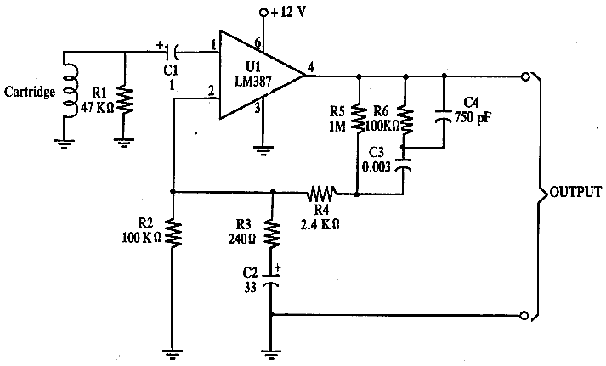
magnet cartridge amplifier
A magnetic pickup from an old record player can function effectively as a pressure and vibration sensor. By replacing the needle with a thin metal plate (copper from a PCB is suitable), an excellent touch sensor can be created. This...