


Scientific Society
#tesla coil
#transformer
#high voltage
#experimental
#water
#primary coil
#secondary coil
#DIY
#science project
#electrical
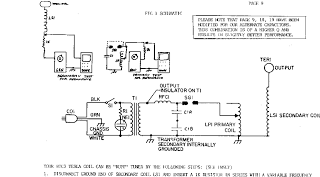
Description: This project effectively utilizes water. The application is unclear, but there is an interest in such devices. A Tesla coil has also been initiated, although there are doubts about its functionality. This differs from a conventional transformer in that the voltage and current relationships between the primary and secondary circuits are independent of the turns ratio. The apparatus essentially comprises a secondary coil (LS1) and a primary coil (LP1). It is evident that the primary circuit is capacitance-dominant, and adjusting the primary circuit through taps along the primary coil does not significantly affect the frequency as one might expect. Nonetheless, fine-tuning the primary circuit to match the secondary is essential for optimal performance. Forcing the secondary coil to operate without proper tuning can result in hot spots and interwinding breakdown.
The described project involves the design and implementation of a Tesla coil, which is a type of resonant transformer circuit. This device operates on the principle of electromagnetic induction and resonance, converting low-voltage, high-current electricity into high-voltage, low-current electricity. The Tesla coil consists of two primary components: the primary coil (LP1) and the secondary coil (LS1).
The primary coil is typically connected to a power source and is tuned to resonate at a specific frequency. This tuning is achieved by adjusting the capacitance in the primary circuit, which can be done using taps along the coil. The tuning process is critical because it ensures that the primary circuit's frequency aligns with that of the secondary coil, maximizing energy transfer between the two coils.
The secondary coil (LS1) is designed to resonate at the same frequency as the primary circuit. When the primary coil is energized, it creates a magnetic field that induces a voltage in the secondary coil. The relationship between the primary and secondary voltages is not dictated by the turns ratio, making the tuning process even more significant.
If the primary circuit is not properly tuned to the secondary coil, it can lead to inefficient operation, characterized by the generation of hot spots within the coils and potential interwinding breakdown. These issues arise due to excessive currents flowing through the coils, which can cause localized heating and damage the insulation between the windings.
In summary, the successful operation of the Tesla coil hinges on the precise tuning of the primary circuit to the secondary coil. This ensures efficient energy transfer and prevents potential damage due to overheating and electrical breakdown. Proper design considerations, including capacitance values and coil dimensions, are essential for achieving optimal performance in such high-voltage applications.This project really works with water. I don`t know how can I use this but you know that I like those stuff. I started my tesla coil too but I don`t think that this stuff will work. from a conventional transformer in that the voltage and current relationships between primary and secondary are independent of turns ratio. A working apparatus basically consists of a secondary (LS1) and a primary (LP1). It is obvious that the primary circuit is capacitance dominant and tuning the primary circuit via taps along the primary coil does not alter the frequency by as much as one would expect. However, this relatively fine tuning of the primary circuit to the secondary is mandatory for proper operation.
Force driving (untuned) the secondary coil will produce hot spots and interwinding breakdown.
The described project involves the design and implementation of a Tesla coil, which is a type of resonant transformer circuit. This device operates on the principle of electromagnetic induction and resonance, converting low-voltage, high-current electricity into high-voltage, low-current electricity. The Tesla coil consists of two primary components: the primary coil (LP1) and the secondary coil (LS1).
The primary coil is typically connected to a power source and is tuned to resonate at a specific frequency. This tuning is achieved by adjusting the capacitance in the primary circuit, which can be done using taps along the coil. The tuning process is critical because it ensures that the primary circuit's frequency aligns with that of the secondary coil, maximizing energy transfer between the two coils.
The secondary coil (LS1) is designed to resonate at the same frequency as the primary circuit. When the primary coil is energized, it creates a magnetic field that induces a voltage in the secondary coil. The relationship between the primary and secondary voltages is not dictated by the turns ratio, making the tuning process even more significant.
If the primary circuit is not properly tuned to the secondary coil, it can lead to inefficient operation, characterized by the generation of hot spots within the coils and potential interwinding breakdown. These issues arise due to excessive currents flowing through the coils, which can cause localized heating and damage the insulation between the windings.
In summary, the successful operation of the Tesla coil hinges on the precise tuning of the primary circuit to the secondary coil. This ensures efficient energy transfer and prevents potential damage due to overheating and electrical breakdown. Proper design considerations, including capacitance values and coil dimensions, are essential for achieving optimal performance in such high-voltage applications.This project really works with water. I don`t know how can I use this but you know that I like those stuff. I started my tesla coil too but I don`t think that this stuff will work. from a conventional transformer in that the voltage and current relationships between primary and secondary are independent of turns ratio. A working apparatus basically consists of a secondary (LS1) and a primary (LP1). It is obvious that the primary circuit is capacitance dominant and tuning the primary circuit via taps along the primary coil does not alter the frequency by as much as one would expect. However, this relatively fine tuning of the primary circuit to the secondary is mandatory for proper operation.
Force driving (untuned) the secondary coil will produce hot spots and interwinding breakdown.
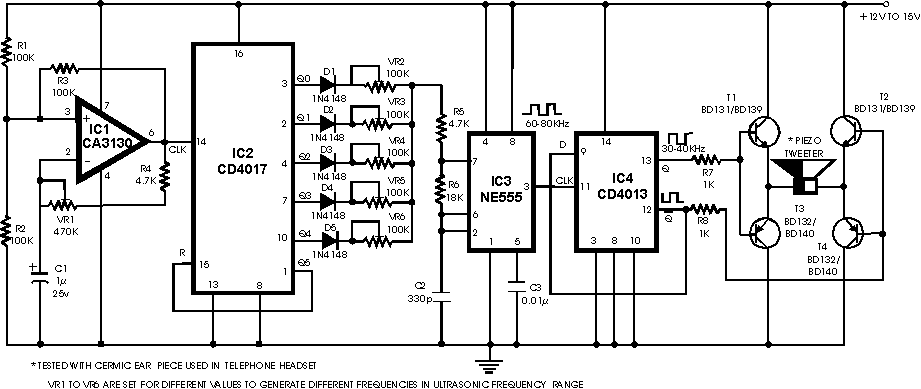
high voltage low current supply circuit diagram
A high voltage power supply is a valuable source that can be effectively used in various applications, such as biasing gas-discharge tubes and radiation detectors. This type of power supply can also serve as a protective measure, such as electrically...
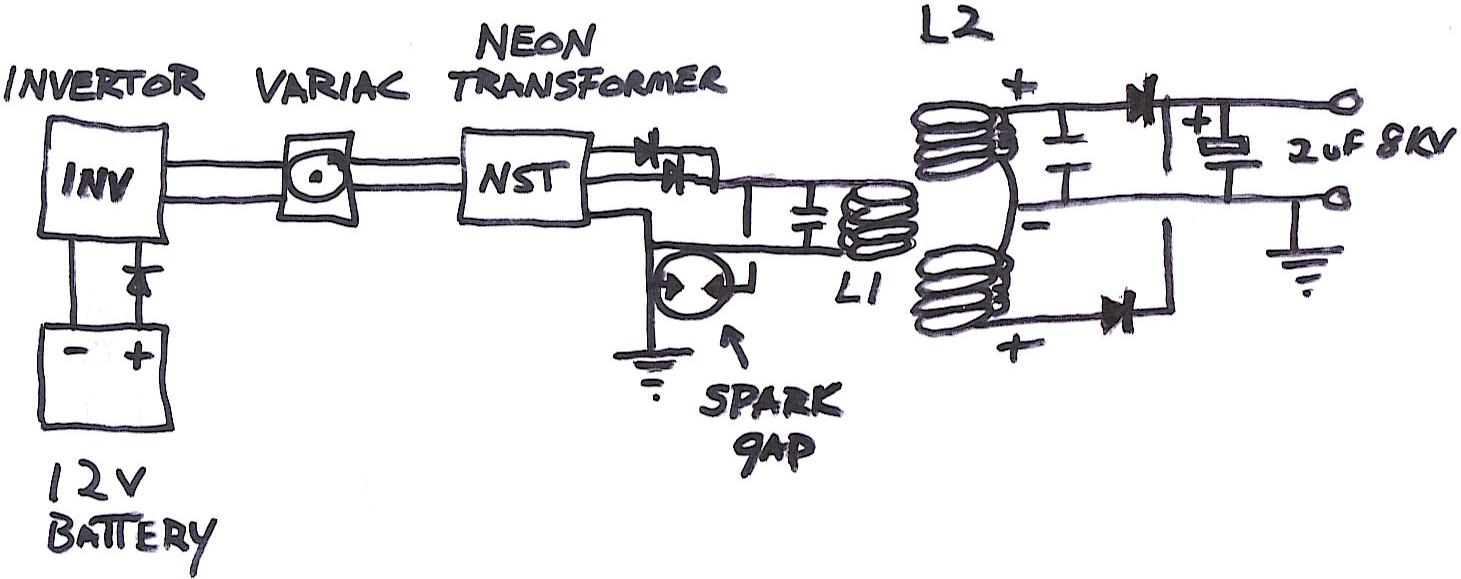
Tesla Coils
This diagram illustrates all components necessary to create a self-sustaining power supply. The input is a 12V DC, 7Ah lead-acid or gel cell battery (not depicted). This input connects to a 12V DC to 120V AC inverter rated approximately 200...
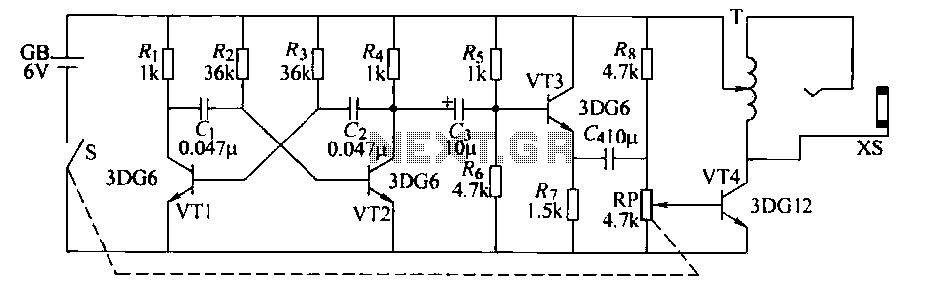
Zhichuan Electronic Circuit
The saying goes "dead ringworm surgical, medical dead asthma." This example describes an electronic anti-asthmatic device that produces high-voltage stimulation pulses, which can serve as an adjunct therapy for patients suffering from cough. The circuit consists of a self-excited multivibrator,...
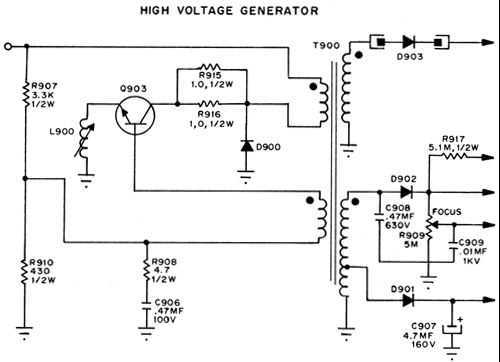
High Voltafe Generator
This is a series regulator with Q900 being the control element, Q901 a driver, and Q902 an error amp. ZD900 forms the emitter reference voltage source. Since the generated high voltage and other voltages are linked by means of the...
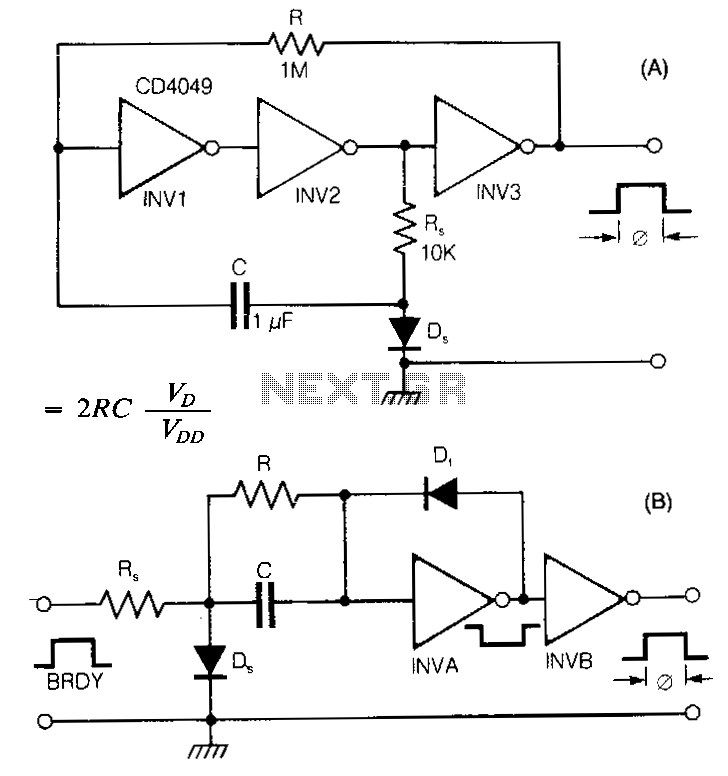
Simple-tesla-coil
The Tesla coil described here can generate 25,000 V. Although the output current is low, caution is essential. The primary component is a flyback transformer sourced from a discarded television. A new primary winding is required. Begin by winding 5...
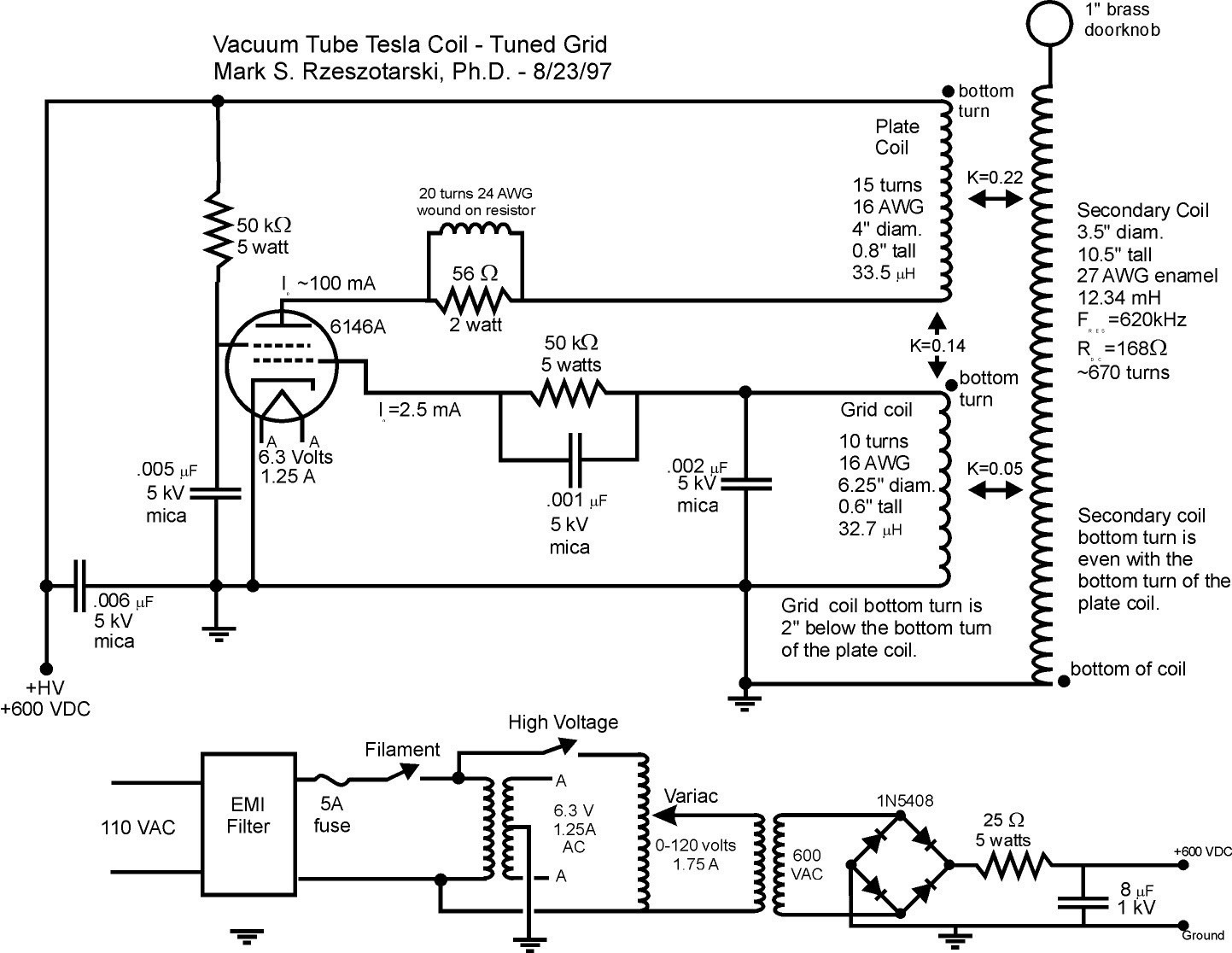
Miniature Vacuum Tube Tesla Coil
Vacuum tube Tesla coils operate in a continuous wave mode, providing constant energy to the Tesla coil secondary. Consequently, the output is mainly determined by the power capacity of the vacuum tube. The spark discharge and operation of these coils...
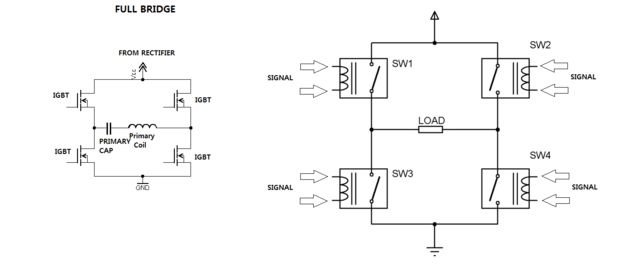
MONSTER Musical Tesla Coil with a Microcontroller
One of the most challenging aspects of constructing a solid-state Tesla coil is the bridge or switching circuit. The bridge switching circuit is the core component of the system.
The bridge switching circuit is essential for controlling the power delivery to...
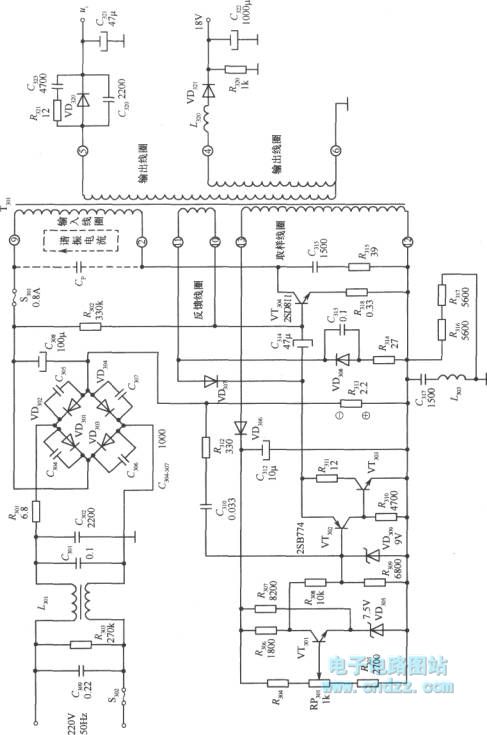
High voltage switching stabilized voltage supply circuit
A high voltage switching stabilized voltage supply circuit is illustrated in the diagram. This is the switching power supply for an 80P type color television. It utilizes auto-excitation and a PWM circuit. The output is isolated from the power system,...
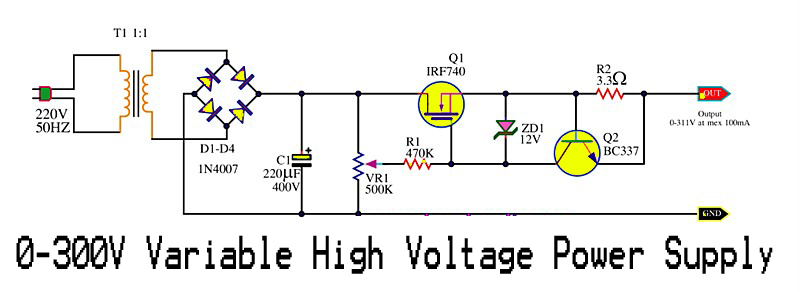
Light circuit diagram: 0-300V Variable High Voltage Power Supply
This is a variable high voltage DC power supply circuit that allows for customization of the output voltage ranging from 0 to 311V DC. It includes a current limit protection feature set at approximately 100 mA. The power MOSFET Q1...