


Using a TENS for relief from RLS or Restless Legs Syndrome
#TENS
#medical
#battery powered
#high voltage
#low current
#electrode pads
#programmable
#dual-channel
#frequency control
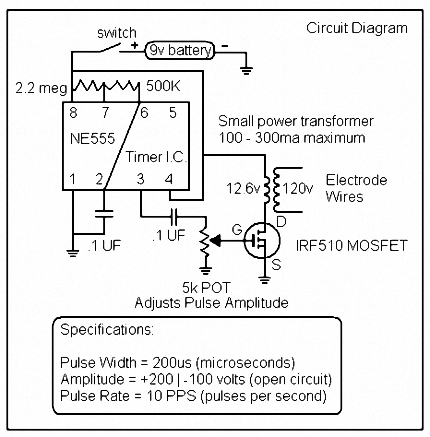
Description: A TENS (Transcutaneous Electrical Nerve Stimulation) device utilizes a battery power source to generate a high-voltage, low-current signal at a specified frequency and duration. This electrical current is applied externally to the skin using adhesive foam electrode pads. More advanced models feature dual channels, programmable functions, and digital displays. TENS devices have been in use for many years, commonly employed by healthcare professionals such as doctors, therapists, chiropractors, and rehabilitation clinics, as well as by individuals seeking non-pharmaceutical relief from muscle pain and discomfort. While there are theoretical claims regarding the efficacy of TENS devices, it is important to note that they should not be used by individuals with heart pacemakers or defibrillators, nor should they be applied to the head or neck. Pregnant individuals or those diagnosed with epilepsy should also avoid using TENS devices. The use of such devices is at the user's own risk.
The TENS unit operates by sending electrical impulses that interfere with the nerve signals responsible for pain and muscle spasms. This mechanism can provide temporary relief from symptoms associated with conditions like Restless Legs Syndrome (RLS). Users typically apply the electrode pads to specific locations on the body to maximize the therapeutic effect. For example, placing pads on the back of the legs can help alleviate the discomfort caused by RLS. The sensation produced by the device can vary, often described as a mild prickling feeling, which tends to diminish over time as the body becomes accustomed to the stimulation. Users often report significant relief from symptoms within minutes, allowing for improved comfort and sleep.
The circuit design of a TENS unit typically includes a microcontroller to manage the output frequency and duration of the electrical pulses, an amplifier to boost the signal, and a power management system to ensure efficient battery usage. The electrode pads are connected to the output of the amplifier, which delivers the electrical impulses to the skin. Various settings can be programmed to adjust the intensity and waveform of the stimulation, allowing users to tailor the experience to their specific needs.
In conclusion, while TENS devices offer a promising solution for managing pain and discomfort, users should exercise caution and consult healthcare professionals before use, especially if they have underlying health conditions.Using a battery power source the TENS device produces a high voltage but low current signal at a specified frequency and duration. This electrical current is applied externally to the skin of the body using sticky foam electrode pads.
The more expensive units have advanced features like dual-channels, programmable functions, a digital readout, etc. They have been around for many years and are used by doctors, therapists, chiropractors, rehab clinics, college and professional sports organizations and individuals. Anyone seeking relief from muscle aches and pain that does not involve the use of drugs. This article, found on a web site for a company that sells TENS units, provides some interesting if albeit theoretical claims on how TENS devices do their thing.
I have no connection whatsoever to this company but it`s worth reading. I found their assumptions to be quite plausable. . I also found some basic guidance about using a TENS unit specifically for RLS at this site:. I am not a medical professional. I am providing this web page for informational purposes only. A TENS unit should not be used by anyone who wears a heart pacemaker or defibrillator. It should never be used about the head or neck. If you have been diagnosed with epilepsy or have been told you are pregnant you should not use a TENS device. If you make or use this device you do so at your own risk and I accept no responsibility for the outcome.
I created this web page to try and help others out there who suffer from RLS. In my search for some kind of help I found little serious discussion or useful information on the internet concerning using a TENS unit to relieve the symptoms of Restless Legs Syndrome or RLS. Surprisingly there does not appear there have ever been any credible medical studies of the potential benefits either.
I`ve had RLS since I was a child. More so now as I`m middle age. I have the typical symptoms. sitting down after a day of work and the legs start to jerk and twitch away to the point I sometimes have to go to bed early just to get some relief. Usually this is enough to get them to subside but sometimes, on really bad days, the RLS seems to follow me to bed.
I`ve been building electronic projects since Iwas a teenager and Ihad made a simple electrical nerve stimulator a few years ago from a circuit I found on the internet. I used it for a bad knee and even for some very bad back strains. Always with excellent results. Basically, the device overrides the nerve impulses to the brain that are causing the pain (or twitches in the case of RLS) and, for a time, fool the brain that they no longer exist.
Even when you turn the device off the benefits of the stimulation treatment continues for several days more. The pain/symptoms stop. It`s that simple. Now I use my TENS unit for controlling my RLS symtoms. When the tingling and twitching gets so bad I cannot sit calmly or even go to sleep I stick the pads on the back of each leg (see diagram) about half way between my butt and my knee.
If I stand up and bend at the knees slightly I can feel the muscle tighten on the back of my leg. This is where I place the pads for maximum benefit. I get into bed and place the circuit board on my chest. At first I can feel the pulses very clearly. They are like a mild pin prick. Over time they get fainter and fainter to the point I have to think about them to really feel them. There is no discomfort whatsoever, andfor me, the relief is relatively quick. Within minutes the nasty jerking effects of my RLS are gone and I`m off to sleepy time. I leave the nerve stimulator on all night. I have had absolutely no side effects to
The TENS unit operates by sending electrical impulses that interfere with the nerve signals responsible for pain and muscle spasms. This mechanism can provide temporary relief from symptoms associated with conditions like Restless Legs Syndrome (RLS). Users typically apply the electrode pads to specific locations on the body to maximize the therapeutic effect. For example, placing pads on the back of the legs can help alleviate the discomfort caused by RLS. The sensation produced by the device can vary, often described as a mild prickling feeling, which tends to diminish over time as the body becomes accustomed to the stimulation. Users often report significant relief from symptoms within minutes, allowing for improved comfort and sleep.
The circuit design of a TENS unit typically includes a microcontroller to manage the output frequency and duration of the electrical pulses, an amplifier to boost the signal, and a power management system to ensure efficient battery usage. The electrode pads are connected to the output of the amplifier, which delivers the electrical impulses to the skin. Various settings can be programmed to adjust the intensity and waveform of the stimulation, allowing users to tailor the experience to their specific needs.
In conclusion, while TENS devices offer a promising solution for managing pain and discomfort, users should exercise caution and consult healthcare professionals before use, especially if they have underlying health conditions.Using a battery power source the TENS device produces a high voltage but low current signal at a specified frequency and duration. This electrical current is applied externally to the skin of the body using sticky foam electrode pads.
The more expensive units have advanced features like dual-channels, programmable functions, a digital readout, etc. They have been around for many years and are used by doctors, therapists, chiropractors, rehab clinics, college and professional sports organizations and individuals. Anyone seeking relief from muscle aches and pain that does not involve the use of drugs. This article, found on a web site for a company that sells TENS units, provides some interesting if albeit theoretical claims on how TENS devices do their thing.
I have no connection whatsoever to this company but it`s worth reading. I found their assumptions to be quite plausable. . I also found some basic guidance about using a TENS unit specifically for RLS at this site:. I am not a medical professional. I am providing this web page for informational purposes only. A TENS unit should not be used by anyone who wears a heart pacemaker or defibrillator. It should never be used about the head or neck. If you have been diagnosed with epilepsy or have been told you are pregnant you should not use a TENS device. If you make or use this device you do so at your own risk and I accept no responsibility for the outcome.
I created this web page to try and help others out there who suffer from RLS. In my search for some kind of help I found little serious discussion or useful information on the internet concerning using a TENS unit to relieve the symptoms of Restless Legs Syndrome or RLS. Surprisingly there does not appear there have ever been any credible medical studies of the potential benefits either.
I`ve had RLS since I was a child. More so now as I`m middle age. I have the typical symptoms. sitting down after a day of work and the legs start to jerk and twitch away to the point I sometimes have to go to bed early just to get some relief. Usually this is enough to get them to subside but sometimes, on really bad days, the RLS seems to follow me to bed.
I`ve been building electronic projects since Iwas a teenager and Ihad made a simple electrical nerve stimulator a few years ago from a circuit I found on the internet. I used it for a bad knee and even for some very bad back strains. Always with excellent results. Basically, the device overrides the nerve impulses to the brain that are causing the pain (or twitches in the case of RLS) and, for a time, fool the brain that they no longer exist.
Even when you turn the device off the benefits of the stimulation treatment continues for several days more. The pain/symptoms stop. It`s that simple. Now I use my TENS unit for controlling my RLS symtoms. When the tingling and twitching gets so bad I cannot sit calmly or even go to sleep I stick the pads on the back of each leg (see diagram) about half way between my butt and my knee.
If I stand up and bend at the knees slightly I can feel the muscle tighten on the back of my leg. This is where I place the pads for maximum benefit. I get into bed and place the circuit board on my chest. At first I can feel the pulses very clearly. They are like a mild pin prick. Over time they get fainter and fainter to the point I have to think about them to really feel them. There is no discomfort whatsoever, andfor me, the relief is relatively quick. Within minutes the nasty jerking effects of my RLS are gone and I`m off to sleepy time. I leave the nerve stimulator on all night. I have had absolutely no side effects to

Electronic Cricket Match Game
This electronic cricket is a gift for children. This simple battery-powered circuit can be utilized to play cricket matches with friends. Each LED in the circuit...
This electronic cricket circuit is designed as an engaging and interactive toy for children, promoting...
Preregulated-high-voltage-supply
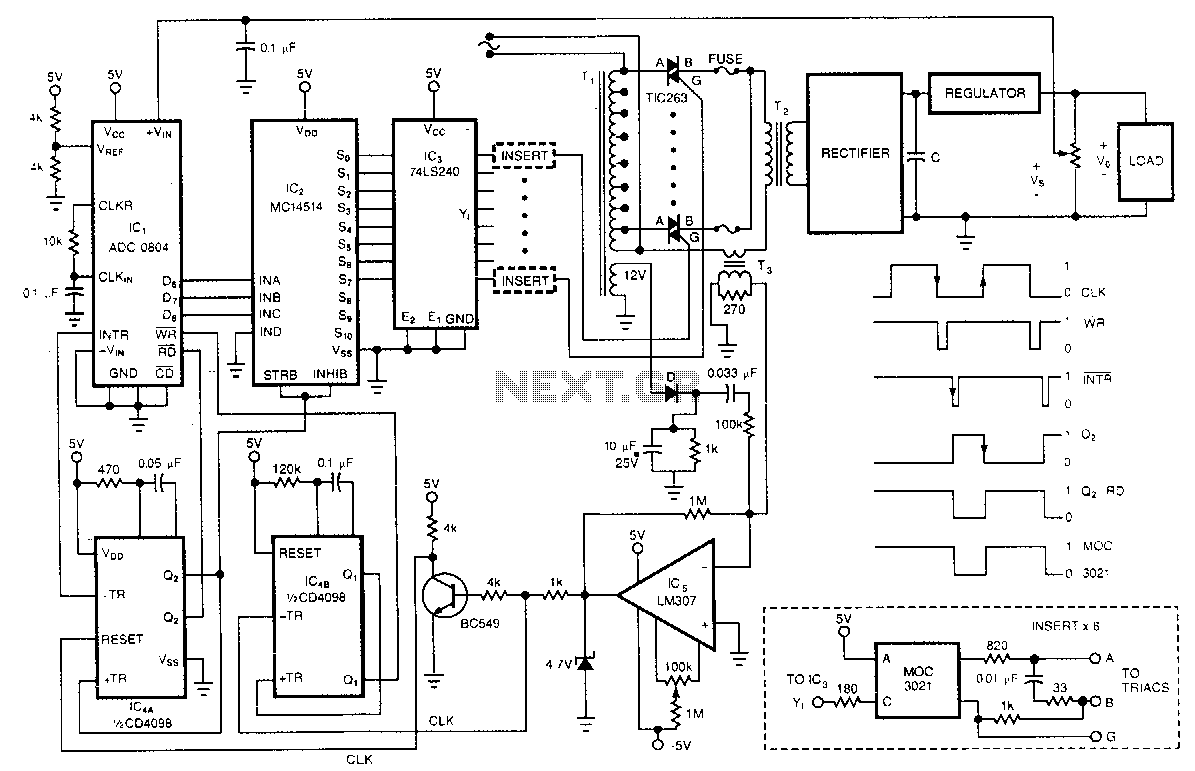
One of the control circuit's triacs selects the tap on the main transformer T1, which provides the proper preregulated voltage to the secondary regulator. T2 and its associated components comprise the secondary regulator. The ADC 0804, IC1, digitizes a voltage...
Electronic Pest Killing Lamp
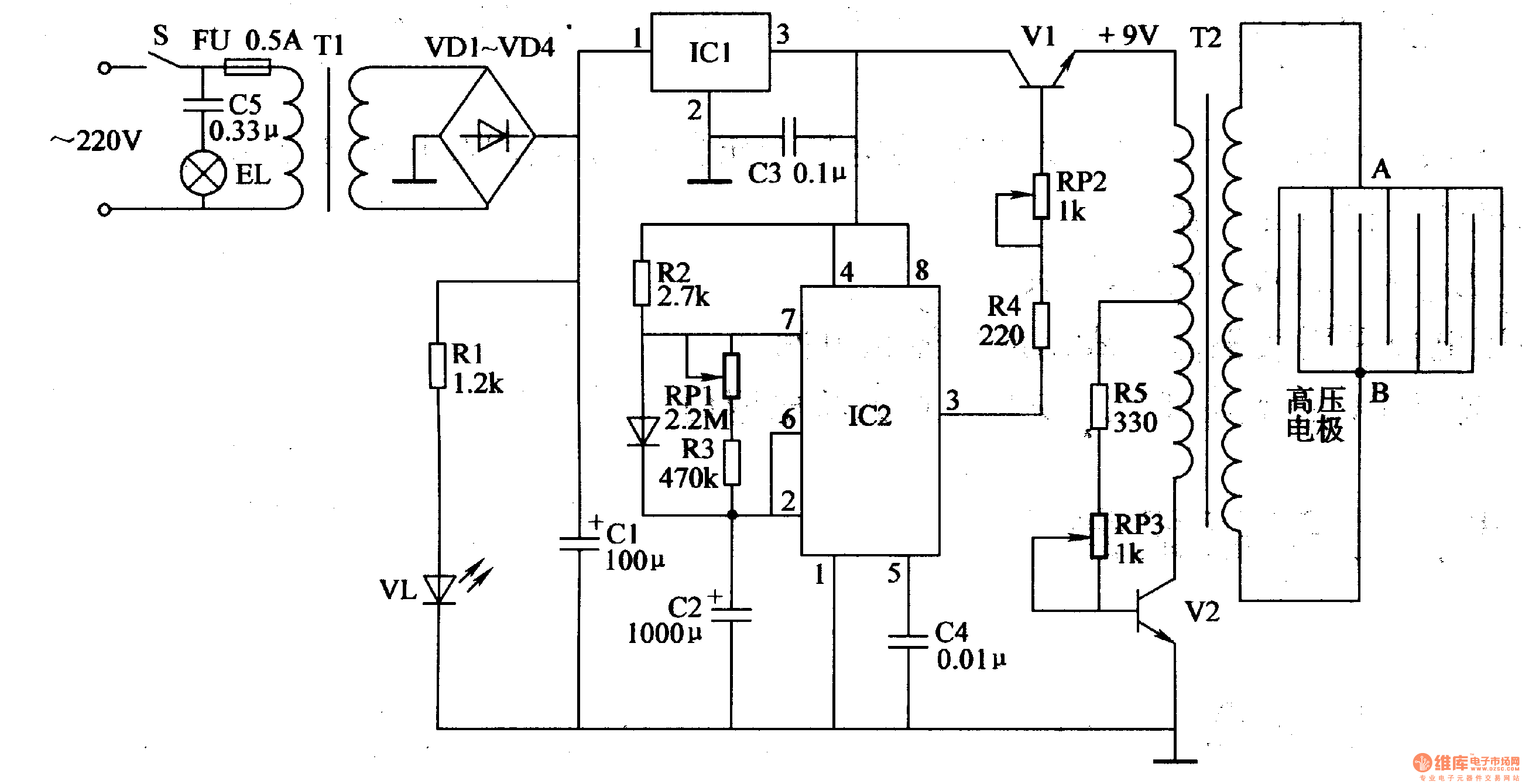
Working Principle: The circuit, as illustrated in figure 4-187, is composed of three main components: the power circuit, the pulse oscillator, and the high voltage generator. The power circuit includes components S, FU, TI, VD1-VD4, C1, C3, IC1, R1, and...
high voltage power supply circuit for fluorescent light
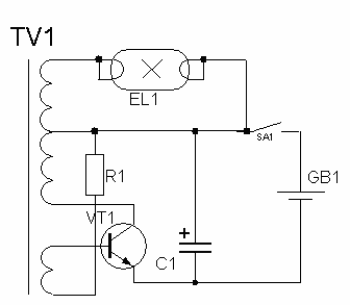
High-voltage power supply circuit for fluorescent light power supply. Refer to that page for an explanation of the related circuit diagram.
The high-voltage power supply circuit designed for fluorescent lights typically consists of several key components that work together to convert...
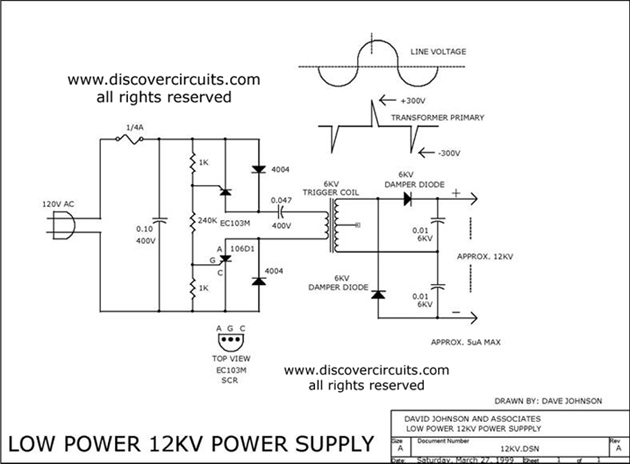
12KV High Voltage Generator
The 12kV High Voltage Generator utilizes a unique adjustment to generate approximately 12,000 volts with a current of about 5 µA. It consists of two SCRs forming two triggering circuit paths. These SCRs discharge a 0.047 µF, 400V capacitor through...
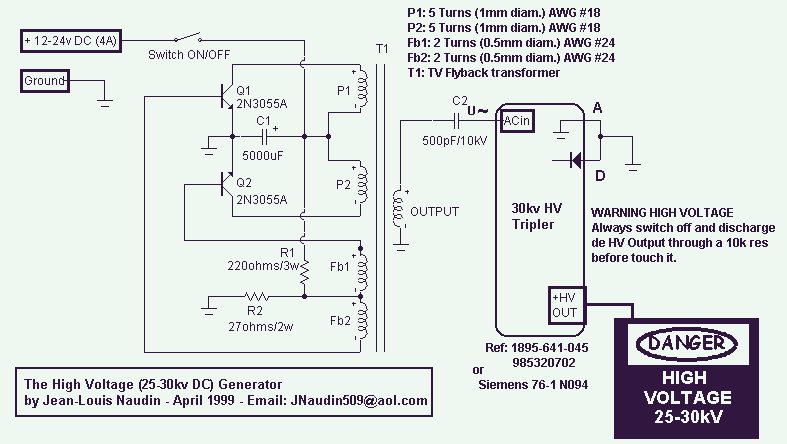
The 25-30kV DC Generator
This High Voltage power supply is able to generate up to 25-30kV DC Output from a 12-24v DC input. With a fully adjustable DC input power supply (0-24V/4A), it is possible to adjust the HV output between 5 to 30kV....
Solid State Tesla Coil/High Voltage Generator
This circuit is designed to demonstrate high-frequency high voltage, capable of producing approximately 30 kV, depending on the transformer utilized. It is cost-effective and simple to construct, primarily using a standard TV flyback transformer. The circuit can power lasers, demonstrate...
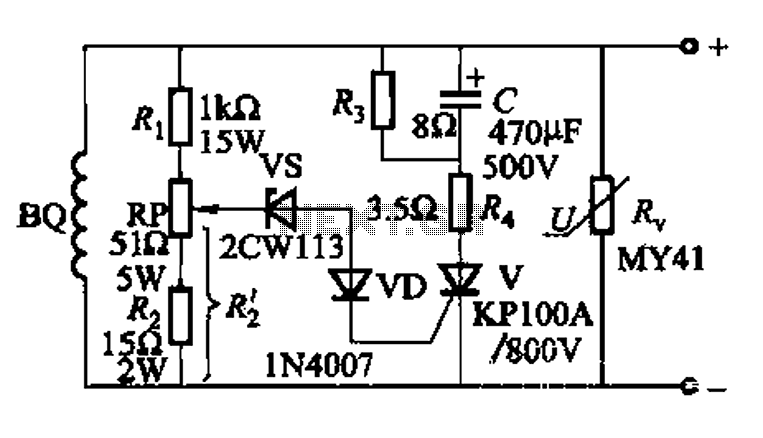
High voltage generator excitation set overvoltage protection circuit
The DC voltage for the generator field winding is supplied by a three-phase thyristor rectifier. In instances of incorrect operation, phase misalignment, or system failure, the rectifier may generate hazardous conditions, leading to over-voltage insulation issues on the DC side...
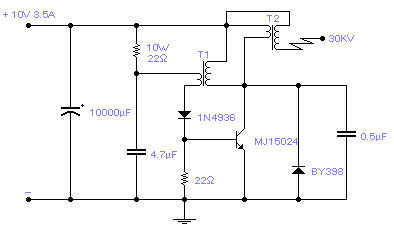
30KV Power supply / Generator
Easy to build, this high voltage generator is capable of generating up to 50KV but the breakdown voltage of the coil limits the voltage to a value somewhat lower. T2 is the ignition coil of a car and also the...