


Circuit Diagram of Fan Speed Control With NE5560 IC
#NE5560
#speed control
#constant speed
#motor driver
#voltage regulation
#PWM
#fan control
#load compensation
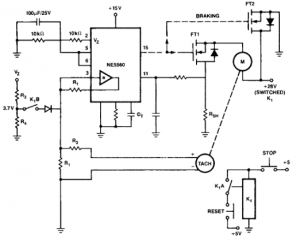
Description: This circuit is useful for creating a constant speed motor control, ensuring that the motor speed remains constant despite variations in load and electrical voltage.
The circuit for a constant speed motor control typically employs feedback mechanisms to maintain a stable output speed. This can be achieved using a closed-loop control system, which includes components such as a microcontroller, sensors, and a driver circuit.
The microcontroller serves as the central processing unit, receiving input from sensors that monitor the motor's speed and load conditions. Commonly used sensors include tachometers or encoders, which provide real-time data on the motor's rotational speed.
The driver circuit, often consisting of a MOSFET or an H-bridge, regulates the power supplied to the motor based on the microcontroller's commands. This allows for precise adjustments to the voltage and current supplied to the motor, compensating for any changes in load or supply voltage.
Additionally, the use of PID (Proportional-Integral-Derivative) control algorithms can enhance the performance of the system. The PID controller calculates the error between the desired speed and the actual speed, adjusting the output to minimize this error over time.
Incorporating these elements into the design results in a robust motor control system capable of maintaining a consistent speed under varying operational conditions, thereby improving the overall efficiency and reliability of motor-driven applications.useful to make a constant speed motor control. Which means the speed will stay constant despite of load and electric voltage change. Component: .
The circuit for a constant speed motor control typically employs feedback mechanisms to maintain a stable output speed. This can be achieved using a closed-loop control system, which includes components such as a microcontroller, sensors, and a driver circuit.
The microcontroller serves as the central processing unit, receiving input from sensors that monitor the motor's speed and load conditions. Commonly used sensors include tachometers or encoders, which provide real-time data on the motor's rotational speed.
The driver circuit, often consisting of a MOSFET or an H-bridge, regulates the power supplied to the motor based on the microcontroller's commands. This allows for precise adjustments to the voltage and current supplied to the motor, compensating for any changes in load or supply voltage.
Additionally, the use of PID (Proportional-Integral-Derivative) control algorithms can enhance the performance of the system. The PID controller calculates the error between the desired speed and the actual speed, adjusting the output to minimize this error over time.
Incorporating these elements into the design results in a robust motor control system capable of maintaining a consistent speed under varying operational conditions, thereby improving the overall efficiency and reliability of motor-driven applications.useful to make a constant speed motor control. Which means the speed will stay constant despite of load and electric voltage change. Component: .
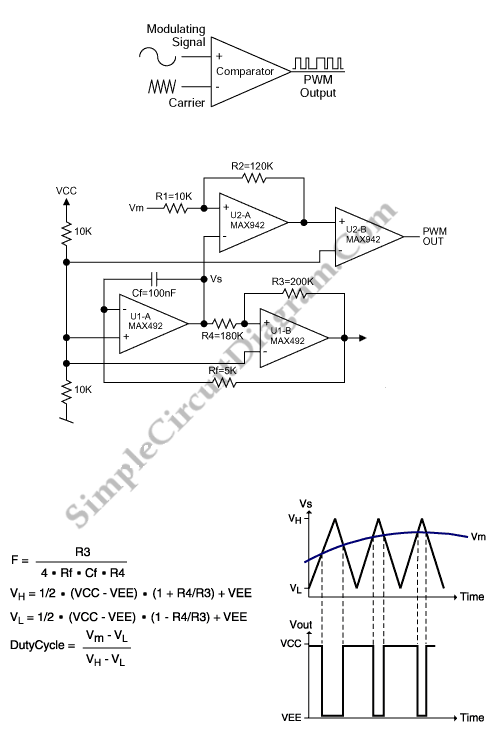
PWM Modulator Using Op-Amp
This is a simple PWM modulator circuit. Comparing the message signal to a ramp or triangular waveform is the simplest way to produce a PWM signal. When the...
The PWM (Pulse Width Modulation) modulator circuit operates by comparing a modulating signal,...
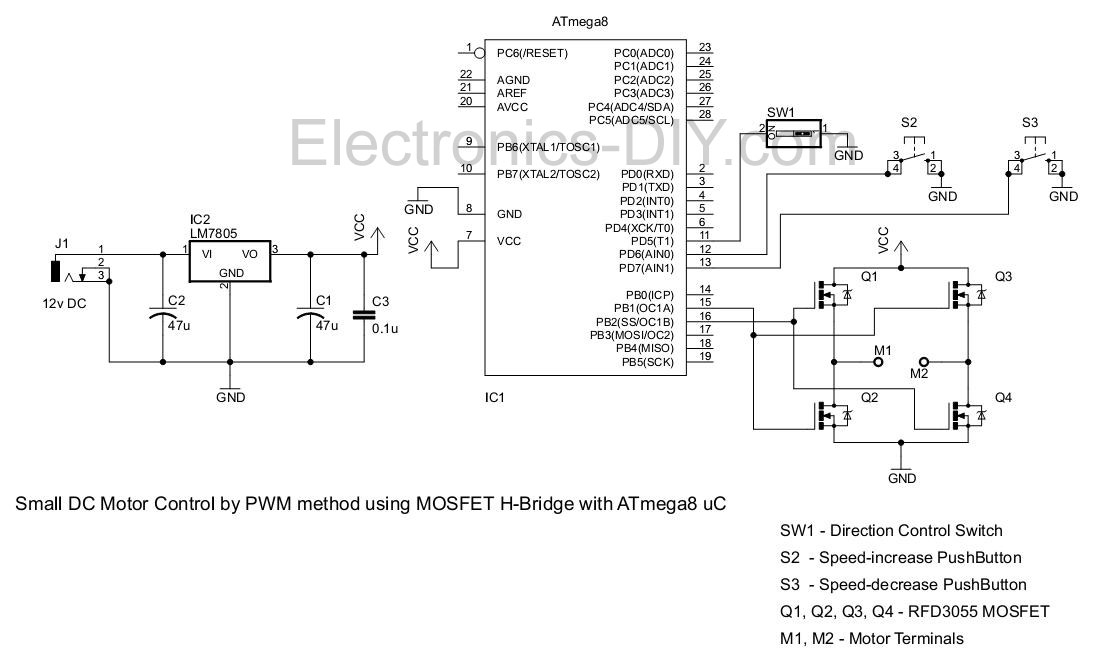
PWM Motor Driver with MOSFET H-Bridge and AVR ATmega8
This project involves controlling a small DC motor, sourced from an old personal cassette player, using the ATmega8 microcontroller. The ATmega8 features three PWM channels, of which two are utilized in this application. The PWM signals are sent to a...
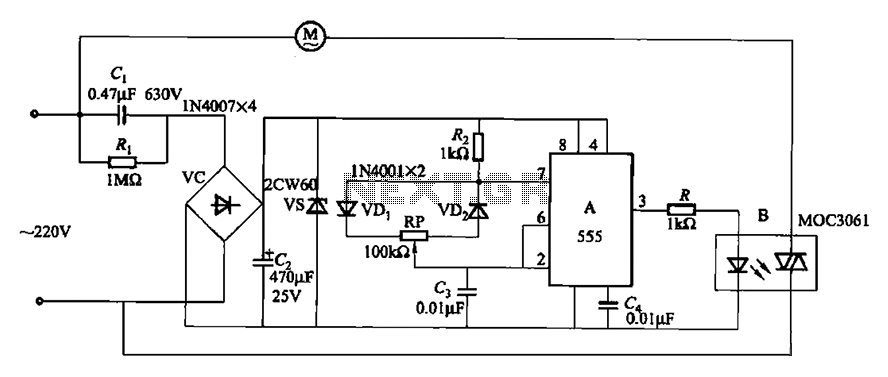
Fans of natural wind simulator circuit 2
The circuit depicted in Figure 3-9 shares similarities with Figure 3-8, with the distinction that the zero-off MOC3061 type photoelectric coupler is directly connected to control the operation of the fan.
The circuit utilizes the MOC3061, a phototransistor optoisolator, which serves...
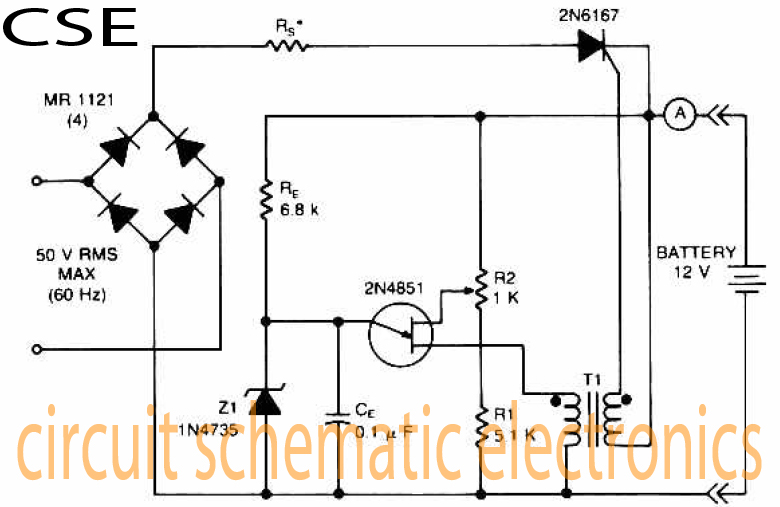
Variable charger circuit Schematic Diagram
The accumulator charger circuit must provide a voltage that matches the specifications of the batteries being charged. For a 12-volt accumulator, the output voltage should not exceed 12 volts, nor should it fall significantly below this threshold. Failure to maintain...
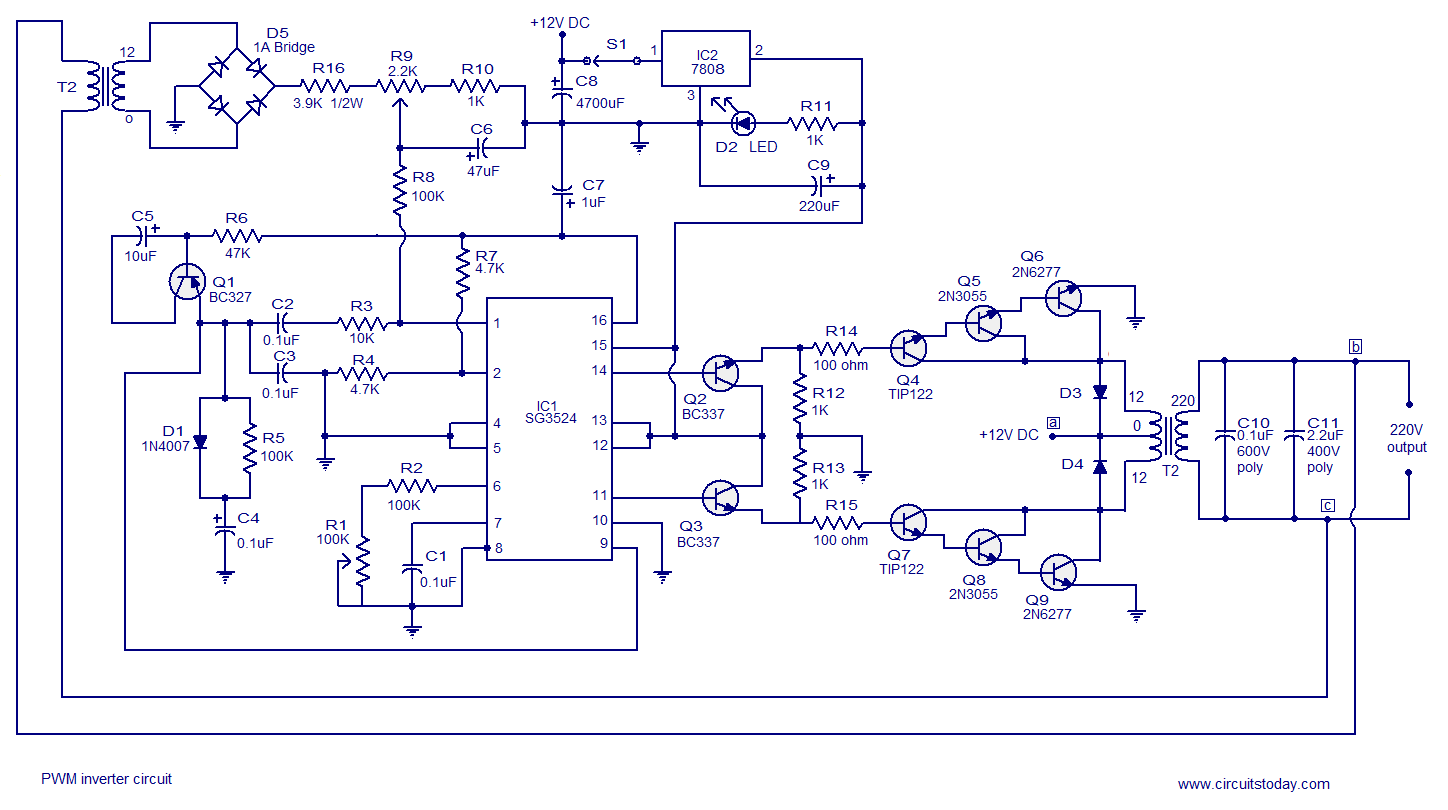
PWM inverter circuit based on SG3524 : 12V input 220V output 250W
A simple PWM inverter circuit utilizes the SG3524 integrated circuit. This PWM inverter is designed for a 12V input, providing a 220V output with a maximum output power of 250 watts. The output power can be extended further.
The described PWM...
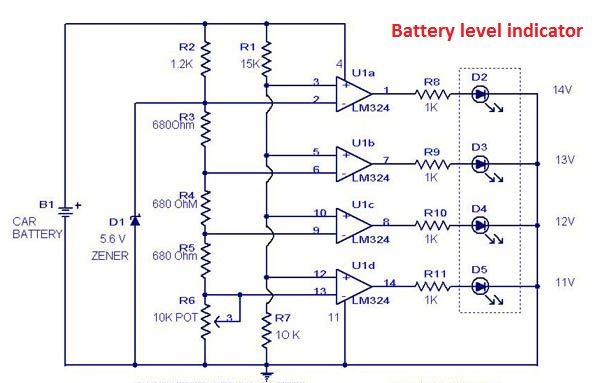
250 to 5000 watts PWM DC/AC 220V Power Inverter
The schematic circuit design is for a 250-watt output inverter. To increase the power of the circuit, additional Q7 and Q8 transistors can be added in parallel; each pair contributes an additional 250 watts. For instance, to achieve 750 watts,...
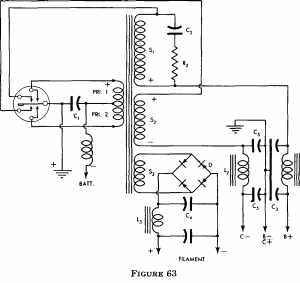
power supply design
The more one understands about any subject, the more interesting it becomes. As this article is read, it will be found that the subject of...
A comprehensive electronic schematic typically involves various components, each serving a specific function in the overall...
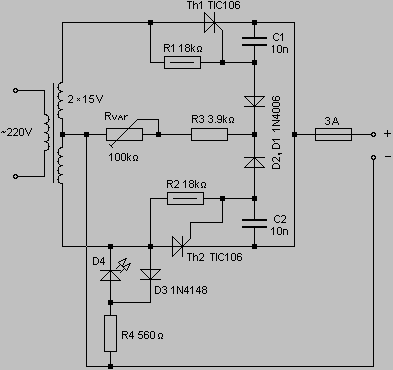
pwm rectifier power controller
PWM rectifier power controller power supply. Visit the page to read the explanation about the associated circuit diagram.
A PWM (Pulse Width Modulation) rectifier power controller is a sophisticated electronic circuit designed to convert alternating current (AC) to direct current (DC)...
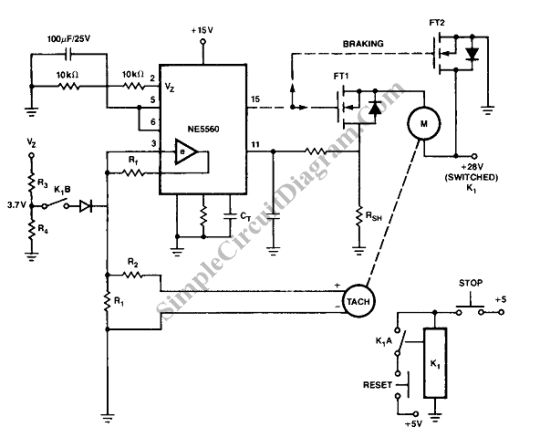
Constant Speed PWM Motor Control
A constant speed motor control can be achieved using closed-loop (servo) control. A constant speed motor maintains a steady speed regardless of variations in load.
In a closed-loop control system, feedback is utilized to compare the actual speed of the motor...