


Active Fourth-Order High-Pass Filter For 50Hz Circuit
#LM1458
#high-pass filter
#fourth-order
#50Hz
#op amp
#active filter
#24 dB/octave
#signal processing
#audio filter
#electronics
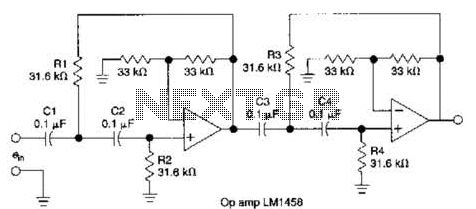
Description: This circuit, which utilizes an LM1458 or a similar operational amplifier, functions as a fourth-order high-pass filter with a roll-off rate of 24 dB per octave. The resistor values Rx/R2 and RJRV can be adjusted to accommodate different cutoff frequencies.
The circuit design leverages the LM1458 operational amplifier, known for its dual-channel configuration and high performance in various applications. As a fourth-order high-pass filter, it is capable of attenuating low-frequency signals while allowing higher frequencies to pass through effectively. The 24 dB/octave roll-off indicates that for every octave increase in frequency, the output signal's amplitude decreases by 24 dB, making it suitable for applications requiring precise frequency filtering.
To implement this circuit, the configuration typically includes multiple stages of active filtering, each contributing to the overall order of the filter. The use of resistors (Rx, R2) and capacitors in the feedback and input paths allows for the adjustment of the filter's cutoff frequency. By selecting appropriate values for these components, the designer can tailor the filter to meet specific frequency response requirements.
The scaling of Rx/R2 and RJRV is crucial for maintaining the desired cutoff frequency. The cutoff frequency (fc) can be calculated using the formula:
fc = 1 / (2πRC)
Where R is the equivalent resistance seen by the capacitor and C is the capacitance. By manipulating the resistor values, the designer can shift the cutoff frequency up or down, providing flexibility in the circuit's application.
This high-pass filter can be utilized in various electronic applications, including audio processing, signal conditioning, and noise reduction, where eliminating unwanted low-frequency signals is essential for optimal performance. The LM1458's characteristics, combined with the fourth-order filter design, ensure that the circuit maintains signal integrity while effectively filtering out undesired frequencies. This circuit which uses an LM1458 or similar op amp is a fourth-order high-pass filter with a 24 dB/octave roll-off. The values of Rx/R2, RJRV can be scaled to suit other cutoff frequencies.
The circuit design leverages the LM1458 operational amplifier, known for its dual-channel configuration and high performance in various applications. As a fourth-order high-pass filter, it is capable of attenuating low-frequency signals while allowing higher frequencies to pass through effectively. The 24 dB/octave roll-off indicates that for every octave increase in frequency, the output signal's amplitude decreases by 24 dB, making it suitable for applications requiring precise frequency filtering.
To implement this circuit, the configuration typically includes multiple stages of active filtering, each contributing to the overall order of the filter. The use of resistors (Rx, R2) and capacitors in the feedback and input paths allows for the adjustment of the filter's cutoff frequency. By selecting appropriate values for these components, the designer can tailor the filter to meet specific frequency response requirements.
The scaling of Rx/R2 and RJRV is crucial for maintaining the desired cutoff frequency. The cutoff frequency (fc) can be calculated using the formula:
fc = 1 / (2πRC)
Where R is the equivalent resistance seen by the capacitor and C is the capacitance. By manipulating the resistor values, the designer can shift the cutoff frequency up or down, providing flexibility in the circuit's application.
This high-pass filter can be utilized in various electronic applications, including audio processing, signal conditioning, and noise reduction, where eliminating unwanted low-frequency signals is essential for optimal performance. The LM1458's characteristics, combined with the fourth-order filter design, ensure that the circuit maintains signal integrity while effectively filtering out undesired frequencies. This circuit which uses an LM1458 or similar op amp is a fourth-order high-pass filter with a 24 dB/octave roll-off. The values of Rx/R2, RJRV can be scaled to suit other cutoff frequencies.
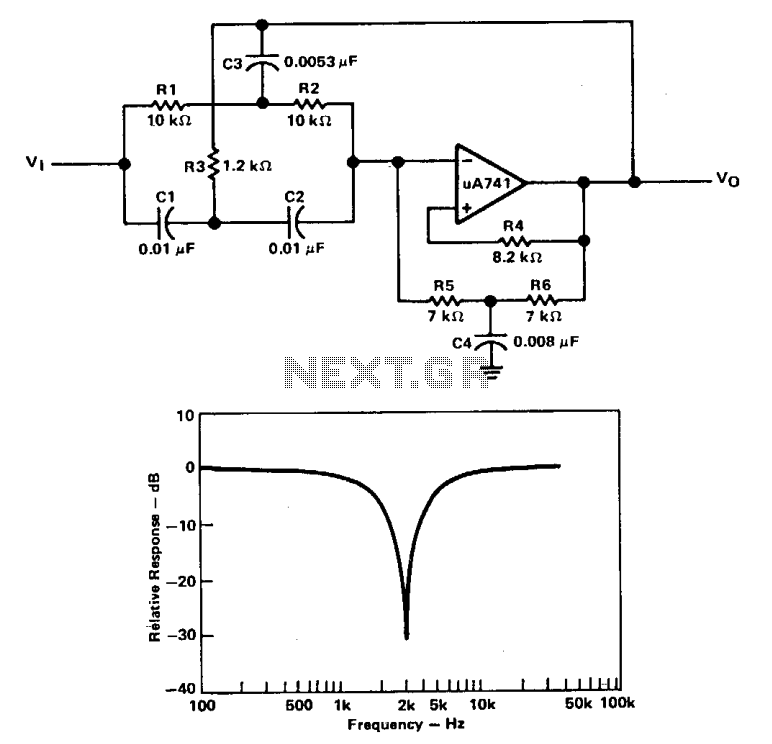
Active band-reject filter
A filter with a band-reject characteristic is commonly known as a notch filter. A typical circuit employing a µ741 operational amplifier is shown in a unity-gain configuration for this type of active filter. The filter response curve illustrated represents a...
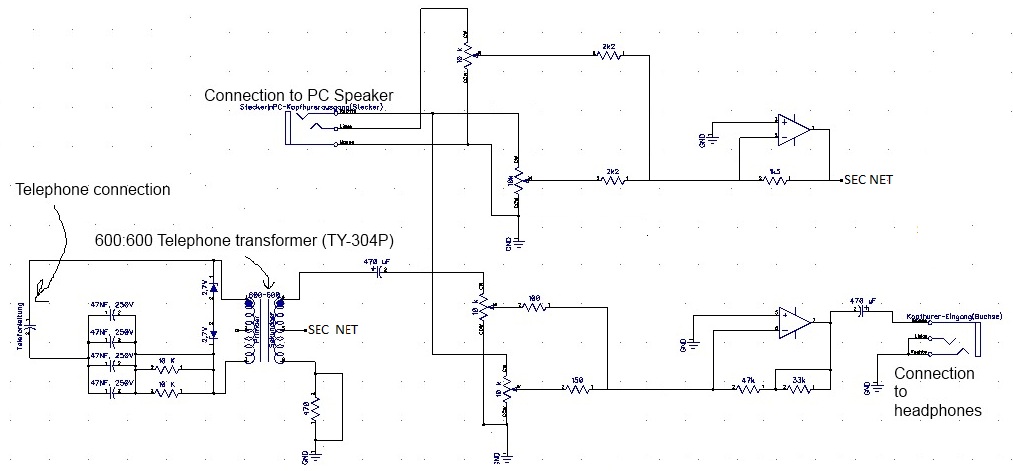
Humming and Transmission issues
An inquiry regarding operational amplifier (op-amp) humming and transmission issues in the context of electrical engineering.
Operational amplifiers (op-amps) are widely used in various electronic circuits for signal amplification, filtering, and other applications. Humming issues in op-amp circuits often arise from...
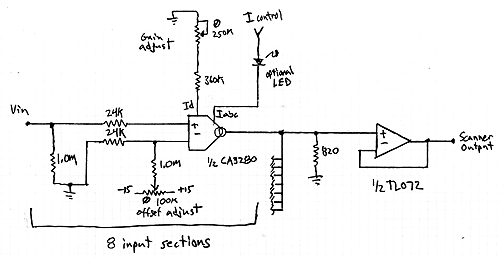
Interpolating Scanner Circuit
This design is for an interpolating scanner, a circuit featuring multiple signal inputs, a control voltage input, and a signal output. The output selectively transitions between inputs, smoothly fading from one to the next as the control voltage increases. A...
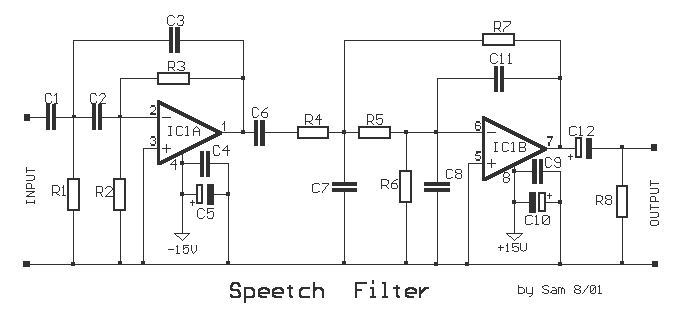
300HZ - 3KHZ Audio Filter
The human speech apprehends a small area of frequencies, that is extended from 300Hz until 3kHz. This spectrum is also internationally recognized for the transmission of speech via telecommunications networks. This is also the main use of this circuit, which...
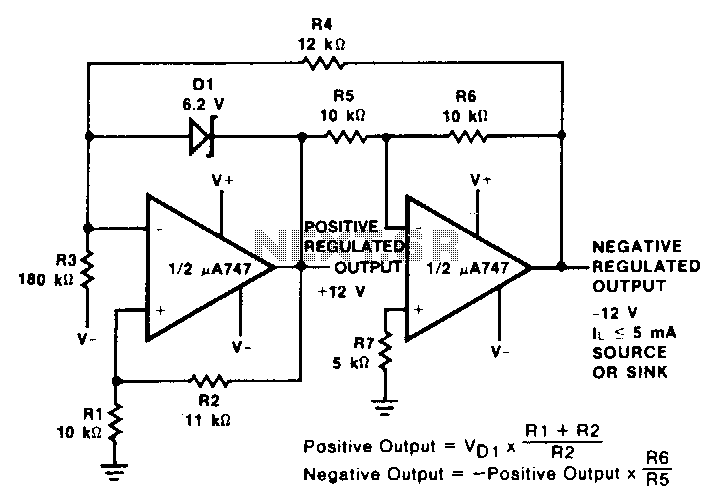
Positive-and-negative-voltage-reference-tracker
This reference utilizes an operational amplifier (op amp) to generate a negative output voltage that corresponds with the positive reference voltage. A pA747 dual op amp, or any similar device such as an LM1458 or two 1-A741 devices, can be...
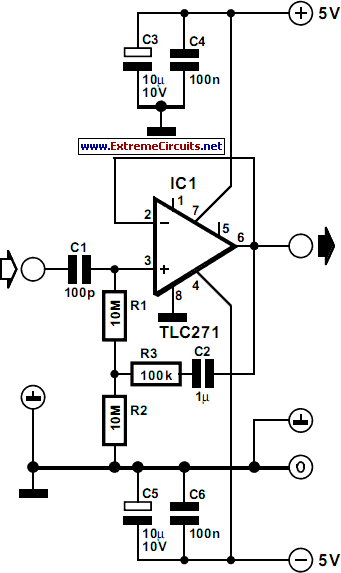
input impedance booster circuit
The input impedance of AC-coupled operational amplifier (op-amp) circuits is primarily determined by the resistance that establishes the DC operating point. When using CMOS op-amps, the input impedance is high, reaching up to 10 MΩ in current op-amps. For applications...
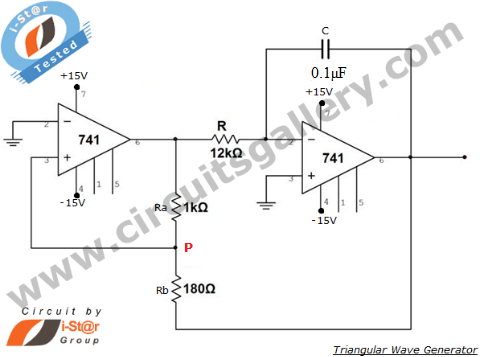
Triangular wave generator using Op Amp 741 circuit working and simulated output waveform
An operational amplifier-based triangular waveform generator is a simple circuit that is widely used in function generators. This circuit utilizes the 741 operational amplifier to create a triangular wave generator. The output waveform of an integrator will be triangular when...
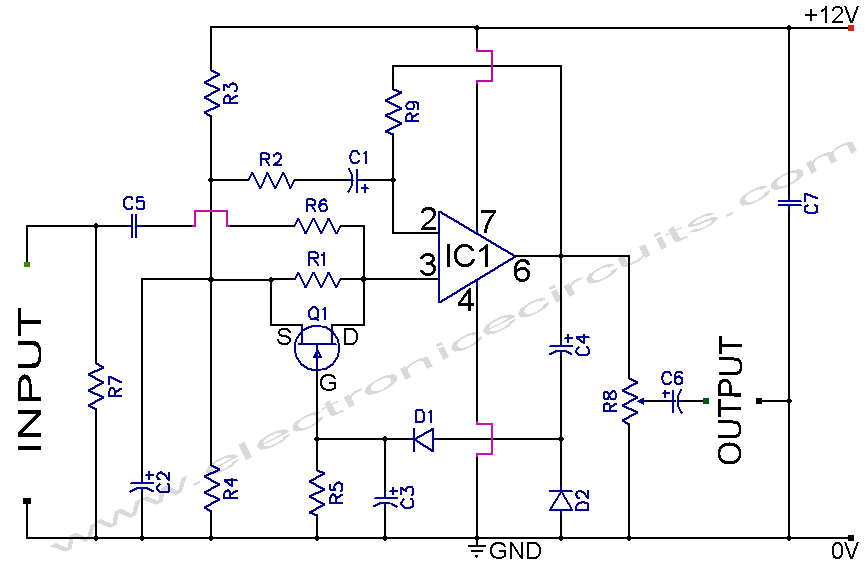
Automatic Gain Control Pre-Amplifier
A section of the operational amplifier's output signal is rectified using 1N4148 diodes, followed by filtering, and is then directed to the gate of the FET input shunting circuit. As the output voltage increases, additional input shunting occurs, which means...
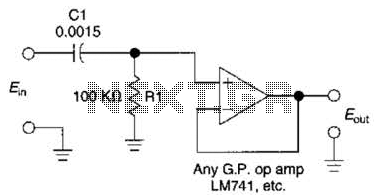
Simple High-Pass (Hp) Active Filter For 1Khz Circuit
This simple 1 kHz filter utilizes a voltage follower and an RC section as its filtering element. For other frequencies, the -3 dB point is given by the formula 1/(6.28 Rl Cv), and the response decreases at a rate of...