


Logarithmic amplifier
#logarithmic amplifier
#frequency compensation
#bias current compensation
#op-amp
#signal processing
#current measurement
#wide temperature range
#high resolution
#converter
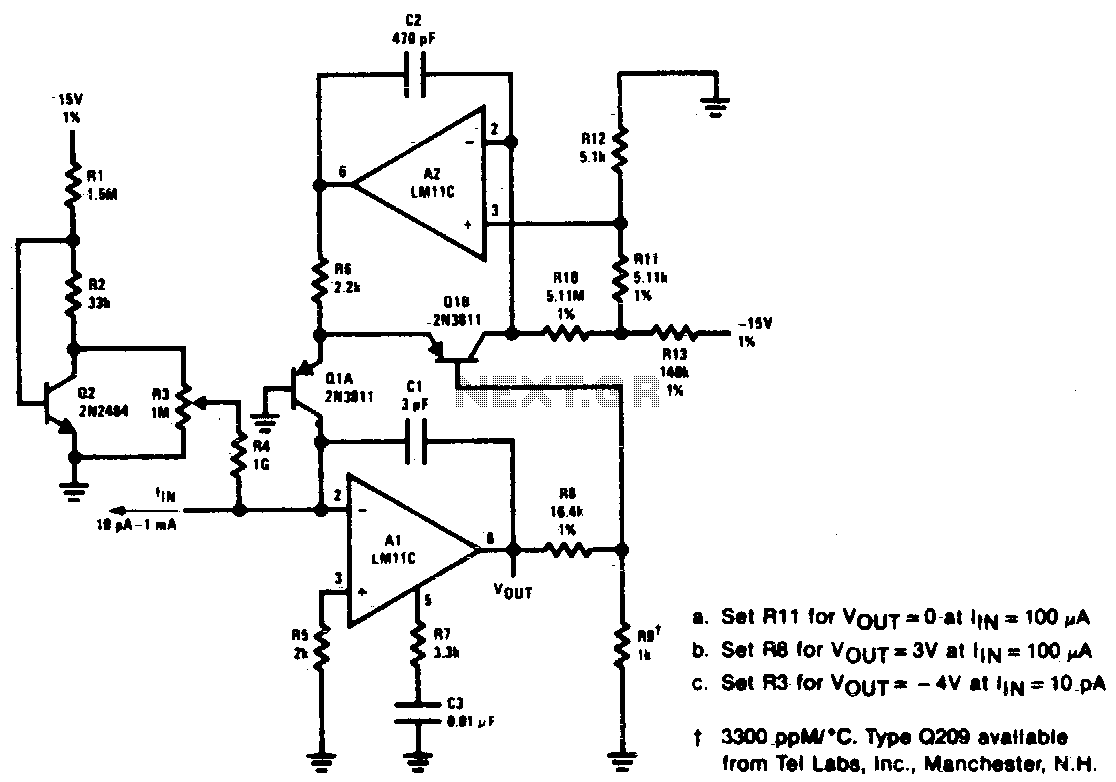
Description: Unusual frequency compensation provides this logarithmic converter with a 100 µs time constant from 1 mA down to 100 µA, increasing from 200 µe to 200 ms from 10 nA to 10 pA. Optional bias current compensation allows for 10 pA resolution across a temperature range of -55 °C to 100 °C. The scale factor is 1 V/decade and is temperature compensated.
This logarithmic converter is designed to offer precise current measurements over a wide dynamic range, making it suitable for applications requiring high sensitivity and accuracy. The frequency compensation mechanism is crucial, as it stabilizes the response time of the converter, allowing it to maintain a consistent time constant of 100 µs for input currents between 1 mA and 100 µA. As the input current decreases to lower levels, the time constant increases significantly, reaching up to 200 ms for inputs ranging from 10 nA to 10 pA.
The optional bias current compensation feature enhances the device's performance by enabling it to achieve a resolution of 10 pA. This feature is particularly beneficial in environments where temperature fluctuations may affect the performance of the circuit. The converter operates effectively across a broad temperature range from -55 °C to 100 °C, ensuring reliable operation in various conditions.
Moreover, the scale factor of 1 V/decade indicates that for every decade change in input current, the output voltage changes by 1 Volt. This logarithmic relationship is vital for applications such as signal processing, sensor interfacing, and data acquisition systems where precise current-to-voltage conversion is required. The temperature compensation ensures that the scale factor remains stable across the specified temperature range, further enhancing the accuracy and reliability of the measurements.
In summary, the unique frequency compensation and optional bias current compensation features of this logarithmic converter make it a highly effective tool for achieving precise current measurements across a wide range of conditions, with a focus on temperature stability and resolution.Unusual frequency compensation gives this logarithmic converter a 100 µs time constant from 1 mA down to 100 µA, increasing from 200 µe to 200 ms from 10 nA to 10 pA. Optional bias current compensation can give 10 pA resolution from - 55 °C to 100 °C Scale factor is 1 V/decade and temperature compensated.
This logarithmic converter is designed to offer precise current measurements over a wide dynamic range, making it suitable for applications requiring high sensitivity and accuracy. The frequency compensation mechanism is crucial, as it stabilizes the response time of the converter, allowing it to maintain a consistent time constant of 100 µs for input currents between 1 mA and 100 µA. As the input current decreases to lower levels, the time constant increases significantly, reaching up to 200 ms for inputs ranging from 10 nA to 10 pA.
The optional bias current compensation feature enhances the device's performance by enabling it to achieve a resolution of 10 pA. This feature is particularly beneficial in environments where temperature fluctuations may affect the performance of the circuit. The converter operates effectively across a broad temperature range from -55 °C to 100 °C, ensuring reliable operation in various conditions.
Moreover, the scale factor of 1 V/decade indicates that for every decade change in input current, the output voltage changes by 1 Volt. This logarithmic relationship is vital for applications such as signal processing, sensor interfacing, and data acquisition systems where precise current-to-voltage conversion is required. The temperature compensation ensures that the scale factor remains stable across the specified temperature range, further enhancing the accuracy and reliability of the measurements.
In summary, the unique frequency compensation and optional bias current compensation features of this logarithmic converter make it a highly effective tool for achieving precise current measurements across a wide range of conditions, with a focus on temperature stability and resolution.Unusual frequency compensation gives this logarithmic converter a 100 µs time constant from 1 mA down to 100 µA, increasing from 200 µe to 200 ms from 10 nA to 10 pA. Optional bias current compensation can give 10 pA resolution from - 55 °C to 100 °C Scale factor is 1 V/decade and temperature compensated.
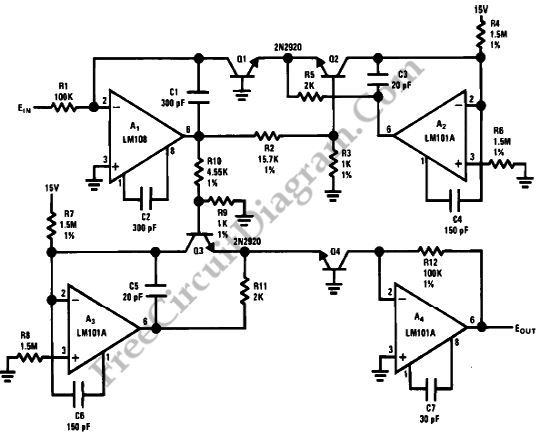
Power Function Circuit
It is possible to easily generate various non-linear functions such as X^(1/2), X^2, X^3, 1/X, XY, and X/Y using logarithms. In this context, division is transformed into subtraction, while multiplication is converted into addition.
The application of logarithmic properties in electronic...
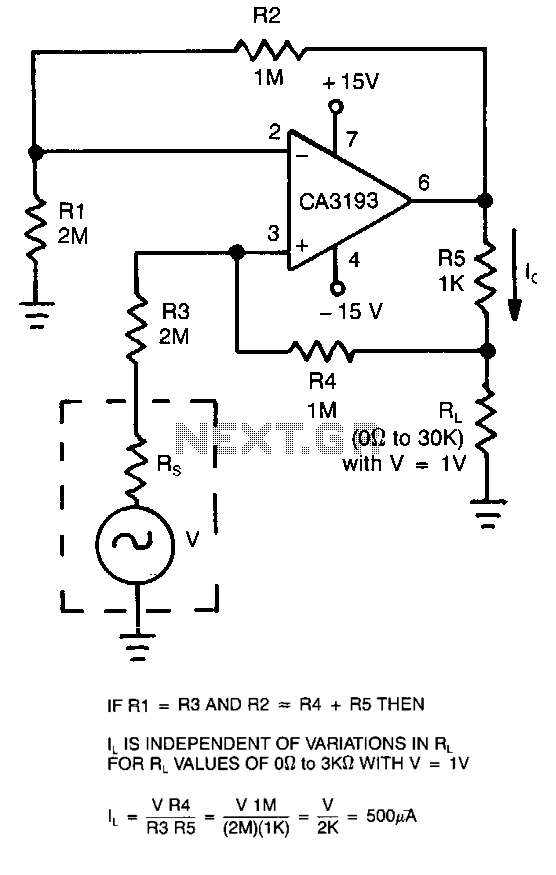
Bilateral-current-source
This circuit employs a CA3193 precision operational amplifier to provide a current that remains consistent regardless of variations in the load resistance (RL). By configuring the input resistance (RI) to be equal to resistance R3 and setting resistance R2 to...
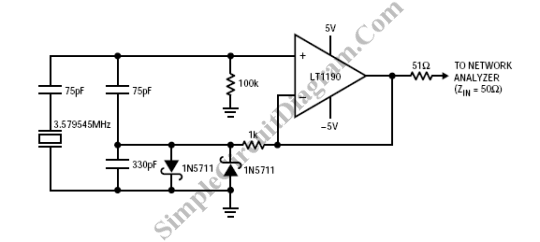
Op-Amp Colpitts Oscillator
A Colpitts oscillator can be implemented using an operational amplifier, provided that the op-amp has an appropriate bandwidth. An example of such a circuit can utilize the LT1190 or LT1191.
The Colpitts oscillator is a type of electronic oscillator that generates...
High Voltage AC Calibrator Circuit Using Op Amp
This is an application circuit for calibration known as a high voltage AC calibrator circuit. An essential aspect of sine wave oscillator design is the stable control of amplitude. This circuit not only stabilizes the amplitude through servo control but...
High Impedance DC Voltmeter Circuit Using Op Amp
This design outlines a high impedance DC voltmeter circuit utilizing the uA741 integrated circuit (IC). The uA741 is configured as a non-inverting DC amplifier. The circuit incorporates negative feedback through a DC meter that requires 1 mA for full-scale deflection....
Linear-ic-siren
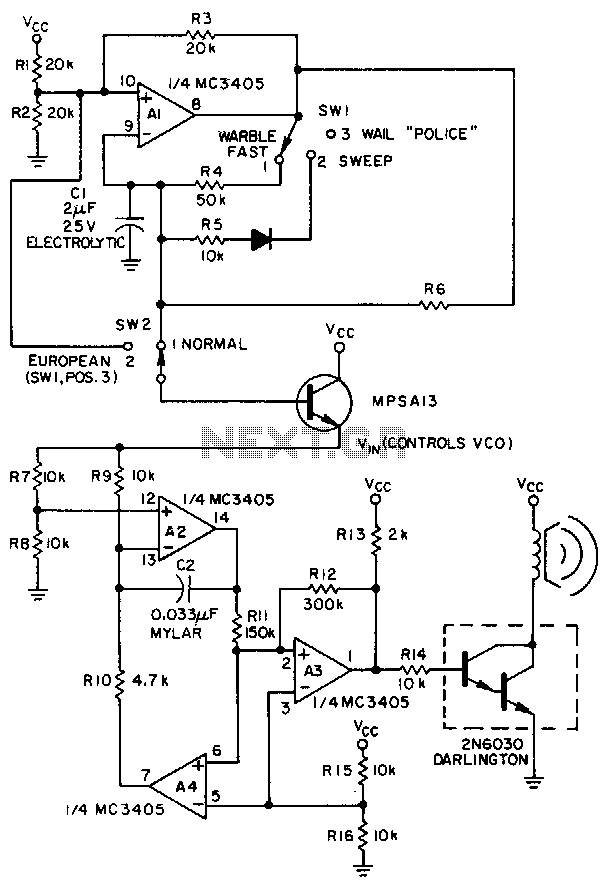
A low-frequency op-amp oscillator and a voltage-controlled oscillator (VCO), both configured using a single MC3405 dual op-amp and dual comparator, are the primary components in a siren circuit capable of producing various warbles and wails, or functioning as an audio...
Robots Bandpass Filter Calculator
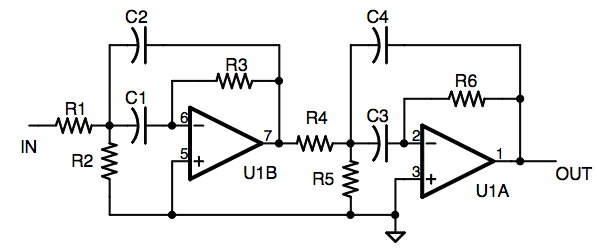
These are operational amplifier (op-amp) based filters that are particularly effective within the audio frequency range. The calculators for these filters utilize formulas and tables from the book "Electronic Filter Design Handbook" by Arthur B. Williams. Bandpass filters allow a...
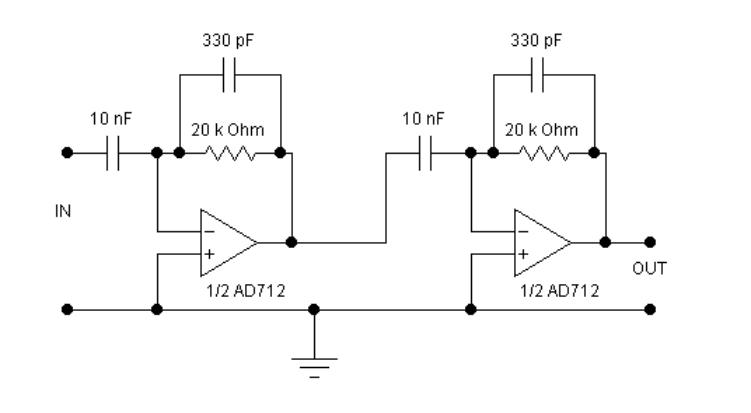
More op-amp circuits
The circuits examined thus far rely on linear feedback for their operation. The magnitude of the signal returned to the negative input is always strictly proportional to the output voltage. Consequently, within the limits defined by the operational amplifier (op-amp),...
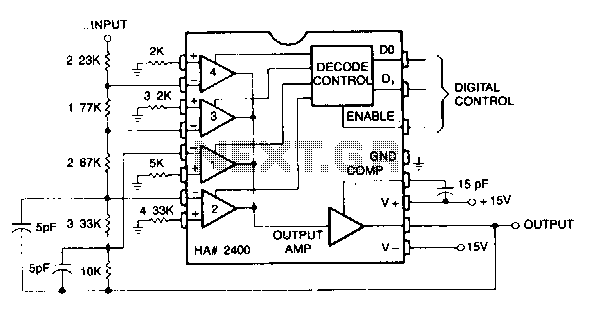
Inverting-programmable-gain-amplifier
This circuit can be programmed for a gain of 0, -1, -2, -4, or -8. This could also be accomplished with one input resistor and one feedback resistor per channel in the conventional manner, but this would require eight resistors...