


Low-voltage-compander
#NE575
#low voltage
#gain control
#expander
#compressor
#dual-channel
#audio processing
#signal conditioning
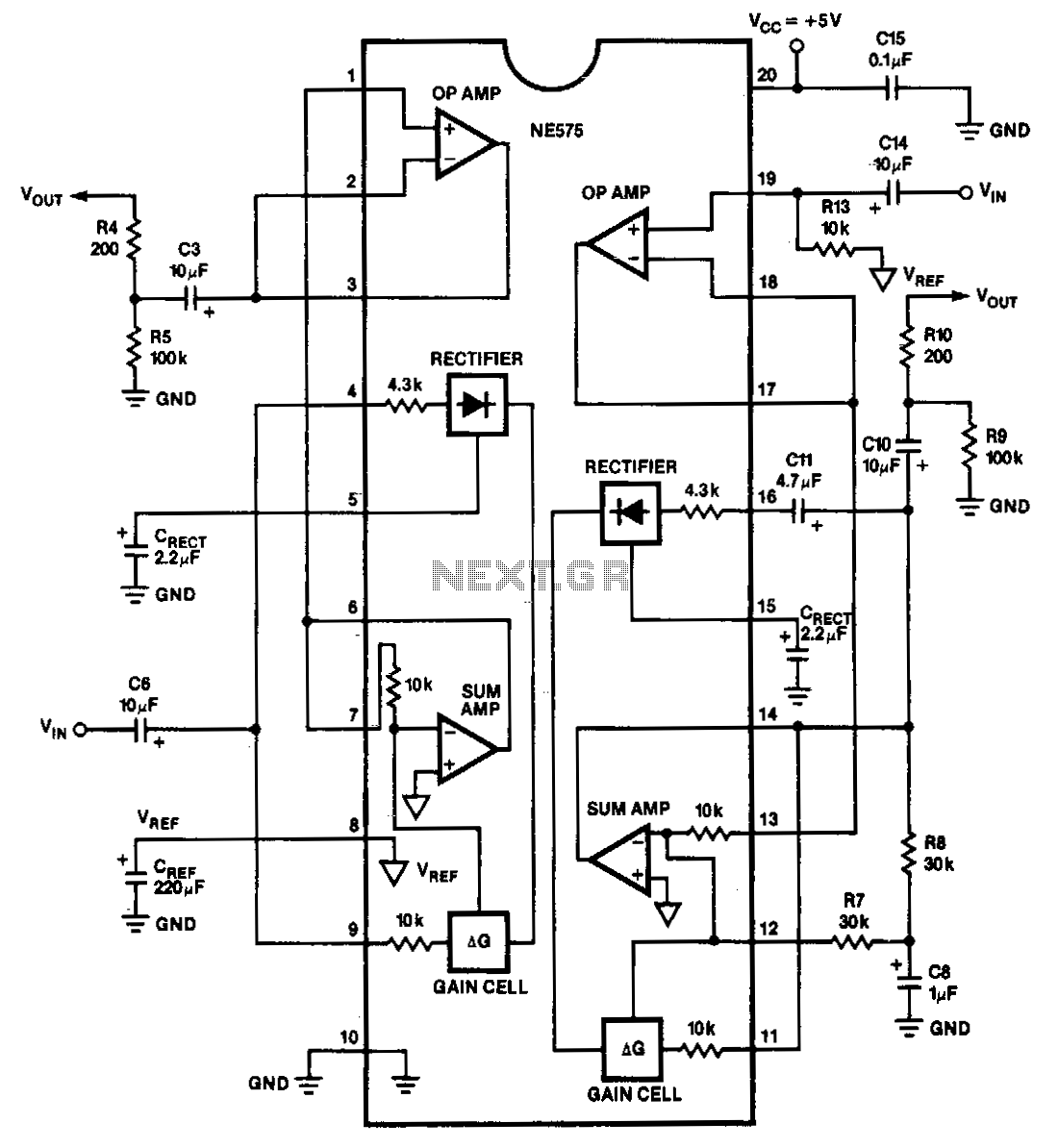
Description: The NE575 is a dual-gain control circuit designed for low voltage applications. Channel 1 acts as an expander, while Channel 2 can be configured for expander, compressor, or automatic level controller (ALC) applications.
The NE575 dual-gain control circuit is specifically engineered for low voltage environments, making it suitable for portable and battery-operated devices. The architecture of the NE575 includes two distinct channels, each serving unique functions that enhance audio processing capabilities.
Channel 1 functions as an expander, which is utilized to increase the dynamic range of audio signals by amplifying quieter sounds while leaving louder sounds unaffected. This is particularly beneficial in applications where noise reduction is crucial, as it allows for a clearer representation of the audio by minimizing background noise.
Channel 2 offers versatility by allowing configuration as either an expander, compressor, or automatic level controller (ALC). As a compressor, it reduces the dynamic range by attenuating louder signals, ensuring that audio levels remain consistent and preventing distortion during playback. When configured as an ALC, Channel 2 automatically adjusts the gain to maintain a steady output level, which is ideal for broadcasting and live sound applications where varying input levels may occur.
The NE575 is characterized by its low power consumption, making it efficient for use in compact electronic devices. The circuit design incorporates feedback mechanisms that enhance performance and stability, ensuring reliable operation across a range of conditions. The integration of these features in the NE575 enables it to be a valuable component in audio processing systems, contributing to improved sound quality and user experience in various applications.The NE575 is a dual-gain control circuit designed for low voltage applications. The NE575"s channell is an expander, while channel2 can be configured either for expander, compressor, or automatic level controller (ALC) applications.
The NE575 dual-gain control circuit is specifically engineered for low voltage environments, making it suitable for portable and battery-operated devices. The architecture of the NE575 includes two distinct channels, each serving unique functions that enhance audio processing capabilities.
Channel 1 functions as an expander, which is utilized to increase the dynamic range of audio signals by amplifying quieter sounds while leaving louder sounds unaffected. This is particularly beneficial in applications where noise reduction is crucial, as it allows for a clearer representation of the audio by minimizing background noise.
Channel 2 offers versatility by allowing configuration as either an expander, compressor, or automatic level controller (ALC). As a compressor, it reduces the dynamic range by attenuating louder signals, ensuring that audio levels remain consistent and preventing distortion during playback. When configured as an ALC, Channel 2 automatically adjusts the gain to maintain a steady output level, which is ideal for broadcasting and live sound applications where varying input levels may occur.
The NE575 is characterized by its low power consumption, making it efficient for use in compact electronic devices. The circuit design incorporates feedback mechanisms that enhance performance and stability, ensuring reliable operation across a range of conditions. The integration of these features in the NE575 enables it to be a valuable component in audio processing systems, contributing to improved sound quality and user experience in various applications.The NE575 is a dual-gain control circuit designed for low voltage applications. The NE575"s channell is an expander, while channel2 can be configured either for expander, compressor, or automatic level controller (ALC) applications.
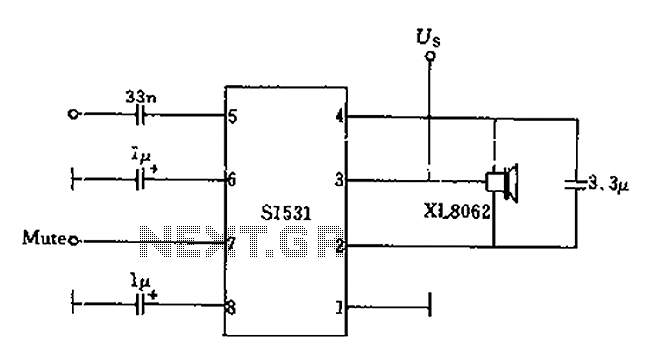
The battery voltage is low frequency amplifying circuit diagram 1v
The battery voltage is 1V for a low-frequency amplifying circuit, which can operate with a power supply voltage ranging from 1V to 1.7V, making it suitable for use with small batteries. The circuit provides an output power of 80mW with...
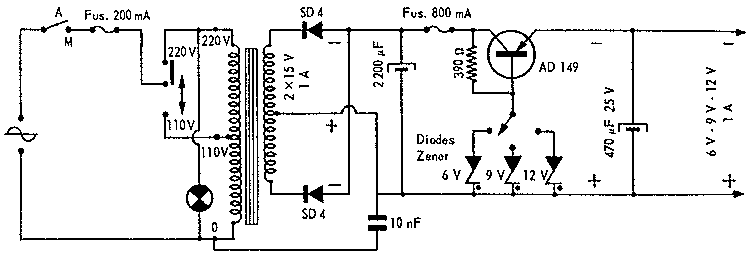
Low Voltage Supplies - Solid State - Tubes
Such supplies are often realised with dedicated integrated circuits nowadays but it's still interesting to give a look at old designs to understand the basics.
The description outlines the evolution of power supply designs in electronics, emphasizing the transition from traditional...
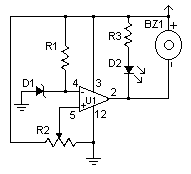
Low Voltage Alarm
This low voltage circuit can be used to monitor batteries and other volatile sources of current for problems. The circuit sounds an alarm and lights an LED, but can be interfaced to any number of other circuits for many different...
Central-image-canceller
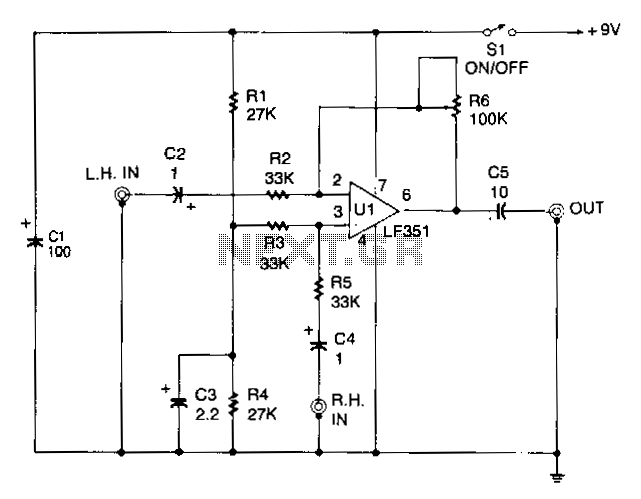
The circuit is designed to eliminate the vocal portion of an audio signal while preserving the instrumental portion. It achieves this by mixing two channels that are 180° out of phase, allowing the signals that create the center-stereo image to...
Low Voltage Preamplifier
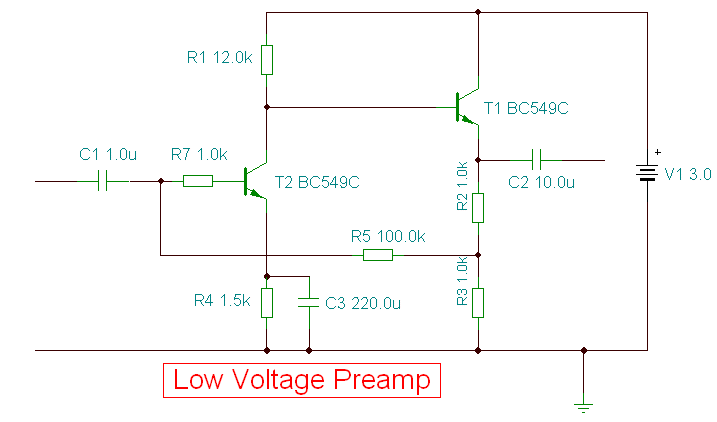
This is a specialized low-voltage version of an audio preamplifier. The emitter voltage of transistor T1 is biased close to half the supply voltage (1.5V) to enable maximum output voltage swing. Both transistors are directly coupled and utilize closed-loop feedback...
4047/4066 audio slicer
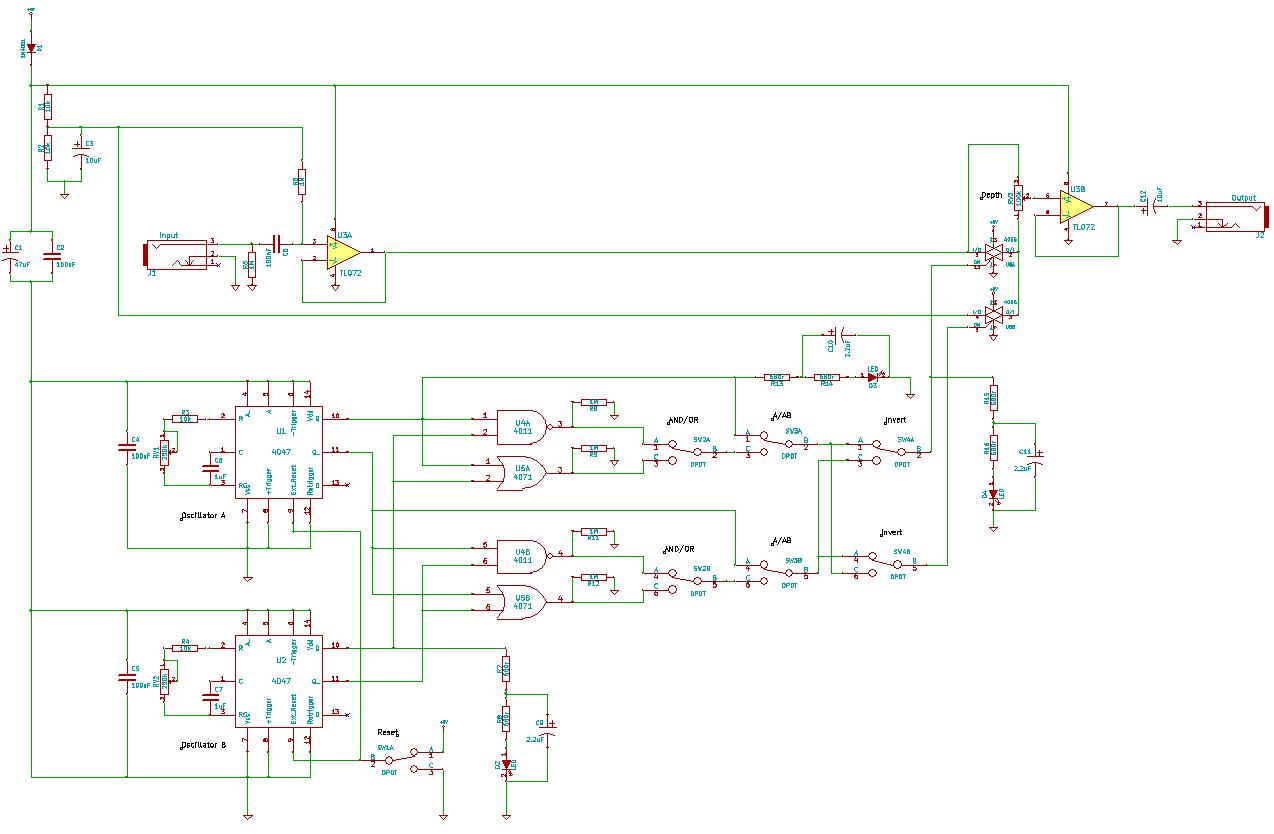
You need to connect pins 1 and 13 of the 4053 to the virtual ground rail (top of C4), not the circuit's 0V rail.
The CD4053 is a triple 2-channel analog multiplexer/demultiplexer integrated circuit, widely used for routing analog signals...
Low voltage regulators
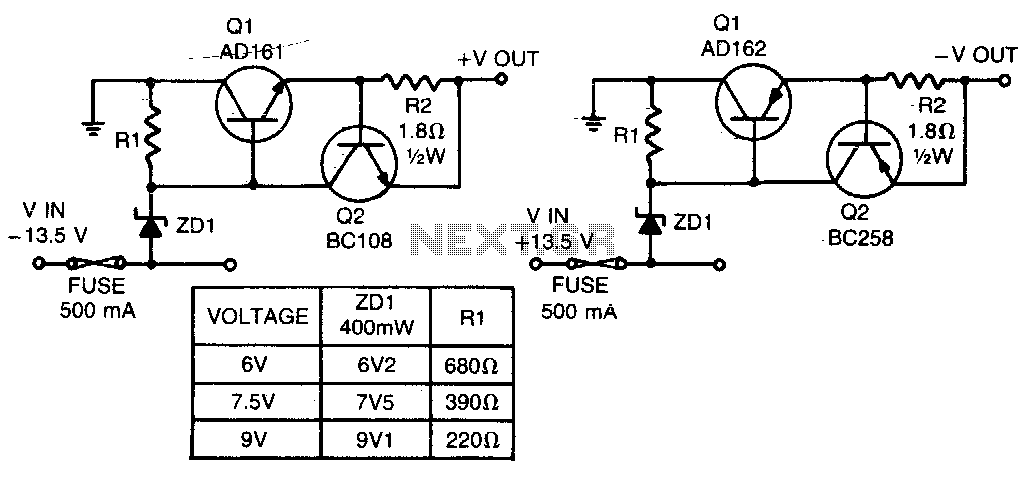
These short-circuit protected regulators provide output voltages of 6, 7, and 9 V from a nominal automobile battery supply of 13 V. They are also compatible with smoothed DC outputs from transformer/rectifier circuits. Two configurations are designed for both positive...
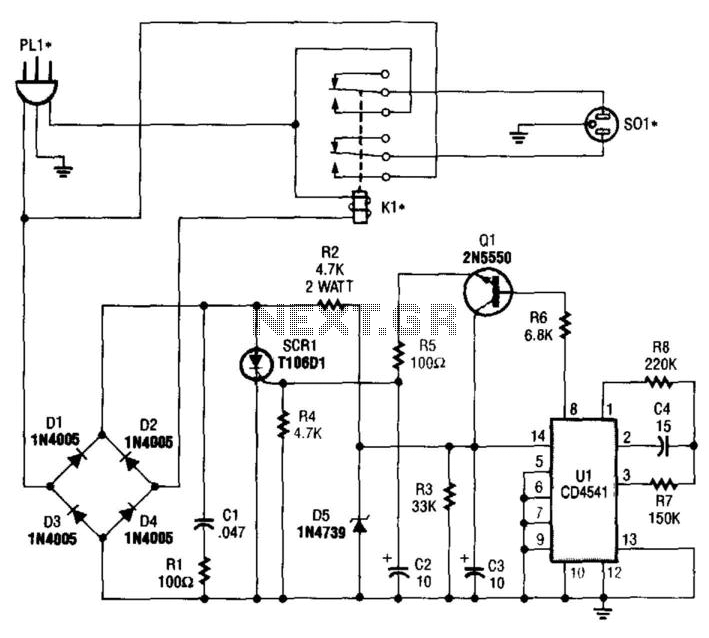
Compressor Protector
This circuit monitors the AC voltage of the power line. Upon a power failure, when power is restored, the circuit introduces a five-minute delay before energizing relay K1, which safeguards the compressor against low voltage conditions. U1 is a 16-stage...
Low Voltage Alarm
This low voltage circuit can be used to monitor batteries and other volatile sources of current for problems. The circuit sounds an alarm and lights an LED, but can be interfaced to any number of other circuits for many different...