


Magnetic Cartridge Preamplifier (LT1028CN8)
#LT1028CN8
#low noise
#high performance
#audio
#frequency synthesizers
#infrared detectors
#total harmonic distortion
#op-amp
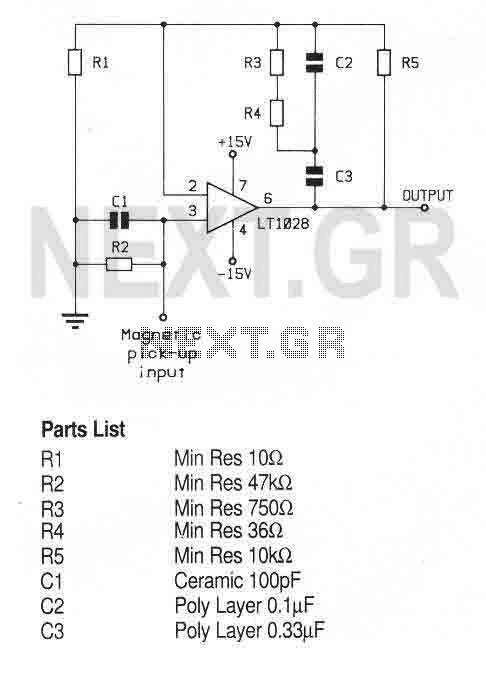
Description: A high performance op-amp that sets a new standard of excellence in noise performance only 0.9nV/Hz with low source resistances. Total harmonic distortion is less than 0.01%. The op-amp is suitable for use in high quality audio, low noise frequency synthesizers, infrared detectors etc. More: Particularly where the source resistance is under 1Kohm.
The described operational amplifier (op-amp) is engineered to deliver exceptional noise performance, achieving a low noise level of 0.9 nV/√Hz. This characteristic is particularly advantageous in applications requiring high fidelity and precision, such as audio processing and sensitive detection systems. The op-amp's performance is optimized when interfaced with low source resistances, particularly those below 1 kΩ.
The total harmonic distortion (THD) is specified to be less than 0.01%, indicating that the op-amp can reproduce signals with minimal distortion, making it ideal for high-quality audio applications where signal integrity is critical. This low THD ensures that the output closely resembles the input signal, preserving the original audio characteristics.
In practical applications, the op-amp can be configured in various circuit topologies, including inverting and non-inverting amplifiers, integrators, and filters. Its low noise figure makes it suitable for low noise frequency synthesizers, which require clean signal generation, as well as infrared detectors, where signal clarity is paramount for accurate detection and measurement.
When designing circuits with this op-amp, it is essential to consider the power supply requirements, input and output impedance, and thermal management to maintain optimal performance. The selection of passive components, such as resistors and capacitors, should also complement the op-amp's specifications to achieve the desired performance metrics in the final application.A high performance op-amp that sets a new standard of excellence in noise performance only 0.9nV/Hz with low source resistances. Total harmonic distortion is less than 0.01%. The op-amp is suitable for use in high quality audio, low noise frequency synthesizers, infrared detectors etc.
Particularly where the source resistance is under 1Kohm.
The described operational amplifier (op-amp) is engineered to deliver exceptional noise performance, achieving a low noise level of 0.9 nV/√Hz. This characteristic is particularly advantageous in applications requiring high fidelity and precision, such as audio processing and sensitive detection systems. The op-amp's performance is optimized when interfaced with low source resistances, particularly those below 1 kΩ.
The total harmonic distortion (THD) is specified to be less than 0.01%, indicating that the op-amp can reproduce signals with minimal distortion, making it ideal for high-quality audio applications where signal integrity is critical. This low THD ensures that the output closely resembles the input signal, preserving the original audio characteristics.
In practical applications, the op-amp can be configured in various circuit topologies, including inverting and non-inverting amplifiers, integrators, and filters. Its low noise figure makes it suitable for low noise frequency synthesizers, which require clean signal generation, as well as infrared detectors, where signal clarity is paramount for accurate detection and measurement.
When designing circuits with this op-amp, it is essential to consider the power supply requirements, input and output impedance, and thermal management to maintain optimal performance. The selection of passive components, such as resistors and capacitors, should also complement the op-amp's specifications to achieve the desired performance metrics in the final application.A high performance op-amp that sets a new standard of excellence in noise performance only 0.9nV/Hz with low source resistances. Total harmonic distortion is less than 0.01%. The op-amp is suitable for use in high quality audio, low noise frequency synthesizers, infrared detectors etc.
Particularly where the source resistance is under 1Kohm.
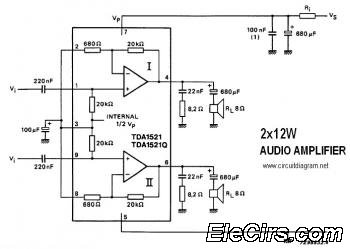
TDA1521 / TDA1521Q: 12W Stereo Amplifier
This is a stereo audio amplifier circuit that delivers 12W output power for each audio channel. The circuit is constructed using a single integrated circuit, the TDA1521 or TDA1521Q, and is supported by a minimal number of external components.
The stereo...

op amp Why do some of my IE converter circuits have a large offset voltage
The inverting input is maintained at a low level via a 10K resistor when the circuit is powered on but not in use. During measurement activities, including calibration measurements where the input is floating, this resistor is disconnected. The circuit...
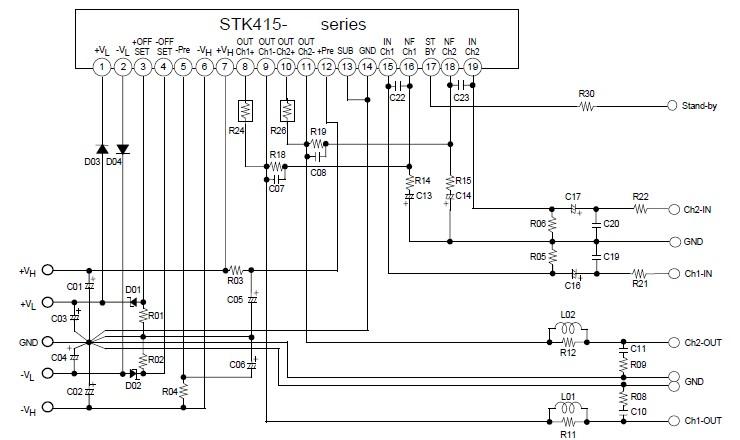
stk415 090e 2x50 watt stereo
This electronic project stereo amplifier is based on the STK415-090-E class H audio power amplifier hybrid integrated circuit (IC), which includes a built-in power supply switching circuit. The STK415-090-E class H audio power amplifier achieves high efficiency in audio power...
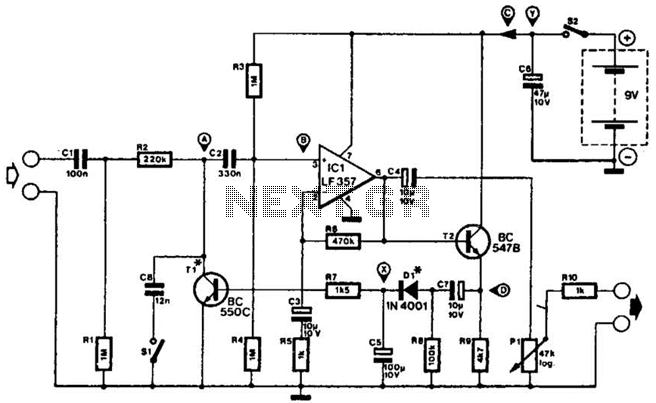
Audio Compressor Circuit
This compressor will compress a 25-mV peak-to-peak (p-p) audio signal to a 20-V p-p output, maintaining input levels between 1.5 V p-p and 3.5 V p-p, with a frequency response ranging from 7 Hz to 67 kHz. It is suitable...
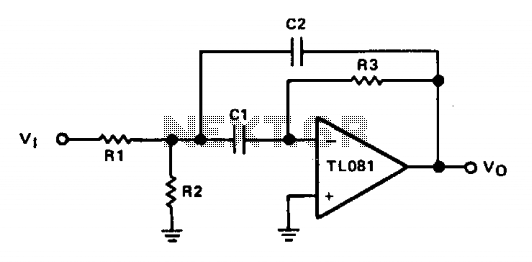
Multiple-feedback bandpass filter
The operational amplifier (op amp) is configured in inverting mode. Resistor R3 connects the output to the inverting input, establishing the gain and the current through the frequency-determining capacitor, C1. Capacitor C2 provides feedback from the output to the junction...
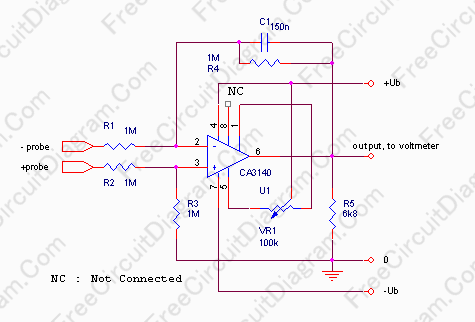
Single Input to Differential Input Adapter for Digital Voltmeter
In some cases, a differential input is needed for voltage measurement. By using a single operational amplifier, it is possible to construct an adapter that provides a floating voltage reference.
To achieve a differential input for voltage measurement using an operational...
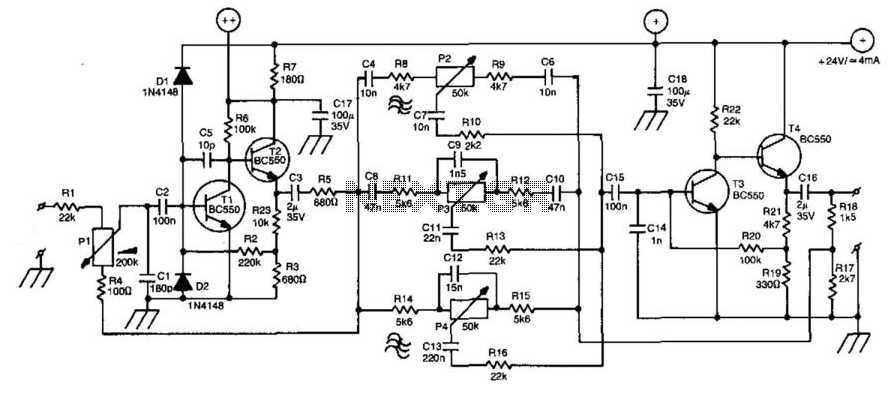
Universal Audio Line Amplifier
A line amplifier is a valuable component for matching line signals or increasing their levels. This functionality is essential during recording sessions or in public-address systems. Additionally, multiple line amplifiers can be combined to create a line mixer. The amplifier's...
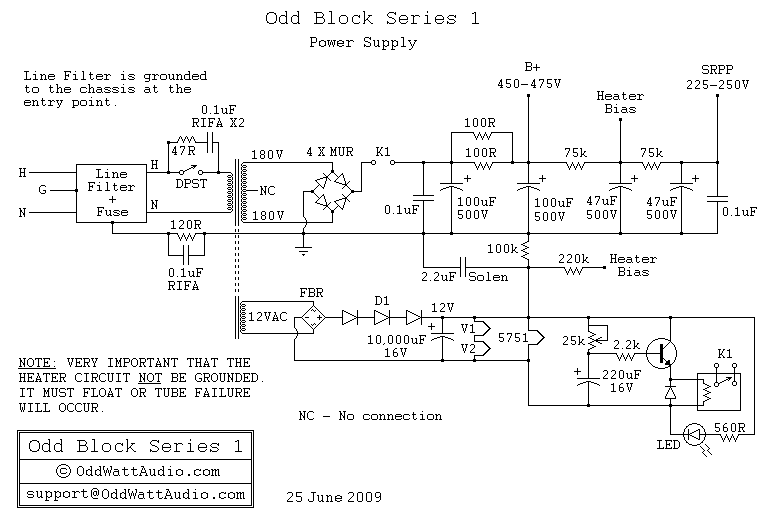
Audio Odd Block KT88 Series 1 Tube Amp-Power Supply
A schematic of the ability accumulation is presented below. Similar to the amplifier schematic, the ability accumulation design is © OddWatt Audio, and permission to host the schematic on this platform has been granted by OddWatt Audio. The schematic may...
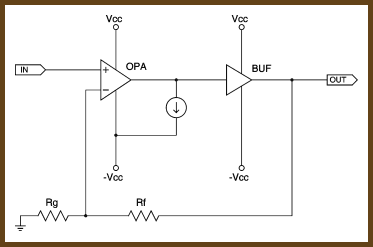
Biasing Op-Amps into Class A
"Class A" refers to configuring an amplifier so that its output devices remain turned on all the time. This reduces thermal variation and eliminates crossover distortion, which makes the chip perform better. To bias an op-amp into class A, you...