


OP90 Micropower Instrumentation Amplifier
#OP90
#micropower
#instrumentation amplifier
#low power consumption
#wide voltage range
#precision
#signal conditioning
#analog circuit
#sensor interface
#low voltage
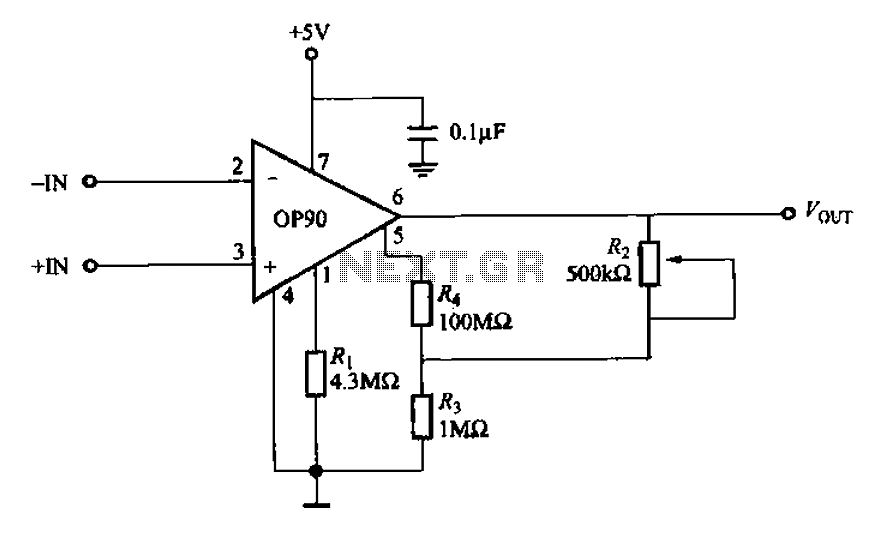
Description: Compared to other operational amplifiers, the OP90 has a significant advantage in low power consumption. Its low power requirements allow for a wide range of power supply voltages (from 1.6V to 18V, and it can also operate with dual supplies from a single supply), making it suitable for portable or battery-powered devices. An example of this is the OP90 configured as a micropower instrumentation amplifier.
The OP90 operational amplifier is designed for applications where low power consumption is critical, particularly in battery-operated devices. Its ability to operate within a wide voltage range enhances its versatility, allowing it to be utilized in various configurations, including single-supply and dual-supply setups.
When configured as a micropower instrumentation amplifier, the OP90 demonstrates its capability to amplify small signals while maintaining low power usage. This configuration typically involves using three OP90 units: two for the differential inputs and one for the output stage.
The input stage typically employs resistors to set the gain of the amplifier, while additional passive components may be included to filter noise and improve stability. The use of low-power resistors ensures that the overall power consumption remains minimal, which is essential for prolonging battery life in portable applications.
In terms of performance, the OP90 offers a low input offset voltage and high input impedance, which are crucial for accurate signal amplification without loading the source. The output stage can drive loads directly or can be coupled to additional stages if further processing is required.
Overall, the OP90's design and characteristics make it an excellent choice for low-power applications, particularly in portable instrumentation and sensor interfacing, where efficiency and performance are paramount. Compared to other operational amplifier, OP90 significant advantage in low power consumption. With its low power consumption, the power supply voltage adapted to a wide range ( 1 6.36V; or 0.8-18V, both can also work in a dual supply from a single supply) and to show their talents in a portable or battery-powered devices. As shown for the OP90 configuration micropower instrumentation amplifier.
The OP90 operational amplifier is designed for applications where low power consumption is critical, particularly in battery-operated devices. Its ability to operate within a wide voltage range enhances its versatility, allowing it to be utilized in various configurations, including single-supply and dual-supply setups.
When configured as a micropower instrumentation amplifier, the OP90 demonstrates its capability to amplify small signals while maintaining low power usage. This configuration typically involves using three OP90 units: two for the differential inputs and one for the output stage.
The input stage typically employs resistors to set the gain of the amplifier, while additional passive components may be included to filter noise and improve stability. The use of low-power resistors ensures that the overall power consumption remains minimal, which is essential for prolonging battery life in portable applications.
In terms of performance, the OP90 offers a low input offset voltage and high input impedance, which are crucial for accurate signal amplification without loading the source. The output stage can drive loads directly or can be coupled to additional stages if further processing is required.
Overall, the OP90's design and characteristics make it an excellent choice for low-power applications, particularly in portable instrumentation and sensor interfacing, where efficiency and performance are paramount. Compared to other operational amplifier, OP90 significant advantage in low power consumption. With its low power consumption, the power supply voltage adapted to a wide range ( 1 6.36V; or 0.8-18V, both can also work in a dual supply from a single supply) and to show their talents in a portable or battery-powered devices. As shown for the OP90 configuration micropower instrumentation amplifier.
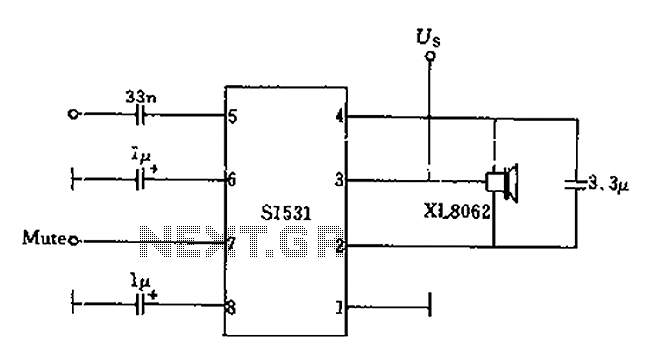
The battery voltage is low frequency amplifying circuit diagram 1v
The battery voltage is 1V for a low-frequency amplifying circuit, which can operate with a power supply voltage ranging from 1V to 1.7V, making it suitable for use with small batteries. The circuit provides an output power of 80mW with...
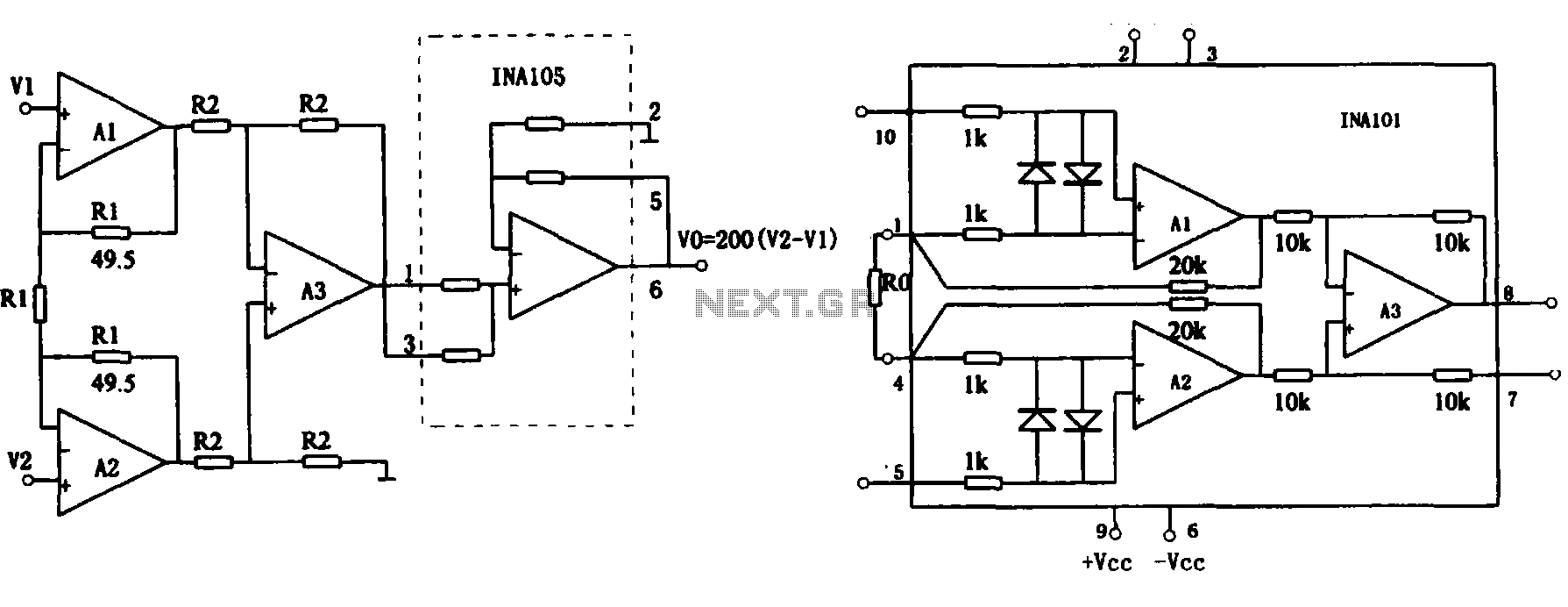
Extended common mode range of the instrumentation amplifier (INA101) circuit
This document describes the extended common mode input voltage range of an instrument amplifier circuit. The circuit consists of three precision instrument amplifiers, A1, A2, and A3, which can be INA101 or INA102 models. The figure illustrates that A1, A2,...
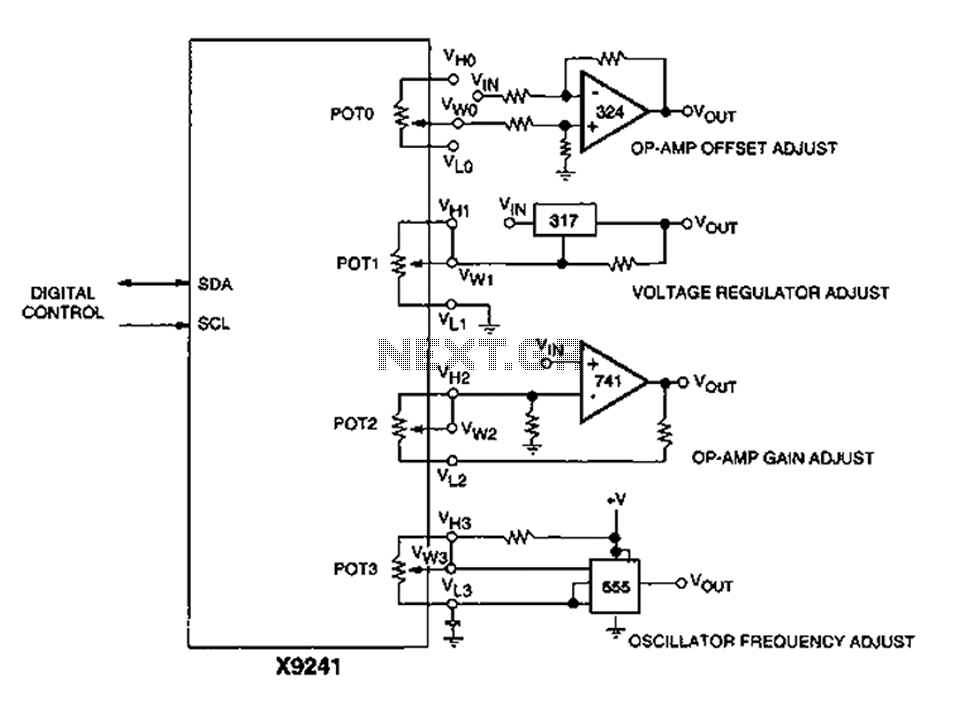
Corrector circuit diagram of an analog circuit
A XICOR X9241 POT IC module can be utilized to modify the four digital analog circuits, as depicted in the schematic.
The XICOR X9241 is a digital potentiometer integrated circuit designed for precise adjustment of analog signal levels in various electronic...
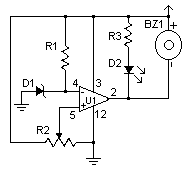
Low Voltage Alarm
This low voltage circuit can be used to monitor batteries and other volatile sources of current for problems. The circuit sounds an alarm and lights an LED, but can be interfaced to any number of other circuits for many different...
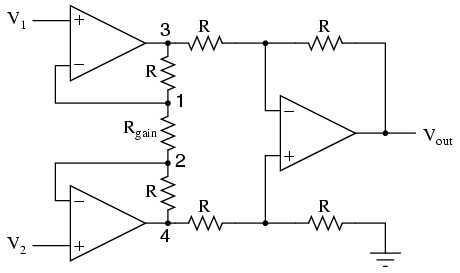
The instrumentation amplifier
It is advantageous to adjust the gain of an amplifier circuit without modifying more than one resistor value, unlike the previous design of the differential amplifier. The instrumentation amplifier builds upon the last version of the differential amplifier to provide...
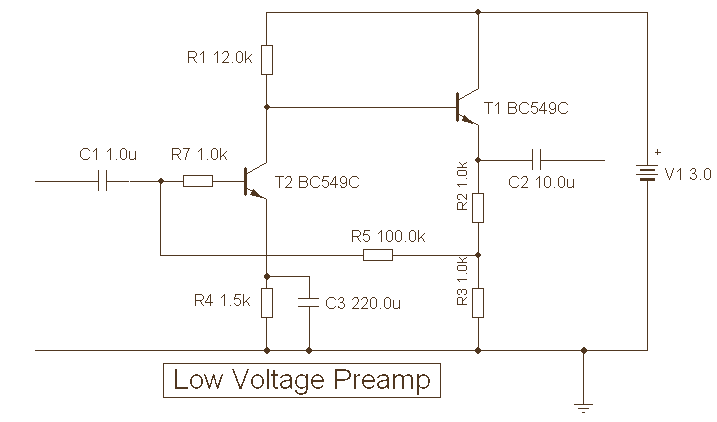
Low Voltage Preamplifier
The provided description pertains to a unique low voltage variant of an audio preamp. The emitter voltage of T1 is biased close to half the supply voltage, which is 1.5V. This biasing allows for the maximum output voltage swing. The...
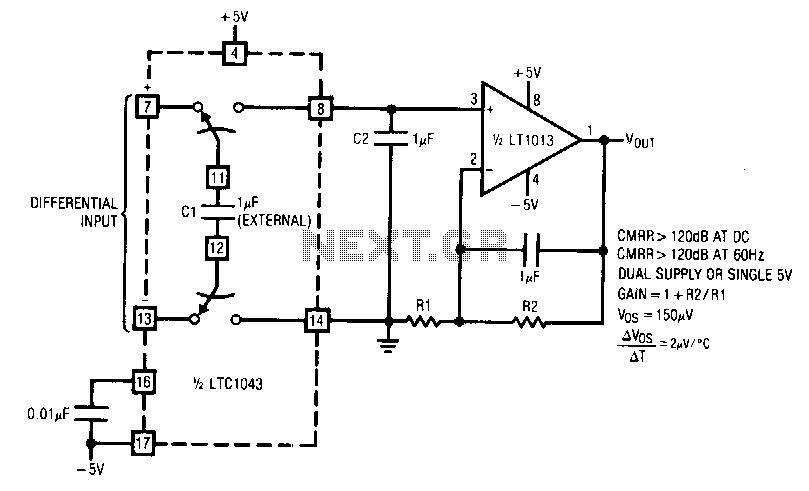
Instrumentation-amplifier
LTC1043 and LT1013 dual operational amplifiers are utilized to construct a dual instrumentation amplifier with only two packages. A single double-pole double-throw (DPDT) switch converts the differential input into a ground-referenced single-ended signal at the input of the LT1013. When...
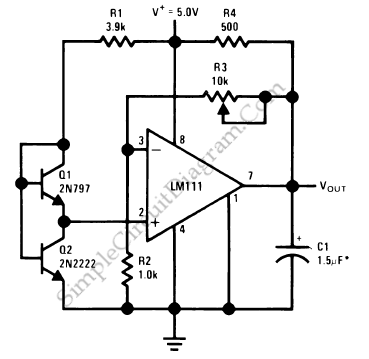
Low Voltage Adjustable Reference Supply
A low voltage reference is essential for providing an offset source or biasing, or simply serving as a reference for a comparator. Its adjustable feature should be compatible with this circuit.
A low voltage reference circuit is designed to deliver a...

Signal Conditioning Analog Front-end for Microcontrollers
The I/O board incorporates 16-bit resolution voltage analog inputs and outputs, along with a 4-20mA current loop transmitter and receiver for microcontroller applications. The document discusses amplifier circuits and schematics, including a signal conditioning variable gain amplifier, analog filter, and...