


Programmable-active-filters
#programmable filter
#low-pass filter
#second-order filter
#HA-2400
#cutoff frequency
#op-amp
#active filter
#signal processing
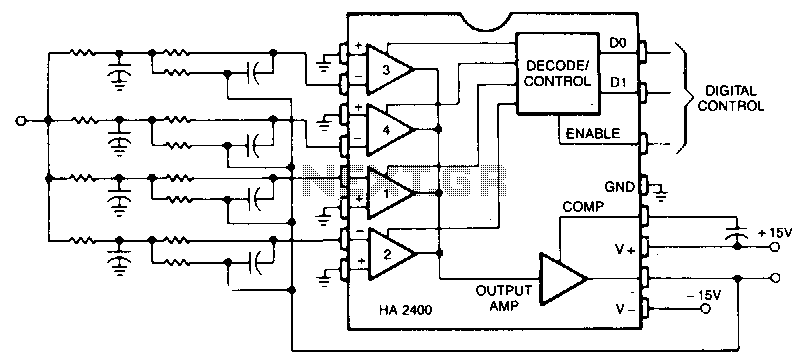
Description: This is a second-order low-pass filter with a programmable cutoff frequency. The circuit should be driven from a low-source impedance, as there are paths from the output to the input through the unselected networks. Virtually any filter function that can be constructed with a conventional operational amplifier can be made programmable with the HA-2400. A useful variation would be to configure one channel as a unity gain amplifier, allowing the selection of either the unfiltered signal or the same signal filtered in various ways. These configurations could be cascaded to provide a wide variety of programmable filter functions.
The described circuit employs a second-order low-pass filter configuration, utilizing operational amplifiers (op-amps) for signal processing. The programmable cutoff frequency feature is achieved through the HA-2400 integrated circuit, which allows for dynamic adjustment of the filter's frequency response. The low-source impedance requirement is critical, as it ensures stability and performance by preventing feedback paths through unselected filter networks from affecting the operation of the active filter.
To implement this low-pass filter, two op-amps are typically arranged in a Sallen-Key configuration, which provides a simple yet effective method for achieving the desired second-order response. The cutoff frequency can be adjusted by altering the values of the resistors and capacitors in the circuit, which can be controlled via digital or analog means, depending on the application.
The option to wire one channel as a unity gain amplifier enhances the versatility of the circuit. This configuration allows the user to toggle between the unfiltered input signal and the filtered output, facilitating real-time monitoring of the signal processing effects. By cascading multiple filter stages, a broader range of filter characteristics can be achieved, including varying degrees of attenuation and phase response. This adaptability makes the circuit suitable for various applications in audio processing, data acquisition systems, and other electronic systems requiring precise signal conditioning.
Overall, this low-pass filter design with programmable features provides a robust solution for applications where flexibility and performance are paramount.This is a second-order, low-pass filter with programmable cutoff frequency. This circuit should be driven from a low-source impedance since there are paths from the output to the input through the unselected networks. Virtually any filter function which can be constructed with a conventional op amp can be made programmable with the HA-2400.
A useful variation would be to wire one channel as a unity gain amplifier, so that one could select the unfiltered signal, or the same signal filtered in various manners. These could be cascaded to provide a wide variety of programmable filter functions.
The described circuit employs a second-order low-pass filter configuration, utilizing operational amplifiers (op-amps) for signal processing. The programmable cutoff frequency feature is achieved through the HA-2400 integrated circuit, which allows for dynamic adjustment of the filter's frequency response. The low-source impedance requirement is critical, as it ensures stability and performance by preventing feedback paths through unselected filter networks from affecting the operation of the active filter.
To implement this low-pass filter, two op-amps are typically arranged in a Sallen-Key configuration, which provides a simple yet effective method for achieving the desired second-order response. The cutoff frequency can be adjusted by altering the values of the resistors and capacitors in the circuit, which can be controlled via digital or analog means, depending on the application.
The option to wire one channel as a unity gain amplifier enhances the versatility of the circuit. This configuration allows the user to toggle between the unfiltered input signal and the filtered output, facilitating real-time monitoring of the signal processing effects. By cascading multiple filter stages, a broader range of filter characteristics can be achieved, including varying degrees of attenuation and phase response. This adaptability makes the circuit suitable for various applications in audio processing, data acquisition systems, and other electronic systems requiring precise signal conditioning.
Overall, this low-pass filter design with programmable features provides a robust solution for applications where flexibility and performance are paramount.This is a second-order, low-pass filter with programmable cutoff frequency. This circuit should be driven from a low-source impedance since there are paths from the output to the input through the unselected networks. Virtually any filter function which can be constructed with a conventional op amp can be made programmable with the HA-2400.
A useful variation would be to wire one channel as a unity gain amplifier, so that one could select the unfiltered signal, or the same signal filtered in various manners. These could be cascaded to provide a wide variety of programmable filter functions.
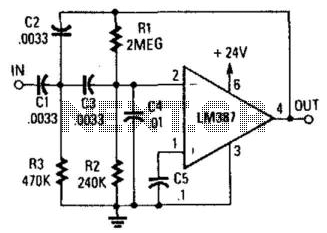
Simple Rumble Filter
This circuit is a two-section active high-pass filter using an LM387, with a cutoff frequency below 50 Hz at a slope of 12 dB per octave. It will help reduce rumble caused by turntable defects in record systems.
The two-section active...

op amp Basic Frequency Control Circuit
R4 prevents the output voltage from drifting toward one of the supply rails of the operational amplifier. It is understood that R4 should have a high resistance, although the reason for this is unclear. The schematic appears to be from...
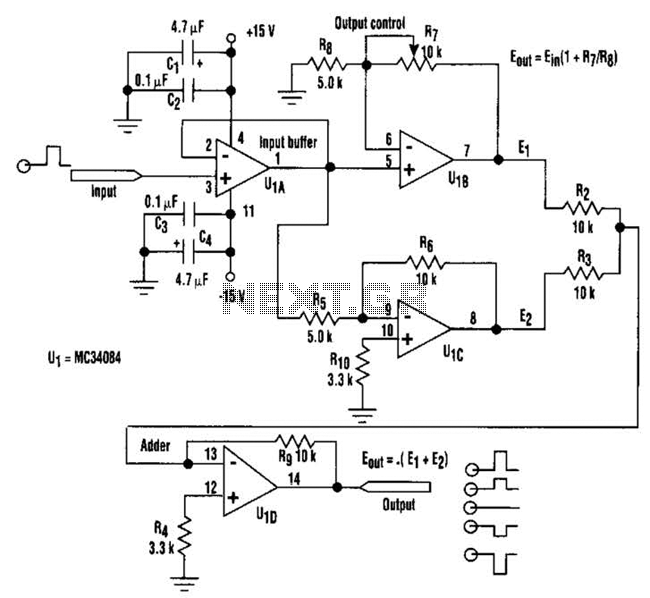
Polarity Gain Adjustment Circuit
By adjusting one potentiometer, the output of this circuit can be varied from a positive version of the input signal, smoothly transitioning through zero output, and then to a negative version of the input. For instance, if the input signal...
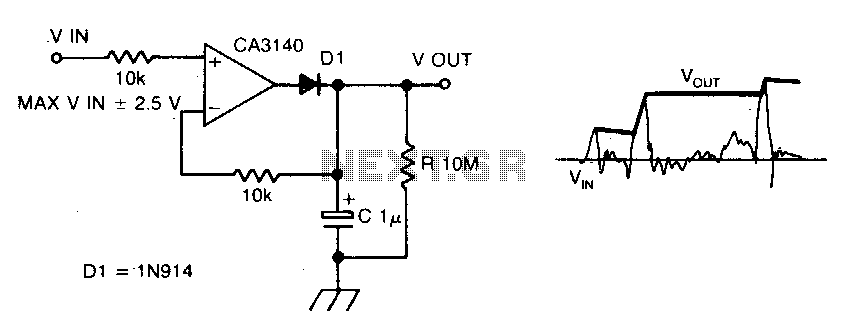
Precision peakvoltage detector
The circuit employs negative feedback exclusively for positive signals. The inverting input receives feedback only when diode D1 is forward biased, which occurs solely with positive input signals. As the positive input signal increases, the output of the operational amplifier...
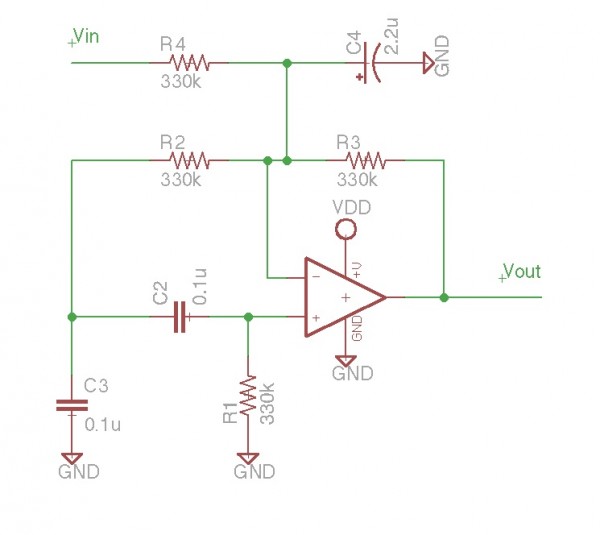
Karplus Strong Opamp Circuit
It is essentially an all-pass filter with two additional components: a capacitor and a resistor, which produces percussion sounds. A schematic of the unmodified all-pass filter circuit, a waveform captured via Audacity, and a short audio sample featuring a drum...
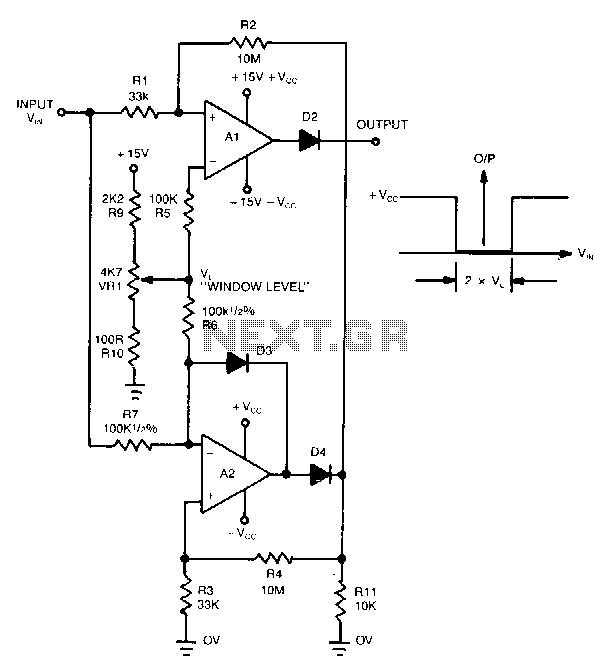
Window-detector
This novel window detector utilizes only two operational amplifiers. The width of the window can be adjusted using a 4.7 kΩ potentiometer.
The described window detector circuit employs two operational amplifiers (op-amps) to create a functional and efficient signal conditioning system....
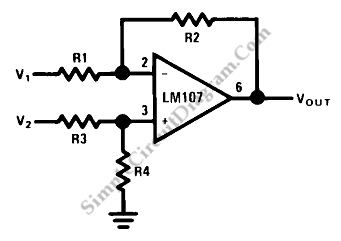
Op-Amp Circuit: Difference Amplifier
This circuit is a difference amplifier. It functions as an inverting amplifier that enables the subtraction of two voltages, effectively performing a summation.
The difference amplifier is a fundamental circuit configuration in analog electronics, primarily used for amplifying the difference between...
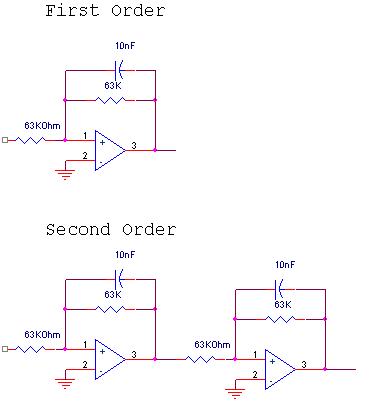
Audio Circuit(BassMidTreble)
The circuit design involves a circular operational amplifier (op-amp) configuration that functions as a second-order low-pass and high-pass filter. The low-pass filter operates within a frequency range of 20 to 250 Hz, while details regarding the high-pass filter are not...
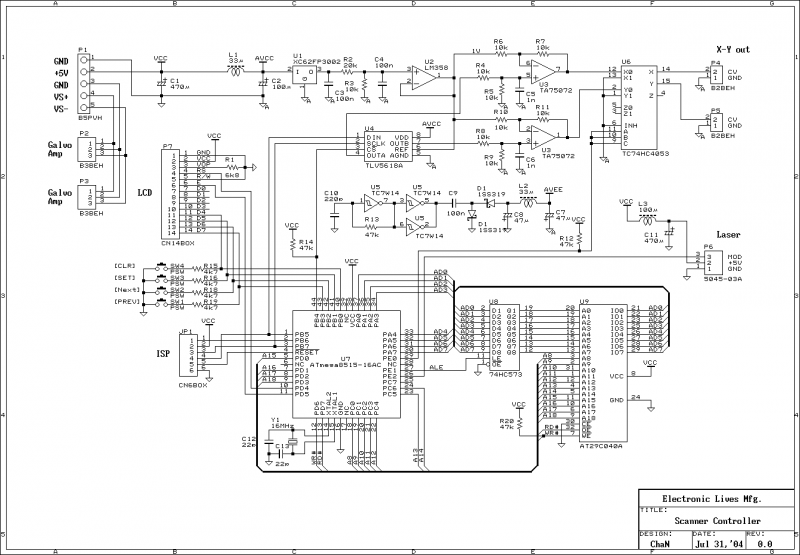
Home Built Laser Projector
This document outlines the servo amplifier and its circuit diagram. It describes a straightforward operational amplifier circuit that integrates both a power amplifier and a small signal amplifier on the same board. Care must be taken to avoid unintended coupling...