


Thermocouple Amplifier circuit (CA3193)
#thermocouple
#amplifier
#CA3193
#precision op amp
#signal amplification
#BiMOS
#high resistance
#15 volts
#sensor interface
#large-scale output

Description: The circuit requires a 15-volt power supply and employs a precision operational amplifier, CA3193 BiMOS, to amplify the generated signal by more than 500 times. Three 22-megohm resistors are utilized to ensure a large-scale output in the event of a thermocouple disconnection.
This thermocouple amplifier is designed to be versatile, making it suitable for a wide range of applications. The CA3193 BiMOS op-amp is selected for its high precision, low offset voltage, and low noise characteristics, which are essential for accurate signal amplification in thermocouple applications.
The circuit configuration leverages the characteristics of the op-amp to achieve a high gain, which is crucial for detecting small voltage changes from the thermocouple. The use of three 22-megohm resistors in the feedback path ensures that the output remains stable and provides a significant output voltage even when the thermocouple is disconnected. This feature is particularly important for maintaining circuit integrity and providing an indication of thermocouple failure.
Additionally, the design may include bypass capacitors near the power supply pins of the op-amp to filter out any high-frequency noise, ensuring that the amplified signal remains clean. The circuit can be implemented on a PCB, with careful attention to layout to minimize noise and interference, particularly in environments with high electromagnetic interference.
Overall, this thermocouple amplifier circuit is an effective solution for applications requiring precise temperature measurements and can be adapted for various industrial and laboratory settings.The circuit needs 15 volts and uses a precision op amp CA3193 BiMOS to amplify the signal generated more than 500 times. Three 22-megohm resistors provide large-scale output if the thermocouple opens. A nice thermocouple amplifier suitable for every apllication.
This thermocouple amplifier is designed to be versatile, making it suitable for a wide range of applications. The CA3193 BiMOS op-amp is selected for its high precision, low offset voltage, and low noise characteristics, which are essential for accurate signal amplification in thermocouple applications.
The circuit configuration leverages the characteristics of the op-amp to achieve a high gain, which is crucial for detecting small voltage changes from the thermocouple. The use of three 22-megohm resistors in the feedback path ensures that the output remains stable and provides a significant output voltage even when the thermocouple is disconnected. This feature is particularly important for maintaining circuit integrity and providing an indication of thermocouple failure.
Additionally, the design may include bypass capacitors near the power supply pins of the op-amp to filter out any high-frequency noise, ensuring that the amplified signal remains clean. The circuit can be implemented on a PCB, with careful attention to layout to minimize noise and interference, particularly in environments with high electromagnetic interference.
Overall, this thermocouple amplifier circuit is an effective solution for applications requiring precise temperature measurements and can be adapted for various industrial and laboratory settings.The circuit needs 15 volts and uses a precision op amp CA3193 BiMOS to amplify the signal generated more than 500 times. Three 22-megohm resistors provide large-scale output if the thermocouple opens. A nice thermocouple amplifier suitable for every apllication.
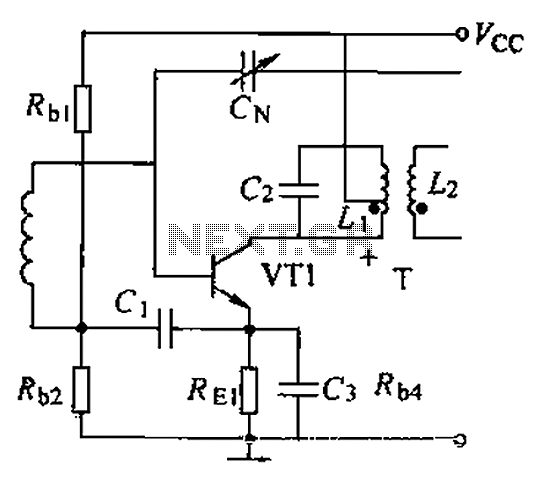
Common intermediate frequency amplifier circuit having a circuit and on the radio
A common intermediate frequency amplifier circuit is presented, along with its components and parameters. The reference values for the components are as follows: 1) Transistors: VT1 to 3DG19, Vcc = 6V. 2) Resistance values: R1 = 50 kΩ, R2 =...
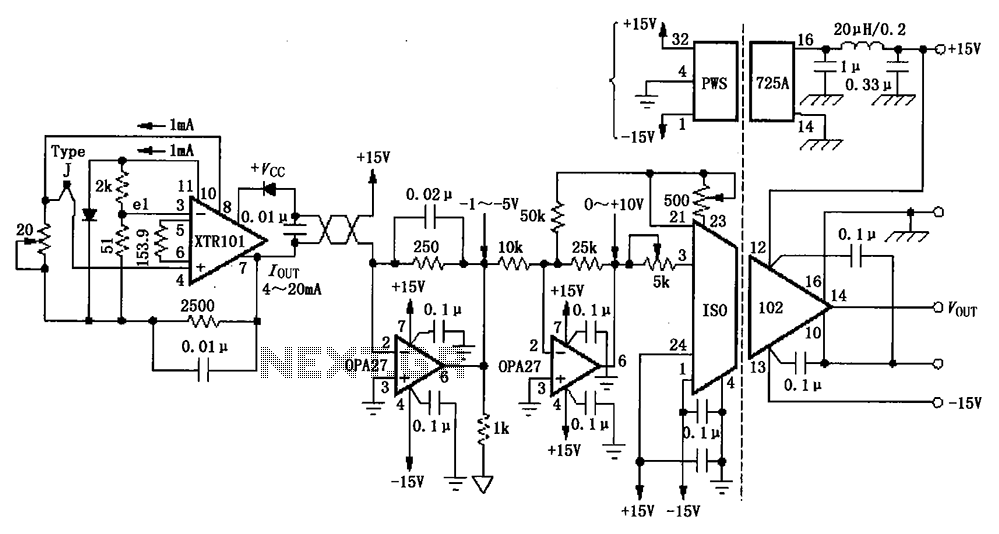
Having a cold junction compensation Remote Isolated Thermocouple transmitter circuit diagram ISO102 XTR101
The circuit depicted in the figure features the ISO102 and XTR101 components, forming an isolated remote transmitter circuit equipped with isolated thermocouple cold-junction compensation. The circuit comprises four main parts: the current loop amplifier XTR101, the isolation amplifier ISO102, and...
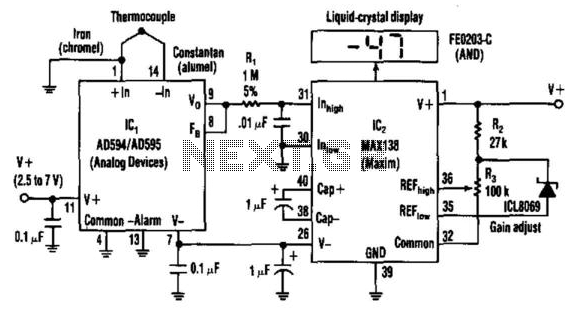
Single-Dc Supply Thermometer
Using a J-type thermocouple, this circuit can indicate temperatures from -350° to 400° with a 6-V supply or from -50° to +100° with a 3-V lithium battery. The AD954 produces a 10 mV/°C output to the MAX 138 digital voltmeter...
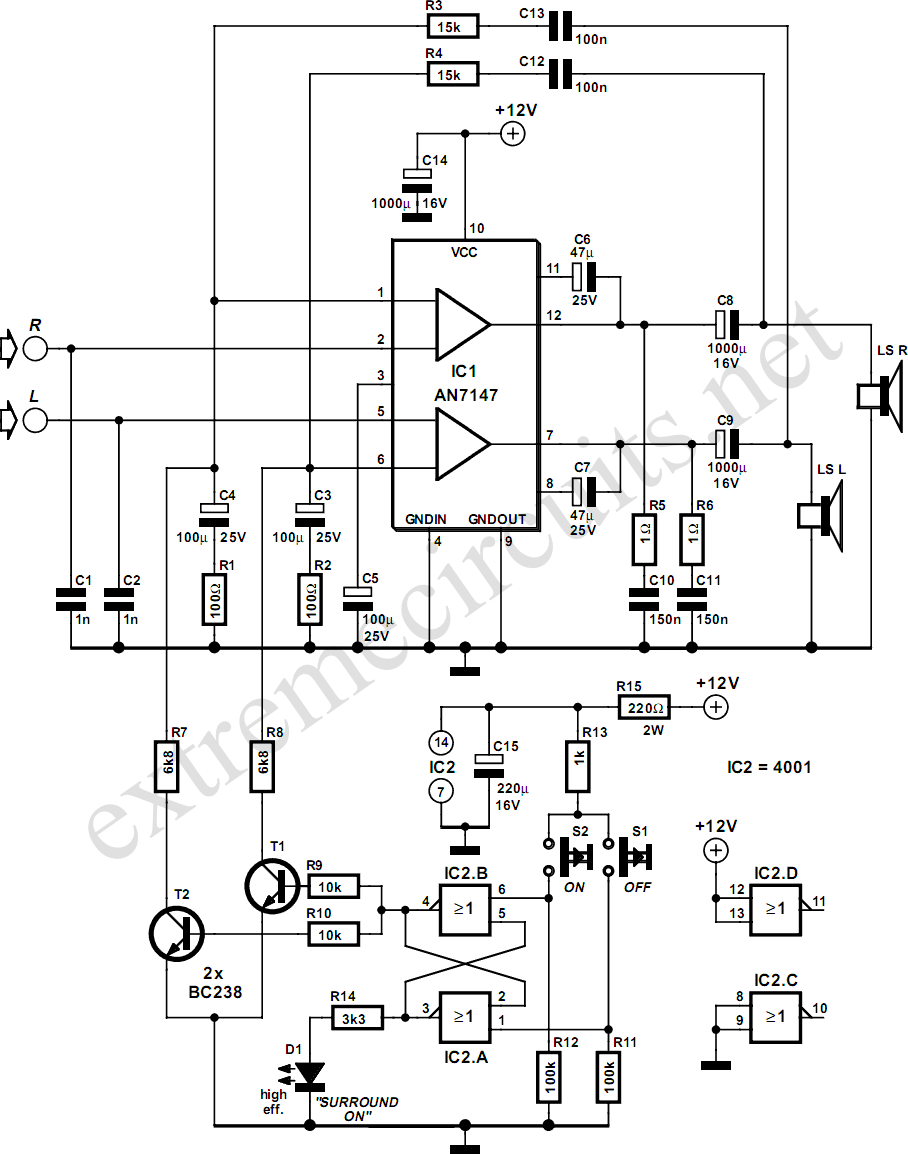
5.3W Amplifier With Surround System
The AN7147 Dual 5.3-watt Audio Power Amplifier from Panasonic is categorized as a replacement type, indicating its anticipated availability in the market for an extended period. When combined with additional components, it can be configured to create a simple surround-sound...
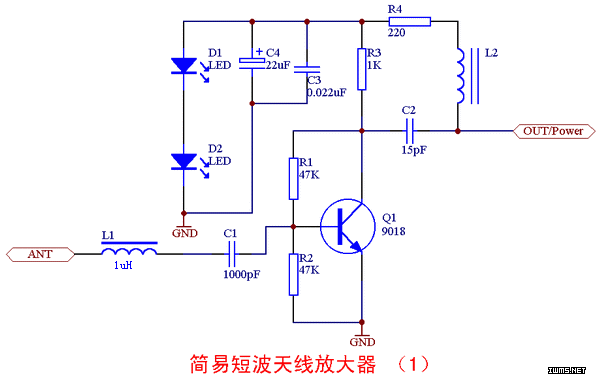
A simple and effective short-wave antenna amplifier circuit
This amplifier is designed for outdoor installation and is connected to an indoor power line box. It utilizes either 50-ohm or 75-ohm coaxial cables for the connection between indoor and outdoor units. The amplifier circuit board is depicted in Figures...
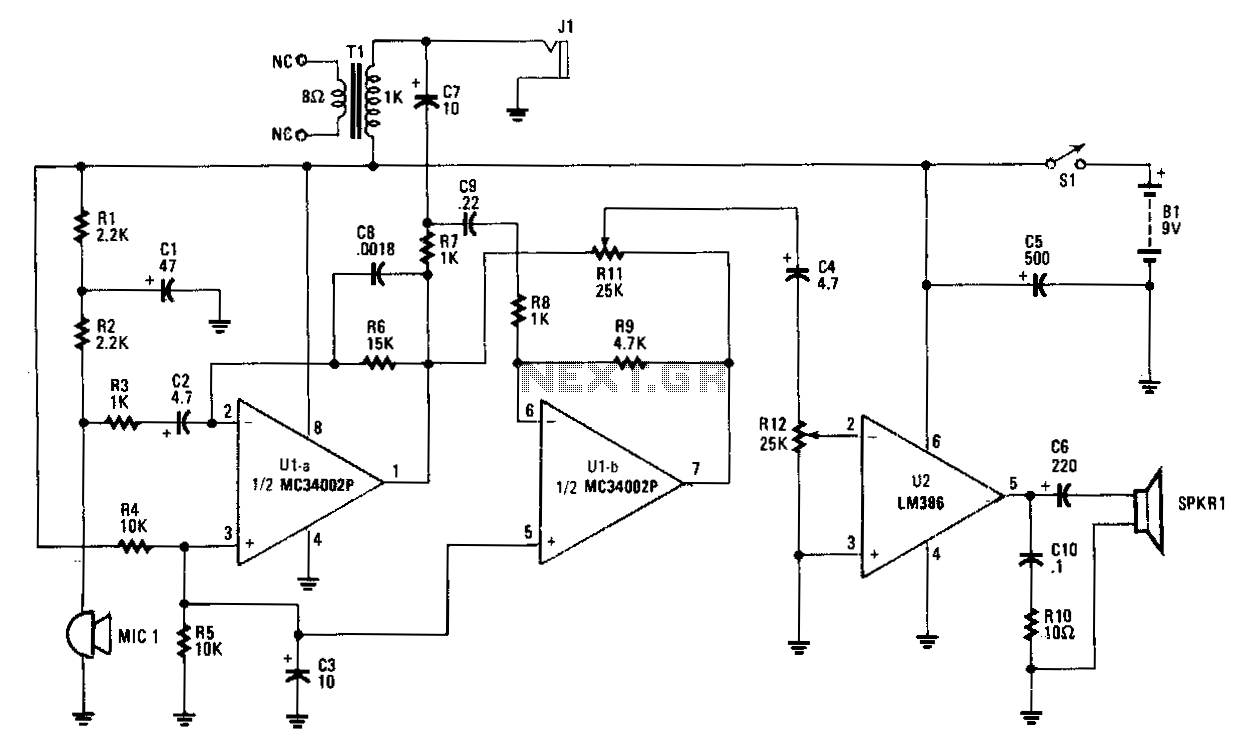
Hands-off-intercom
Amplifier A increases the microphone's output to a usable level. The output signal is fed to op amp B, which inverts the signal by 180 degrees. A balance-control potentiometer connects across the outputs of amplifiers A and B. If an...
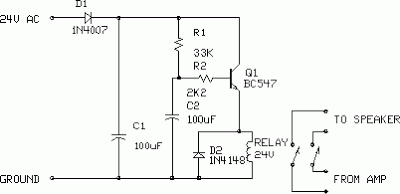
Amplifier Output Delay with Relay Schematic Diagram
This is a minimal circuit designed for individual audio amplifier projects to control the presenter output relay. The purpose of this circuit is to manage the relay that activates the speaker output within the audio amplifier. The circuit introduces a...
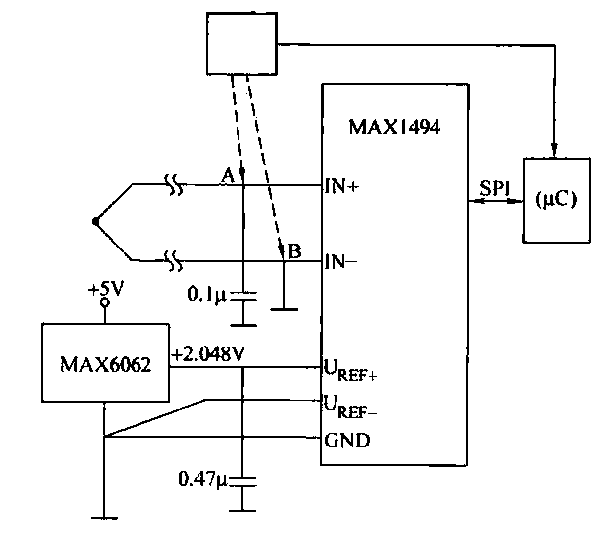
Thermocouple thermometer circuit
The circuit consists of the MAX1494 and a thermocouple temperature measurement system. The MAX1494 is terminated at 1N GND 5-32. An external temperature sensor, such as the DS75, can be utilized for junction temperature compensation. The MAX1494 employs an external...
RECEIVER BUILDING BLOCKS
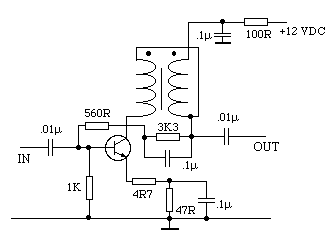
This amplifier has about 20dB of gain, bandwidth of 100MHz and noise figure of about 7dB. The output transformer is 8 turns bifilar wound on a ferrite core. Use a medium power UHF transistor 2N5109, 2N3866, 2N4427 or similar. The...