


12kHz IF signal generator circuit diagram
#intermediate frequency
#signal generator
#variable feedback
#12kHz
#alarm circuit
#oscillation frequency
#RF
#frequency determiner
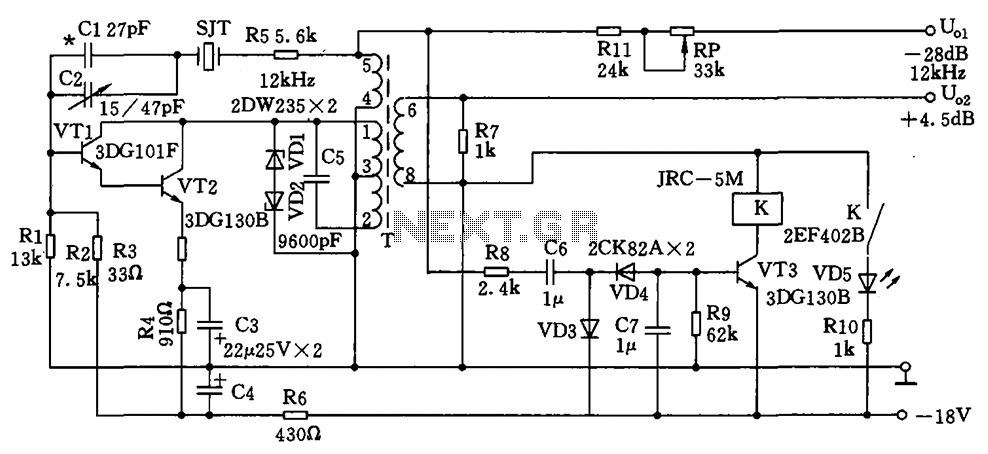
Description: The circuit depicted is a 12 kHz intermediate frequency oscillator designed for an alarm system. It employs a variable feedback oscillation circuit where the oscillation frequency is primarily determined by a quartz crystal. Capacitors C1 and C2 are used for fine-tuning the frequency. The oscillating tube is configured to increase input impedance, while stable amplitude is achieved through bidirectional regulators VD1 and VD2.
Specifications: (1) Nominal frequency: 12 kHz, with a frequency deviation not exceeding 1 Hz; (2) Frequency accuracy: within a temperature range of 25 degrees Celsius, the deviation does not exceed 1 Hz; (3) U01 Output Level: -28 dB/600 ohms, with a deviation of less than 0.2 dB; (4) U02 Output Level: +4.5 dB, with a tolerance of 0.5 dB.
The circuit operates as a stable oscillator, utilizing a quartz crystal as the frequency-determining element. The feedback mechanism is critical for maintaining the desired oscillation frequency, which is set at 12 kHz. The inclusion of capacitors C1 and C2 allows for precise adjustments to the frequency, enabling the circuit to adapt to slight variations in component values or environmental conditions.
The use of an oscillating tube enhances the input impedance, which is essential for interfacing with subsequent stages of the alarm circuit, such as signal processing or amplification stages. The bidirectional regulators, VD1 and VD2, serve to stabilize the amplitude of the output signal, ensuring consistent performance across varying load conditions.
The specifications highlight the performance metrics of the oscillator, emphasizing its reliability and accuracy. The nominal frequency is tightly controlled, with minimal deviation, ensuring that the alarm system operates within its designed parameters. The output levels from U01 and U02 indicate the circuit's capability to interface effectively with other components in the alarm system, providing both low and high-level outputs as required for different parts of the system.
Overall, this intermediate frequency oscillator circuit is well-suited for alarm applications, delivering stable and accurate performance essential for reliable operation. Circuit as shown by the l2kHz the intermediate frequency oscillator, an alarm circuit. It uses variable feedback oscillation circuit, the oscillation frequency is mainly determ ined by a quartz crystal. Cl, C2 can fine-tune the frequency. Oscillating tube composite pipe to increase input impedance, stable amplitude by VDl, VD2 bidirectional regulator obtained.Specifications: (1) Nominal frequency: 12kHz, the frequency difference does not exceed 1Hz; (2) frequency accuracy: in the temperature range of 25 25, F does not exceed lHz; (3) U01 Output Level: -28dB/600, deviation of less than 0.2dB; (4) U02 Output Level: + 4.5dB 0.5dB.
Specifications: (1) Nominal frequency: 12 kHz, with a frequency deviation not exceeding 1 Hz; (2) Frequency accuracy: within a temperature range of 25 degrees Celsius, the deviation does not exceed 1 Hz; (3) U01 Output Level: -28 dB/600 ohms, with a deviation of less than 0.2 dB; (4) U02 Output Level: +4.5 dB, with a tolerance of 0.5 dB.
The circuit operates as a stable oscillator, utilizing a quartz crystal as the frequency-determining element. The feedback mechanism is critical for maintaining the desired oscillation frequency, which is set at 12 kHz. The inclusion of capacitors C1 and C2 allows for precise adjustments to the frequency, enabling the circuit to adapt to slight variations in component values or environmental conditions.
The use of an oscillating tube enhances the input impedance, which is essential for interfacing with subsequent stages of the alarm circuit, such as signal processing or amplification stages. The bidirectional regulators, VD1 and VD2, serve to stabilize the amplitude of the output signal, ensuring consistent performance across varying load conditions.
The specifications highlight the performance metrics of the oscillator, emphasizing its reliability and accuracy. The nominal frequency is tightly controlled, with minimal deviation, ensuring that the alarm system operates within its designed parameters. The output levels from U01 and U02 indicate the circuit's capability to interface effectively with other components in the alarm system, providing both low and high-level outputs as required for different parts of the system.
Overall, this intermediate frequency oscillator circuit is well-suited for alarm applications, delivering stable and accurate performance essential for reliable operation. Circuit as shown by the l2kHz the intermediate frequency oscillator, an alarm circuit. It uses variable feedback oscillation circuit, the oscillation frequency is mainly determ ined by a quartz crystal. Cl, C2 can fine-tune the frequency. Oscillating tube composite pipe to increase input impedance, stable amplitude by VDl, VD2 bidirectional regulator obtained.Specifications: (1) Nominal frequency: 12kHz, the frequency difference does not exceed 1Hz; (2) frequency accuracy: in the temperature range of 25 25, F does not exceed lHz; (3) U01 Output Level: -28dB/600, deviation of less than 0.2dB; (4) U02 Output Level: + 4.5dB 0.5dB.
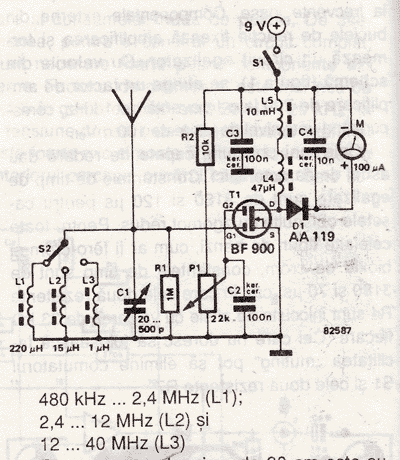
Radio Field Indicator Circuit
An RF field indicator is needed to verify power stages and transmitter antennas. This radio field indicator allows for the measurement of radiated energy from antennas.
An RF field indicator is a crucial device in the field of telecommunications and broadcasting....
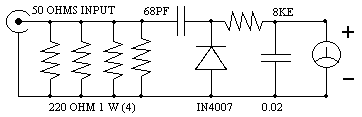
Simple RF Power Meter
Many beginners trying out their skill with QRP TX for the first time have to overcome many problems before they are able to come on the air. One usual complaint is that everything is working fine, but the signal is...
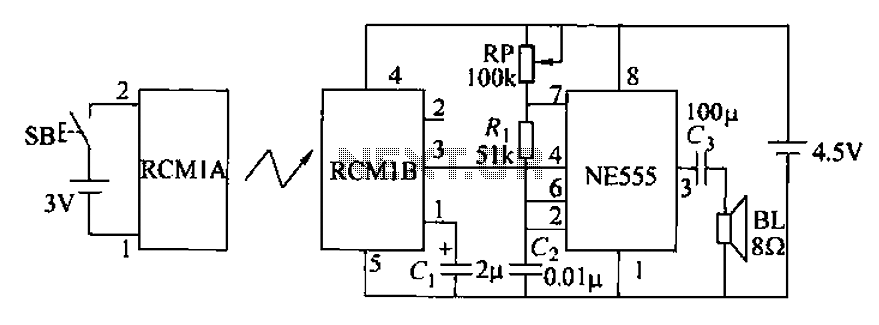
Elderly lost alarm circuit
The circuit utilizes an RMIB multivibrator component that operates at a maximum distance. When the distance exceeds a specific threshold, the output pin of the receiver goes low, effectively stopping the oscillation. The NE555 multivibrator, which is part of the...
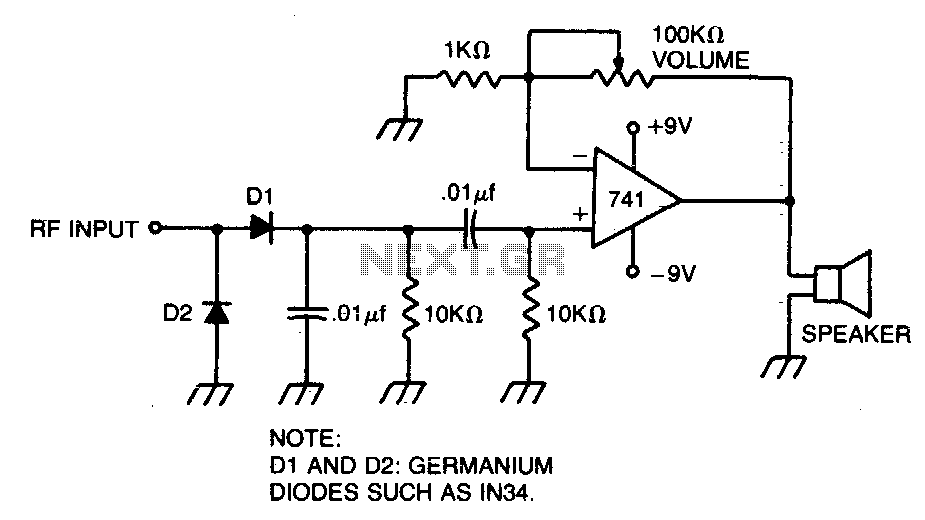
Modulation monitor
A broad-tuned receiver demodulates the RF signal picked up by a loosely coupled wire placed near the transmitting antenna.
The broad-tuned receiver operates by utilizing a loosely coupled wire antenna, which is strategically positioned in proximity to the transmitting antenna. This...
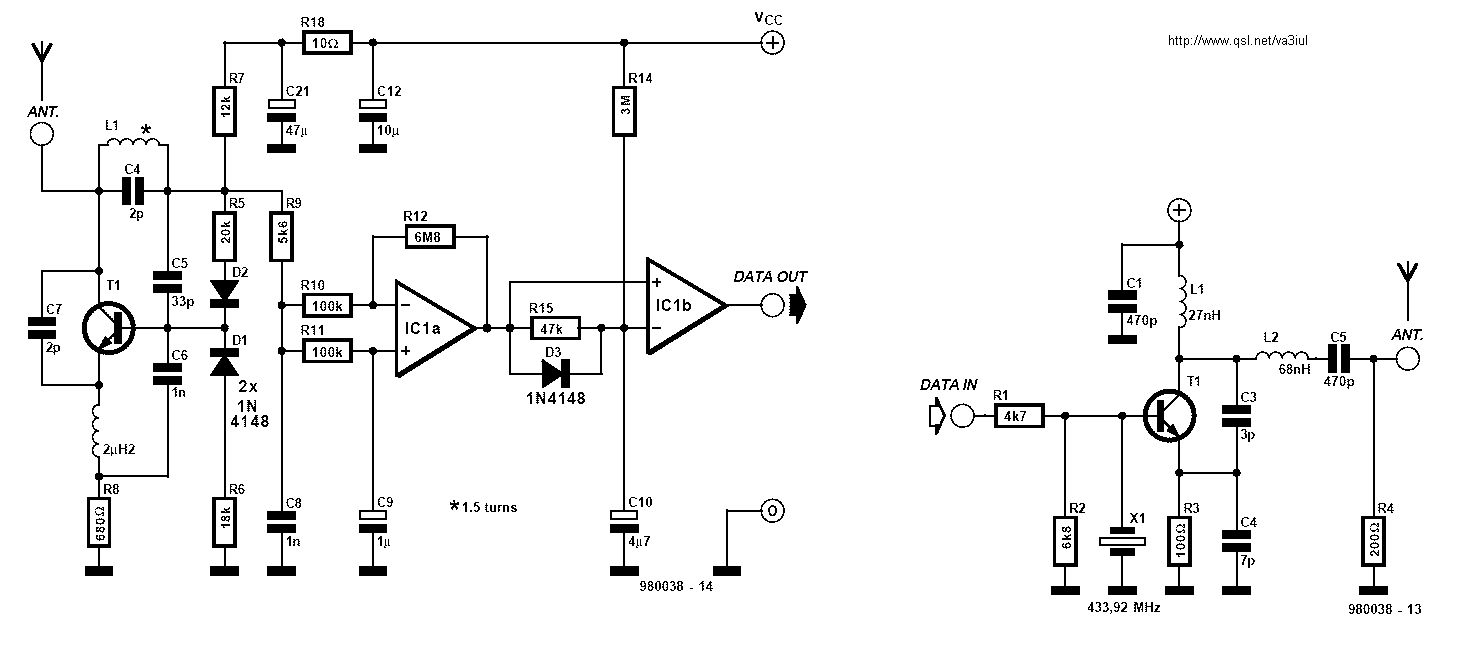
What do I need for a basic RF circuit
The purpose of this circuit is for research and education. Assistance is sought in acquiring components for simple RF circuits, as well as tutorials or schematics. The requester is facing challenges in locating quality resources for beginner-level RF circuit building...
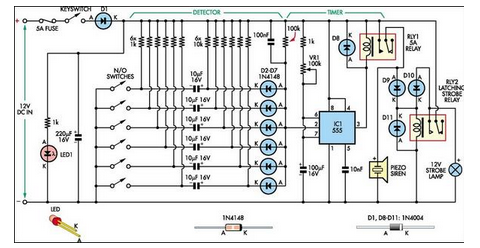
Simple 6-Input Alarm
This simple alarm circuit was designed for use in a combined garage and rumpus room. It can be assembled on Veroboard and uses just one IC plus a handful of additional components.
The alarm circuit is based on a single integrated...
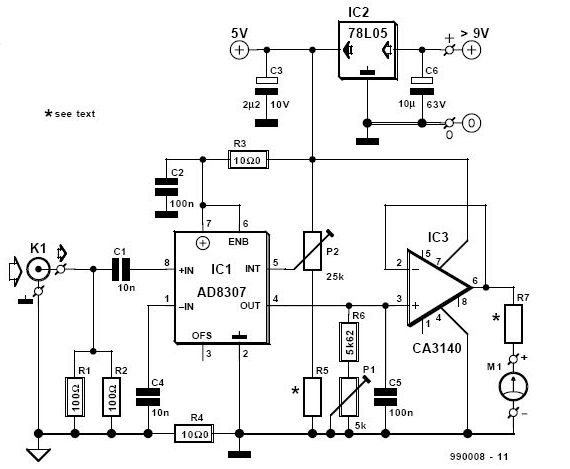
RF Decibel Meter Circuit
A DIY RF decibel (or power) meter is an essential instrument in any radio workshop. However, accurate, wideband models can be quite costly.
A DIY RF decibel meter serves as a valuable tool for measuring the power levels of radio frequency...
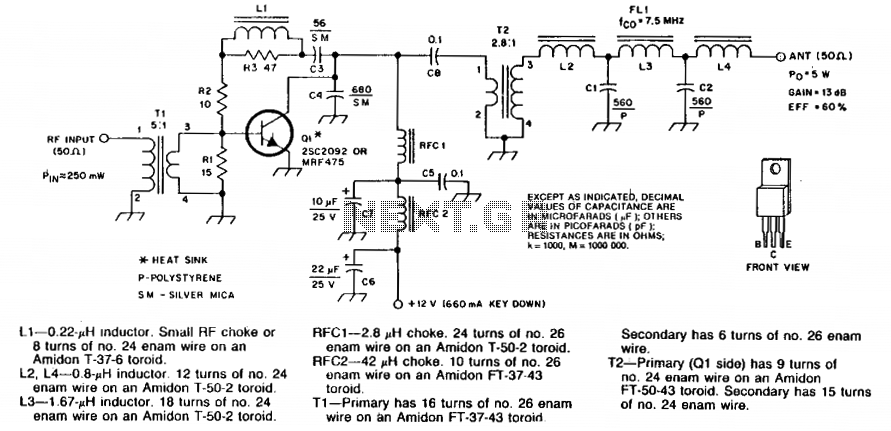
5W RF power amplifier
Numbered components are designated for PC-board layout purposes. C5 and C8 are disc ceramic capacitors. C6 and C7 are tantalum or electrolytic capacitors. R1, R2, and R3 are 1/4 W carbon composition resistors. Silver-mica capacitors may be substituted for polystyrene...
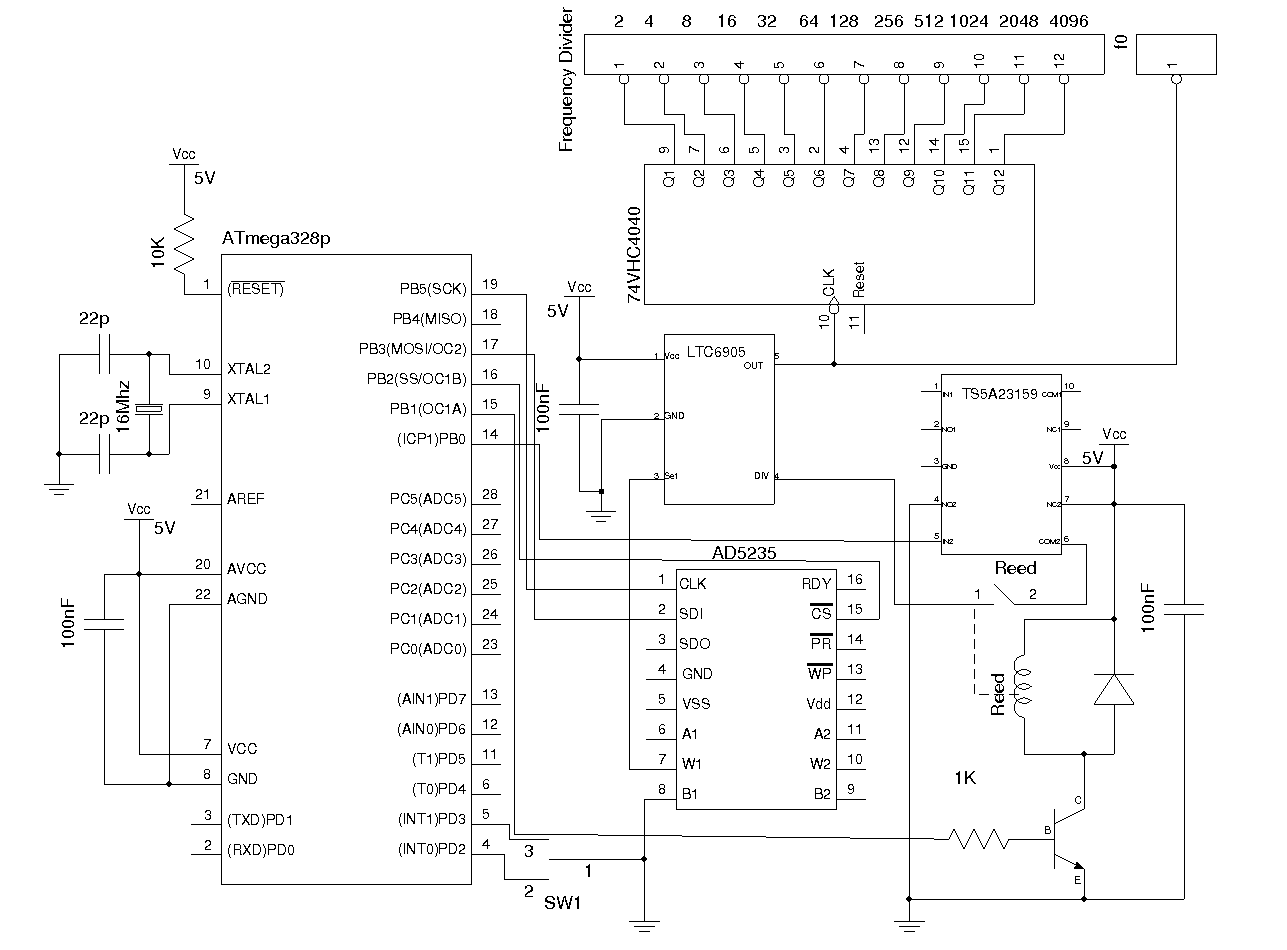
4KHz-170MHz Wide Band RF Signal Generator I
Most commercial-grade signal generators provide more than just sinusoidal waveform output, but they tend to be expensive for casual use. This article presents a simple wideband signal generator built around Linear Technology's LTC6905 Silicon Oscillator, capable of generating frequencies from...