


3-state sound generator with LM556
#LM556
#sound generator
#dual timer
#timing circuit
#audio oscillator
#555 timer
#signal generator
#electronic oscillator
#pulse generator
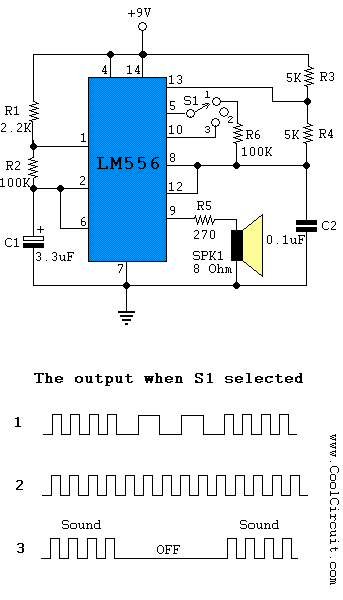
Description: A 3-state sound generator utilizing the LM556. The LM556 is a dual timer that can function as two independent LM555 timers, sharing only VCC and ground. Timing can be defined by the user.
The circuit design for the 3-state sound generator using the LM556 involves configuring the two timers in a manner that allows for distinct sound generation states. Each timer can be set up to generate different frequencies or duty cycles, thereby producing varied sound outputs.
The LM556 consists of two identical timer circuits that can operate independently. Each timer has its own timing components, which typically include resistors and capacitors connected to the discharge and threshold pins. By selecting appropriate resistor and capacitor values, the timing intervals can be adjusted to achieve the desired sound characteristics.
To implement the 3-state functionality, the circuit may utilize a switch or microcontroller to toggle between the different sound states. For instance, Timer A could be configured to produce a square wave at a specific frequency, while Timer B generates a different frequency. The output from both timers can be mixed using a simple resistor network or an operational amplifier configured as a summing amplifier.
The output signals can be fed into a speaker or buzzer, allowing for audible sound generation. Additionally, incorporating a low-pass filter might be beneficial to smooth out the output waveform, reducing high-frequency noise and enhancing sound quality.
The power supply for the LM556 should be stable and within the specified voltage range, typically between 4.5V to 15V. Proper decoupling capacitors should be placed near the power pins to minimize voltage fluctuations and ensure reliable operation.
In summary, the 3-state sound generator circuit using the LM556 is a versatile design that allows for creative sound generation by leveraging the independent operation of the dual timers. By adjusting the timing components and utilizing switching mechanisms, a variety of sound outputs can be achieved, making it suitable for applications in toys, alarms, and electronic musical instruments.3-state sound generator with LM556 . LM556 is a dual timer that can be operated as two LM555. The two timers operate independently of each other sharing only VCC and ground.You can define timing.
The circuit design for the 3-state sound generator using the LM556 involves configuring the two timers in a manner that allows for distinct sound generation states. Each timer can be set up to generate different frequencies or duty cycles, thereby producing varied sound outputs.
The LM556 consists of two identical timer circuits that can operate independently. Each timer has its own timing components, which typically include resistors and capacitors connected to the discharge and threshold pins. By selecting appropriate resistor and capacitor values, the timing intervals can be adjusted to achieve the desired sound characteristics.
To implement the 3-state functionality, the circuit may utilize a switch or microcontroller to toggle between the different sound states. For instance, Timer A could be configured to produce a square wave at a specific frequency, while Timer B generates a different frequency. The output from both timers can be mixed using a simple resistor network or an operational amplifier configured as a summing amplifier.
The output signals can be fed into a speaker or buzzer, allowing for audible sound generation. Additionally, incorporating a low-pass filter might be beneficial to smooth out the output waveform, reducing high-frequency noise and enhancing sound quality.
The power supply for the LM556 should be stable and within the specified voltage range, typically between 4.5V to 15V. Proper decoupling capacitors should be placed near the power pins to minimize voltage fluctuations and ensure reliable operation.
In summary, the 3-state sound generator circuit using the LM556 is a versatile design that allows for creative sound generation by leveraging the independent operation of the dual timers. By adjusting the timing components and utilizing switching mechanisms, a variety of sound outputs can be achieved, making it suitable for applications in toys, alarms, and electronic musical instruments.3-state sound generator with LM556 . LM556 is a dual timer that can be operated as two LM555. The two timers operate independently of each other sharing only VCC and ground.You can define timing.
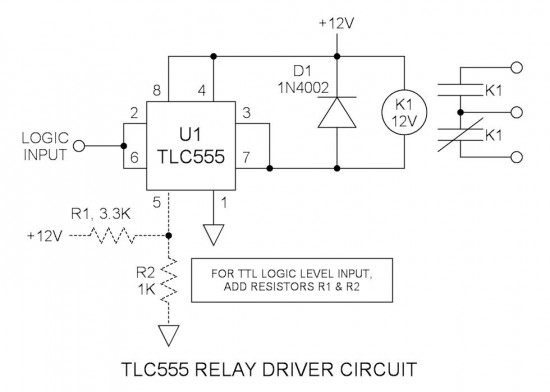
555 tlc555 relay driver circuit
Many integrated circuits possess undocumented features or capabilities. One such example is the TLC555, which can sink a 100mA load down to 1.28V at its output (pin 3). The open-drain transistor reset (pin 7) can also sink 100mA to 1V....
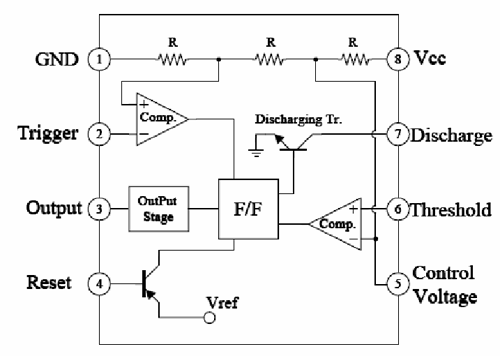
1 Hz Pulse Frequency Generator with 555
A 1 Hz pulse frequency generator utilizes the widely used timer IC 555 configured as an Astable Multivibrator. The output pulses can be visually indicated by an LED. An Astable Multivibrator, often referred to as a free-running Multivibrator, is a...
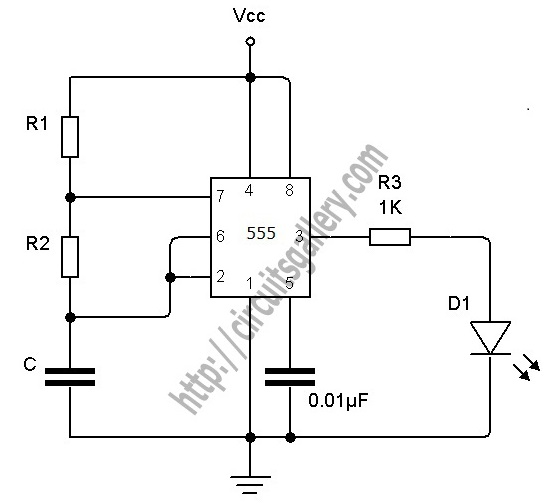
555 Timer Astable calculator for Astable Multivibrator Designing
The astable multivibrator is an oscillator circuit that generates continuous pulses without requiring any external triggering. The oscillation frequency and time period can be manually adjusted by modifying the values of resistors R1, R2, and capacitor C1. A 555 timer...
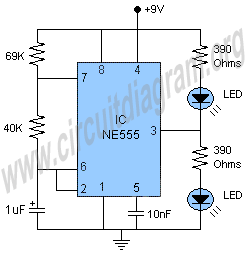
555 tester circuit
A project of a 555 tester circuit, the circuit will start blinking LEDs when power is applied, which will indicate that the IC is working correctly.
The 555 tester circuit is designed to verify the operational status of the 555 timer...
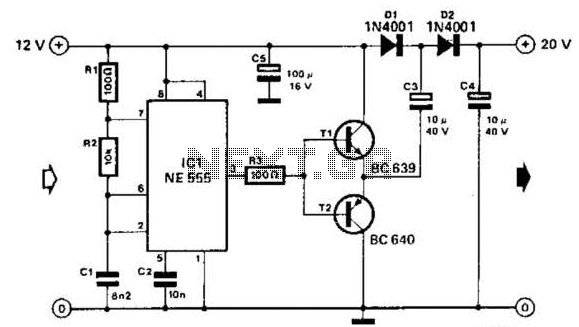
Inductorless Power Supply Converter Circuit
Using a 555 timer and voltage doubler, this circuit will supply over 50 mA at 20 V DC. Transistors T1 and T2 act as power amplifiers to drive the voltage doubler. The frequency of operation is approximately 8.5 kHz.
The circuit...
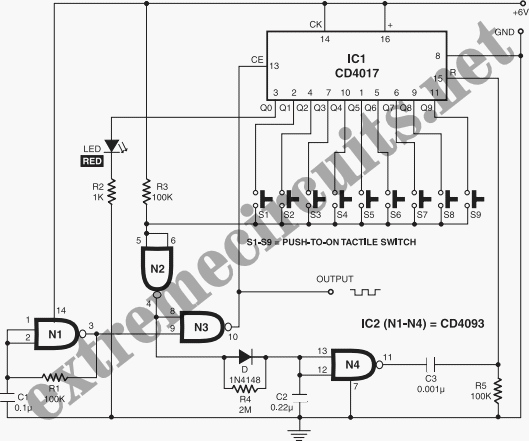
Pulse Generator
This circuit is quite effective for testing or operating counters and stepping relays, as it eliminates the need for manually setting a switch for the desired number of pulses. By pressing the appropriate switches S1 to S9, one can generate...
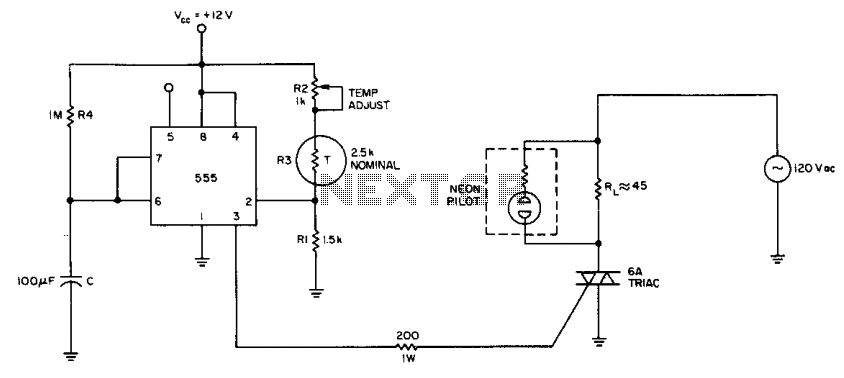
simple temperature controller
The internal comparator of the 555 timer, combined with a thermistor, creates a low-cost temperature controller. Resistor R2 establishes the temperature trip point.
The 555 timer is a versatile integrated circuit widely used in various applications, including timers, oscillators, and pulse...
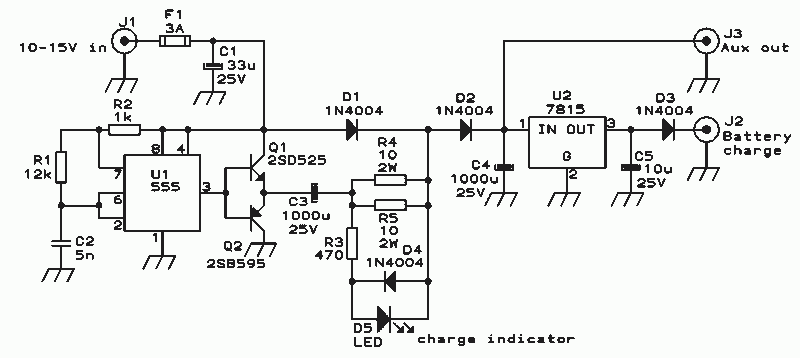
12V battery charger with 555
The charger consists of two stages: The first is a capacitive voltage doubler, which uses a 555 timer IC driving a pair of transistors connected as emitter followers, which in turn drive the voltage doubler proper. The doubler has power...
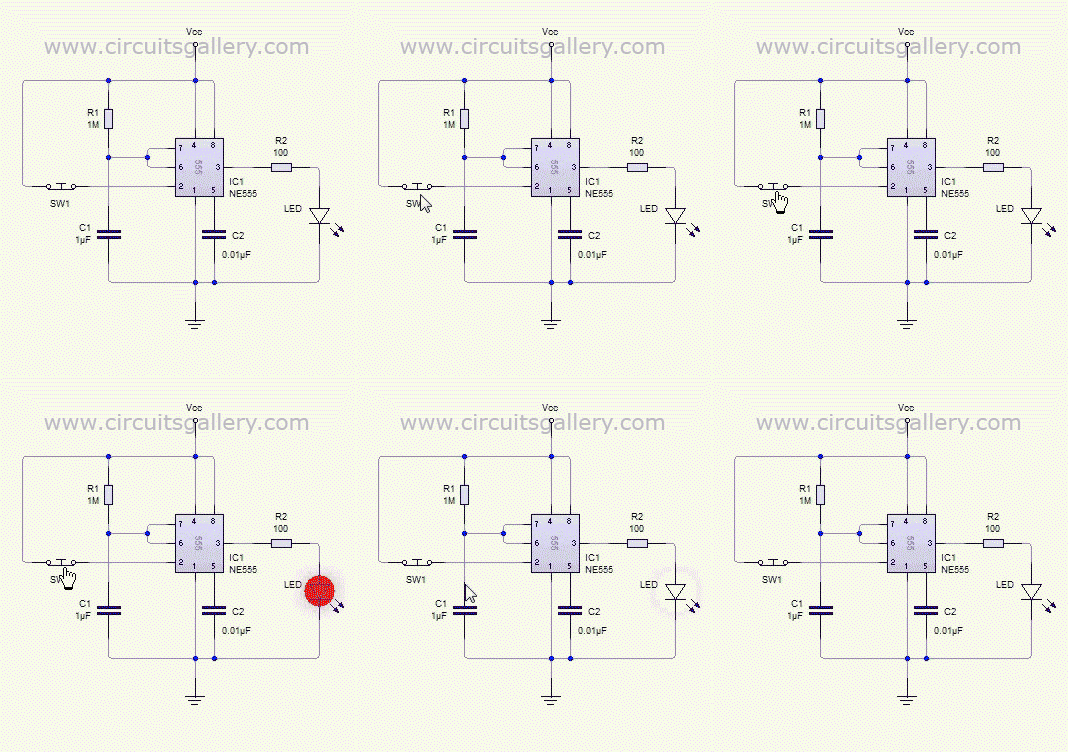
Monostable 555 Multivibrator Working Principle and Circuit diagram with Animation
The monostable 555 timer multivibrator circuit, also known as a one-shot monostable multivibrator, functions as a retriggerable pulse generator. The term "monostable" indicates that the circuit has only one stable state, with the unstable state referred to as the "quasi-stable...