


330Mhz Crystal Oscillator
#330MHz
#crystal oscillator
#fundamental mode
#PC1651G
#capacitor
#RF
#high frequency
#experimental
#electronic oscillator
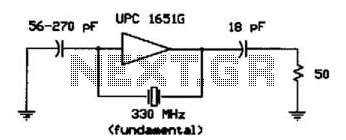
Description: A /xPC 1651G IC operates in the fundamental mode with an experimental crystal at 330 MHz. The 56-to-270 pF capacitor is not critical; about +1 dBm RF output is available.
The /xPC 1651G integrated circuit (IC) is designed to function in the fundamental mode, utilizing a crystal oscillator operating at a frequency of 330 MHz. This frequency is critical for applications requiring precise timing and synchronization. The IC's operation in fundamental mode suggests that it directly uses the fundamental frequency of the crystal for its oscillation, which is often preferred for its simplicity and stability.
The capacitor range specified, from 56 to 270 pF, indicates a tuning capability that allows for adjustments in the circuit's resonant frequency. While the description states that this capacitor is not critical, it implies that variations within this range will not significantly affect the performance of the circuit. This flexibility can be advantageous in experimental setups where component values may be adjusted based on availability or specific application needs.
The output power of approximately +1 dBm signifies that the IC is capable of delivering a modest RF signal suitable for various applications, including signal processing and transmission in communication systems. The RF output level indicates that the IC can interface effectively with other RF components, such as amplifiers and mixers, within a broader electronic system.
In summary, the /xPC 1651G IC's operational characteristics, including its frequency, capacitor range, and output power, make it a versatile component for RF applications, providing essential functionality in experimental and practical electronic designs. A /xPC 1651G IC operates in the fundamental mode with an experimental crystal at 330 MHz. The 56-to-270 pF capac itor is not critical; about + 1-dBm RF output is available.
The /xPC 1651G integrated circuit (IC) is designed to function in the fundamental mode, utilizing a crystal oscillator operating at a frequency of 330 MHz. This frequency is critical for applications requiring precise timing and synchronization. The IC's operation in fundamental mode suggests that it directly uses the fundamental frequency of the crystal for its oscillation, which is often preferred for its simplicity and stability.
The capacitor range specified, from 56 to 270 pF, indicates a tuning capability that allows for adjustments in the circuit's resonant frequency. While the description states that this capacitor is not critical, it implies that variations within this range will not significantly affect the performance of the circuit. This flexibility can be advantageous in experimental setups where component values may be adjusted based on availability or specific application needs.
The output power of approximately +1 dBm signifies that the IC is capable of delivering a modest RF signal suitable for various applications, including signal processing and transmission in communication systems. The RF output level indicates that the IC can interface effectively with other RF components, such as amplifiers and mixers, within a broader electronic system.
In summary, the /xPC 1651G IC's operational characteristics, including its frequency, capacitor range, and output power, make it a versatile component for RF applications, providing essential functionality in experimental and practical electronic designs. A /xPC 1651G IC operates in the fundamental mode with an experimental crystal at 330 MHz. The 56-to-270 pF capac itor is not critical; about + 1-dBm RF output is available.
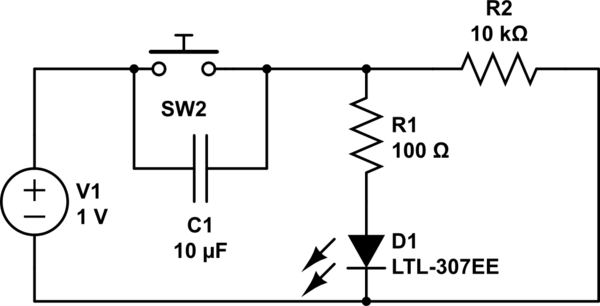
How the capacitor works (in a debouncing circuit)
Understand why the LED does not light up, as the capacitor appears to be bypassing the switch. When the capacitor is fully charged, it does not conduct electricity. Although the individual is a beginner, after 20 hours of studying various...
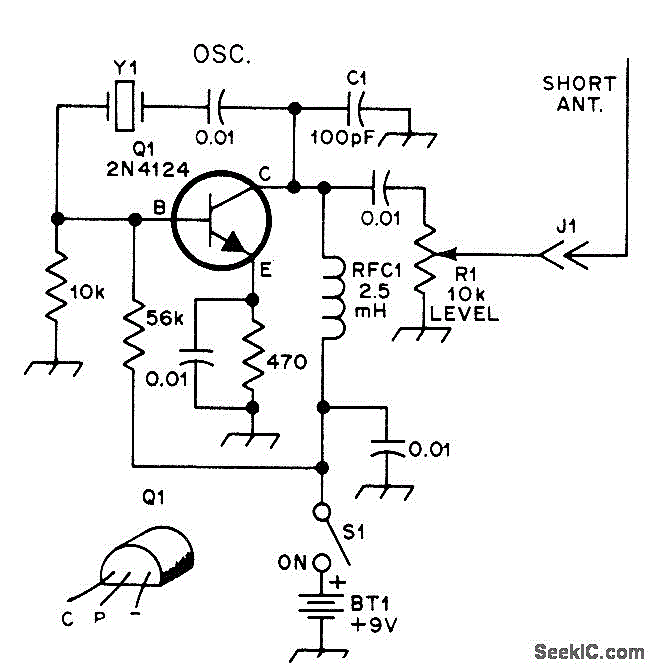
UNIVERSAL TEST OSCILLATOR
The crystal is positioned in the feedback path of a Pierce oscillator, situated between the base and collector of transistor Q1, with a 2.5 mH RF choke replacing the tuned collector circuit. The oscillator operates within a frequency range of...
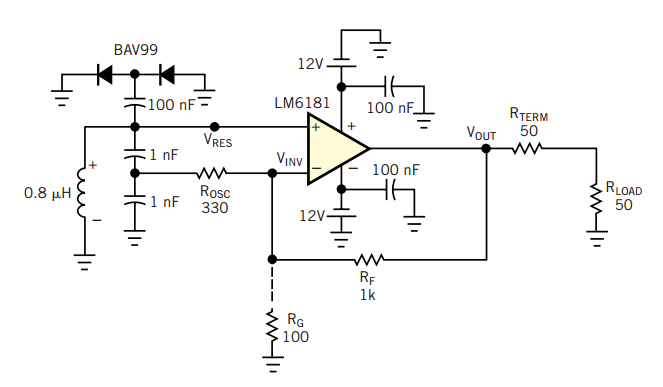
RF oscillator uses current-feedback op amp
A current-feedback amplifier is a well-known component with many uses. Its basic block diagram shows that its input stage is a voltage follower in practice, a symmetrical emitter follower. The configuration samples the output current, converts it to voltage across...
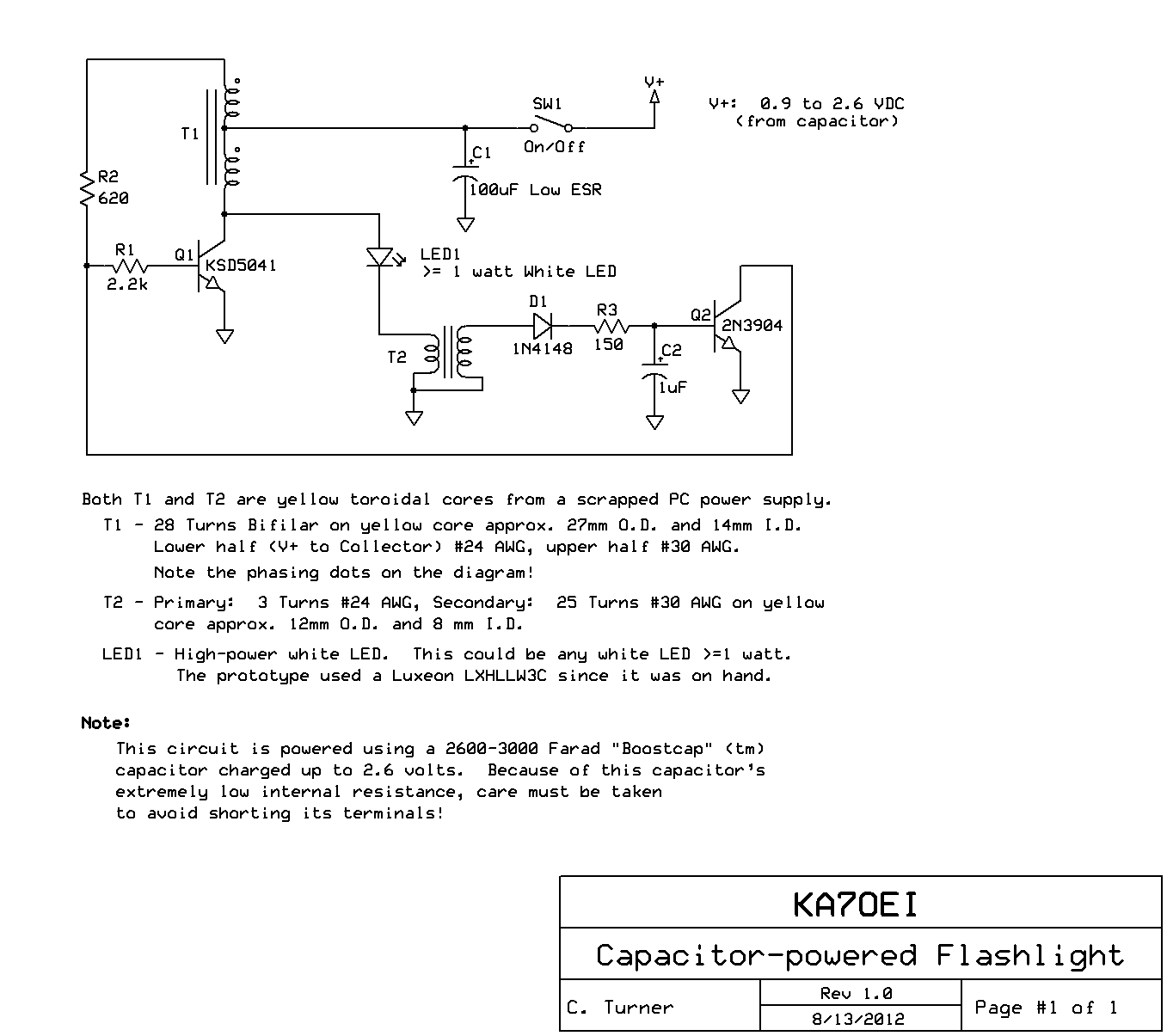
a more practical capacitor powered
The inexpensive flashlight utilized a small (0.22 Farad) capacitor for energy storage, which provided approximately 6.6 Joules of energy, significantly less than 1/1000th of the energy contained in a single AA alkaline cell. As a standard "super capacitor," it had...
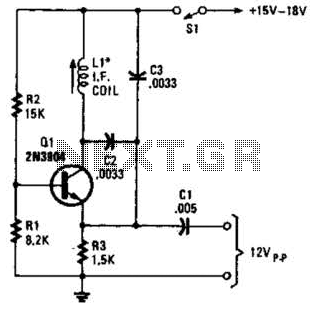
Simple Rf Test Oscillator Circuit
A simple oscillator for intermediate frequency (IF) alignment at 455 kHz can be useful in field testing or in scenarios where a standard signal generator is available. The inductor (L1) should resonate at the desired output frequency with the series...
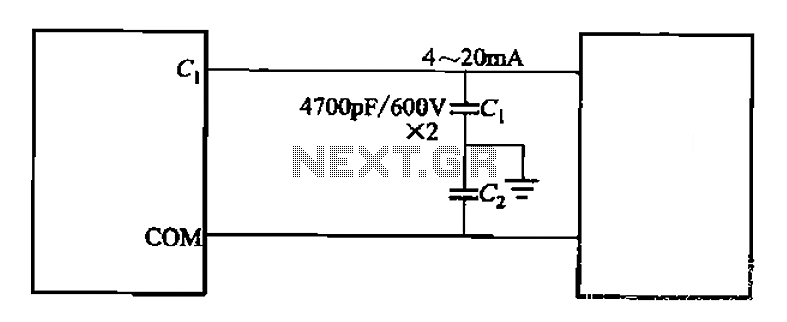
Control cables plus anti-interference capacitors
A capacitor filter is utilized in frequency control circuits and is a common method for implementing anti-jamming measures. It addresses frequency interference noise within the wiring of the 4-20mA control loop. The anti-interference is achieved through bypass capacitors C1 and...
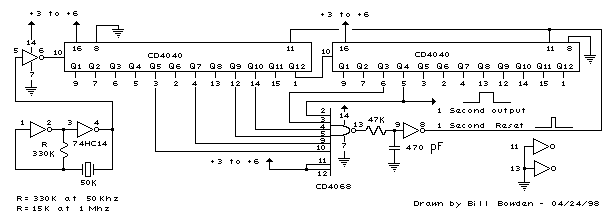
Crystal Oscillator counter
Using a 50 Khz crystal, a count of 50000 is detected when the appropriate counter bits that add up to 50000 are all high. This corresponds to bits 15 (32768) + 14 (16384) + 9 (512) + 8 (256) +...

Third-overtone crystal oscillator
This circuit utilizes a 74S00 Schottky TTL gate. Additionally, no inductors are necessary.
The 74S00 is a dual 4-input NAND gate that operates at high speeds due to its Schottky technology, which minimizes propagation delay and power consumption. The circuit design...
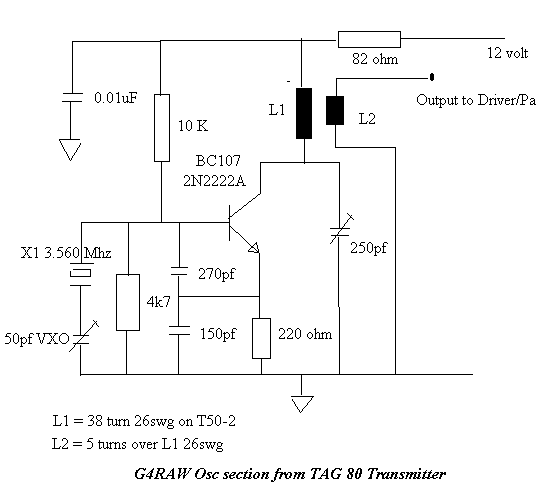
Crystal Oscillator Design
This circuit is a crystal oscillator that operates at a frequency of 3.5 MHz.
The crystal oscillator circuit utilizes a quartz crystal resonator to generate a stable frequency output. The primary components typically include the crystal, an amplifier (often a transistor...