


Audio oscillator circuit based on ICL8038
#ICL8038
#audio oscillator
#sine wave
#triangle wave
#square wave
#dual supply
#frequency range
#waveform generator
#signal generator
#audio frequency
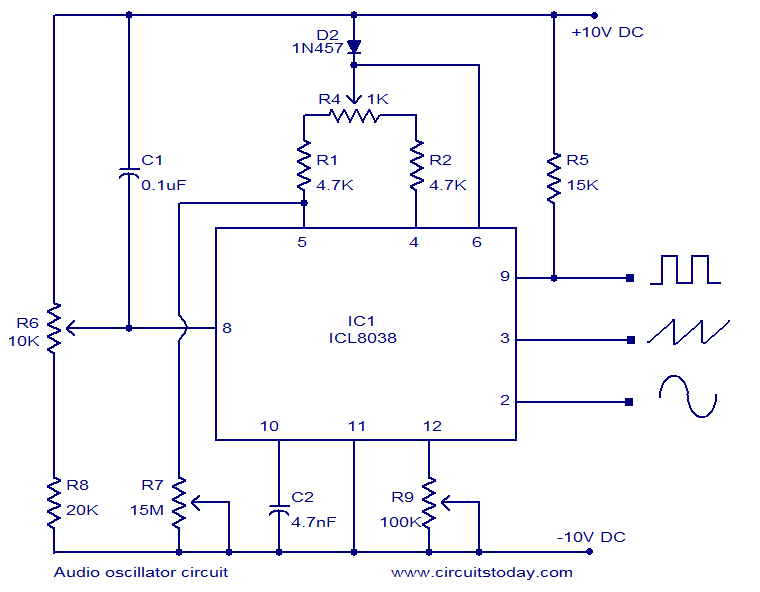
Description: ICL8038-based audio oscillator circuit. Simultaneous sine, triangle, and square waveforms. Dual supply operation. Covers the full audio frequency range.
The ICL8038 is a precision waveform generator integrated circuit that can produce sine, triangle, and square waveforms simultaneously. This versatility makes it suitable for a variety of audio applications, including signal generation for testing audio equipment or creating sound effects in synthesizers.
The circuit typically operates with dual supply voltages, allowing for a wide range of output amplitudes. The ICL8038 can generate waveforms across the full audio frequency spectrum, typically from 0.1 Hz to 100 kHz, making it ideal for musical applications.
To construct an ICL8038-based audio oscillator circuit, the following components are generally required:
- ICL8038 integrated circuit
- Resistors and capacitors for setting the frequency and waveform characteristics
- Dual power supply (often ±15V) to provide the necessary operating voltage range
- Output coupling capacitors to block DC components from the waveform outputs
The circuit's configuration involves connecting the appropriate resistors and capacitors to the ICL8038's pins, which determine the frequency and shape of the output waveforms. The sine, triangle, and square wave outputs can be taken from designated output pins on the IC, allowing for simultaneous use of all three waveforms.
In applications where precise frequency control is necessary, additional components such as variable resistors (potentiometers) may be included to allow for fine-tuning of the output frequency. Furthermore, the circuit can be enhanced with additional filtering stages to improve the quality of the sine wave output, reducing harmonic distortion.
Overall, the ICL8038-based audio oscillator circuit is a robust solution for generating high-quality audio waveforms, making it a valuable tool for engineers and hobbyists in the field of audio electronics.ICL8038 based audio oscillator circuit. Simultaneous sine, triangle and square wave forms. Dual supply operation. Cover full audio frequency range..
The ICL8038 is a precision waveform generator integrated circuit that can produce sine, triangle, and square waveforms simultaneously. This versatility makes it suitable for a variety of audio applications, including signal generation for testing audio equipment or creating sound effects in synthesizers.
The circuit typically operates with dual supply voltages, allowing for a wide range of output amplitudes. The ICL8038 can generate waveforms across the full audio frequency spectrum, typically from 0.1 Hz to 100 kHz, making it ideal for musical applications.
To construct an ICL8038-based audio oscillator circuit, the following components are generally required:
- ICL8038 integrated circuit
- Resistors and capacitors for setting the frequency and waveform characteristics
- Dual power supply (often ±15V) to provide the necessary operating voltage range
- Output coupling capacitors to block DC components from the waveform outputs
The circuit's configuration involves connecting the appropriate resistors and capacitors to the ICL8038's pins, which determine the frequency and shape of the output waveforms. The sine, triangle, and square wave outputs can be taken from designated output pins on the IC, allowing for simultaneous use of all three waveforms.
In applications where precise frequency control is necessary, additional components such as variable resistors (potentiometers) may be included to allow for fine-tuning of the output frequency. Furthermore, the circuit can be enhanced with additional filtering stages to improve the quality of the sine wave output, reducing harmonic distortion.
Overall, the ICL8038-based audio oscillator circuit is a robust solution for generating high-quality audio waveforms, making it a valuable tool for engineers and hobbyists in the field of audio electronics.ICL8038 based audio oscillator circuit. Simultaneous sine, triangle and square wave forms. Dual supply operation. Cover full audio frequency range..
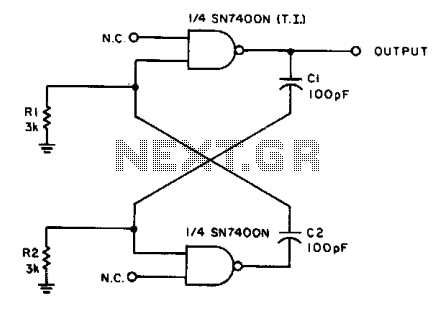
2MHz square-wave generator
With the values shown, the circuit generates a 2-MHz symmetrical square wave. Changing capacitors C1 and C2 to 0.01 µF results in a frequency of 500 Hz. For the particular integrated circuits and power supply voltages (5.0 V), the reliable...
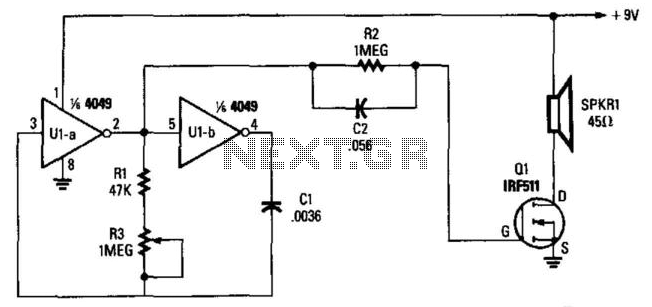
Audio Oscillator
Two gates, U1A and U1B, of a 4049 hex inverter, are connected in a VFO circuit. Components R1, R3, and C1 set the frequency range of the VFO. With the given values, the circuit's output can range from a few...
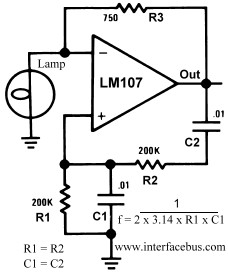
Sinewave Oscillator
This circuit generates a 10Hz sine wave using a minimal number of components, based on the specified component values. The active components are generic and can be substituted as needed. The passive component values determine the frequency and should only...
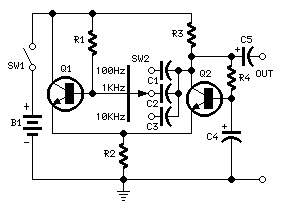
Simple Square wave Generator
This simple circuit generates a good and stable 1V peak-to-peak square wave at 100Hz, 1KHz and 10KHz using a single 1.5V cell as power supply. An useful feature of this circuit is that frequency changes can be obtained by switching...
Waveform Generators Circuits
Many applications require low-frequency signal generators that can deliver high-performance, high-resolution signals. This design idea presents a circuit that generates frequencies from 0 to 1 MHz, providing sinusoidal, triangular, and square-wave outputs with frequency resolution better than 0. A DDS...
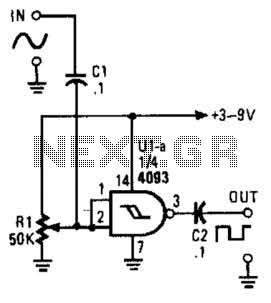
Sine Wave To Square Wave Converter Circuit
This circuit converts a sine wave into a square wave. It consists of a single 2-input NAND Schmitt trigger configured as an inverter, with an adjustable trigger level at its input. As the input voltage exceeds the gate's trigger point,...
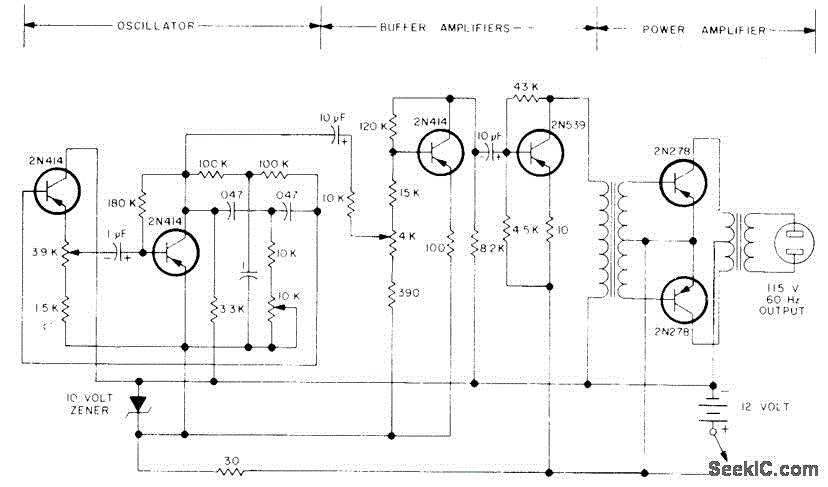
100W SINE AT 60Hz
The circuit primarily comprises a 60-Hz sine-wave oscillator featuring a 10K frequency-control potentiometer, two buffering stages, and a push-pull power amplifier. This design effectively addresses the noise issues associated with square-wave inverters, particularly when powering a 115-V radio receiver or...
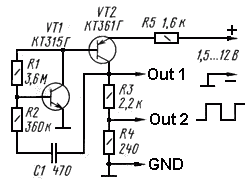
Simple square wave generator
Square wave generators are typically based on symmetrical multivibrators using bipolar transistors of the same structure, along with two frequency-determining networks. However, a simpler oscillator can be constructed with two transistors of different structures (refer to figure 1) utilizing only...
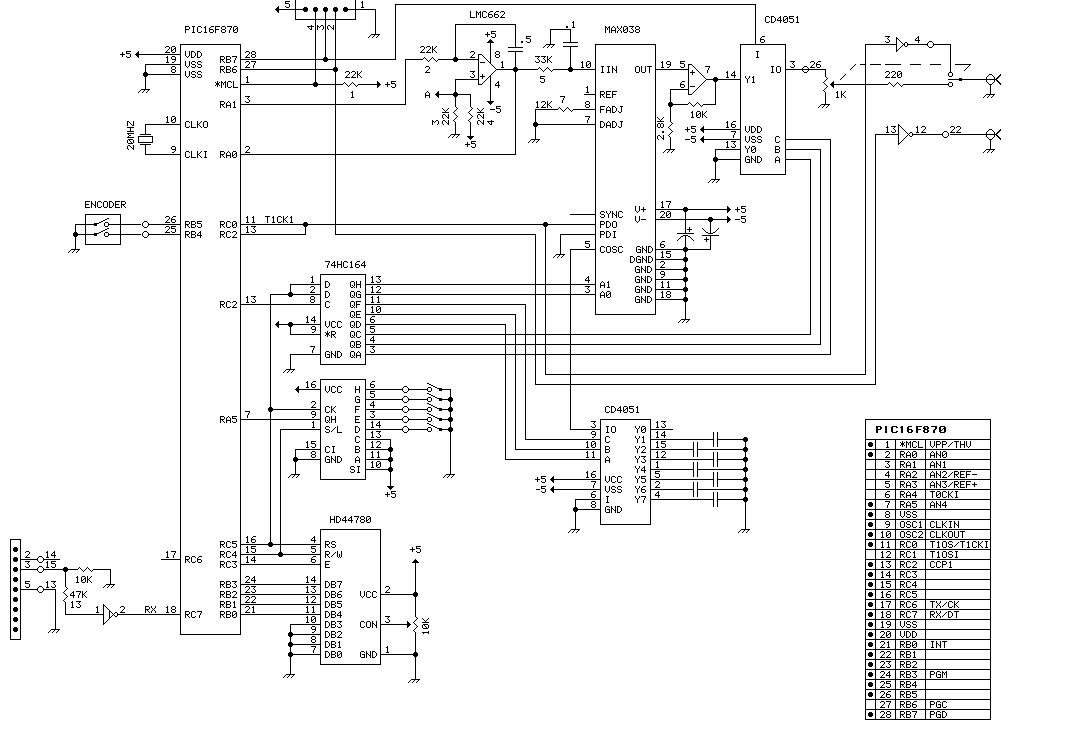
Signal Generator 20KHz
This function generator IC is specified to work to 20 MHz. So far, this unit works nicely to 50KHz. Since I seldom need signals higher than that, it has taken up a happy home on my workbench and further development...