


Building A Synchronous Clock
#quartz
#clock
#time-keeping
#synchronous
#precision
#timing
#cumulative error
#crystal oscillator
#frequency
#accuracy
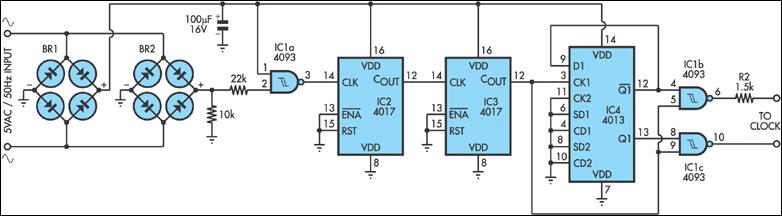
Description: Quartz clocks, which have dominated timekeeping for the past 20 years, have one issue: their errors, although slight, are cumulative.
Quartz clocks operate based on the piezoelectric effect of quartz crystals, which oscillate at a precise frequency when subjected to an electric field. This frequency is typically 32.768 kHz, which is derived from the division of the frequency of a quartz crystal. The oscillation of the crystal is converted into a timekeeping signal through a series of electronic components, including amplifiers and dividers, which ultimately drive a display mechanism such as an LCD or LED.
The primary advantage of quartz clocks is their accuracy and reliability compared to mechanical clocks. However, the cumulative error in timekeeping arises from various factors, including temperature variations, aging of the quartz crystal, and the quality of the electronic components used. Over extended periods, these small discrepancies can lead to significant time loss or gain, which may not be acceptable in precision applications.
To mitigate these errors, advanced quartz clock designs may incorporate temperature compensation techniques, such as using temperature-stable materials or active temperature sensors to adjust the frequency of the oscillator. Additionally, some designs might integrate a microcontroller that can periodically recalibrate the time based on external time references, such as GPS signals or radio time signals.
In summary, while quartz clocks have been a staple in timekeeping technology due to their accuracy and low cost, the inherent cumulative errors necessitate the exploration of compensatory mechanisms to enhance their reliability over long durations.The quartz clocks which have dominated time-keeping for the past 20 years or so have one problem: their errors, although slight, are cumulative. After run..
Quartz clocks operate based on the piezoelectric effect of quartz crystals, which oscillate at a precise frequency when subjected to an electric field. This frequency is typically 32.768 kHz, which is derived from the division of the frequency of a quartz crystal. The oscillation of the crystal is converted into a timekeeping signal through a series of electronic components, including amplifiers and dividers, which ultimately drive a display mechanism such as an LCD or LED.
The primary advantage of quartz clocks is their accuracy and reliability compared to mechanical clocks. However, the cumulative error in timekeeping arises from various factors, including temperature variations, aging of the quartz crystal, and the quality of the electronic components used. Over extended periods, these small discrepancies can lead to significant time loss or gain, which may not be acceptable in precision applications.
To mitigate these errors, advanced quartz clock designs may incorporate temperature compensation techniques, such as using temperature-stable materials or active temperature sensors to adjust the frequency of the oscillator. Additionally, some designs might integrate a microcontroller that can periodically recalibrate the time based on external time references, such as GPS signals or radio time signals.
In summary, while quartz clocks have been a staple in timekeeping technology due to their accuracy and low cost, the inherent cumulative errors necessitate the exploration of compensatory mechanisms to enhance their reliability over long durations.The quartz clocks which have dominated time-keeping for the past 20 years or so have one problem: their errors, although slight, are cumulative. After run..
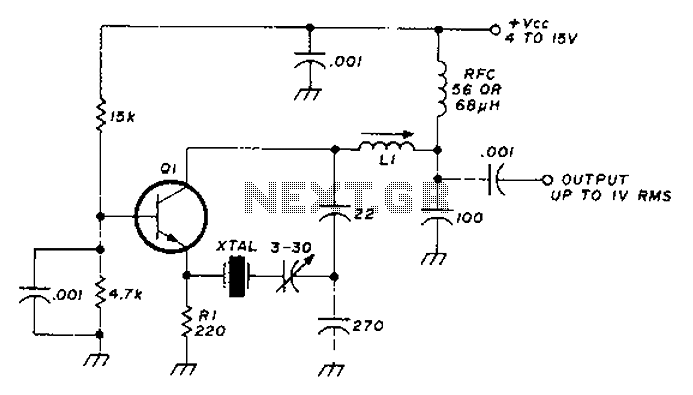
15-65MHz circuit diagram of the third harmonic
A circuit diagram illustrating the reliability of crystal startup, with power consumption significantly lower than the maximum allowed for the crystal. The transistor Q1 can be one of the following: 2N918, 2N3564, 2N5770, BF180, or BF200. The inductor L1 is...
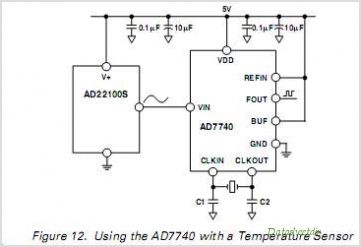
3 V/5 V Low Power Synchronous Voltage-to-Frequency Converter
The ADF4107 Frequency Synthesizer can be used to implement local oscillators in the upconversion and downconversion sections of wireless receivers and transmitters. It consists of a low noise digital phase frequency detector (PFD), a precision charge pump, a programmable reference...
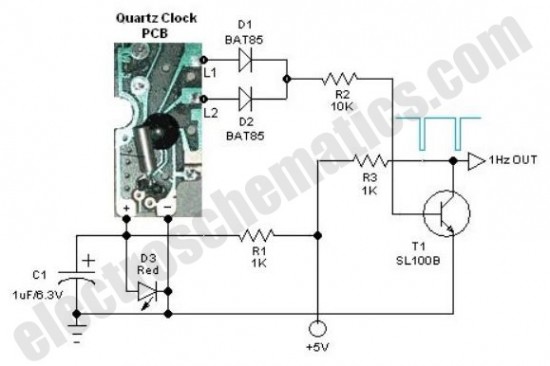
Quartz 1Hz Timebase
This document outlines a basic circuit for a simple yet accurate 1Hz timebase generator, utilizing a standard quartz clock circuit board. The process involves extracting the clock PCB from an inexpensive quartz clock and meticulously removing all unnecessary components, such...
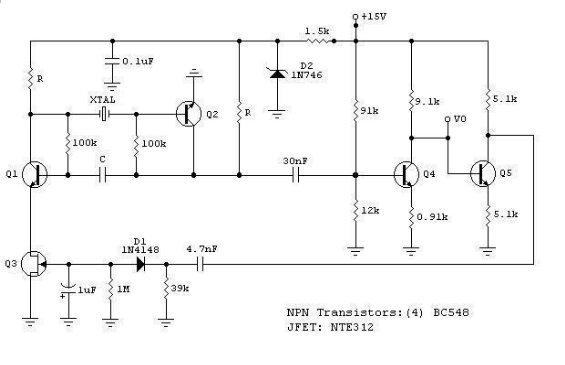
Low-Frequency Crystal Controlled Oscillator
The RF engineer often needs an instrument that can reliably and quickly check a low-frequency quartz crystal unit. However, such equipment is challenging to find, and engineers frequently refer to electronic circuit handbooks for schematics that can perform this task....
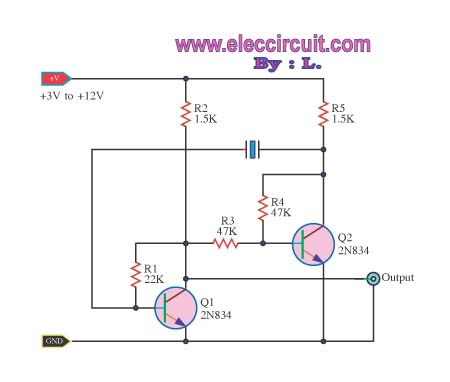
Oscillator astable multi-vibrator with Crystal controller
An oscillator circuit of this nature is often utilized as a clock circuit. This circuit employs a crystal frequency control with a stability of one million hertz.
An oscillator circuit designed for clock applications typically generates a periodic signal, which can...
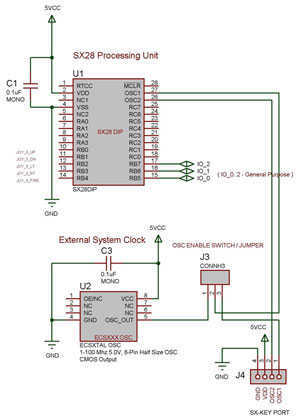
Clock circuit using SX 28 internal oscillator
The SX 28 internal oscillator is not that fast, so an external oscillator can be hooked up to the processor as shown in the diagram to increase the operation cycles per second.
The SX 28 microcontroller is designed with an internal...
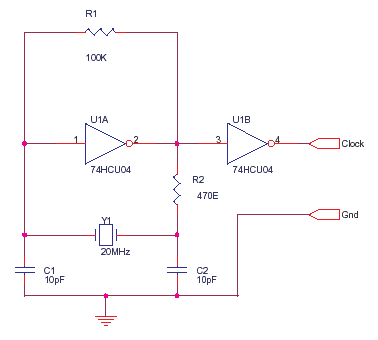
Crystal Oscillator - Parallel Resonant
The 74HCU04 is a chip designed for specific circuit applications, while the HCT variant may not be suitable for such configurations. Capacitors C1 and C2 can be utilized up to 33pF, and resistor R2 can be adjusted to achieve the...
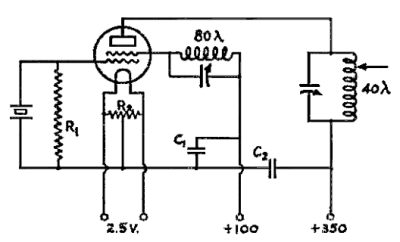
Tri-Tet Oscillator
QST's latest development, the Tri-tet oscillator, has finally made the single-tube crystal transmitter a practical option. It is now feasible to operate effectively on two, and occasionally three, amateur bands using a single crystal. This particular device signifies the onset...
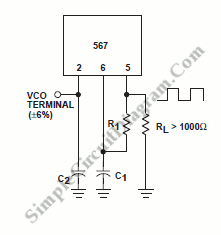
Precision Oscillator With 20ns Switching
A precision oscillator can be constructed using a quartz crystal; however, with appropriate component selection, it is also possible to build one using an RC (resistor and capacitor) circuit.
An RC oscillator generates an oscillating signal through the use of resistors...