


Digitally-controlled oscillator
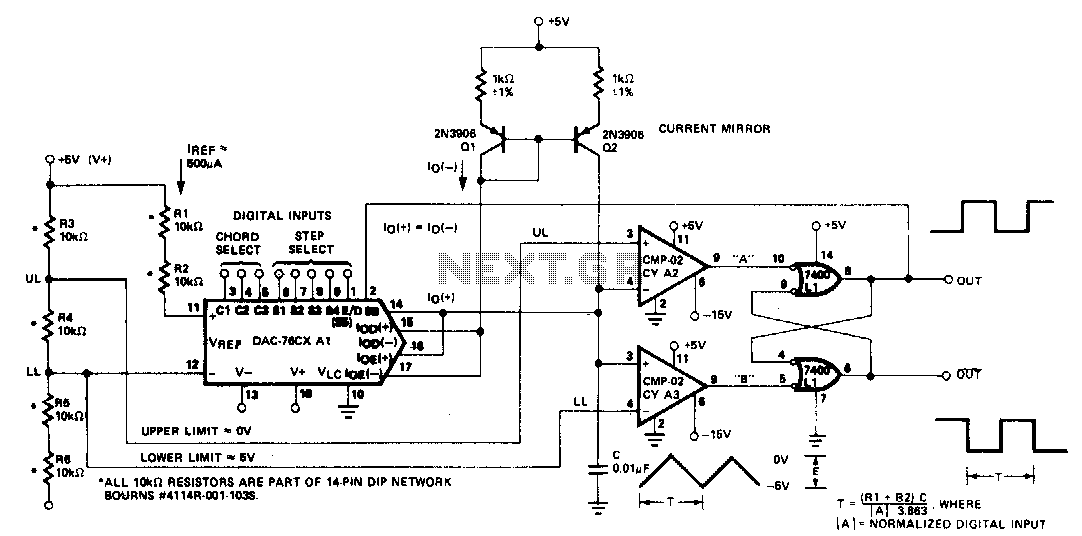
Description: The microprocessor-controlled oscillator has a frequency range of 8159 to 1, covering from 2 Hz to 20 kHz. An exponential, current output integrated circuit digital-to-analog converter (DAC) functions as a programmable current source, alternately charging and discharging a capacitor between precisely controlled upper and lower limits. The circuit features instantaneous frequency change, operates with +5 ±1 V and -15 V ±3 V supplies, and has a dynamic range of a 13-bit DAC.
The microprocessor-controlled oscillator circuit is designed to produce a wide range of frequencies, from a minimum of 2 Hz to a maximum of 20 kHz, with a frequency ratio of 8159:1. This feature allows for precise control over the output frequency, making it suitable for various applications that require accurate timing and signal generation. The core of the circuit is an exponential current output DAC, which serves as a programmable current source. This DAC is responsible for generating the necessary charging and discharging currents that control the capacitor's voltage levels.
The capacitor in the circuit is charged and discharged between specific upper and lower voltage limits, which are defined by the application requirements. The ability to rapidly change the frequency is a significant advantage, allowing for instantaneous adjustments without the need for mechanical components. The circuit operates on dual power supplies, providing +5 V ±1 V for the digital components and -15 V ±3 V for the analog components, ensuring stability and reliability in various operating conditions.
The dynamic range of the circuit is determined by the 13-bit resolution of the DAC, allowing for a high level of precision in the output signal. This resolution enables fine adjustments to the current output, which is critical for applications that require detailed signal modulation or waveform generation. The overall design of the oscillator circuit emphasizes flexibility, precision, and rapid response, making it an ideal choice for modern electronic applications that demand high-performance signal generation capabilities.The microprocessor-controlled oscillator has a 8159 to 1 frequency range covering 2 Hz to 20 kHz. An exponential, current output IC DAC functioning as a programmable current source alternately charges and discharges a capacitor between precisely-controlled upper and lower limits The circuit features instantaneous frequency change, operates with +5 ±1 V and -15 V ±3 V supplies, and has the dynamic range of a 13-bit DAC.
The microprocessor-controlled oscillator circuit is designed to produce a wide range of frequencies, from a minimum of 2 Hz to a maximum of 20 kHz, with a frequency ratio of 8159:1. This feature allows for precise control over the output frequency, making it suitable for various applications that require accurate timing and signal generation. The core of the circuit is an exponential current output DAC, which serves as a programmable current source. This DAC is responsible for generating the necessary charging and discharging currents that control the capacitor's voltage levels.
The capacitor in the circuit is charged and discharged between specific upper and lower voltage limits, which are defined by the application requirements. The ability to rapidly change the frequency is a significant advantage, allowing for instantaneous adjustments without the need for mechanical components. The circuit operates on dual power supplies, providing +5 V ±1 V for the digital components and -15 V ±3 V for the analog components, ensuring stability and reliability in various operating conditions.
The dynamic range of the circuit is determined by the 13-bit resolution of the DAC, allowing for a high level of precision in the output signal. This resolution enables fine adjustments to the current output, which is critical for applications that require detailed signal modulation or waveform generation. The overall design of the oscillator circuit emphasizes flexibility, precision, and rapid response, making it an ideal choice for modern electronic applications that demand high-performance signal generation capabilities.The microprocessor-controlled oscillator has a 8159 to 1 frequency range covering 2 Hz to 20 kHz. An exponential, current output IC DAC functioning as a programmable current source alternately charges and discharges a capacitor between precisely-controlled upper and lower limits The circuit features instantaneous frequency change, operates with +5 ±1 V and -15 V ±3 V supplies, and has the dynamic range of a 13-bit DAC.
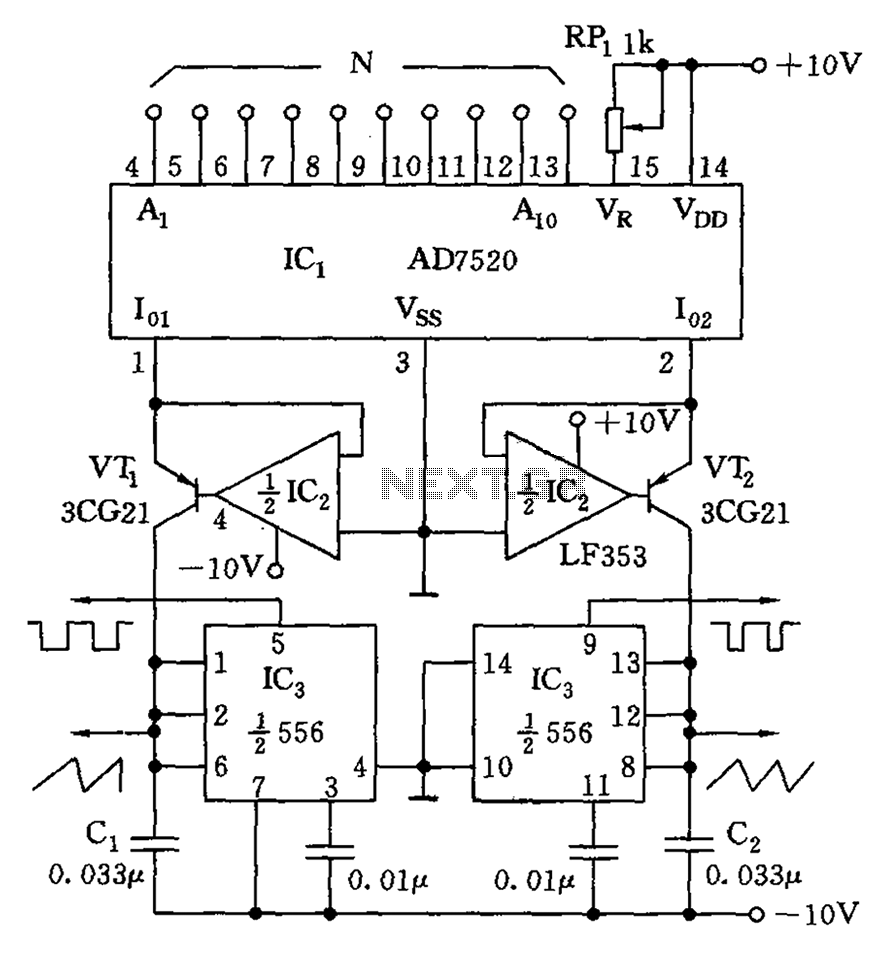
D A conversion frequency generator complementary bipolar
As shown in the figure, the AD7520 is a CMOS type integrated circuit Digital-to-Analog Converter (DAC) featuring 10 channels. It can provide 10 N-bit digital outputs that are proportional to the input current Io1, as well as outputs that are...
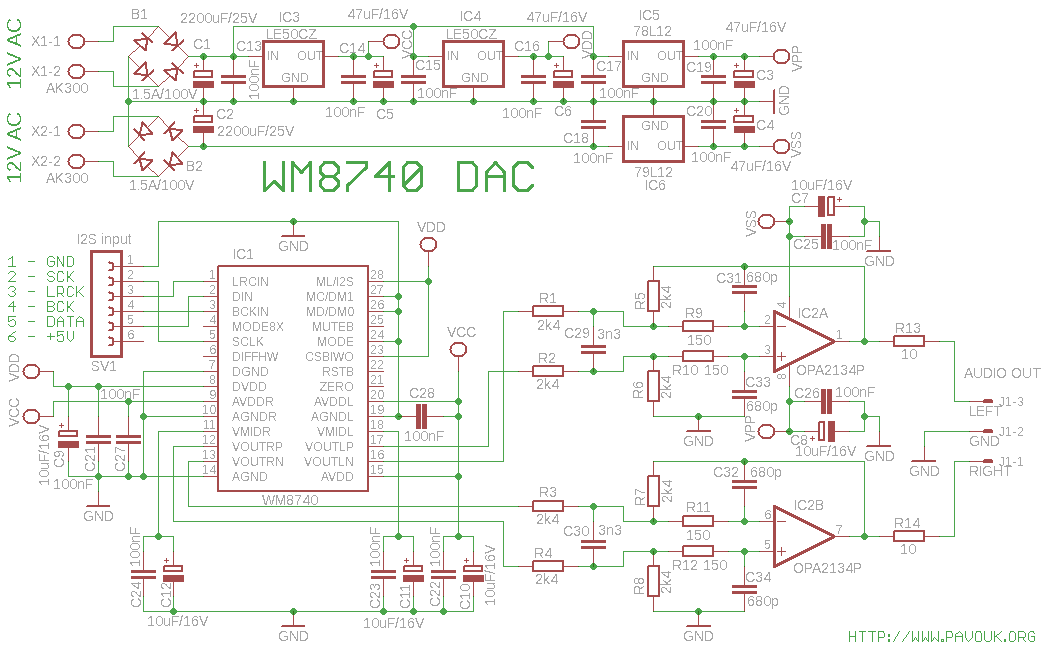
DAC with WM8740
This is a high-performance Digital-to-Analog Converter (DAC) featuring oversampling, delta-sigma architecture, and a maximum sample frequency of 192 kHz at 24 bits. It provides balanced voltage output and is connected to a high-quality operational amplifier that includes a low-pass filter...
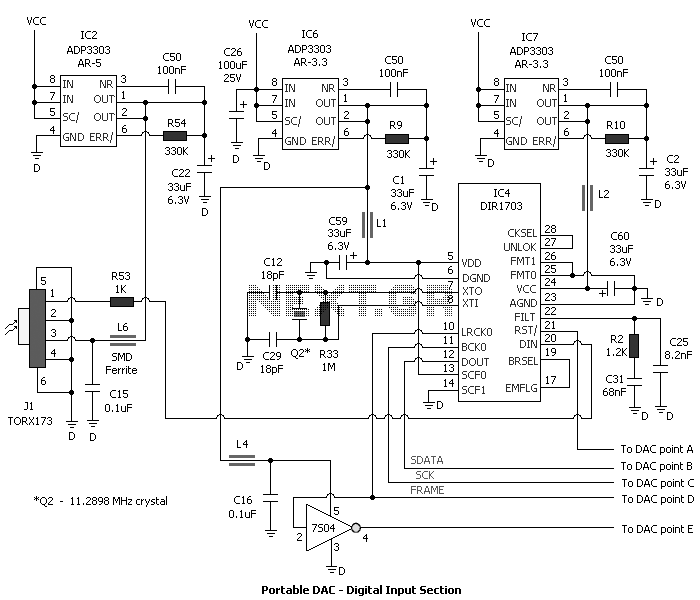
DAC and Headphone Amplifier
The idea behind the portable DAC is to get better sound than from the line out or headphone out of portable CD player, a pc sound card or other digital audio source. Many of us want to listen to music...
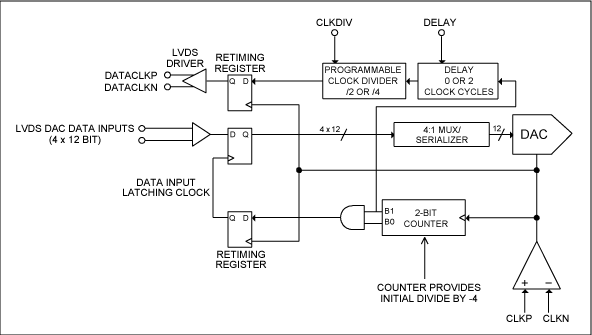
Synchronizing Multiple High-Speed Multiplexed DACs for Transmit Applications
This application note provides insight into how to synchronize multiple high-speed DACs in transmitter applications.
This document outlines the techniques and methodologies for synchronizing multiple high-speed Digital-to-Analog Converters (DACs) in various transmitter applications. Synchronization is crucial in systems where multiple DACs...
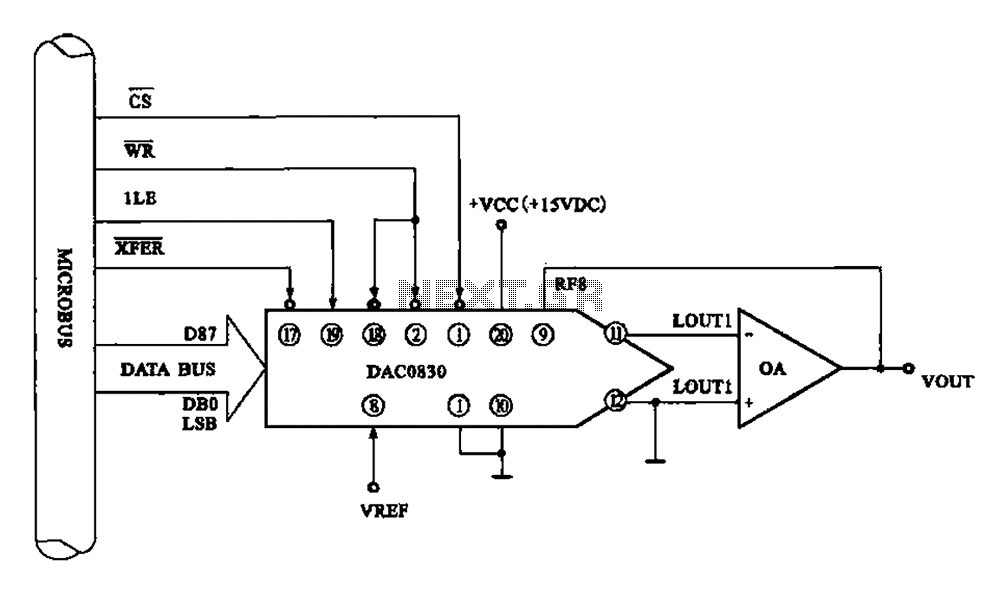
Typical DA conversion circuit 8
Figure 8 illustrates a typical digital-to-analog (D/A) conversion circuit that utilizes the DAC0830/DAC0832 chip. The microprocessor outputs an 8-bit digital signal, which is converted into an analog signal.
The D/A conversion circuit depicted employs the DAC0830/DAC0832, which is a dual 8-bit...
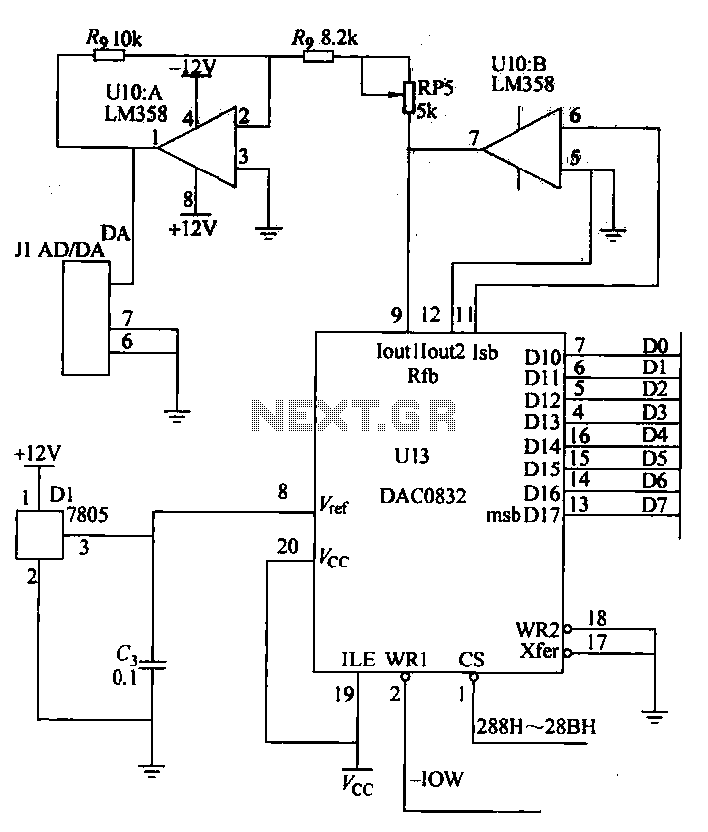
DA conversion circuit
A digital-to-analog (D/A) conversion circuit utilizing the DAC0832 and the operational amplifier LM358, featuring two output channels with unipolar voltage output. The digital input range is from 00H to FFH, which corresponds to an output voltage range of 0V to...
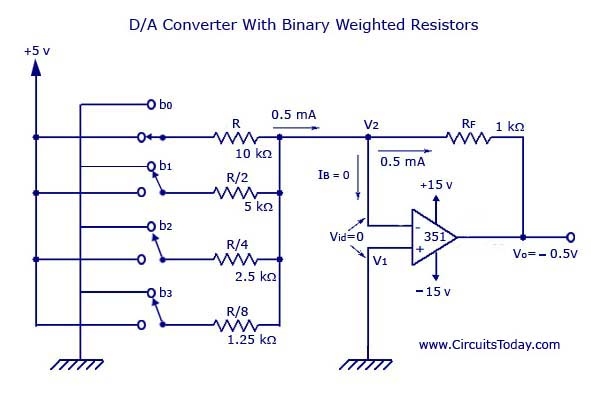
digital to analog converters
A digital-to-analog (D/A) converter utilizing binary-weighted resistors is illustrated in the accompanying figure. In this circuit, the operational amplifier (op-amp) is configured in inverting mode, although it may also be arranged in non-inverting mode. The schematic represents a 4-bit converter,...
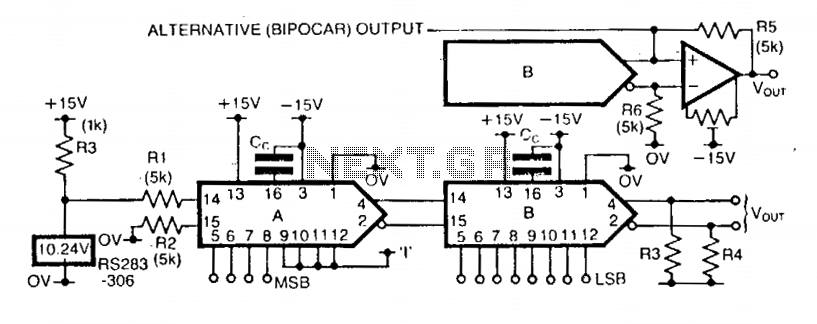
12-Bit dac with variable step size
The step size of the converter is variable by selecting the high-order data bits. The first DAC, A, has a stable reference current supplied via a 10.24 V reference IC and resistor R1. Resistor R2 provides bias cancellation. Only the...
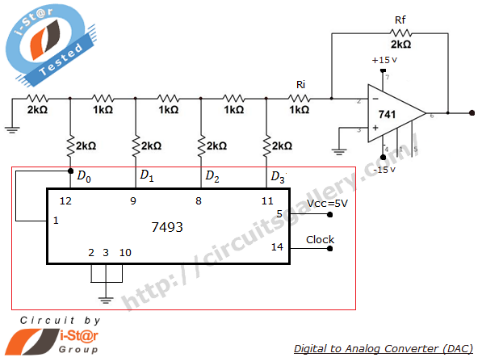
Digital to analog converter using R 2R ladder network and 741 op amp with simulated output waveform
A Digital to Analog Converter (DAC) is utilized to produce an analog voltage that corresponds to input digital data. Binary data can be transformed into its analog equivalent using an R-2R ladder network combined with a summing amplifier, which is...