


Oscillator produces audio sinusoids
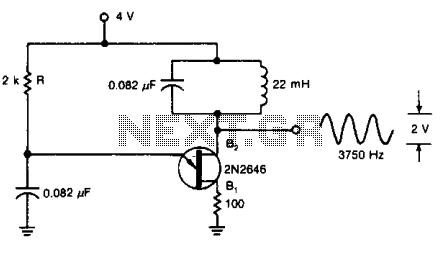
Description: A tuned circuit can be incorporated into the current-pulse path of a UJT oscillator to generate a 3750-Hz sinusoidal signal at output B2, using the specified component values.
The UJT (Unijunction Transistor) oscillator is a type of relaxation oscillator that utilizes the unique characteristics of a UJT to generate oscillations. When a tuned circuit, consisting of an inductor and capacitor, is placed in the current path, it can enhance the oscillator's performance by creating a resonant frequency.
In this configuration, the UJT is triggered into conduction by the charging of the capacitor, which is part of the tuned circuit. The oscillation begins as the capacitor charges through a resistor until it reaches the UJT's threshold voltage, causing the UJT to turn on. This action discharges the capacitor quickly, generating a pulse. The tuned circuit, which resonates at 3750 Hz, filters these pulses into a smooth sinusoidal waveform.
The specific component values for the tuned circuit must be calculated to achieve the desired frequency. This involves selecting appropriate inductance (L) and capacitance (C) values such that the resonant frequency (f) is given by the formula:
f = 1 / (2π√(LC))
The output at B2 will thus provide a sinusoidal signal at the specified frequency, suitable for audio applications. The UJT oscillator's ability to produce audio sinusoids makes it particularly useful in various electronic applications, including signal generation and modulation tasks. Proper selection and arrangement of components are crucial for optimizing performance and achieving the desired output characteristics.By placing a tuned circuit in the UJT oscillator's current-pulse path, a 3750-Hz sinusoid can be created at B2 with the component values shown. Oscillator produces audio sinusoids.
The UJT (Unijunction Transistor) oscillator is a type of relaxation oscillator that utilizes the unique characteristics of a UJT to generate oscillations. When a tuned circuit, consisting of an inductor and capacitor, is placed in the current path, it can enhance the oscillator's performance by creating a resonant frequency.
In this configuration, the UJT is triggered into conduction by the charging of the capacitor, which is part of the tuned circuit. The oscillation begins as the capacitor charges through a resistor until it reaches the UJT's threshold voltage, causing the UJT to turn on. This action discharges the capacitor quickly, generating a pulse. The tuned circuit, which resonates at 3750 Hz, filters these pulses into a smooth sinusoidal waveform.
The specific component values for the tuned circuit must be calculated to achieve the desired frequency. This involves selecting appropriate inductance (L) and capacitance (C) values such that the resonant frequency (f) is given by the formula:
f = 1 / (2π√(LC))
The output at B2 will thus provide a sinusoidal signal at the specified frequency, suitable for audio applications. The UJT oscillator's ability to produce audio sinusoids makes it particularly useful in various electronic applications, including signal generation and modulation tasks. Proper selection and arrangement of components are crucial for optimizing performance and achieving the desired output characteristics.By placing a tuned circuit in the UJT oscillator's current-pulse path, a 3750-Hz sinusoid can be created at B2 with the component values shown. Oscillator produces audio sinusoids.
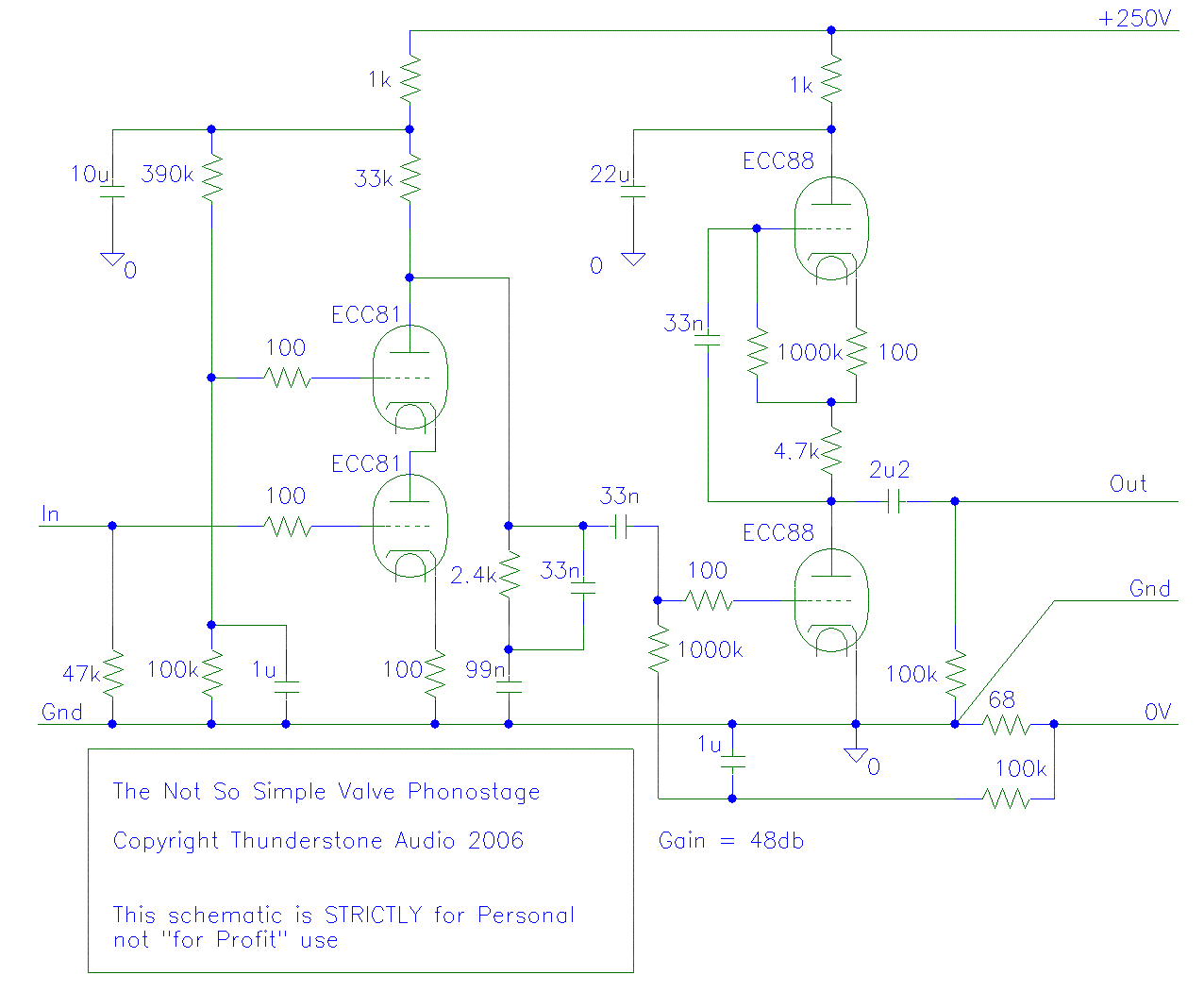
New Phono amp
Very interesting points Chris and Thorsten, but I would like to take a moment to revisit my latest design, which is represented in the attached schematic.
The attached schematic represents a recent design that integrates various electronic components to achieve a...
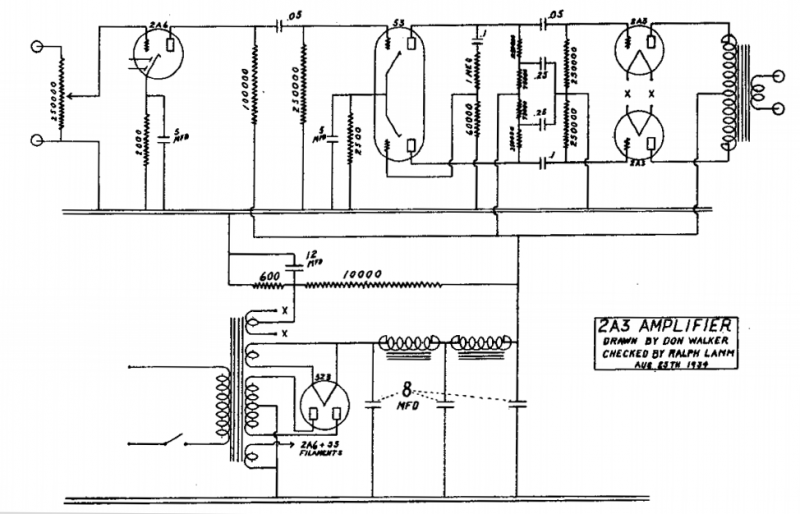
2a3 Tube Amplifier
Cleaned Input: Description: Two circuits of audio tubes amplifiers.
Additional Content: The indicated schematic represents two circuits of audio tube amplifiers. These amplifiers are primarily designed to increase the amplitude of audio signals that pass through them. They are typically used...
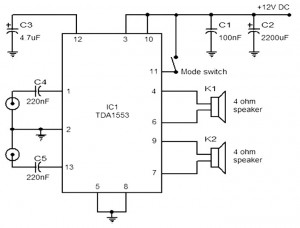
Car stereo amplifier based TDA1535
The provided schematic represents a car stereo amplifier circuit that can be utilized in cars or other vehicles. The circuit is based on the TDA1553, which is a Class-B audio amplifier. This circuit is straightforward, consisting solely of the integrated...
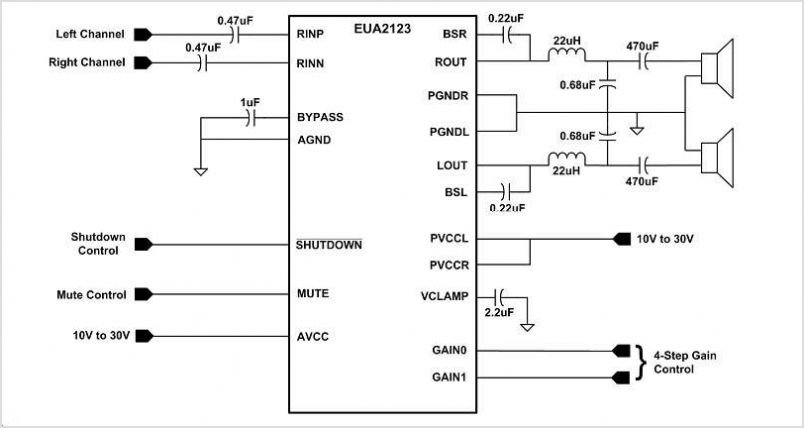
EUA2123 20-W Stereo Class-D Audio Power Amplifier
This application note describes the evaluation board for the AD7892-2, a 12-bit analog-to-digital (A/D) converter. The AD7892-2 is a high-speed, low-power device capable of 500 ksps sampling rate, operating from a single +5V supply. It features an on-chip track/hold amplifier,...
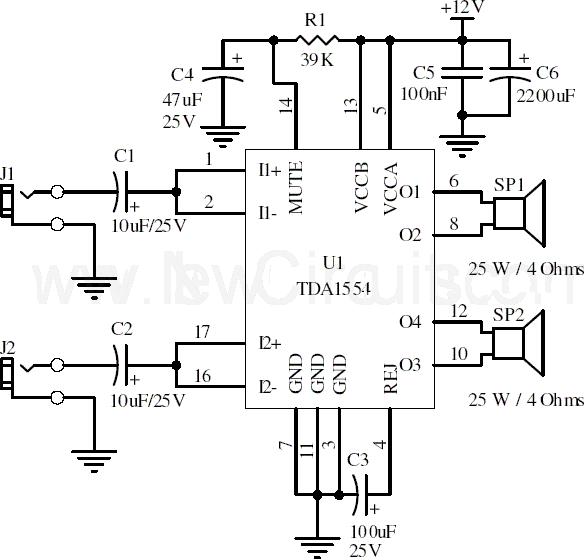
Circuit 22W Stereo Amplifier Using TDA1554
This document presents a 22-watt stereo audio power amplifier circuit diagram utilizing the TDA1554 integrated circuit from NXP Semiconductors (formerly known as PHILIPS Semiconductors). The circuit is designed to amplify stereo signals effectively. It dissipates approximately 28 watts of heat,...
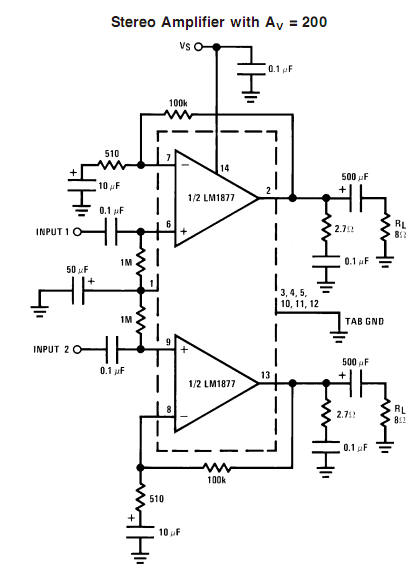
Stereo amplifier circuit with LM1877
The LM1877 is a stereo amplifier designed to deliver 2W per channel into 8-ohm loads. It is intended to operate with a minimal number of external components, making it a versatile integrated circuit suitable for various audio amplification applications, such...
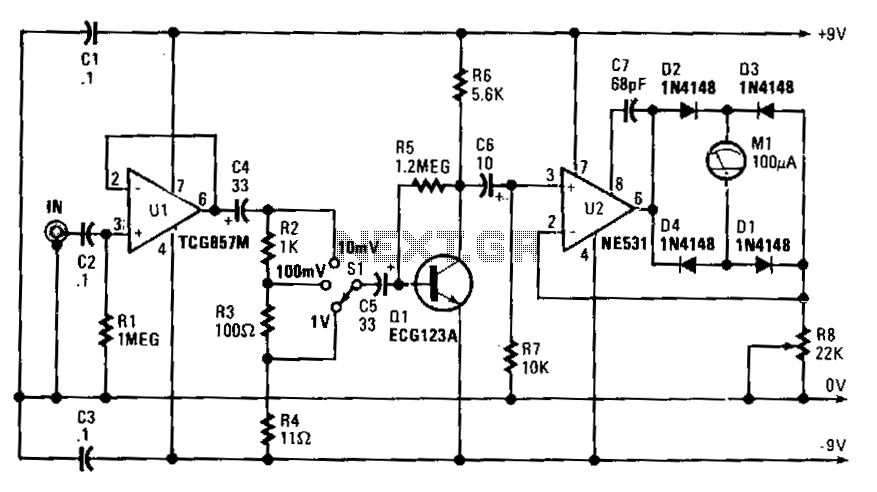
Audio-millivoltmeter
Capacitor C4 couples the output of U1 to a simple attenuator, which provides a loss of 0 dB, 20 dB, or 40 dB, depending on the setting of range switch S1. The circuit's sensitivity is 10 V rms for full-scale...
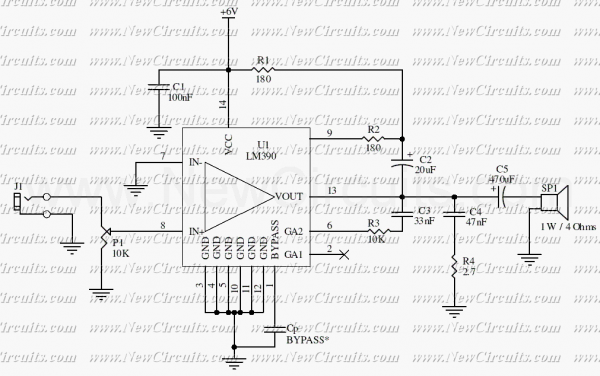
LM390 Bass Amplifier
This circuit is a mono audio amplifier that will boost low frequencies as you see at the frequency response. The circuit is suitable for driving a subwoofer speaker for example. The output power of the circuit is about 1 Watt...
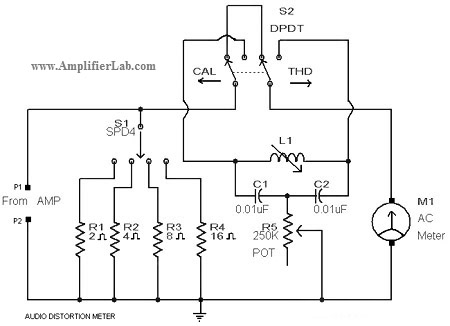
Audio Distortion Meter Circuit
A circuit diagram of an audio distortion meter is presented here. An audio distortion meter is utilized to measure Total Harmonic Distortion (THD).
The audio distortion meter is an essential tool in audio engineering, designed to quantify the level of distortion...